If you want desktop games with genuinely incredible gameplay, start with Baldur’s Gate 3, Elden Ring, DOOM Eternal, Hades, and Factorio. They cover tactical role-playing, precision combat, high-speed shooting, replayable action, and automation, while the other five picks add superb puzzle design, deckbuilding, hunting, stealth, and reactive storytelling.
This ranking focuses on how games feel minute to minute, not just their production values. The best desktop games give you meaningful decisions, readable feedback, strong progression, and mechanics that keep revealing new layers after the tutorial ends. Every pick below has a clear reason to stay installed.
The ten desktop games worth your time
1. Baldur’s Gate 3 — S-Tier tactical freedom
Larian’s RPG is the rare game where a failed roll can create better gameplay than a successful one. Its combat uses Dungeons & Dragons 5e rules: characters generally have one action, one bonus action, and movement per turn, while concentration limits powerful spells such as Spirit Guardians and Haste. That structure makes positioning and action economy matter immediately.
Throwing Grease beneath clustered enemies, igniting it with Fire Bolt, then shoving a survivor from a ledge is not a scripted trick. It is the system responding to you. Paladin smites, Rogue sneak attacks, and Wizard spell preparation all feel distinct, and companions such as Shadowheart, Lae’zel, and Astarion alter how your party approaches the same encounter. The official Baldur’s Gate 3 site remains the best place for current patch information.
2. Elden Ring — S-Tier exploration and boss mastery
Elden Ring’s best idea is that exploration directly improves combat literacy. You can find the Flame, Grant Me Strength incantation in Caelid, the Mimic Tear Spirit Ash in Nokron, or a stronger weapon before confronting Margit. That freedom makes failure informative rather than purely punitive.
Bosses also demand specific habits. Margit delays several hammer swings to punish panic rolls, while Malenia’s Waterfowl Dance requires distance, a well-timed sprint, or a shield-and-spacing solution rather than frantic button presses. Weapon scaling matters: a Strength build gets more from upgrading a Heavy-infused Claymore, while a Dexterity character can build around the Bloodhound’s Fang’s bleed and mobility. Check the official Elden Ring page for updates and expansion details.
3. DOOM Eternal — S-Tier combat rhythm
DOOM Eternal is not simply a shooter with fast movement. It is a resource loop. The Chainsaw restores ammunition, the Flame Belch creates armor, and Glory Kills produce health. The game expects you to rotate those tools instead of hiding behind cover and conserving everything.
A reliable arena rhythm is: freeze a dangerous target with the Ice Bomb, use the Super Shotgun’s Meat Hook to close distance, Flame Belch a group, then finish a staggered demon for armor. The Ballista handles aerial enemies, the Rocket Launcher’s lock-on burst deletes Mancubus targets, and the Precision Bolt removes weak points. On PC, a stable 120 frames per second makes quick-swap timing and aerial corrections feel dramatically cleaner than 60 fps. The Steam listing for DOOM Eternal has the current platform details.
4. Hades — A-Tier action roguelike design
Hades makes repetition feel like progress because every run teaches something. Zagreus’s weapons change the game’s spacing: the Stygian Blade rewards close-range dash strikes, the Heart-Seeking Bow controls lanes, and the Shield of Chaos supports safer blocking before a bull-rush counterattack. Boons from Athena, Artemis, and Dionysus then reshape those foundations.
The most satisfying builds connect a weapon aspect to a god’s effect. The Shield’s Aspect of Zeus pairs well with damage-over-time effects because its spinning shield can maintain pressure while Zagreus repositions. Athena’s Divine Dash remains a superb defensive pick, but it should not replace learning boss patterns. Against Theseus and Asterius, save your call for Theseus’s invulnerability phase and keep Asterius separated from the champion’s spear lines.
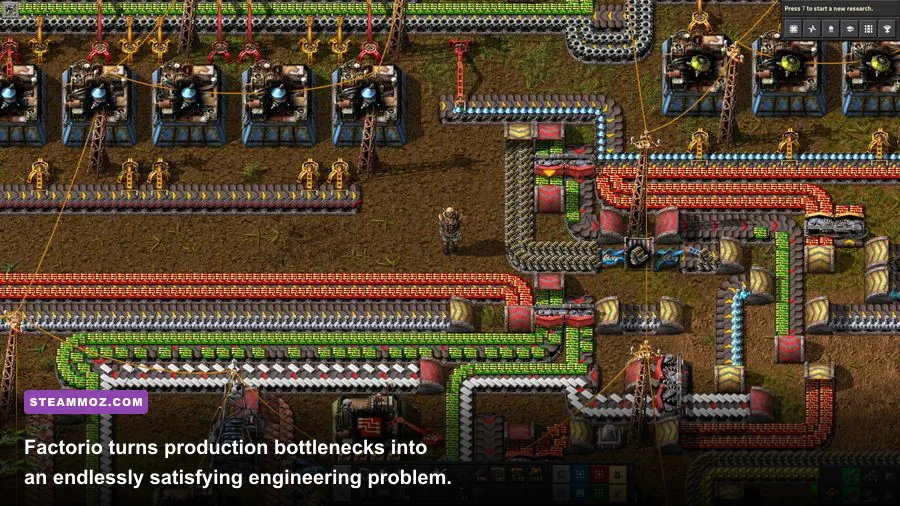
5. Factorio — A-Tier systems mastery
Factorio is the desktop game for players who see a clogged belt and feel curiosity instead of dread. Its progression moves from hand-fed burner drills to electric mining, oil processing, trains, construction robots, and ultimately rocket launches. Each technology solves one bottleneck while exposing another.
The key is throughput. A yellow transport belt carries 15 items per second, while red and blue belts carry 30 and 45. If a furnace line is starved, adding more furnaces will not help unless mining, smelting, and belt capacity match. Use splitters to balance ore, underground belts to cross lanes cleanly, and circuit conditions to stop storage chests from overflowing. Factorio’s official website is packed with development updates and design references.
| Game | Core gameplay strength | Best for | Learning curve |
|---|---|---|---|
| Baldur’s Gate 3 | Turn-based systems and choice | Creative RPG players | Medium |
| Elden Ring | Exploration and pattern mastery | Action RPG veterans | High |
| DOOM Eternal | Combat resource rotation | Fast FPS fans | High |
| Hades | Runs, builds, and responsive movement | Short-session players | Medium |
| Factorio | Automation and optimization | Systems thinkers | High |
Five more games with exceptional mechanics

6. Slay the Spire — The deckbuilder that teaches probability
Slay the Spire’s elegance comes from making every card decision matter several rooms ahead. The Ironclad can build around Strength and attacks such as Heavy Blade, while the Silent can stack Poison with Noxious Fumes and multiply it using Catalyst. Defect’s Orbs turn focus and channel order into the central puzzle, and Watcher’s Wrath stance doubles attack damage while making incoming hits twice as dangerous.
Good players do not draft the strongest-looking card. They draft what their deck lacks: block, draw, scaling, or reliable damage. Removing a weak Strike at a shop can be more valuable than buying a flashy rare, especially when an elite fight is approaching.
7. Sekiro: Shadows Die Twice — Precision as progression
Sekiro strips away conventional RPG escape routes. You cannot grind ten levels to erase a boss; you must understand posture, deflection, and aggression. A successful deflection damages an enemy’s posture, and repeated pressure prevents that posture bar from recovering. The Mikiri Counter is the essential answer to thrust attacks, while jumping over sweeps creates a reliable posture punish.
Against Genichiro Ashina, stay close enough to force his sword strings, deflect the opening sequence, and watch for the perilous kanji. In phase three, lightning reversal turns his signature attack into a major opening. The combat is demanding, but its feedback is exceptionally clear: every clang tells you whether your timing is improving.
8. Portal 2 — Puzzle design without wasted motion
Portal 2 remains one of the smartest desktop games because each new mechanic arrives with a controlled experiment. Repulsion Gel changes jump arcs, Propulsion Gel creates speed, and Conversion Gel lets portals work on surfaces that were previously inert. The game teaches through level layout rather than walls of text.
Its puzzles reward spatial planning. Before firing a portal, identify the launch surface, the exit angle, and where momentum must be preserved. The later excursion funnels and excursion tunnels are especially good at forcing players to separate “where I am” from “where I need to land.” That clarity is why the campaign still works for both puzzle newcomers and veterans.
9. Monster Hunter: World — Preparation that pays off
Monster Hunter: World turns a boss fight into a complete loop of scouting, preparation, execution, and crafting. The Great Sword’s True Charged Slash can produce enormous damage, but only when you read a monster’s movement well enough to commit. The Insect Glaive offers aerial mobility and extracts, while the Long Sword’s Spirit Gauge rewards clean counters with the Foresight Slash and Helm Breaker.
Armor skills are the real build language. Weakness Exploit improves affinity when striking tenderized weak points, Health Boost increases survivability, and Critical Eye raises affinity broadly. Against Nergigante, target white spikes before they harden, avoid standing beneath its dive-bomb trajectory, and keep a Superman dive available when it launches from range.
10. Disco Elysium — Role-playing through consequences
Disco Elysium proves that gameplay does not need conventional combat. Your 24 skills are active voices in the detective’s head: Inland Empire invents strange possibilities, Encyclopedia supplies facts, and Shivers connects you to Revachol itself. Clothing and temporary modifiers can push a skill over a difficult check, while failed checks often unlock different scenes instead of ending progress.
A high-Physique detective plays nothing like a high-Intellect one. Equip the White Satin Shirt for Inland Empire, use thought cabinet bonuses strategically, and do not reload every failed roll. The game’s strongest moments happen when a bad decision becomes a permanent part of your detective’s identity.
How to choose the right game for your setup

Start with the kind of feedback you want. If you enjoy mastering attack patterns, choose Elden Ring or Sekiro. If you want every decision to branch into a new possibility, Baldur’s Gate 3 and Disco Elysium are unmatched. Players who want repeatable sessions should pick Hades or Slay the Spire, while builders can lose hundreds of hours to Factorio.
Hardware also changes the experience. DOOM Eternal benefits most from high refresh rate, Monster Hunter: World gains from a fast SSD that shortens hunts and hub transitions, and Factorio eventually becomes CPU-limited once factories reach megabase scale. For older machines, Steamoz’s PC crash and FPS fixes and graphics settings guide offer useful optimization principles.
| Priority | Best pick | Recommended target | Why it matters |
|---|---|---|---|
| High refresh rate | DOOM Eternal | 120–144 fps | Sharper tracking and faster movement corrections |
| CPU efficiency | Factorio | Stable UPS at late game | Large factories depend on simulation speed |
| Fast storage | Monster Hunter: World | SSD installation | Shorter loading between hunts and zones |
| Controller comfort | Elden Ring | 60 fps minimum | Consistent dodge and attack timing |
| Low-end flexibility | Hades | 1080p, locked 60 fps | Excellent responsiveness without demanding hardware |
The mechanics that separate great PC games
These games succeed because they respect three principles. First, actions have readable consequences. A missed deflection in Sekiro, an overfilled production line in Factorio, and a poor portal angle in Portal 2 all explain themselves. You may not like the result, but you understand it.
Second, progression expands decisions instead of merely inflating numbers. Hades adds weapons and boons that change your route through a run; Monster Hunter adds armor skills that alter your hunting plan; Baldur’s Gate 3 gives you more social and tactical options rather than turning every enemy into a larger health bar.
Finally, the best desktop games make mastery feel personal. Your successful Elden Ring build may depend on bleed and fast weapons, while another player prefers colossal Strength weapons. One Factorio player designs elegant bus layouts; another builds chaotic spaghetti that somehow launches rockets. Both approaches work because the systems are deep enough to support ownership.
Final ranking for gameplay alone

If gameplay is your only scoring category, Baldur’s Gate 3 takes the top spot for its astonishing interaction between combat, dialogue, exploration, and consequence. Elden Ring follows for exploration and boss design, while DOOM Eternal remains the purest action game here. Hades is the safest recommendation for short sessions, and Factorio is the most dangerous if you have responsibilities tomorrow.
The remaining five deserve their places because they excel at a specific craft. Slay the Spire makes probability addictive, Sekiro makes timing tangible, Portal 2 makes teaching look effortless, Monster Hunter: World turns preparation into excitement, and Disco Elysium makes conversation mechanically meaningful. For more PC-focused recommendations and troubleshooting, browse Steamoz’s Everspace 2 secrets guide and strategy game farming guide.
Pick the game whose decisions sound most tempting, not the one with the biggest map or the loudest marketing. Incredible gameplay is the moment a system gives you a problem, hands you the tools, and makes the winning move feel completely yours.