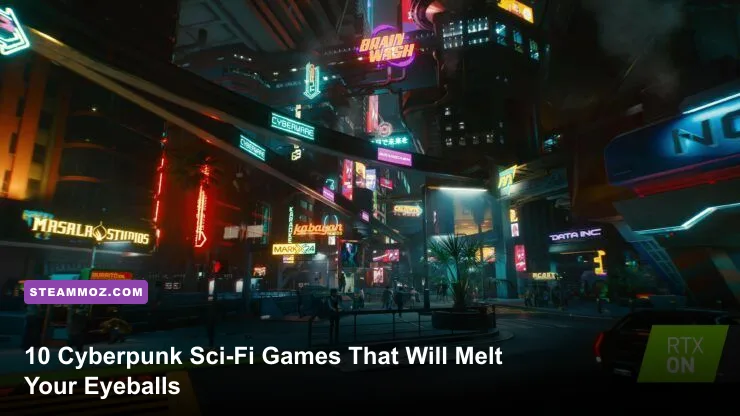
If you want cyberpunk sci-fi games that actually deliver on both story and visuals, your short list has to include Cyberpunk 2077 (especially post-2.0 with Phantom Liberty), Control, Deus Ex: Human Revolution, Ghostrunner, and The Ascent. These aren't just games with neon signs slapped on buildings — they're the ones where the narrative, world-building, and graphics engine all pull in the same direction to make you feel like you're living in a decaying, beautiful future. Let's break down exactly why each one earns its spot, and where they stack up against each other.
Why Cyberpunk 2077 Still Sets the Bar
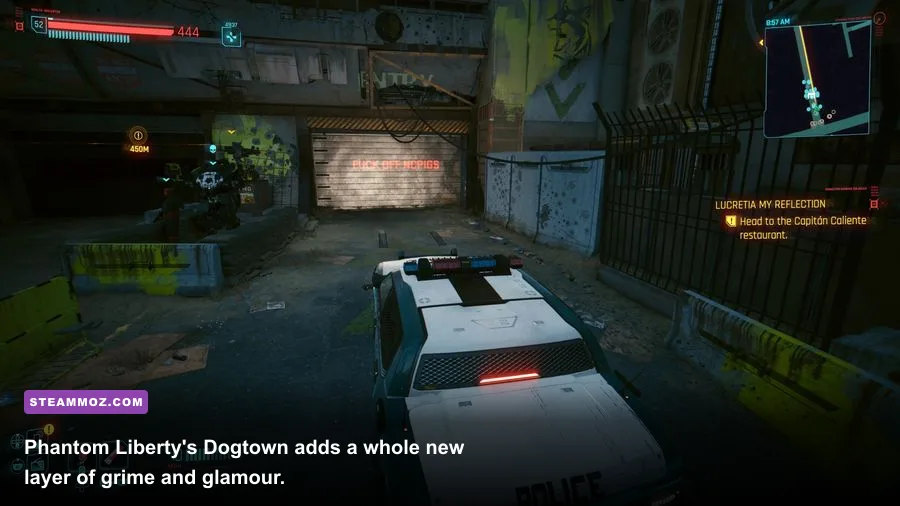
CD Projekt Red didn't just patch Cyberpunk 2077 — they rebuilt its guts. Update 2.0 overhauled the perk trees, police AI, and vehicle combat, while Phantom Liberty added Dogtown, a walled-off district that feels like Blade Runner had a baby with Escape from New York. Turn on Path Tracing (Overdrive Mode) on an RTX 4080 or better and you're looking at genuinely next-gen global illumination — reflections in puddles, volumetric fog rolling off Watson's rooftops, neon bouncing realistically off wet pavement. The story backbone, V's fight against the Relic eating their brain, still hits harder than most sci-fi movies released in the last decade, and Idris Elba's Solomon Reed adds a spy-thriller layer that Phantom Liberty threads perfectly into the main plot.
If you're chasing max fidelity, you'll want a beefy rig — check our breakdown on optimizing settings for max FPS in similarly demanding open-world titles for a sense of the tradeoffs involved with ray tracing at 4K.
Deus Ex: Human Revolution's Gold-and-Black Masterclass

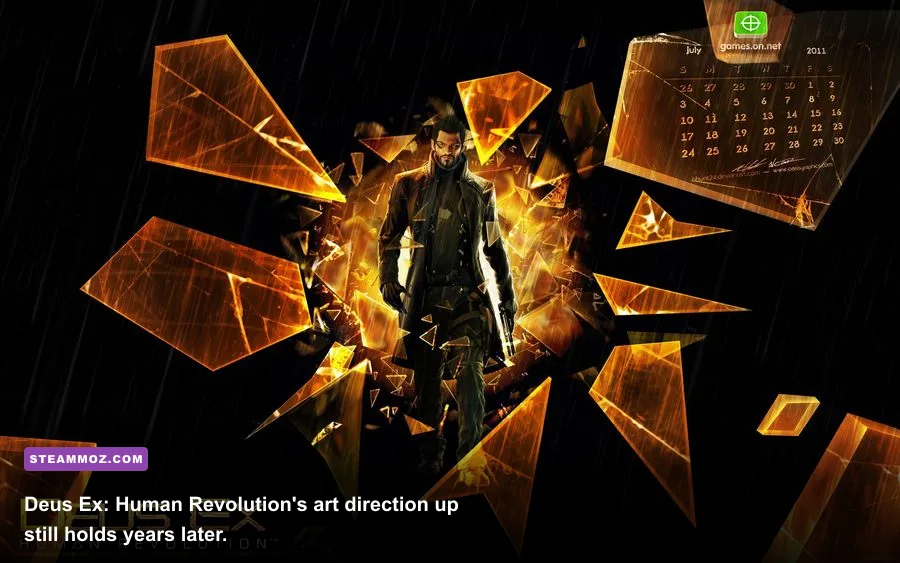
Before Cyberpunk 2077 existed, Deus Ex: Human Revolution proved that a cyberpunk RPG could have a distinct visual identity without chasing photorealism. The gold-and-black color grading wasn't a technical limitation — it was a deliberate art direction choice meant to evoke Renaissance imagery colliding with augmented humanity. Adam Jensen's story about corporate conspiracy and forced evolution ("I never asked for this") remains one of the most quotable arcs in sci-fi gaming. Boss fights are famously the weak link (thanks to an outsourced studio handling them), but the hub cities of Detroit and Hengsha are dense enough that you'll spend hours just reading emails on NPC computers to piece together lore.
Control: Brutalist Sci-Fi Horror Done Right
Remedy's Control isn't pure cyberpunk, but it earns its spot on this list because of how it fuses sci-fi bureaucracy-horror with visuals that still make jaws drop in 2024. The Oldest House shifts and warps using techniques inspired by brutalist architecture and the SCP Foundation's aesthetic of "normal things gone wrong." Jesse Faden's story, told through live-action Ahti sequences and found documents, builds one of gaming's most underrated mysteries. Turn on ray-traced reflections and destruction physics on PC and watch entire rooms shatter into thousands of individually lit debris chunks — it's still a benchmark demo four years later.
| Game | Story Depth | Visual Tech | Best For |
|---|---|---|---|
| Cyberpunk 2077 (2.0 + Phantom Liberty) | S-Tier, branching endings | Path Tracing, RTX 4080+ | Full open-world RPG immersion |
| Deus Ex: Human Revolution | A-Tier, philosophical | Stylized gold/black art | Choice-driven stealth RPG fans |
| Control | A-Tier, surreal mystery | RTX reflections, destruction physics | Sci-fi horror + action hybrid |
| Ghostrunner | B-Tier, minimal but stylish | Neon parkour visuals | Fast, punishing action fans |
| The Ascent | B-Tier, dense lore drops | Layered isometric lighting | Twin-stick shooter/RPG fans |
Ghostrunner: When Speed Becomes the Art Style
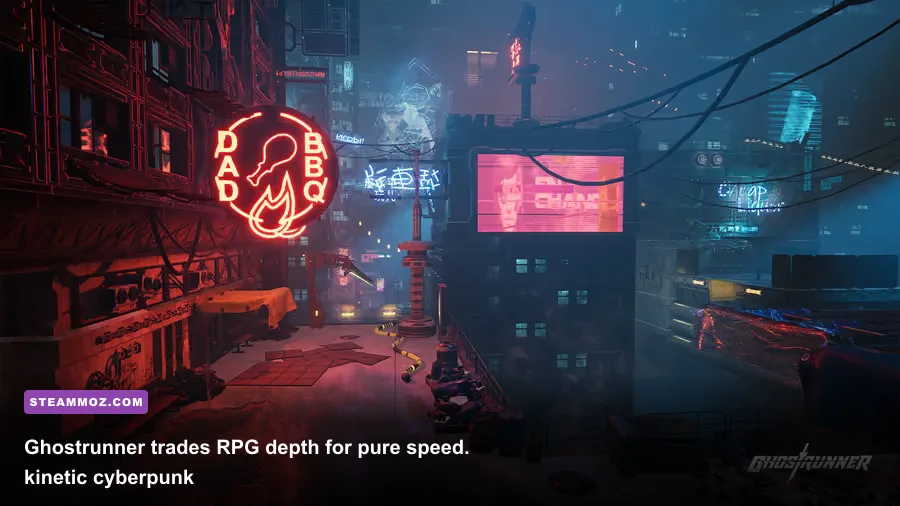
Ghostrunner doesn't have a sprawling RPG narrative, but don't sleep on it — its story of a lone cyber-samurai climbing the Dharma Tower to overthrow the Keymaster is tight, brutal, and paced perfectly against its one-hit-kill combat. The visual trick here is verticality: every level is built as a massive tower you're constantly scaling, with neon signage and holographic ads bleeding into motion-blurred backgrounds as you dash at insane speed. It's basically what would happen if Mirror's Edge and Blade Runner had a fever dream together. On PC with ray tracing enabled, chrome surfaces reflect the city below in real time as you wall-run past them — a small detail that sells the whole "falling through neon hell" fantasy.
The Ascent: Isometric Cyberpunk Nobody Talks About Enough
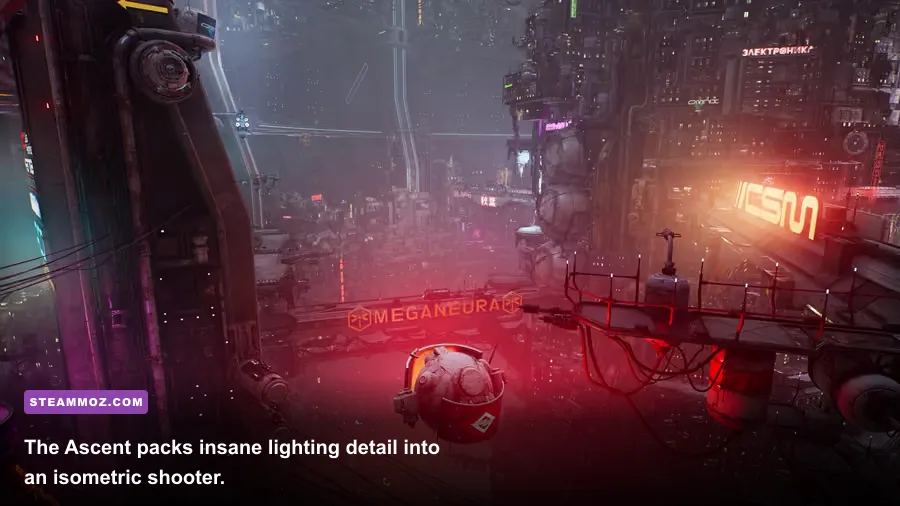
The Ascent flew under a lot of radars at launch, but Neon Giant built one of the most visually dense cyberpunk worlds in gaming — just from a top-down isometric angle. The Cluster, the arcology city you explore, layers dozens of lighting sources (holographic billboards, steam vents, gunfire, and environmental particles) into every single frame without tanking performance on a mid-range GPU. The story follows a corporate collapse and the fallout among indentured workers, delivered through voiced dialogue and environmental storytelling rather than cutscenes. It's a great pick if you want cyberpunk atmosphere without the 100-hour commitment Cyberpunk 2077 demands.
Graphics Settings That Actually Matter for Cyberpunk Visuals
Not every setting is worth cranking. Here's where your FPS budget should actually go if you're chasing that "breathtaking" cyberpunk look without murdering your frame rate:
| Setting | Recommended Value | FPS Impact | Visual Note |
|---|---|---|---|
| Ray-Traced Reflections | High / Psycho | -15 to -25 FPS | Massive difference on wet streets and chrome |
| Volumetric Fog | High | -5 to -8 FPS | Sells the neon-haze atmosphere |
| Crowd Density | Medium-High | -8 to -12 FPS | Big visual boost for city immersion |
| Screen Space Reflections | Low (if no RT GPU) | -2 to -4 FPS | Weaker than RT but budget-friendly |
| Motion Blur | Off/Low | Negligible | Personal preference, hurts clarity |
Whichever of these games you jump into, they all share one thing: the tech is in service of the story, not the other way around. That's the real difference between "cyberpunk aesthetic slapped on a generic shooter" and games that actually earn the genre's name. If you're building a PC specifically to chase this kind of visual fidelity, it's worth reading up on optimization guides like our notes on fixing crashes before chasing higher FPS — stability always comes before eye candy. And if you loved the weapon variety in these worlds, our Blood Dragon weapons tier list is a fun retro-cyberpunk detour worth checking out too.
For official patch notes and system requirement updates, always check CD Projekt Red's official Cyberpunk site, Remedy's Control page, and the Cyberpunk 2077 Steam store page before buying, since GPU requirements shift with every major content update.