
The PC is the undisputed proving ground for role-playing games because raw mouse-and-keyboard precision, high frame rates, and uncapped mechanical headroom elevate good combat into pure artistry. If you're tired of walking simulators with shallow dialogue trees, our definitive ranking cuts straight to the core: games where your build choices, positioning, frame data, and tactical execution dictate whether you conquer encounters or end up flat on your back. From the stance-breaking rhythm of Elden Ring to the hyper-lethal cyberware rotations of Cyberpunk 2077 2.0 and the layered environmental chain reactions in Baldur's Gate 3, these ten titles deliver the absolute highest mechanical gameplay ceilings on PC.
| Game Title | Gameplay Tier | Primary Combat Engine | Signature Mechanic / Build Synergy | Skill Ceiling Focus |
|---|---|---|---|---|
| Elden Ring | S-Tier | Real-Time Action / Stamina-Gated | Stance-breaking jumping heavies + Poise trading (Greatsword Lion's Claw) | Boss move telegraphs & dodge i-frame management |
| Baldur's Gate 3 | S-Tier | Turn-Based Tactical (D&D 5e Modified) | Tavern Brawler Monk + Cloud Giant Strength Elixir + Wet status burst | Verticality, barrelmancy, & initiative economy |
| Cyberpunk 2077 (2.0) | S-Tier | First-Person Movement Shooter / Slasher | Militech Apogee Sandevistan + Byakko Katana Dash Leap loops | High-speed slide-dodging & cyberware cooldown uptime |
| Monster Hunter: World - Iceborne | S-Tier | Weighty Action / Animation Priority | Charge Blade Guard Points into SAED + Tenderize wall-bangs | Frame recovery knowledge & monster stagger thresholds |
| Divinity: Original Sin 2 | A-Tier | Turn-Based Environmental Sandbox | Apotheosis + Blood Storm + Grasp of the Starved physical wipes | Dual-armor pool stripping & surface chain reactions |
| Dragon's Dogma 2 | A-Tier | Physics Action / Monster Climbing | Mystic Spearhand Mirour Shelde + Magick Archer Ricochet Hunter | Climbing balance & physical monster knockdowns |
| Kingdom Come: Deliverance | A-Tier | First-Person Physics HEMA Fencing | Captain Bernard Master Strikes + Clinch master perk face-stabs | Directional 5-point weapon tracking & stamina management |
| The Witcher 3: Wild Hunt | B-Tier | Action Slasher / Alchemy Prep | Euphoria Mutagen + Ekimmara Decoction + Whirl stamina shred | Toxicity optimization & quick-cast sign weaving |
| Mass Effect Legendary Edition | B-Tier | Third-Person Cover Shooter / Squad Tactics | Vanguard Biotic Charge + Nova invincible iframe cycles (ME3) | Biotic/Tech priming and detonation cooldown chains |
| Disco Elysium | B-Tier (Tactical Dialogue) | Psychological Narrative Dice System | Thought Cabinet passives + Inland Empire / Shivers perception | Dialogue failure redirection & stat synergy routing |
The Undisputed S-Tier: Masterclasses in Combat and Sandbox Freedom
At the apex of PC role-playing games sit experiences where every frame of your animation, every stat point you allocate, and every weapon swing directly tests your mastery of the engine. These titles throw out rubber-band balancing and demand that you respect their internal physics, timing, and build depth.
1. Elden Ring: Uncapped Mechanical Mastery
FromSoftware didn't just expand Dark Souls into an open world; they gave combatants unprecedented agency through the jump attack, guard counter, and flexible Ash of War systems. By moving past the console-standard 60 FPS cap using trusted community frame-unlockers, PC players experience buttery dodge windows and responsive hitbox porn that make frame-perfect dodges feel surgical. Stance-breaking mechanics form the true backbone of high-level encounters. Landing a two-handed jumping heavy attack with a +25 Heavy Greatsword inflicts roughly 36 to 40 poise damage. Chain that with the Lion's Claw Ash of War, and you can reliably posture-break Malenia or Godfrey within three offensive rotations.
Weapon scaling isn't a passive numbers game here. Pumping Strength to the 80 hardcap while dual-wielding Colossal weapons grants hyper-armor frames that let you swing through incoming light hits, turning boss fights into lethal trades. Compare that to an Intelligence/Dexterity setup running Wing of Astel, where the Nebula weapon art lays down a cluster of delayed magic explosions that obliterate massive hitboxes like the Elden Beast. For full breakdown data on weapon progression curves and build viability, check out the official Elden Ring Steam Hub to witness how regular balancing patches keep combat razor-sharp.
2. Baldur's Gate 3: The King of Reactive Turn-Based Arenas
Larian Studios tore up the rigid constraints of traditional tabletop adapters by translating D&D 5th Edition into a dynamic sandbox running on custom PC engine architecture. Combat encounters in Act 2 and Act 3 turn into lethal spatial puzzles. Throwing a bottle of water at an enemy cluster applies the Wet condition, doubling all incoming Cold and Lightning damage for three turns. Line up an Evocation Wizard casting a Level 6 Chain Lightning, and your damage floor spikes from 40 to 80 points across four separate targets with zero damage falloff.
Physical combat reaches equal madness via the Tavern Brawler feat. When picked on an Open Hand Monk chugging an Elixir of Cloud Giant Strength (fixing Strength at an absurd 27), the feat adds your +8 Strength modifier twice to both attack rolls and damage calculations. Your hit chance sits permanently at 95% against boss armor classes, while your Flurry of Blows: Topple strips legendary actions before high-tier adversaries can even take their turn. Much like the structured gear-progression strategies we analyzed in our Far Cry 6 beginner build guide, min-maxing your party's turn initiative ensures you lock down the battlefield before enemy combatants get a single roll.
3. Cyberpunk 2077 (Update 2.0 & Phantom Liberty): High-Octane Cybernetic Mayhem
CD Projekt Red rebuilt Night City's combat from the ground up in the 2.0 overhaul, throwing out stat-sponge clothing mods and replacing them with a strict Cyberware Capacity threshold and a hyper-kinetic movement engine. At the heart of melee combat sits the Militech Apogee Sandevistan. Pop this operating system, and time slows by 85% for up to 8 seconds, while each enemy neutralised refunds 20% of your operational duration and 22% stamina. Pairing this with the Reflexes perk tree unlocks the Dash and Air Dash maneuvers, effectively transforming V into a teleporting butcher.
Wielding the Iconic Byakko Katana enables lunge attacks that instantly close 10-meter gaps without burning your primary dash cooldown. Meanwhile, Smart Weapon gunslingers run the Militech Hercules 3AX, tagging targets with explosive rounds while their Tech perk tree's Bolt shots bypass heavy armor plating entirely. If you want to push your rig to its absolute limit, toggle Ray Tracing Overdrive to test high-speed responsiveness under extreme graphics stress, as detailed directly on the official Cyberpunk 2077 developer portal.

🎮 Depth
Looking to experience this game? Grab your digital key directly on our store for $19.99.
View on Steammoz Store →Tactical Brilliance: Environmental Mayhem and Narrative Mechanics

Some of the greatest PC RPGs avoid twitch-reflex timing entirely, focusing instead on deep systemic interactions, environmental physics, and mental agility. If you prefer outsmarting AI through meticulous pre-buffing or out-talking armed guards with pure psychological warfare, this tier delivers unmatched satisfaction.
4. Divinity: Original Sin 2: The Elementalist's Playground
Before Larian made Baldur's Gate 3, they perfected elemental warfare in Divinity: Original Sin 2. The combat system splits all vitality defense into two distinct layers: Physical Armor and Magic Armor. Crowd control effects—such as Knockdown, Frozen, or Stunned—cannot trigger until you strip the corresponding defensive bar to zero. This forces players to create focused party compositions that burst down specific health pools rather than splitting their damage output haphazardly.
The real magic happens on the ground. Bleeding an enemy with a rogue's Backstab creates a blood puddle. Your Necromancer then casts Rain of Blood, saturates the entire floor, and converts it into physical devastation via Grasp of the Starved, which inflicts massive physical damage and Cripples every target caught in the mess. Throw in an Aerotheurge applying Shock to the puddle, and the entire zone turns into electrified steam that stuns anyone stepping into the vapor. Managing action points (AP) through skills like Adrenaline (+2 AP now, -2 AP next turn) turns every encounter on Tactician difficulty into a calculated chess match.
5. Disco Elysium - The Final Cut: Mind as an RPG Battlefield
Disco Elysium removes conventional hit points, swords, and guns, proving that raw RPG progression can thrive entirely inside the human psyche. The combat arena is your own fractured mind, where 24 distinct psychological and physiological skills speak to you as independent internal voices. Investing skill points into Inland Empire feeds you supernatural hunches and lets you converse with corpses or your own necktie, while Shivers links your consciousness to the heartbeat of Revachol to expose unseen environmental clues.
The Thought Cabinet mechanic works like an esoteric gear-socketing system. By internalizing complex ideological concepts over in-game hours—such as the "Jamais Vu" thought, which grants +1 XP for every dialogue interaction across the city—you completely alter your character's dialogue routing and unlock alternate paths through seemingly dead-end investigations. It's a clinic in mechanical game design that treats character personality traits with the same mathematical precision that FromSoftware treats weapon scaling.
Weapon Mastery: Action RPGs with Relentless Skill Ceilings

When you want your personal mechanical inputs to carry as much weight as your character sheet's numerical stats, action RPGs with complex movesets and ruthless attack recovery frames take center stage.
6. Monster Hunter: World - Iceborne: Unrivaled Weapon Physics
Calling Monster Hunter: World an action game sells its deep RPG progression short. With 14 distinct weapon archetypes, each packing its own input combos, frame data, and positioning requirements, mastering a single weapon can take upwards of 100 hours. The Charge Blade exemplifies this depth: you slash with a sword to generate kinetic energy, store that energy into phials, transfer the charge into your shield to unlock Guard Points, and unleash a Super Amped Elemental Discharge (SAED) that lands five explosive shockwaves across a monster's spine.
High-rank Iceborne monsters like Fatalis and Alatreon feature aggressive attack patterns that require precise frame-recovery awareness. Missing your Guard Point timing by three frames means eating a tail swipe that strips 70% of your health bar. Build optimization demands running armor sets that trigger Agitator Secret and Weakness Exploit, pushing your Affinity (critical strike chance) to 100% on tenderized weak points. Learn more about the combat system and ongoing community speedruns on the Monster Hunter: World Steam page.
7. Dragon's Dogma 2: Dynamic Physics and Monster Wrestling
Capcom's RE Engine fuels Dragon's Dogma 2, turning every encounter with a Griffin or Cyclops into a dynamic physics simulation. Stamina is your most vital stat. Depleting your green bar leaves your character bent over gasping for air, leaving you completely exposed to heavy enemy stomps. Grabbing onto the fur of a raging Minotaur and scaling its back requires constant stamina monitoring, but reaching its neck weak spot lets you execute downward heavy stabs that send the beast crashing into nearby cliff walls.
Vocation synergies let you customize your combat flow on the fly. The Mystic Spearhand's Mirour Shelde provides temporary invulnerability bubbles for your entire party, allowing your Sorcerer pawn to safely channel catastrophic high-tier spells like Meteoron. Meanwhile, the Magick Archer's Ricochet Hunter fires energy arrows that bounce off cave surfaces, multiplying in speed and destructive power every time they hit a wall. In tight underground dungeons, this single ability melts entire packs of Saurians in seconds, proving that terrain awareness matters just as much as weapon upgrades.
Grounded Realism and Hybrid Combat Engines
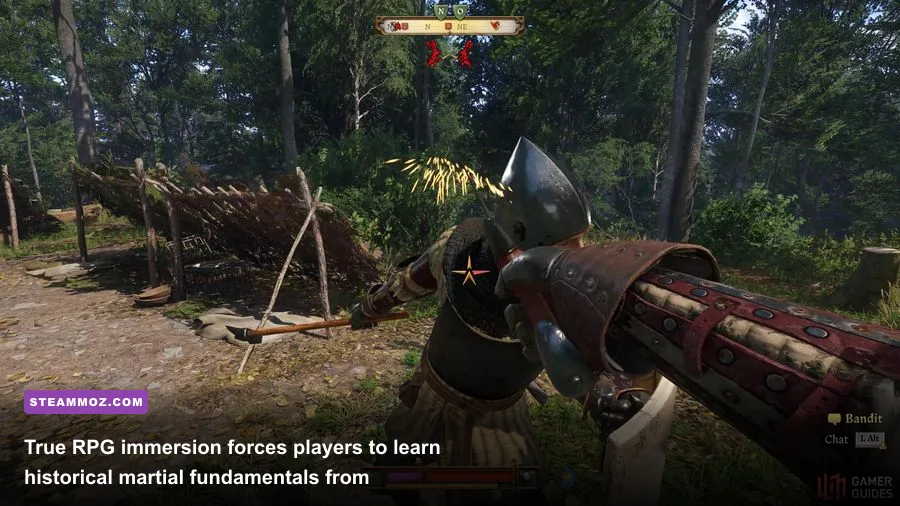
Not every legendary RPG relies on magic spells or high-fantasy beasts. Some of the most satisfying PC experiences strip away superhero tropes, replacing them with historical martial arts, tactical cover mechanics, and deep preparation systems.
8. Kingdom Come: Deliverance: Hardcore Historical Fencing
Kingdom Come: Deliverance throws you into 15th-century Bohemia as Henry, an illiterate blacksmith's son who literally cannot hold a sword steady. Combat utilizes an authentic Historical European Martial Arts (HEMA) system centered on a five-point directional combat star. When you swing from the top right, your blade tracks that exact trajectory; if an armored cuman guard raises his longsword in a high guard, your attack glances off his plate armor and drains your stamina to zero.
Stamina acts as your true life bar. As long as you maintain stamina, incoming strikes deal minimal damage; run out of breath, and every sword thrust punctures Henry's gambeson, causing bleeding debuffs and vision-blurring head trauma. Surviving means spending hours sparring with Captain Bernard outside Rattay, unlocking Master Strikes—a defensive counter-timing technique that deflects an incoming blow and lands an unblockable riposte in one seamless motion. It's punishing, methodical, and arguably the most immersive melee combat engine ever built for PC.
9. The Witcher 3: Wild Hunt (Next-Gen Update): Alchemy and Sign Weaving
The Next-Gen update transformed Geralt's combat loop by introducing Quick Sign Casting, allowing players to sling Aard, Igni, and Quen instantly without opening the slow-motion radial wheel. This mechanical overhaul turns swordplay into a fluid dance. Dodging consumes zero stamina, but rolls delay your stamina regeneration, making tight sidesteps the optimal defensive choice for maintaining offensive tempo.
High-level combat shines brightest through the Euphoria Mutation build. By chugging three decoctions—such as Ekimmara (lifesteal on hit), Water Hag (+50% damage at full health), and Arachas (damage reduction based on inventory weight)—you push Geralt's Toxicity bar past 80%. Euphoria converts every point of toxicity into raw sword damage and Sign intensity, boosting attack power by up to 210%. Chaining this raw stat boost with the Whirl ability lets you carve through entire bandit camps in a continuous spinning vortex of steel.
10. Mass Effect Legendary Edition: Synergistic Squad Powers
While the original Mass Effect laid narrative foundations, Mass Effect 2 and Mass Effect 3 perfected tactical third-person power combos. Playing on Insanity difficulty strips away run-and-gun safety; every enemy comes shielded, barriered, or heavily armored. Conquering these gauntlets requires executing tight power detonations: priming an elite target with Warp or Reave, then detonating them with Throw or Warp to trigger a Biotic Explosion that blasts away nearby infantry.
The Vanguard class remains the ultimate expression of aggressive third-person gameplay. Using Biotic Charge, you instantaneously teleport across the battlefield directly into an enemy's face, fully restoring your barrier shields and staggering the target. You then immediately chain into Nova, sacrificing your barrier to deal massive 360-degree point-blank area damage, using the brief invulnerability frames of the animation to avoid incoming sniper fire. You can review detailed gear progressions similar to this loop in our breakdown of ranked weapon progression and DPS scaling.
| Game Title | Engine / Architecture | Recommended API | System Bottleneck Focus | Pro Frame-Pacing Advice |
|---|---|---|---|---|
| Elden Ring | FromSoftware Proprietary | DirectX 12 | Shader Compilation / CPU Draw Calls | Set Nvidia Shader Cache to 10GB; use Flawless Widescreen to unlock 120Hz+. |
| Baldur's Gate 3 | Divinity 4.0 Engine | Vulkan (AMD) / DX11 (Nvidia) | Heavy CPU Core Loading (Act 3 City) | Toggle "Slow HDD Mode" off on NVMe SSDs; limit background party pathfinding. |
| Cyberpunk 2077 | REDengine 4 | DirectX 12 Ultimate | GPU Bound (RT/PT) / High Core Utilization | Enable DLSS/FSR Quality; keep Crowd Density on Medium for smooth frametimes. |
| Monster Hunter: World | MT Framework | DirectX 12 | CPU Multi-threading / Volumetric Fog | Disable Volumetric Fog for a flat 18% FPS jump with zero impact on hitboxes. |
| Kingdom Come: Deliverance | CryEngine 3.8 | DirectX 11 | Single-Thread CPU Performance | Cap framerate slightly below monitor refresh rate; avoid Ultra Physics in Rattay. |
Maximizing Frame Pacing and Input Latency in Heavy RPGs
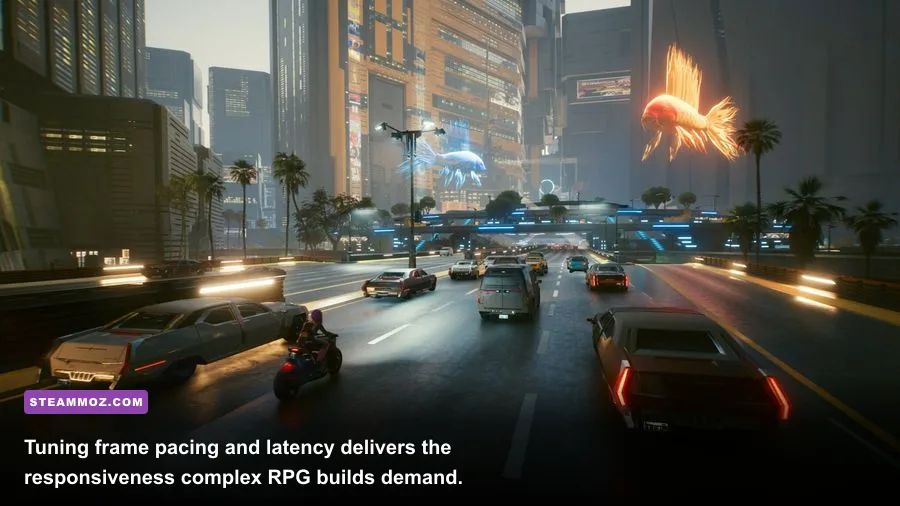
Nothing ruins a frame-tight combat build faster than erratic frame delivery or sluggish input latency. In action RPGs like Elden Ring or Monster Hunter: World, an erratic 50ms frametime spike during an enemy's swing telegraph guarantees you miss your parry window and take critical damage. Maintaining competitive responsiveness requires fine-tuning your PC's engine parameters.
Start inside your GPU driver software. In the Nvidia Control Panel or AMD Software Adrenalin Edition, set your Shader Cache Size to 10GB or higher. Expansive open-world RPGs constantly stream assets and compile shaders on the fly; an undersized 1GB cache forces the driver to purge and recompile shaders constantly, causing the notorious micro-stutter that plagues modern DirectX 12 titles. For players dealing with persistent engine-level crashes or stability hitches in older and mid-era open-world role-playing titles, applying targeted fixes like the community solutions detailed in our Elex PC crash and FPS recovery guide can rescue your system performance and stabilize your background frame delivery.
Next, tackle the trade-off between visual clarity and mouse latency. While Frame Generation technologies (DLSS 3, FSR 3) boost your visual frame counter, they inherently add a half-frame of input latency because the GPU must hold the rendered frame to interpolate intermediate images. For turn-based tactical games like Baldur's Gate 3 or environmental sandboxes like Divinity: Original Sin 2, Frame Generation is fantastic for smoothing out bustling city hubs. However, when you're executing frame-perfect Guard Points in Monster Hunter: World or parrying cumans in Kingdom Come: Deliverance, disable Frame Generation and run pure reflex latency reduction (Nvidia Reflex or AMD Anti-Lag) with an uncapped native render to keep your controller or mouse inputs direct and immediate.
Exploration rewards also drive the pacing of top RPG gameplay loops. Knowing how to efficiently navigate massive zones, farm currency, and uncover hidden weapon caches without grinding mindlessly separates casual runs from elite builds. Whether you're tracking legendary loot caches using methods similar to our Everspace 2 hidden rewards and secrets guide or mastering exponential leveling curves like those mapped out in our DBZ Kakarot fast leveling walkthrough, optimizing your progression loop ensures your combat stats scale right alongside your personal mechanical skill.
Lock down your keybinds, tune your shader cache, and dive into these ten PC titan experiences. Each one proves that when deep RPG character sheets meet top-tier mechanical game design, the PC platform has no equal.