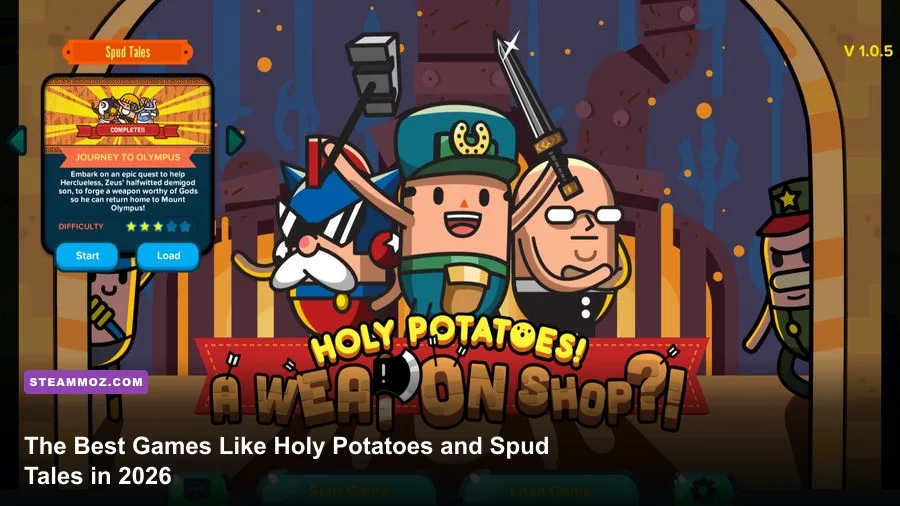
If you love Holy Potatoes! A Weapon Shop?! and want something with the same satisfying mix of crafting, staffing, upgrades, and light RPG progression, start with Weapon Shop Fantasy, Recettear: An Item Shop’s Tale, and Potionomics. They cover the three strongest reasons to play Holy Potatoes: building a production business, turning loot into profit, and making every customer or adventurer part of the strategy. Moonlighter and Blacksmith of the Sand Kingdom are excellent follow-ups, while Weapon Shop De Omasse is the oddball pick for players who want a much more focused blacksmithing gimmick.
This list is aimed at 2026 players specifically. Some recommendations are better if you want the cheerful potato presentation and short management cycles; others are stronger if you want tactical combat, relationship systems, or a more demanding economy. The key is knowing which part of Holy Potatoes you actually want to preserve.

What Makes Holy Potatoes So Addictive
The original Holy Potatoes! A Weapon Shop?! is not simply a crafting game with a shop attached. Its hook is the production chain. You hire potato staff, assign them to forge stations, research recipes, craft weapons, and sell the results to adventurers. Every decision feeds the next one: a better employee improves output, better materials unlock stronger recipes, and stronger weapons attract customers with more money to spend.
That loop is unusually readable. The game does not bury its core in a gigantic skill tree or an intimidating spreadsheet. You can glance at a forge, see its queue, inspect a weapon's required materials, and understand why the shop is earning or losing money. The campaign also gives the business a gentle sense of urgency through objectives and progression gates rather than throwing you into a completely open economy.
The important details are the small bonuses. Staff members have different specializations, crafting stations have upgrade paths, and weapon types serve different customer demands. A shop that blindly crafts the highest damage weapon can still struggle if its materials are expensive or its production time is too long. Efficient players rotate recipes, protect rare resources for research, and avoid filling every station with a low-margin item.
That is why the best alternatives below are not just games that contain swords. They recreate at least two of Holy Potatoes' defining tensions: spend now or save for an upgrade, craft for immediate cash or long-term progression, and optimize a workforce without draining the fun out of the fantasy.
🎮 Holy Potatoes! A Weapon Shop?! Spud Tales: Journey To Olympus
Looking to experience this game? Grab your digital key directly on our store for $1.49.
View on Steammoz Store →S-Tier Alternatives for Holy Potatoes Fans
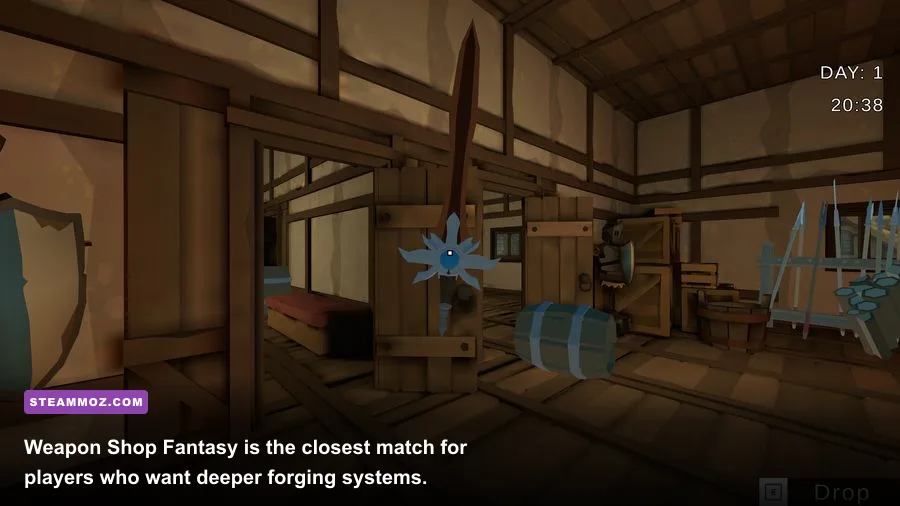
Weapon Shop Fantasy is the closest mechanical replacement. Its premise is almost absurdly direct: operate a weapon store, craft gear, hire workers, and support adventurers. The major difference is that it pushes more aggressively into RPG systems. You are not only making equipment; you are also managing a party, exploring areas for materials, and using crafted gear to solve combat and progression problems.
Choose it if the forge was your favorite part of Holy Potatoes. Weapon Shop Fantasy gives you more room to experiment with recipes and production efficiency, but it also asks more from you. Material shortages matter, and a bad production plan can leave your party under-equipped. This is the pick for players who want the shop to feel like the engine behind an entire adventure rather than a charming side activity.
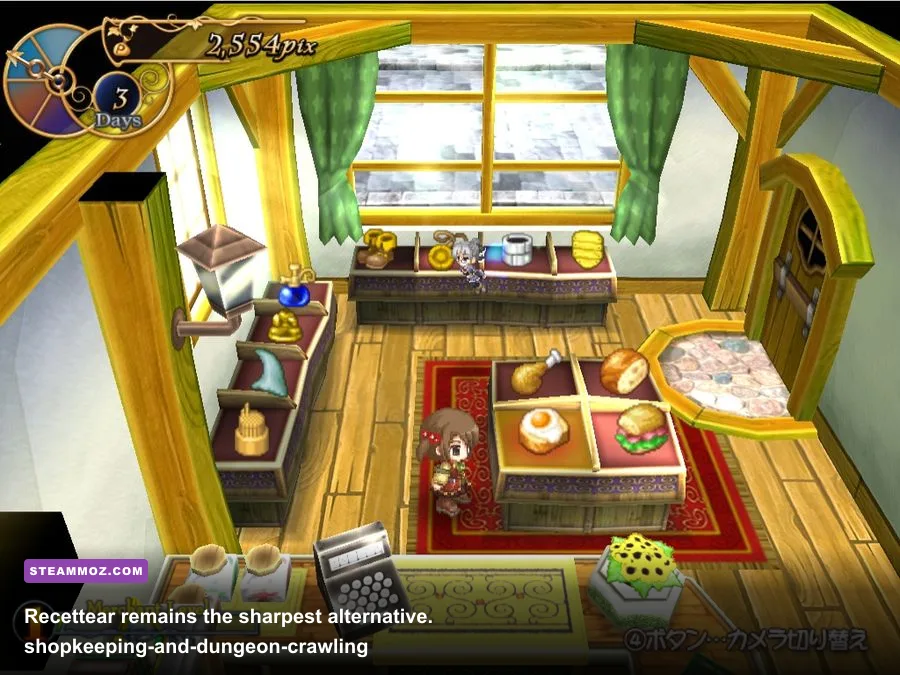
Recettear: An Item Shop’s Tale remains the best all-round recommendation. Its shop phase lets you set prices, negotiate with customers, manage inventory, and decide which adventurer-generated loot deserves shelf space. Its dungeon phase then supplies the items that keep the store alive. The design is older, but the feedback loop is still fantastic: combat produces inventory, inventory creates revenue, and revenue pays the debt that drives the campaign.
Recettear is more demanding than Holy Potatoes because pricing mistakes are immediately painful. You cannot simply dump every item into a queue and wait for profit. Watch customer reactions, keep a healthy mix of cheap and premium goods, and resist the urge to overpay for rare loot during the opening chapters. Its iconic “Capitalism, ho!” energy is funny, but the underlying economy is surprisingly sharp.
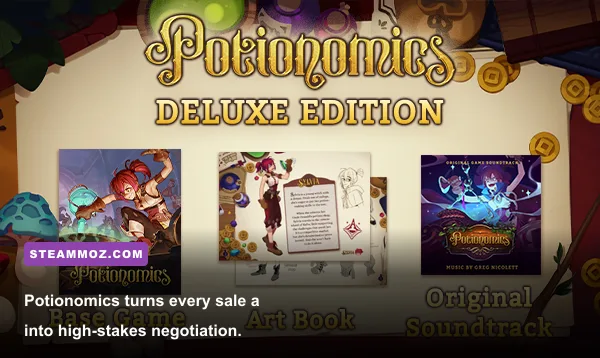
Potionomics takes the shop idea in a more character-driven direction. Sylvia's potion business runs on brewing, ingredient quality, customer relationships, and negotiation cards. There are no weapon stations to optimize, but the emotional rhythm is similar: you turn raw materials into products, sell them under pressure, and reinvest the proceeds into a better operation.
The major warning is that Potionomics is not a pure management sandbox. Its story, deadlines, romance routes, and deck-building negotiation system are central. If you want employee assignments and a quiet production spreadsheet, start with Weapon Shop Fantasy. If you want every sale to feel like a miniature boss fight, Potionomics is the stronger choice.
| Game | Best Match For | Management Depth | Combat or Pressure |
|---|---|---|---|
| Weapon Shop Fantasy | Forging and production chains | High | Party RPG and exploration |
| Recettear | Shop economy and loot resale | High | Action dungeon runs |
| Potionomics | Crafting and customer negotiation | Medium | Deck-building sales battles |
| Holy Potatoes! A Weapon Shop?! | Accessible weapon-factory management | Medium | Light RPG progression |
For official details, compare the Holy Potatoes Steam page, the Recettear Steam listing, and the official Potionomics page before buying. Availability, controller support, and platform features can change over time.
A-Tier Picks for More Combat and Crafting
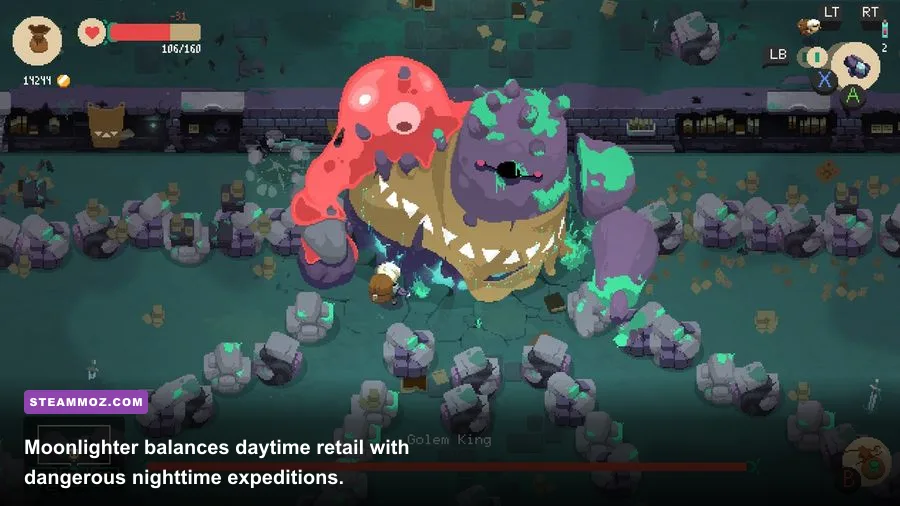
Moonlighter is the obvious recommendation if you enjoy gathering materials personally. Will runs the shop by day and raids dungeons by night, bringing home weapons, armor, relics, and resources for sale. The shop is not a factory in the Holy Potatoes sense, but it creates the same satisfying conversion: risk in the field becomes capital behind the counter.
Moonlighter's defining mechanic is pricing. Customers communicate through reactions, and you learn whether an item is too cheap, too expensive, or appropriately priced. The game also punishes careless inventory management because dungeon space is limited. Keep valuable loot, identify cursed items, and use the town's upgrade systems strategically. The blacksmith and merchant upgrades are not cosmetic; they directly determine whether later dungeon tiers feel manageable.
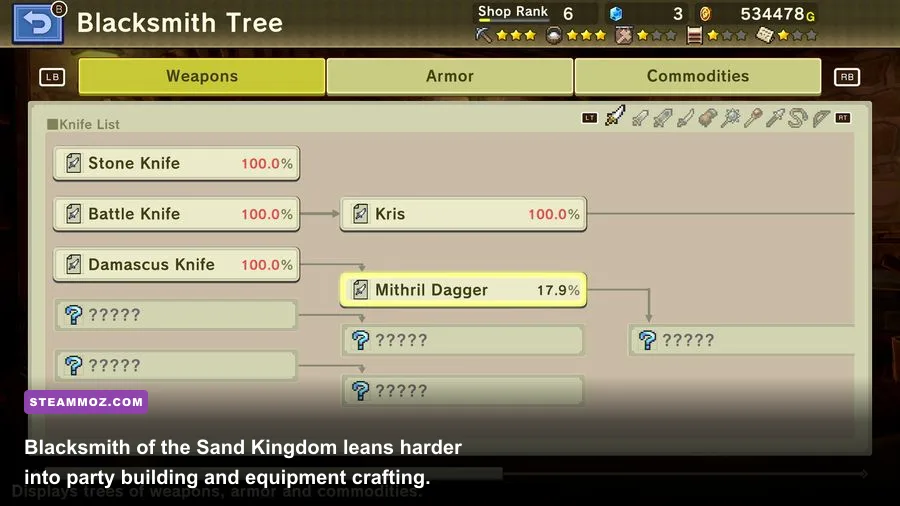
Blacksmith of the Sand Kingdom is a better choice for players who care more about equipment builds than running a storefront. You play as Volker, a royal blacksmith who joins an RPG party and crafts equipment for the journey. The loop centers on gathering materials, learning recipes, improving gear, and assembling a party that can survive tougher encounters.
It lacks Holy Potatoes' customer-facing business drama, but its crafting has a clearer combat payoff. If you like comparing weapon stats, adjusting party roles, and hunting materials for a specific upgrade, it offers a compact and approachable experience. Expect less personality and less economic tension than Recettear, but a cleaner focus on conventional RPG progression.
Weapon Shop De Omasse deserves an honorable A-tier mention because it understands that weapons can have stories. You operate a shop, rent weapons to adventurers, and watch how those weapons perform in their journeys. The structure is much more limited than Holy Potatoes, and it is not the right pick for a sprawling simulation. Still, the feedback between lending gear and hearing about the results is wonderfully distinctive.
These games also pair well with Steamoz's guides to systems-heavy titles. Players who enjoy optimizing equipment should check the Bug Fables weapon tier list, while anyone who prefers a build-focused RPG can jump to Excubitor's best starter build. They are different genres, but the same lesson applies: a good upgrade is valuable because it changes your options, not just because its number is larger.
B-Tier Games With the Right Flavor
Shop Titans is worth considering if you want a persistent fantasy storefront and do not mind free-to-play design. You craft equipment, sell to heroes, fulfill orders, and expand the town around your shop. Its long-term loop is substantial, but timers, online features, and monetization make it feel less like a self-contained campaign than Holy Potatoes.
Travellers Rest swaps weapons for food, drinks, and hospitality, yet the operational appeal is familiar. You gather ingredients, research recipes, assign tasks, decorate your establishment, and respond to customer demand. It is a calmer recommendation, especially for players who liked arranging the shop floor and gradually improving a business more than watching adventurers fight.
Bear and Breakfast also fits the management side of the fantasy. Hank builds and operates woodland resorts, balancing room quality, guest needs, staff, and resources. There is no weapon crafting, but the game understands the pleasure of taking a shabby operation and turning it into a polished machine. Its quests and decorating systems make it friendlier and less numbers-heavy than Holy Potatoes.
Finally, Little Big Workshop is the most industrial alternative here. You run a factory, place workstations, plan production lines, assign workers, and deliver products to contracts. It lacks Holy Potatoes' heroic framing, but its production-chain thinking is excellent. Choose it if you want the “why is this queue blocked?” side of the original rather than its potato jokes and fantasy characters.
| Game | Core Loop | Why It Fits | Main Trade-Off |
|---|---|---|---|
| Moonlighter | Dungeon loot into shop profit | Strongest risk-and-reward loop | Less staff and recipe management |
| Blacksmith of the Sand Kingdom | Craft gear for an RPG party | Best for equipment progression | Minimal storefront simulation |
| Shop Titans | Craft, sell, expand a town | Large persistent economy | Free-to-play friction |
| Travellers Rest | Run and improve an inn | Relaxed business management | No combat-focused crafting |
| Little Big Workshop | Plan factory production | Deepest logistics angle | Less character-driven |
How to Choose Your 2026 Replacement
Start by identifying your favorite Holy Potatoes activity. If you spent most of your time assigning employees, upgrading stations, and watching production queues, choose Weapon Shop Fantasy or Little Big Workshop. The former keeps the fantasy-RPG wrapper; the latter turns the same satisfaction into a more serious factory puzzle.
If your favorite moment was selling a rare item for a huge margin, play Recettear first and Moonlighter second. Recettear offers better customer economics and more direct price control. Moonlighter makes you earn inventory through combat, so every shelf item carries the memory of a dangerous expedition.
If you liked recipes, resource quality, and the feeling that preparation matters before a major challenge, choose Potionomics. Its brewing system has more personality than Holy Potatoes' weapon catalogue, while the negotiation deck gives sales encounters genuine tactical texture. Just know that its story schedule can limit the freedom you may expect from a pure sandbox.
For a handheld-friendly or lower-commitment RPG experience, Blacksmith of the Sand Kingdom is the safest pick. It is easier to understand than Weapon Shop Fantasy and more focused than Moonlighter. You will not get the same shop-floor drama, but the craft-equip-fight cycle is clean and satisfying.
| Your Priority | Best Choice | Why | Difficulty Feel |
|---|---|---|---|
| Closest overall substitute | Weapon Shop Fantasy | Crafting, workers, party RPG | Moderate |
| Best shop simulation | Recettear | Pricing, inventory, customer reactions | Demanding |
| Best character-driven option | Potionomics | Relationships and negotiation cards | Moderate |
| Best combat crossover | Moonlighter | Dungeons directly supply the shop | Challenging |
| Best traditional RPG crafting | Blacksmith of the Sand Kingdom | Party builds and equipment upgrades | Approachable |
There is no single replacement because Holy Potatoes deliberately sits between genres. It is too light to be a hardcore tycoon game, too management-focused to be a conventional RPG, and too playful to feel like a spreadsheet simulator. The best match depends on which edge of that triangle you want to sharpen.
The Smartest 2026 Play Order
Play Recettear first if you want to understand the foundation of shopkeeping games. Its customer reactions and inventory pressure teach lessons that carry over everywhere: don't overstock slow sellers, don't mistake rarity for profit, and always keep enough cash available for the next opportunity.
Move to Weapon Shop Fantasy when you want more production depth. Treat materials as a strategic budget rather than a checklist. Early on, prioritize recipes that use common resources and provide reliable margins. Save rare materials for upgrades that unlock a new tier of equipment or improve your party's ability to reach better gathering zones.
Then try Potionomics for a change of pace. Its core skill is not queue optimization but information management. Learn which customers respond to discounts, which negotiation cards preserve your composure, and when a sale is not worth forcing. The best potion is useless if the final negotiation burns all your resources.
Finish with Moonlighter or Blacksmith of the Sand Kingdom depending on whether you want action or party planning. Moonlighter tests execution, inventory decisions, and timing. Blacksmith tests preparation, equipment selection, and long-term build coherence.
For players still exploring management-heavy games, Steamoz's Bounty Train review and Construction Simulator equipment tier list are useful next stops. They show how different genres turn upgrades and resource planning into the main event.
The short version is simple: Weapon Shop Fantasy is the closest match, Recettear is the essential classic, and Potionomics is the boldest modern variation. Add Moonlighter for dungeon pressure and Blacksmith of the Sand Kingdom for conventional RPG crafting, and you have a strong 2026 lineup that captures nearly every reason Holy Potatoes! A Weapon Shop?! remains so easy to recommend.