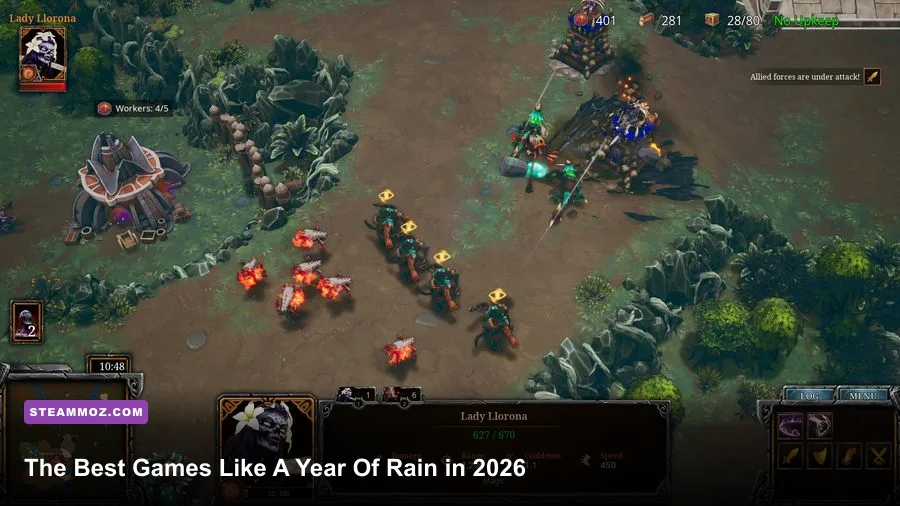
If you miss A Year Of Rain’s mix of fantasy factions, named heroes, settlement building, and campaign-scale battles, start with Warcraft III: Reforged for the closest classic formula, then move to SpellForce 3 Reforced for a deeper modern alternative. Northgard, They Are Billions, and Company of Heroes 3 round out the best games like A Year Of Rain you need to play in 2026, each preserving a different part of Daedalic’s ambitious design.
A Year Of Rain was never simply another base-building RTS. Its identity came from three strongly contrasted factions—the disciplined House Rupah, the desperate Restless Regiment, and the supernatural Restless Dead—plus hero units that gave battles a personal edge. The campaign structure, co-op emphasis, resource economy, and deliberate combat made it feel closer to a modern successor to Warcraft III than to a pure 4X game.
That distinction matters when choosing a replacement. If you want the same fantasy battlefield rhythm, a game like Northgard is only a partial match: its territory system and survival economy are excellent, but its armies and heroes behave very differently. If what you really want is a punishing defensive challenge, They Are Billions is a better fit despite its steampunk setting. Here’s how the strongest alternatives stack up in 2026.
The best A Year Of Rain alternatives ranked
The ranking below prioritizes five things: faction identity, the usefulness of hero or commander units, campaign quality, base-building depth, and whether multiplayer still gives the game a reason to stay installed. I’m also weighing how much each title rewards the same habits A Year Of Rain encouraged—scouting early, protecting production, timing upgrades, and choosing a fight before the enemy chooses one for you.
| Game | Tier | Closest Strength | Best For |
|---|---|---|---|
| Warcraft III: Reforged | S-Tier | Heroes, factions, campaign storytelling | Players chasing the nearest fantasy RTS match |
| SpellForce 3 Reforced | S-Tier | RPG heroes plus large-scale economy | Long campaigns and customizable armies |
| Northgard | A-Tier | Faction asymmetry and strategic expansion | Slower, more economic multiplayer |
| They Are Billions | A-Tier | Base defense and punishing pressure | Solo players who enjoy high-stakes survival |
| Company of Heroes 3 | B-Tier | Tactical positioning and battlefield control | Players willing to leave fantasy behind |
| Age of Empires IV | B-Tier | Factions, tech progression, competitive RTS | Economy-first multiplayer and ranked play |
S-Tier is reserved for games that reproduce the core sensation of building an army around distinct leaders and pushing into an opposing base. A-Tier games capture the pressure or asymmetry but change the pacing. B-Tier picks are still excellent strategy games, yet they require you to accept a major difference in setting, unit control, or campaign structure.
One warning: none of these games is a one-to-one replacement for A Year Of Rain’s exact three-faction setup. That game’s combination of a fixed hero roster, faction campaigns, and traditional resource nodes was unusually specific. The smart approach is to pick the alternative based on the feature you miss most rather than expecting a clone.

🎮 A Year Of Rain
Looking to experience this game? Grab your digital key directly on our store for $1.49.
View on Steammoz Store →Warcraft III is still the closest fantasy successor
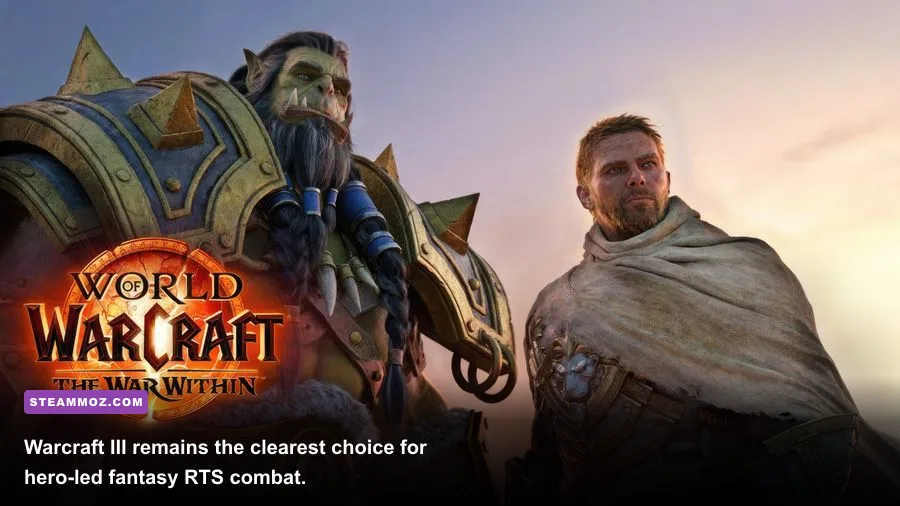
Warcraft III: Reforged remains the obvious recommendation because A Year Of Rain clearly belongs to the same design lineage. You command a compact army, expand through a familiar gold-and-wood economy, clear neutral camps, and rely on heroes whose abilities can swing a battle before raw unit count does. The official Warcraft III site still documents the game’s core factions and campaign legacy.
Its heroes are the difference. The Archmage can open with Blizzard against clustered infantry, summon a Water Elemental to absorb hits, and use Brilliance Aura to improve nearby mana regeneration. The Mountain King is the more direct bruiser: Storm Bolt interrupts a priority target, while Bash and Thunder Clap let him punish groups at close range. Those abilities create the same “protect the centerpiece” tension found in A Year Of Rain’s hero-led engagements.
The basic build order is forgiving but still teaches useful habits. As Human, send five starting Peasants to mine gold, queue two more, build a Farm before the initial food cap, and use the Altar of Kings early enough that your first hero arrives before the opponent’s first serious push. A standard opening reaches a Barracks, then a lumber operation, before adding a second Farm and teching. The exact timing changes with the map, but the priority never does: don’t spend every resource on footmen while your tech and hero experience fall behind.
Neutral creeps also make the map feel alive. Clearing an easy green camp gives experience and sometimes an item, but taking a red camp too early can cost the army you planned to use for the first attack. That risk-and-reward loop is one reason Warcraft III feels closer to A Year Of Rain than Age of Empires IV does.
There are caveats. Reforged’s visual presentation is heavier than the original release, and the remaster’s reputation has never fully recovered from its launch problems. For a smoother competitive experience, use conservative graphics settings, cap the frame rate to your monitor’s refresh rate, and avoid spending performance headroom on shadows when unit readability matters more. Players who want a broader classic-RPG angle should also read Steamoz’s Dungeon Siege retrospective; it scratches a different but related fantasy-progression itch.
SpellForce 3 Reforced goes deeper on heroes and armies
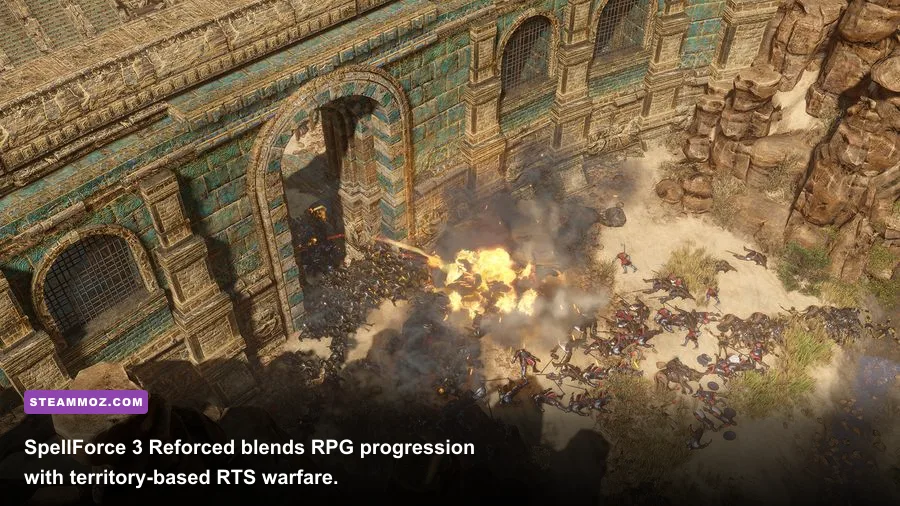
SpellForce 3 Reforced is the strongest recommendation if you liked A Year Of Rain’s campaign ambition but wanted more RPG systems around the battlefield. The game combines a controllable hero party with classic RTS territory management: you recruit workers, establish bases, capture sectors, gather resources, and field armies while your heroes gain levels and select abilities.
The campaign’s protagonist is built through a skill-tree system rather than a fixed Warcraft-style hero class. You can push a character toward melee damage, ranged support, magic, or a hybrid role, while companions add their own combat identities. That flexibility changes how you approach fights. A durable frontline hero can hold a chokepoint while archers focus a dangerous target, or a magic-heavy build can soften a formation before your infantry commits.
Its sector system is the key mechanical difference. Instead of placing buildings anywhere inside a giant construction zone, you expand through connected regions and establish production where the map allows it. This creates meaningful logistics. A forward sector may shorten reinforcement times but become difficult to defend; a safer rear base may keep your economy running while leaving the front line starved of units. A Year Of Rain players who enjoy planning rally routes will appreciate this immediately.
| Priority | Recommended Choice | Why It Works | Common Mistake |
|---|---|---|---|
| Early economy | Secure a second resource sector | Supports both hero upgrades and army production | Overbuilding military units before income scales |
| Frontline | Durable melee hero with control abilities | Creates space for ranged units and casters | Sending the hero ahead of healing or reinforcements |
| Army composition | Infantry screen plus ranged damage | Protects fragile damage dealers during sieges | Mixing every unit type without a clear role |
| Expansion | Capture sectors along a defensible route | Keeps reinforcements and workers safer | Taking isolated territory that cannot be supported |
Reforced is also a better long-form solo recommendation than most entries here. Its campaigns are built around exploration, dialogue, and battles rather than a sequence of disconnected skirmishes. That makes it slower than Warcraft III, but the extra minutes are doing real work: you’re learning the world, developing characters, and deciding where the next economic foothold should go.
For performance, a midrange gaming PC should target 60 frames per second at 1080p with textures on High and shadows on Medium. Large fights can become CPU-limited when several armies collide, so reducing resolution alone won’t always fix stutter. Lower shadow quality first, then effects, and keep unit detail high enough that spell zones remain readable. If your PC struggles with older strategy titles, Steamoz’s PC troubleshooting guide for ELEX has useful general steps for drivers, overlays, and shader-related crashes.
Northgard rewards the patient strategist
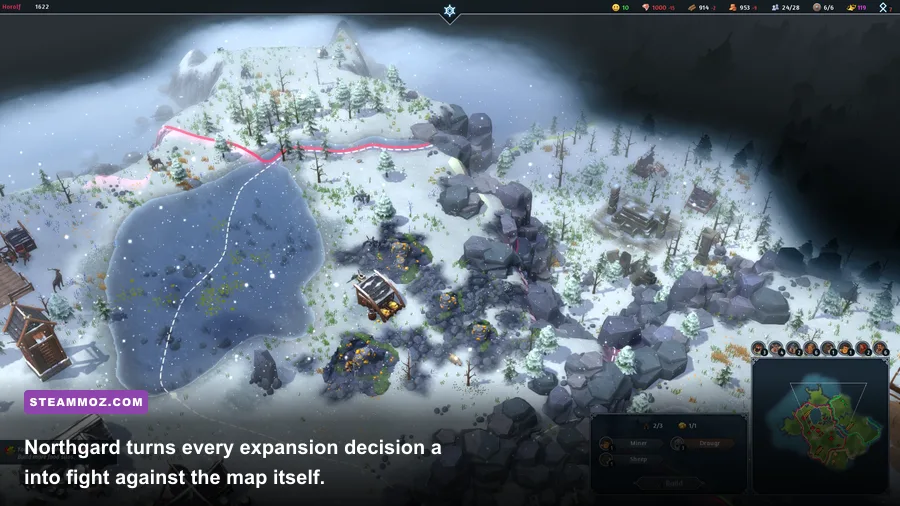
Northgard is not a direct mechanical copy, but it captures A Year Of Rain’s most interesting strategic idea: every faction should force you to rethink the same map. The Viking clans work through territory tiles, limited building slots, seasonal resource pressure, and a winter that can wreck an economy built without a food buffer.
The Clan of the Wolf is a comfortable starting point for aggressive players because its hunting economy supports early military pressure. The Clan of the Raven leans into trade and exploration, while the Clan of the Bear handles winter more comfortably and gives you room to learn the seasonal cycle. These identities are less hero-centric than House Rupah or the Restless Dead, but they’re still substantial enough to change your opening plan.
Your first minutes should be about tile value, not speed-building. Scout for a food source, a forest, and a defensible route toward neutral territory. Claiming a tile adds a recurring food cost, so expanding just because a tile is available can put you into a winter deficit. Build enough food infrastructure to survive the next season, then add military production only when you know which border is likely to matter.
Northgard’s combat is deliberately less granular. You don’t micro every attack animation like Warcraft III; instead, you choose the engagement tile, reinforce it, and use clan bonuses to win the exchange. That makes it excellent for players who enjoy strategic forecasting but less satisfying if your favorite A Year Of Rain moments involved rapidly cycling hero abilities.
Multiplayer is where Northgard earns its place on this list. Matches are readable, faction matchups are meaningful, and victory can come through domination, fame, lore, trade, or a map-specific objective. You’re constantly asking whether to attack an opponent’s food tile, contest a neutral zone, or quietly pursue a non-military win. That broader victory structure gives it more replay value than a campaign-only alternative.
If the economic side of strategy games is what keeps pulling you back, Steamoz’s Empires of the Undergrowth progression guide is worth a look too. It isn’t a fantasy RTS, but its advice on expansion timing and resource efficiency translates surprisingly well.
They Are Billions turns base defense into a nightmare
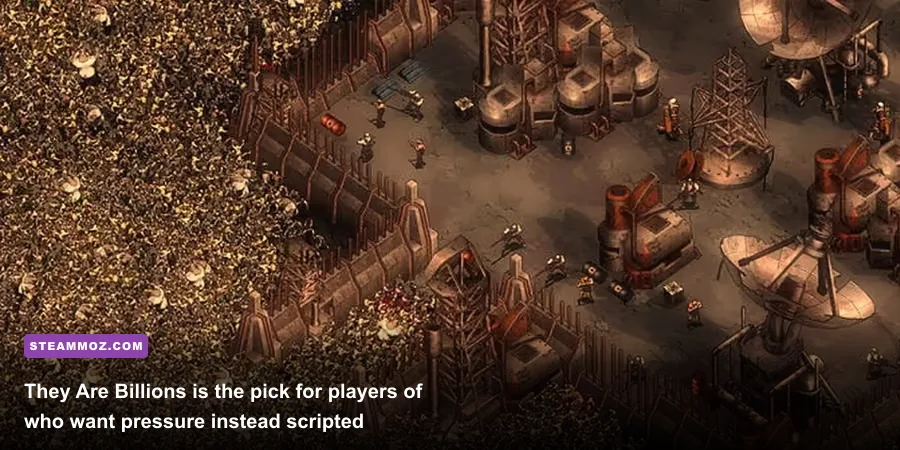
They Are Billions is the best pick for anyone who remembers A Year Of Rain’s defensive missions more fondly than its open-field battles. Its steampunk colonies face infected swarms, and one mistake can turn a secure settlement into a wall-to-wall disaster. The game’s defining rule is simple: a single infected unit reaching a building can create more infected units, which can then overwhelm the entire colony.
That contagion mechanic changes how you build. Early workers should prioritize food and housing, but you also need a wood economy strong enough to produce walls, gates, and defensive towers before the first major wave. A single layer of walls buys time; overlapping towers and a second fallback line buy survival. Don’t put every defender on the outermost wall. If it collapses, you need a second position that is already staffed.
The campaign’s Survival missions also punish greed. Expanding too quickly increases the perimeter you must defend and exposes workers to roaming infected. Expanding too slowly leaves you with weak income and poor firing positions. The practical rhythm is to clear nearby space with Rangers, establish a compact defensive ring, then push outward only after your food and energy budgets can support new housing and military buildings.
| Threat | Telegraph | Counter | Best Tool |
|---|---|---|---|
| Roaming infected group | Slow movement toward noise or buildings | Pull back before the group reaches workers | Rangers for kiting, Soldiers for finishing |
| Fast infected | Rapid approach through an unguarded gap | Keep patrols and a reserve squad nearby | Soldiers and tower fire |
| Large wave | Wave timer and direction marker | Concentrate units, repair walls, close gates | Executors, Thanatos units, layered walls |
| Infected inside the colony | Building or worker suddenly attacked | Pause expansion and eliminate the breach first | Soldiers, Shocking Towers, emergency walls |
The major difference from A Year Of Rain is that They Are Billions rarely gives you a heroic unit who can rescue a bad position. Your army is a system, not a personality. Rangers are excellent for scouting and pulling slow groups, Soldiers deal reliable damage but generate more noise, and advanced defenses become essential once waves grow. A patient player who plans fallback lines will outperform someone with faster mouse control.
For a similar resource-and-pressure mindset in a different genre, check Steamoz’s Dungeons 3 strategy tips. The games aren’t interchangeable, but both reward building a functional system before chasing flashy upgrades.
Company of Heroes 3 is the tactical wildcard
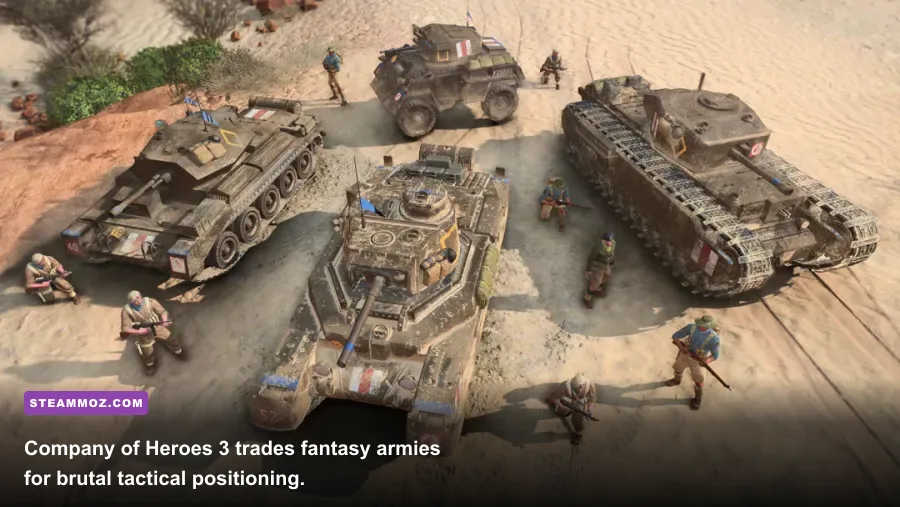
Company of Heroes 3 belongs on this list because it understands that positioning can matter more than production speed. It replaces fantasy heroes with commanders, infantry squads, armor, suppression, cover, and destructible terrain. The result feels very different from A Year Of Rain, but the mental process is familiar: scout a route, identify the opponent’s dangerous unit, and commit only when your army has a positional advantage.
Infantry in cover can survive exchanges that would shred a squad caught in the open. Suppressed units lose combat effectiveness and movement freedom, so machine guns should control approaches rather than sit in the middle of a field. Mortars punish fixed defenses, while tanks can break a line but become vulnerable when they drive past infantry support. The tactical lesson is blunt: never send an expensive unit into an unexplored angle just because the front looks clear.
The Italian Dynamic Campaign adds a layer of operational planning, while the North African Operations campaign delivers more focused missions. Company of Heroes 3’s tactical pauses are especially useful when a battlefield becomes chaotic. Pause, queue movement, rotate a damaged squad, and set a retreat path before resuming. That isn’t cheating or slow play; it’s how you prevent one bad click from erasing ten minutes of careful positioning.
It ranks below Warcraft III and SpellForce 3 because it lacks fantasy heroes, neutral-creep progression, and the same kind of magical faction identity. Still, players who liked controlling a compact force rather than managing hundreds of villagers may find it more immediately satisfying than a traditional base-heavy RTS.
For a competitive alternative with a clearer civilization-and-tech structure, Age of Empires IV is the safer pick. Its Abbasid Dynasty, English, French, and other civilizations offer distinct bonuses, but its battles are more strongly tied to economy, landmarks, and production cycles than to individual commander abilities. That makes it excellent for ranked play, though less similar to A Year Of Rain’s campaign personality.
How to choose your next RTS in 2026
Choose Warcraft III: Reforged if the words “hero unit,” “fantasy campaign,” and “neutral camp” describe exactly what you want. Choose SpellForce 3 Reforced if you want that formula expanded with RPG builds, exploration, and sector-based expansion. Go with Northgard if you prefer deliberate multiplayer where food, winter, and territory are as dangerous as enemy soldiers.
Pick They Are Billions for a solo endurance test. It’s the most stressful game here, but also the one that turns defensive planning into a genuine skill. Pick Company of Heroes 3 if you’re ready to trade spells and undead armies for cover, suppression, and tactical retreats. Finally, choose Age of Empires IV when competitive matchmaking, build orders, and civilization mastery matter more than campaign heroes.
| If You Missed This A Year Of Rain Feature | Play This First | Why |
|---|---|---|
| Named heroes and fantasy campaigns | Warcraft III: Reforged | Its hero abilities and faction stories are the closest match |
| RPG progression inside an RTS | SpellForce 3 Reforced | Custom heroes and companions shape every major battle |
| Faction asymmetry and careful expansion | Northgard | Clans, seasons, and tile costs create long-term decisions |
| Defensive missions under constant pressure | They Are Billions | Walls, noise, and infection make every breach terrifying |
| Small-unit battlefield tactics | Company of Heroes 3 | Cover, suppression, armor, and retreats define each engagement |
| Competitive economy and build orders | Age of Empires IV | Strong matchmaking and clear civilization identities |
My personal order for an A Year Of Rain fan in 2026 is SpellForce 3 Reforced, then Warcraft III: Reforged, followed by Northgard. SpellForce 3 best captures the feeling of leading important characters through a living campaign, while Warcraft III remains unmatched at turning a small hero-led army into a memorable story. Northgard is the long-term multiplayer choice, especially if you enjoy winning through planning rather than constant attacks.
There’s also no reason to stop at one. These games cover different parts of A Year Of Rain’s promise, and that’s the point. One gives you the hero, another gives you the economy, another gives you the survival pressure. If Daedalic’s RTS left you wanting a richer fantasy battlefield in 2026, start with the feature you miss most—and let that decide your next campaign.
For more strategy recommendations, browse Steamoz’s Dungeons 2 weapon tier list and Dungeons 4 hidden-reward guide. For official details, visit the SpellForce 3 Reforced Steam page, the Northgard Steam page, the They Are Billions Steam page, or the official Company of Heroes website.