
Yes, but only at the right price and with realistic expectations. Predator: Hunting Grounds is still worth buying on PC in 2026 if you want a tense asymmetrical shooter, have friends for a Fireteam squad, and can accept a smaller, less predictable player base. It is not a safe recommendation for solo buyers chasing instant matchmaking, a deep single-player campaign, or a polished live-service experience. The core hunt remains fantastic; the surrounding package feels unmistakably like a six-year-old multiplayer game.
This review focuses on the PC version of Predator: Hunting Grounds, rather than Acer Predator gaming laptops or desktops. IllFonic's licensed shooter launched in 2020, moved from the Epic Games Store to Steam in 2021, and has accumulated a substantial roster of Predators, Fireteam classes, weapons, maps, and balance changes. I tested the Steam release with a Ryzen 5 5600X, GeForce RTX 3060 12GB, 16GB DDR4 memory, and Windows 11 at 1080p and 1440p. Your matchmaking results will vary by region and time of day, so treat the performance figures below as a repeatable PC profile, not a promise of identical server populations.
What you actually get in 2026
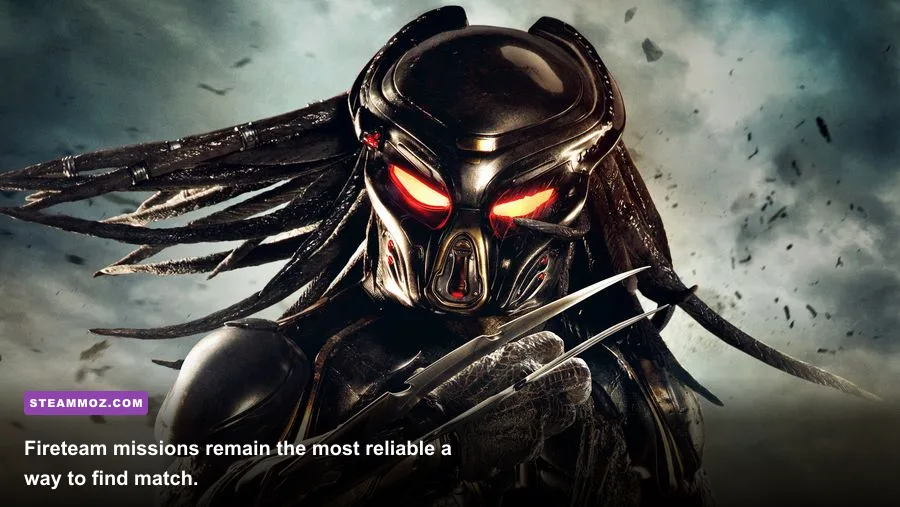
The pitch is beautifully simple: four soldiers complete objectives in a jungle, while one player controls an invisible, heavily armed Yautja hunting them from the canopy. Fireteam players investigate enemy camps, collect intel, destroy equipment, and reach an extraction point. The Predator tracks them using thermal vision, follows sound and muzzle flashes, then decides whether to isolate a target or attack the whole squad.
That formula remains the game's strongest feature because both sides are constantly making imperfect information decisions. The squad hears a branch snap but cannot tell whether it was a teammate, an AI soldier, or the Predator. The hunter sees heat signatures but risks revealing its position by firing the Plasma Caster. A Fireteam that spreads out clears objectives faster but becomes easy prey. A tight group survives longer but gives the Predator one noisy, predictable target.
The official Steam page lists the major PC features and current purchase options, while the official game website remains useful for character and update information. The game is not a campaign shooter like Predator: Concrete Jungle. Its content is built around repeated four-versus-one matches, progression unlocks, and learning player behavior.
| Mode or feature | What it offers | 2026 verdict |
|---|---|---|
| Fireteam | Four players complete missions against AI and a human Predator | Best entry point; fastest way to find practical matches |
| Predator | One player hunts the squad with ranged weapons, mobility, and melee tools | Most distinctive role, but queue times can be less consistent |
| Private matches | Friends can set up custom hunts and practice encounters | Excellent fallback for a regular group |
| Progression | Levels unlock weapons, classes, perks, and Predator equipment | Rewarding early, grindy once the novelty fades |

🎮 FORM
Looking to experience this game? Grab your digital key directly on our store for $14.99.
View on Steammoz Store →How good is the Predator versus Fireteam gameplay?
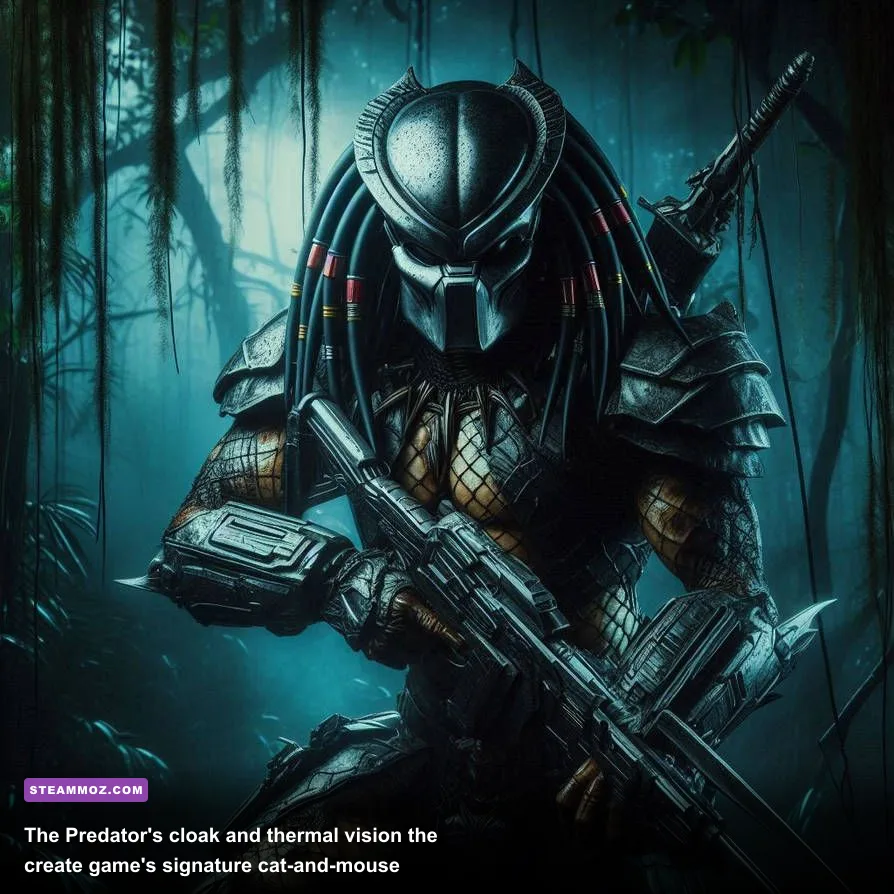
The Predator role is the reason to play this game. You begin with the Jungle Hunter and eventually unlock or access variants such as the Berserker, Alpha, Valkyrie, Emissary, Viking, and Samurai Predators, depending on the edition and progression state. Their differences are not just cosmetic. Health, stamina, gear capacity, movement, and melee emphasis change how aggressively you can approach a squad.
The basic Predator toolkit still feels excellent. Thermal vision identifies warm bodies through foliage. The cloak makes you hard to spot, but it is not true invisibility: movement, mud, water, visual shimmer, and attentive players can expose you. The Plasma Caster rewards patience. Charge a shot while perched above the team, target the medic or rear player, then relocate before the squad triangulates your position. The Smart Disc is powerful in open lanes but demands a clean escape route. The Combistick can punish a separated player, while the wrist blades are devastating only after you have created confusion.
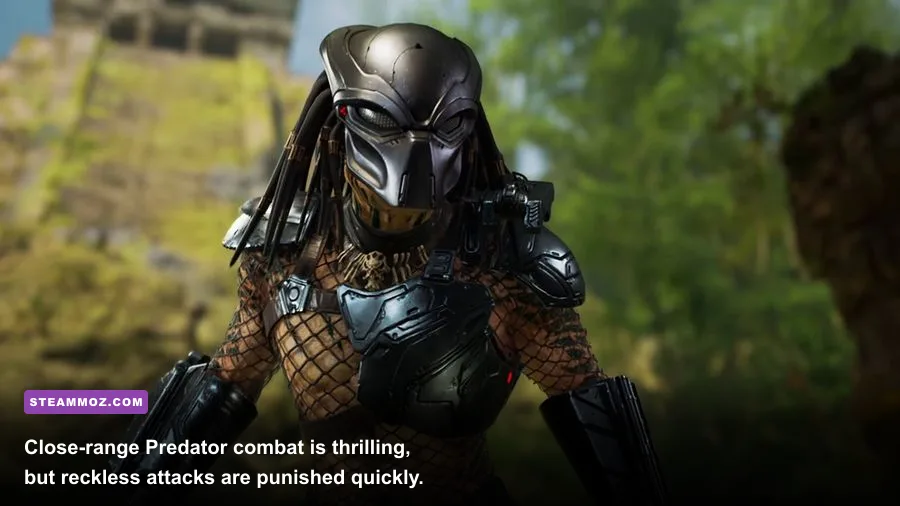
The mistake new Predators make is treating the character like a conventional melee boss. Four guns focused on your red health bar will end a careless ambush rapidly. Your armor can be removed, your mask can be shot off, and a downed Predator can be finished or forced into the self-destruct sequence. The best attacks are short: scout, mark a vulnerable target, deal burst damage, disengage into the canopy, heal, and repeat. Winning is usually about controlling the rhythm rather than chasing an immediate kill.
Fireteam has more tactical depth than its straightforward shooting initially suggests. The Assault class offers better weapon handling and team pressure; Recon favors long-range information and damage; Support brings durability and ammunition; Medic keeps the squad alive through prolonged fights. Weapons such as the M4, AKM, GOSL-R, SAWZ-50, and QR-4 are differentiated enough to support distinct preferences, although the most effective loadout often depends on map sightlines and squad coordination rather than raw damage alone.
AI enemies are useful pressure, not convincing opponents. They occupy compounds, call reinforcements, and force the team to expose itself while completing objectives. They also create the sound and visual clutter that lets a smart Predator attack. If you expect enemy behavior comparable to Hunt: Showdown or Ready or Not, you will be disappointed. If you understand the AI as a distraction system, it works.
| Role | Best strengths | Weakness | Ideal player |
|---|---|---|---|
| Assault | Weapon handling and aggressive objective play | Less forgiving when isolated | Players who lead pushes |
| Recon | Information, range, and target marking | Low tolerance for close combat | Patient shooters and callout leaders |
| Support | Health, ammunition, and defensive presence | Slow movement and a large profile | Squad anchors |
| Medic | Revives and sustained team survival | Becomes a priority target | Players who watch teammates first |
| Predator | Mobility, stealth, burst damage, and map control | Outnumbered and vulnerable after mistakes | Hunters who enjoy mind games |
Maps, progression, and the biggest content problem
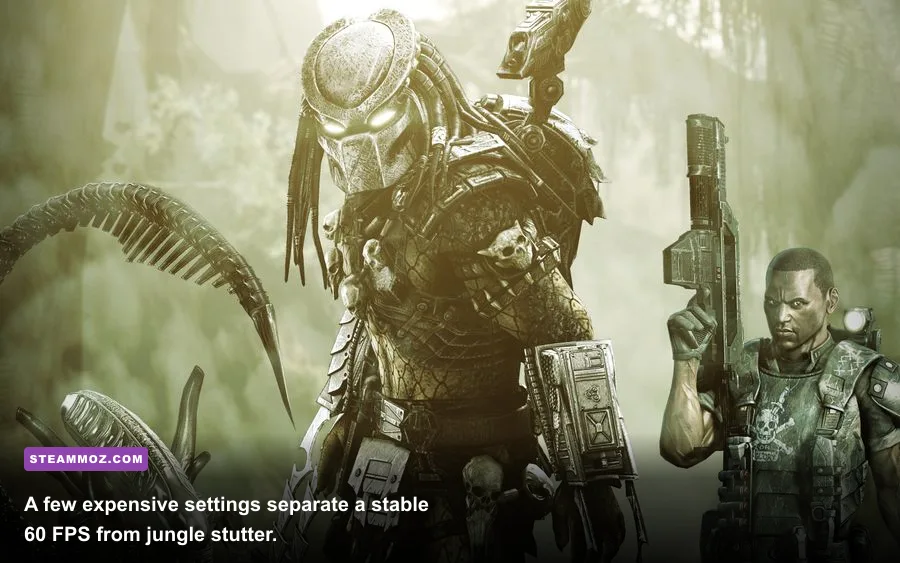
Maps such as Overgrowth, Derailed, Airstrip, Backwater, Excavation, and Headquarters give the hunt different shapes. Dense jungle supports tree movement and ambushes, while industrial spaces produce longer sightlines and more dangerous Fireteam crossfire. The objective chain also shifts from match to match, so the same location rarely plays identically twice.
Still, the content loop has aged. You level classes and weapons, complete missions, earn currency, and unlock additional equipment. Early progression is satisfying because every few matches can add a new tool. Later, the reward cadence feels thinner, particularly if you are mainly chasing cosmetic items. There is no story campaign to break up the repetition, and the AI objectives become familiar quickly.
That makes the player-versus-player hunt carry almost the entire product. With a coordinated squad, it can remain compelling for dozens of hours because human Predators create genuinely different matches. Against inexperienced or disconnected teammates, the Fireteam side can feel like a routine objective run followed by an abrupt ambush. As Predator, you may dominate one match and spend the next one being tracked, stunned, and melted by a coordinated squad.
Steam reviews and community discussions are worth checking before purchase, but don't mistake a broad review score for a live population guarantee. Search times depend heavily on crossplay settings, your region, selected role, and the hour. The developer's Predator: Hunting Grounds page provides the official feature context; it cannot tell you whether your local Predator queue will pop instantly on a Tuesday afternoon.
Crossplay helps keep the ecosystem alive, and that is a major reason the PC version remains viable. The healthiest approach is to queue Fireteam first, keep crossplay enabled, and use Predator as the secondary role. A regular group changes the value proposition completely. Four friends can create their own reliable endgame even when public matchmaking is quiet.
PC performance test and best graphics settings
Predator: Hunting Grounds is built on Unreal Engine 4 and is not particularly demanding by modern PC standards, but the jungle can expose inconsistent frame pacing. Foliage, shadows, effects, and volumetric lighting are the settings that matter most. The difference between a locked 60 FPS and a technically higher but unstable frame rate is noticeable when you are tracking a cloaked Predator through moving leaves.
On my Ryzen 5 5600X and RTX 3060 system, the game held around 92-118 FPS at 1080p on High settings, with dips into the mid-70s during heavy firefights and extraction effects. At 1440p High, the typical range was 72-94 FPS, with lows around 60-66 FPS in the busiest compounds. Epic settings reduced the 1440p average to roughly 58-76 FPS and made foliage look richer without improving target visibility enough to justify the cost.
These figures are most useful as relative guidance. Driver versions, map loading, server behavior, CPU background tasks, and resolution scaling can change the result. Cap the frame rate slightly below your monitor's refresh ceiling if you see uneven delivery. A stable 90 FPS feels better than a fluctuating 110 FPS in this particular game.
| Setting | Recommended value | Estimated FPS impact | Visual note |
|---|---|---|---|
| Resolution | Native 1080p or 1440p | Very high | Use resolution scaling only as a last resort |
| View distance | High | Medium | Important for spotting movement and tree silhouettes |
| Shadows | Medium or High | Medium to high | Epic shadows cost frames without adding much combat clarity |
| Effects | High | Medium | Lower this first if explosions cause stutter |
| Foliage | High | Medium | Epic looks denser but can obscure visual reads |
| Post-processing | Medium | Low | Reduces haze and keeps the image cleaner |
| Motion blur | Off | Negligible | Improves target tracking during quick turns |
| V-sync | Off with VRR; on if tearing persists | Low | Use G-Sync or FreeSync where available |
For a competitive profile, use High textures if your GPU has at least 8GB of VRAM, Medium shadows, High view distance, Medium post-processing, and disabled motion blur. The RTX 3060 handled that profile comfortably at 1440p. Older four-core CPUs may experience more severe minimum-frame drops because firefights combine AI, destruction, players, and effects. If your system struggles, our PC crash and FPS troubleshooting guide covers the general Windows checks that apply here too, including overlays, drivers, and shader-related problems.
The official Epic Games listing is also worth checking if a bundle or discount is cheaper there. Before installing, make sure your storage has room for updates and that your GPU drivers are current. Avoid judging the game from a single first-match hitch; Unreal shader compilation and initial asset streaming can make the first session feel rougher than later matches.
What still frustrates me in 2026
The biggest problem is matchmaking uncertainty. A multiplayer game can be mechanically excellent and still be a poor purchase if you cannot reliably access its best mode. Predator queue times are especially vulnerable because the game needs one hunter and four Fireteam players. Crossplay reduces the pain, but it doesn't erase regional dead periods or uneven role demand.
Balance is another mixed bag. A veteran Predator understands how to use vertical space, healing windows, and ranged harassment. A new player can feel powerless because the game does not clearly teach the importance of relocation and target selection. On the other side, a coordinated Fireteam with good aim can make the Predator feel less like a horror-movie monster and more like a very large health bar. That swing is part of the design, but the learning curve is not especially welcoming.
There are also small technical irritations: occasional animation oddities, muddy foliage at distance, menu friction, and moments when audio positioning fails to communicate exactly where the Predator is. None of these ruins the game alone. Together, they remind you that this is an older licensed multiplayer release rather than a continuously rebuilt flagship shooter.
Don't buy it expecting the long-term support cadence of Dead by Daylight. Its attraction is the licensed fantasy and the match-to-match mind game, not an endless stream of seasonal content. If you want a different science-fiction hunting experience with more solo structure, you may prefer checking our Everspace 2 secrets guide; it is a completely different genre, but offers a more dependable solo loop.
Is Predator: Hunting Grounds worth buying?
At a deep discount, yes. I would recommend it to PC players who love asymmetrical multiplayer, enjoy learning a specialist role, and can play during active hours or bring a squad. The Predator fantasy is unusually well realized: cloak shimmer, thermal vision, tree traversal, the Plasma Caster charge, and the desperate self-destruct countdown all create moments that few other shooters can reproduce.
At full price, my answer is much more conditional. The progression is repetitive, AI opponents are functional rather than clever, and matchmaking is the product's long-term risk. Solo players should expect more frustration than the store screenshots suggest. You are buying a focused multiplayer toy, not a complete Predator adventure.
| Player type | Buy in 2026? | Why | Recommended approach |
|---|---|---|---|
| Predator fan with friends | Yes | Human hunts deliver the fantasy better than most licensed games | Buy a four-player copy during a sale |
| Solo Fireteam player | Maybe | Crossplay helps, but queue and teammate quality vary | Queue during peak evening hours |
| Competitive FPS player | Maybe at a steep discount | Gunplay is solid but not as deep as dedicated esports shooters | Use 1080p or 1440p competitive settings |
| Campaign-only player | No | There is no substantial solo story mode | Choose a narrative Predator game instead |
| New PC gamer on modest hardware | Yes on sale | Scales well with sensible settings | Target a locked 60 FPS first |
My final score for 2026 is 7/10 at the right price. The score is not higher because the game depends so heavily on population, coordination, and tolerance for repetition. It is not lower because the central hunt still works brilliantly. When a Fireteam hears clicking in the trees, loses sight of its medic, and realizes the extraction zone is being watched, Predator: Hunting Grounds can still make a familiar map feel dangerous.
Buy it on sale, keep crossplay enabled, start as Fireteam, and learn the Predator role after you understand the objectives and escape routes. If you have two or three friends ready to play, it remains one of the most entertaining licensed multiplayer experiments on PC. If you're buying alone and need instant matches every night, wait for a free weekend or a major discount before committing.
For more PC performance advice, Steamoz readers can also use our Far Cry 6 graphics settings guide when tuning demanding foliage-heavy games. The lesson applies here too: stable frame pacing, clear visibility, and a responsive mouse matter more than blindly selecting Epic.