
To win more matches in King's Table - The Legend of Ragnarok, stop treating it like a simple Viking chess variant. The reliable beginner plan is to identify your side's objective immediately, keep the king's escape lanes open, create captures with two-sided pressure, and spend every move improving your next threat. The game uses a 9x9 board, so a single blocked file can decide the match; careless movement is punished much faster than beginners expect.
This guide focuses on ten practical habits that make the first hours far less frustrating. If you enjoy learning unusual strategy games, Steamoz's beginner tips for Anachronox are also worth a look, but King's Table demands a much sharper eye for space.
1. Learn Your Side's Win Condition First
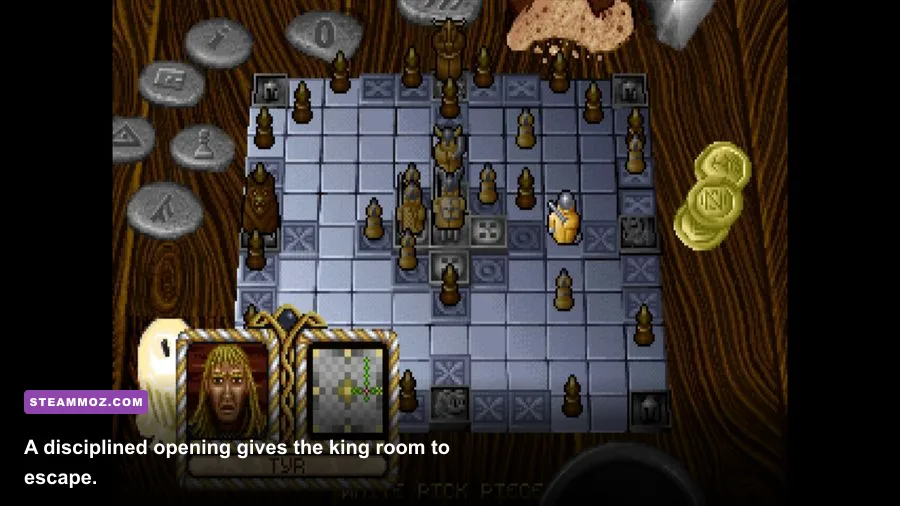
King's Table is built around an asymmetric contest. The king's side is trying to move the king out of danger and toward an escape square or edge, while the opposing force is trying to surround and capture him. That means the same move can be brilliant for one side and disastrous for the other.
Before moving, ask one question: am I creating an escape route or removing one? If you control the attackers, don't chase random defenders. Your real target is the king's mobility. If you control the king's side, don't automatically flee toward the nearest edge. First check whether the destination leaves the king exposed to a capture net on the following turn.

🎮 King's Table - The Legend of Ragnarok
Looking to experience this game? Grab your digital key directly on our store for $0.99.
View on Steammoz Store →2. Count Squares, Not Just Pieces
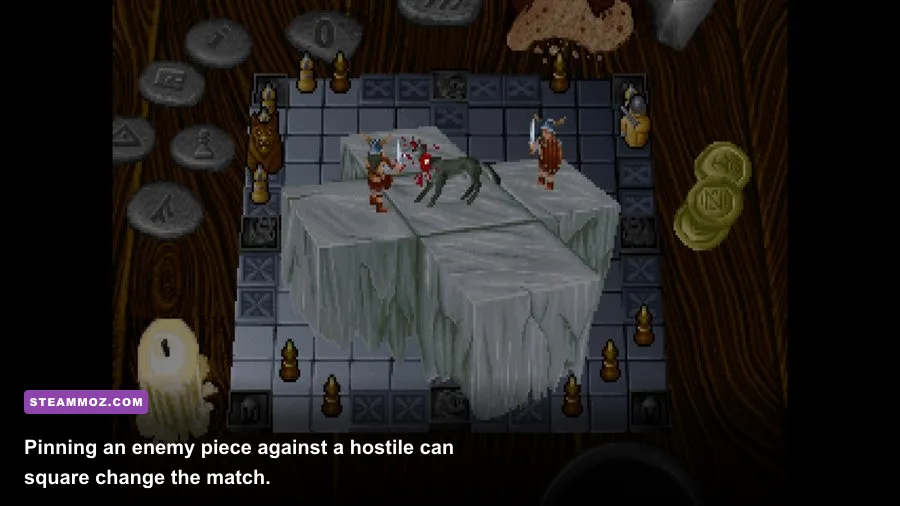
Material is useful, but King's Table is primarily a game of movement. A defender trapped behind the king may have little value, while one piece controlling an open corridor can be worth an entire exchange. On the 9x9 board, count the king's available destinations before and after every move.
A quick beginner exercise is to count three things after each turn: the king's legal exits, the number of enemy pieces attacking those exits, and the number of friendly pieces that can answer a capture. If those numbers get worse, your move probably helped the opponent even if you captured something.
| Board Signal | What It Usually Means | Best Beginner Response |
|---|---|---|
| King has four or more safe routes | The position is flexible | Improve a flank piece before rushing forward |
| King has two safe routes | A funnel is forming | Open one lane or trade the blocking piece |
| King has one safe route | A forced attack is close | Calculate the next two captures immediately |
| King has no safe route | The position may already be lost | Look for a forcing counter-capture, not a quiet move |
3. Don't Empty the Center Too Early
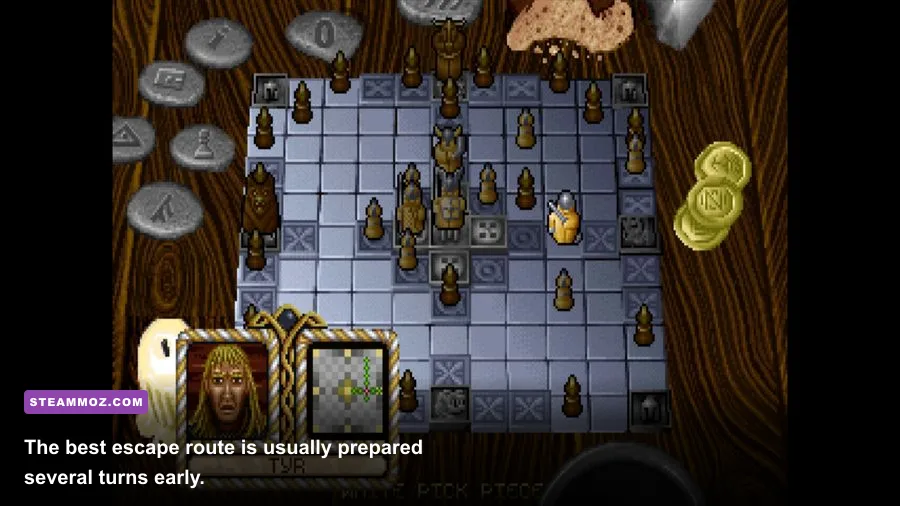
The central area is where the king's side gets its best mobility, but it is also where attackers can build a net. New players often move every central defender away as soon as an edge route appears. That looks active, yet it can leave the king without a protected retreat.
Keep at least one defender capable of moving across the king's rear lane. Your first few turns should normally do three jobs: clear one route, keep another route protected, and force the opponent to react. If you clear all three routes at once, the opponent gets a free choice of attack direction.
Attackers should apply the opposite pressure. Do not rush the closest piece into the center just because it is available. Place pieces where they control exits and prevent defenders from connecting. A quiet move that reduces the king's options from four to three is often stronger than an immediate capture.
4. Use Two-Sided Captures as Your Basic Weapon
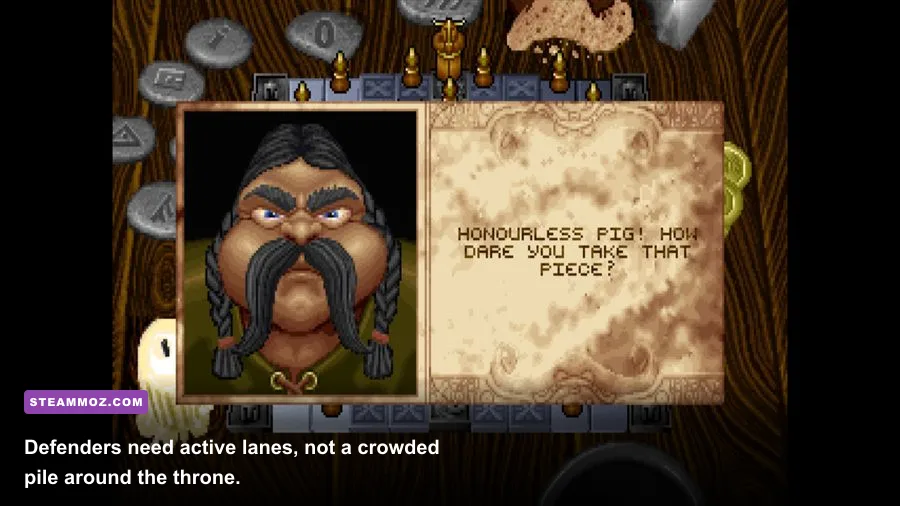
The core capture pattern is simple: a piece is removed when it is bracketed between two hostile pieces or between a hostile piece and a hostile special square, depending on the ruleset and board position. The trap is assuming every apparent capture is safe. In King's Table, moving in for one capture can place your own piece between two defenders on the next turn.
Before every capture, check the landing square. Then check whether the opponent can capture the piece that just moved. Strong players see the exchange one move earlier: they offer a piece on a square that forces the opponent to capture, then use the resulting placement to open a lane or remove a guard.
Pay special attention to edge squares. Edges reduce movement options, making them excellent places to pin attackers, but they can also become dangerous dead ends for defenders. A piece on the edge is only safe if it still has a useful job: blocking, supporting a capture, or protecting the king's route.
5. Build an Escape Route Before You Need It
The king should rarely be the first piece you move toward the edge. Prepare the route with supporting pieces first. A good escape route has a clear destination, a protected intermediate square, and at least one friendly piece that can answer an attack from the side.
Think of the route as a three-turn project. Turn one opens or protects the corridor. Turn two forces the attacker to commit. Turn three moves the king through while the opponent's pieces are badly positioned. If you move the king before creating that sequence, the opponent can often close the corridor with one tempo.
When attacking, reverse the logic. Identify the most attractive escape edge, then occupy or control the squares that lead there. You don't need to surround the king immediately. You need to make every apparently safe route end in a capture threat.
6. Keep Defenders Active Instead of Stacking Them
Four defenders clustered around the king may look reassuring, but a crowded formation can be a liability. Pieces block one another, offer fewer capture angles, and make it easier for the attacker to attack from one side. Aim for a loose defensive ring with at least one open lane.
Assign every defender a role. One should protect the king's immediate route, another should contest the center, and another should threaten a flank capture. If a piece has no role beyond standing next to the king, it is probably misplaced.
This is where King's Table differs from a typical exchange-heavy board game. Trading a defender is not automatically bad. If the trade opens the king's path and removes an attacking anchor, it can be the correct sacrifice. Judge the move by mobility, not by the scoreboard alone.
7. Attack the Formation's Weakest Link
Attackers win by making the king's protection collapse in sequence. Look for a defender that is doing two jobs at once, such as guarding the king while also blocking an attacker. Force that piece to move, and the entire structure may unravel.
A useful approach is to attack from two directions without committing both groups. One wing applies visible pressure while the other controls the retreat. If the defender responds to the visible threat, the second wing advances. If the defender ignores it, the king loses another escape square.
Don't chase a defender that is already moving away from the king. Chase the piece that maintains the formation. This distinction saves turns and prevents the classic beginner mistake of winning material while letting the king sprint to safety.
8. Calculate Forced Sequences Two Moves Deep
King's Table rarely requires a ten-move calculation, but two full turns are non-negotiable. For every aggressive move, identify the opponent's strongest capture, strongest escape, and strongest blocking move. If your plan fails against any one of those, change the move.
Use a simple notation in your head: threat, reply, follow-up. For example, “close the north lane, expect the king to move east, occupy the east support square.” This prevents tunnel vision and makes your attacks deliberate rather than emotional.
| Situation | Calculate First | Common Mistake | Better Choice |
|---|---|---|---|
| King is near an edge | Every legal escape square | Chasing with the nearest attacker | Block the destination before attacking |
| Defender offers a piece | The recapture position | Taking automatically | Take only if the follow-up improves control |
| Two attackers can advance | Which move creates a second threat | Moving both pieces toward the king | Use one to attack and one to seal a lane |
| King has a clear corridor | Whether the corridor is genuinely safe | Moving immediately | Prepare support, then move the king |
9. Treat Time Controls and Practice Differently
New players should learn the board in slower matches before attempting fast games. Time pressure magnifies the same errors: missed capture squares, rushed king moves, and attacks launched without checking the reply. Use relaxed games to memorize patterns, then introduce quicker limits once you can identify threats instantly.
After a loss, review the first turn where your king's mobility dropped sharply. Don't only inspect the final blunder. The decisive error often happened three or four moves earlier when a useful defender was moved without a replacement route.
If you're playing with a controller, test the input layout before a serious match. Steam's official Steam search page and the game's Steam Community results are the safest places to check current updates, control notes, and player discussions.
10. Tune Readability Before Chasing Visuals
A board strategy game doesn't need extreme frame rates, but it does need clean piece recognition. Use the display mode that keeps the board sharp and the cursor responsive. If the game offers camera zoom, choose a level where the king, hostile pieces, and special squares are visible without constant scrolling.
Start with native resolution, fullscreen or borderless fullscreen, and medium shadows. Lower effects first if visual clutter makes pieces harder to distinguish. A steady 60 frames per second is more useful than unstable high performance, especially when animations briefly obscure a capture line.
| Setting | Recommended Starting Value | Performance Impact | Visual Priority |
|---|---|---|---|
| Resolution | Native monitor resolution | High | Keep high for crisp board squares |
| Display Mode | Fullscreen or borderless | Low | Choose the mode with stable input |
| Shadows | Medium | Medium | Lower if pieces become harder to read |
| Effects | Medium | Medium | Reduce visual distractions first |
| Frame Rate Limit | 60 FPS | Low | Prioritize consistency over peaks |
For more PC troubleshooting ideas, Steamoz's guides to smooth PC settings and low FPS fixes cover the same practical performance checks.
The Beginner Routine That Actually Works
Use this routine for your first ten matches: identify the win condition, count the king's exits, preserve one central defender, and refuse any capture you haven't checked two moves ahead. On the attacking side, control the escape edge before surrounding the king. On the defending side, prepare the route before moving the king.
That sounds modest, but it fixes the biggest early mistakes in King's Table - The Legend of Ragnarok. The strongest move is rarely the flashiest one. It is the move that leaves your opponent with fewer useful replies while keeping your own king, formation, and escape plan intact.
For more strategy-focused reading, check Steamoz's Northland starting build guide and Bang-On Balls gear breakdown.