The short version: Sword is the best all-purpose weapon in Iris and the Giant, Bow is the strongest answer to protected or awkward enemies, and Shield is the most valuable defensive equipment for consistent clears. Hammer and Scythe can reach S-tier in the right deck, but they need more deliberate positioning and support. The rankings below focus on reliability, action-point efficiency, enemy coverage, and how well each card survives the game's later encounters.
Iris and the Giant is a deckbuilder where “highest damage” rarely means “best card.” Every turn asks you to read enemy intent, spend a limited number of actions, preserve your combo, and avoid taking damage that permanently chips away at your run. A weapon that looks modest on paper can be excellent if it solves several enemy patterns at once. A spectacular finisher can be a liability if it sits in your hand while a threat is already attacking.
The weapon tier list at a glance

This list ranks weapon families rather than one isolated card roll. Damage values and bonuses can change through upgrades, skills, rarity, and equipment effects, so comparing a basic Sword directly with a late-run upgraded Hammer is misleading. The useful question is how often each weapon gives Iris a clean answer with the action points available that turn.
| Tier | Weapon or Equipment | Why it ranks here | Best role |
|---|---|---|---|
| S-Tier | Sword | Reliable damage, flexible targeting, low setup | Core damage in almost every deck |
| S-Tier | Bow | Excellent reach and strong answers to protected targets | Safe removal and back-row pressure |
| S-Tier | Shield | Prevents damage while preserving future turns | Defensive backbone |
| A-Tier | Hammer | High impact against clustered or durable enemies | Front-line control |
| A-Tier | Scythe | Strong multi-target pressure with the right positioning | Wave clearing |
| A-Tier | Spear | Good reach and efficient lane control | Linear enemy formations |
| B-Tier | Axe | Powerful but less forgiving when targets are spread out | Single-target burst |
| B-Tier | Dagger | Fast and useful early, but struggles to scale alone | Cheap cleanup and combo support |
| B-Tier | Fire-based attacks | Can snowball, but needs timing and complementary effects | Damage-over-time strategies |

🎮 Iris and the Giant
Looking to experience this game? Grab your digital key directly on our store for $3.59.
View on Steammoz Store →Why Sword is the best default weapon
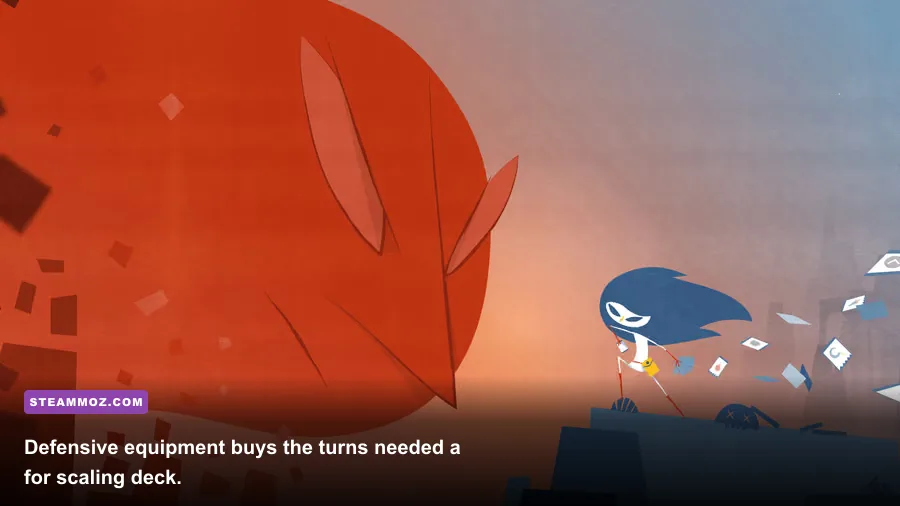
Sword earns the top spot because it asks almost nothing from the rest of your deck. It is dependable at close range, useful against ordinary enemies, and easy to pair with defensive cards. That matters in the first sections, where your deck is still thin and every dead draw hurts. You don't need a perfect setup before Sword starts doing its job.
The best Sword turns usually involve removing the enemy that is closest to attacking, then using any remaining actions to improve your position or maintain a combo. Don't burn every Sword card on the weakest target just because the attack is available. The game rewards preserving a useful hand and controlling the order in which enemies become dangerous.
Sword also benefits heavily from general upgrades. Skills that increase basic damage, improve critical-hit consistency, or reward consecutive attacks all make it better without forcing a narrow build. This is why Sword is a superior first pick when you don't yet know what the upcoming map will offer. It remains useful even after your deck acquires specialized weapons.
Bow and Spear solve positioning problems
Bow is the best weapon when the board makes melee inconvenient. It lets Iris pressure enemies from a safer position and reach targets that would otherwise demand an awkward movement turn. That has a major action-point benefit: a ranged attack can remove a threat without spending one action moving Iris into danger first.
Bow is particularly valuable against enemies protected by front-line bodies. Rather than wasting attacks clearing a path, you can target the dangerous unit behind the screen. It also gives defensive decks a way to keep dealing damage while Shield, Armor, or Dodge effects do the survival work.
Spear is less universally safe than Bow, but it is excellent when enemies line up in predictable lanes. Its value rises when a single attack can affect more than one meaningful target or finish an enemy while setting up the next hit. Spear wants planning: check the attack indicators, identify where enemies will move, and avoid spending it on a target that will naturally walk into a better lane next turn.
Bow and Spear are also strong partners for Sword. Sword handles immediate close threats, while ranged cards prevent the back row from becoming an unmanageable problem. That hybrid plan is usually more stable than committing every card slot to one weapon type.
Hammer and Scythe are powerful but conditional
Hammer belongs in A-tier because its impact is enormous when the board cooperates. It is the weapon to reach for when durable enemies or compact groups are threatening to overwhelm you. The catch is tempo. Hammer's best value often depends on having enemies positioned correctly, and a bad draw can leave you holding a premium card without a clean target.
Use Hammer after reading the entire enemy layout, not as your first reflex. If one target is about to attack and another is harmless for a turn, a cheap Sword hit may be better than forcing Hammer immediately. Save the heavier tool for a line that removes multiple threats or breaks the most dangerous defensive pattern.
Scythe has a similar profile. Its multi-target potential makes it a brilliant wave-clear option, but its value drops sharply when enemies are scattered. Scythe decks should prioritize movement, positioning, and cards that manipulate enemy lanes. When those pieces appear together, Scythe can feel like an S-tier weapon. Without them, it is merely an expensive attack competing for hand space.
Axe is the more straightforward burst option. It is useful against a single high-priority enemy and can finish a target that ordinary attacks leave alive. It ranks below Hammer because it offers fewer answers when the board contains several simultaneous threats. Axe is a good supplement, not usually the foundation of a first clear.
Best equipment for a consistent run
Equipment should be judged by how many future turns it improves, not just by its immediate stat line. Shield is the standout because preventing one hit can preserve your health, your combo, and your ability to choose a better position. In a game where damage taken can make later rooms dramatically harder, that prevention compounds.
Armor is close behind. It is less flexible than Shield when you need to respond to a specific attack, but its passive protection makes ordinary encounters much less expensive. Take Armor early when your deck has reliable damage but lacks a safety net. Take Shield when enemy intent shows a large incoming hit or when your strategy needs one extra turn to assemble a combo.
Helmet and Boots are generally supporting picks rather than automatic priorities. Their value depends on the rest of the deck: a movement-focused build gains more from mobility, while a critical-hit or attack-heavy build may prefer any equipment that improves damage consistency. Amulets and rings can become excellent late picks when their bonuses multiply a clear plan, but don't dilute your deck for a small effect that doesn't solve a current problem.
| Equipment | Tier | What it improves | When to prioritize it |
|---|---|---|---|
| Shield | S-Tier | Immediate survival and turn flexibility | Before difficult rooms or heavy incoming attacks |
| Armor | A-Tier | Reliable passive damage reduction | When your damage deck is already functional |
| Helmet | B-Tier | Build-specific defensive or combat bonuses | When it directly supports your chosen weapon package |
| Boots | B-Tier | Positioning and movement efficiency | For Scythe, Spear, or mobility-focused decks |
| Amulet or Ring | B to A-Tier | Scaling and specialization | After your core damage and defense are secured |
Three weapon packages worth building
Sword, Bow, and Shield: This is the safest all-round package. Sword handles nearby threats, Bow reaches protected enemies, and Shield covers turns where the draw doesn't provide enough damage. It is also the least dependent on a particular map layout, which makes it ideal for learning the game or pushing a new chapter.
Hammer, Sword, and Armor: Choose this when you want a durable front-line deck. Sword removes small targets efficiently, while Hammer waits for a high-value cluster or tough enemy. Armor smooths out mistakes, but you'll need to watch your hand carefully so the deck doesn't become clogged with expensive attacks.
Scythe, Spear, and Boots: This is the technical option. It rewards reading enemy movement and creating lanes where one attack hits several targets. The ceiling is high, especially in rooms with predictable formations, but it is less forgiving if you spend movement actions without a clear payoff.
| Build | Core weapons | Defensive anchor | Main weakness |
|---|---|---|---|
| Balanced control | Sword and Bow | Shield | Less explosive against huge targets |
| Heavy front line | Hammer and Sword | Armor | Can suffer from slow draws |
| Lane clearer | Scythe and Spear | Boots or Shield | Needs precise positioning |
| Single-target burst | Axe and Sword | Armor | Struggles against wide enemy groups |
How to draft and upgrade without ruining the deck
The biggest mistake is taking every weapon that looks strong. A bloated deck lowers the chance of drawing Sword, Bow, or Shield when you need them. Pick a primary damage plan, add one complementary weapon, then prioritize equipment and skills that make those cards more reliable.
Upgrade quality matters more than raw rarity. A stronger version of a card you draw regularly will usually outperform a flashy card that appears once every several turns. Remove or avoid redundant low-impact attacks when the opportunity appears. Your goal is a deck that produces a useful answer every turn, not a museum of every weapon in Iris's arsenal.
Skills such as damage boosts, critical-hit improvements, Dodge, regeneration, and combo-enhancing effects should be selected according to your active package. Don't take a movement skill for a stationary Sword-and-Shield deck just because it sounds powerful. Likewise, a Scythe build should actively seek movement and positioning support instead of hoping raw damage will compensate.
Final ranking and practical verdict
For most players, the winning priority is simple: take Sword when you need a dependable attack, take Bow when positioning is becoming dangerous, and take Shield before the game starts demanding perfect turns. Hammer, Scythe, and Spear are excellent A-tier choices when the board and skill tree support them. Axe and Dagger still have value, especially early, but they need more help to remain competitive deep into a run.
That flexible mindset is the real key to the Iris and the Giant weapon tier list. You aren't chasing one unbeatable card. You're building a compact deck that can answer close threats, distant threats, enemy clusters, and incoming damage without spending more actions than the room allows.
For the official game details and updates, check the Iris and the Giant Steam page, the Lozange Lab developer page, and the official Lozange Lab website. If you enjoy this kind of careful run planning, Steamoz's Fated Souls weapon tier list and Dark Cult of the Dead survival tips are worth bookmarking too.