Yes, Hacknet is absolutely worth playing in 2026—especially if you enjoy immersive sims, puzzle games, or fiction that makes you feel clever rather than merely busy. Its command-line hacking is still satisfying, the campaign remains tightly paced, and the low-spec presentation has aged far better than a lot of mid-2010s 3D games. The catch is that Hacknet is a focused 6–10-hour experience, not a realistic cybersecurity simulator or an endlessly replayable sandbox.
That distinction matters. Hacknet does not teach you how to break into real computers, and it does not pretend that typing commands alone makes you a professional hacker. Instead, it builds a believable fictional operating system around readable commands, escalating puzzles, social engineering, and a story about identity, surveillance, and digital power. In 2026, that focused design feels refreshing.
What Hacknet Actually Is
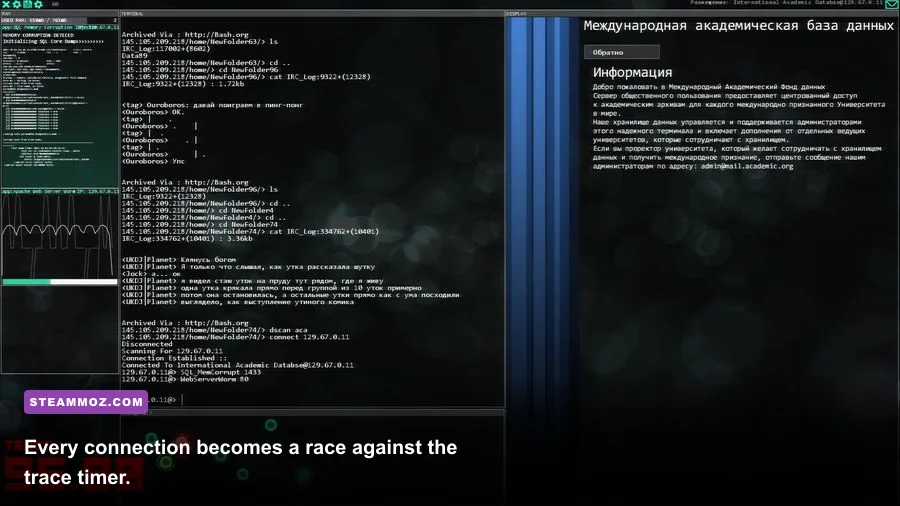
Hacknet is a single-player terminal-based hacking game developed by Team Fractal Alligator and published by Surprise Attack. You play through a series of contracts delivered through an in-game email client, connecting to remote systems, locating files, opening ports, deleting evidence, and following trails left by the missing hacker known as Bit.
The central trick is presentation. You are not selecting “hack computer” from a menu. You type commands into Hacknet’s fictional UNIX-like shell. The game introduces tools such as help, nmap, connect, probe, ports, ssh, scp, ls, cat, rm, dc, and trace as you progress. The commands are simplified for accessibility, but they have enough internal logic to make every success feel earned.
Most missions follow a satisfying loop: scan a target, identify its open ports, bypass security, search the file system, read context clues, and cover your tracks before the trace completes. You are constantly switching between deduction and execution. A mission may tell you to steal a file, but the real puzzle is discovering whether that file sits in a user folder, a hidden server, or a second machine referenced by an email.
That structure makes Hacknet closer to a narrative puzzle game than an open-world hacking simulator. If you want something more systemic and combat-heavy, our strategy recommendations for AI War 2 fans are a better direction. Hacknet is about reading carefully, spotting patterns, and keeping calm when the timer starts screaming.

🎮 Hacknet
Looking to experience this game? Grab your digital key directly on our store for $1.49.
View on Steammoz Store →How the Hacking Mechanics Hold Up
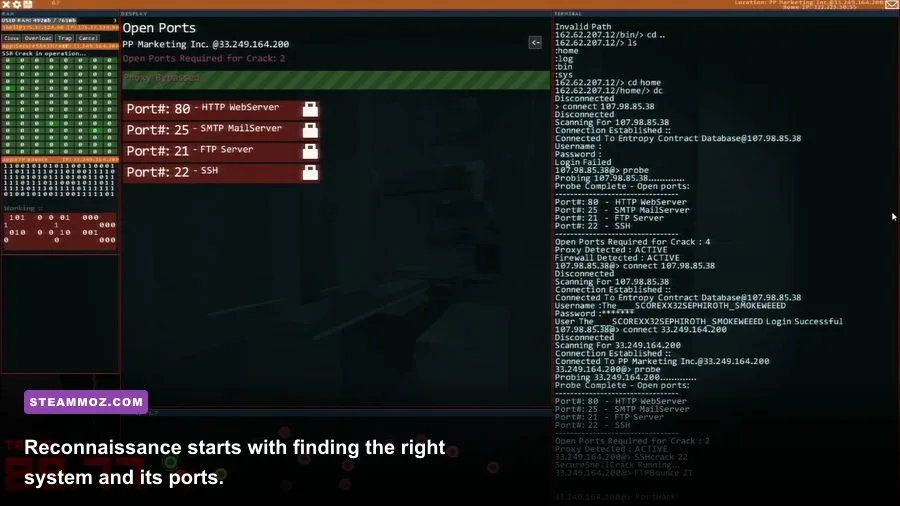
The strongest part of Hacknet is how quickly it turns basic terminal commands into meaningful decisions. The game does not bury you under hundreds of tools. Instead, each command has a clear job and becomes more useful as systems grow more complicated.
Reconnaissance comes first
You typically begin with nmap, which reveals the target’s available ports. A machine might expose FTP, SSH, HTTP, or a custom security service. The ports command helps explain which ports are open, while probe gives you information about a particular service. This creates a small but important reasoning step: you are not just clicking the highlighted solution; you are identifying the attack surface.
Security is a sequence, not a single button
Once you know which services are available, you use tools such as PortHack or SSHcrack to gain access. PortHack is fast but limited by the target’s configuration. SSHcrack and related tools are more specialized, and later missions require you to understand which exploit works against which port. The game rarely demands technical knowledge outside its own vocabulary, but it does demand that you remember what each tool does.
The trace timer creates pressure
Every unauthorized connection risks detection. A trace percentage appears while you are connected, and reaching 100 percent triggers consequences. You can use trace to monitor the countdown and disconnect to leave a system. Later, ProxyBypass and FirewallDisable become vital for delaying or avoiding defensive systems. These are not reflex challenges; they are planning challenges. The best players prepare their route before touching the target.
| Command or Tool | Primary Function | Why It Matters | Common Mistake |
|---|---|---|---|
nmap | Scans a remote system | Reveals available attack paths | Connecting before checking ports |
probe | Inspects a service | Provides useful target information | Ignoring service details |
| PortHack | Bypasses compatible port security | Often opens the first route inside | Assuming every port supports it |
| SSHcrack | Cracks compatible SSH security | Essential for protected remote access | Using it without checking SSH |
dc | Disconnects from a system | Stops an active trace | Staying connected after the objective |
| ProxyBypass | Handles proxy defenses | Creates time for complex intrusions | Saving it until the trace is too high |
The command design is still excellent because Hacknet teaches through friction. You will forget a command, type the wrong path, or connect to the wrong node. Those tiny failures make the interface feel like a place rather than a collection of menus. The game’s best moments happen when you suddenly understand a system’s architecture and execute the entire plan without pausing.
The Campaign and Story Are Better Than Expected
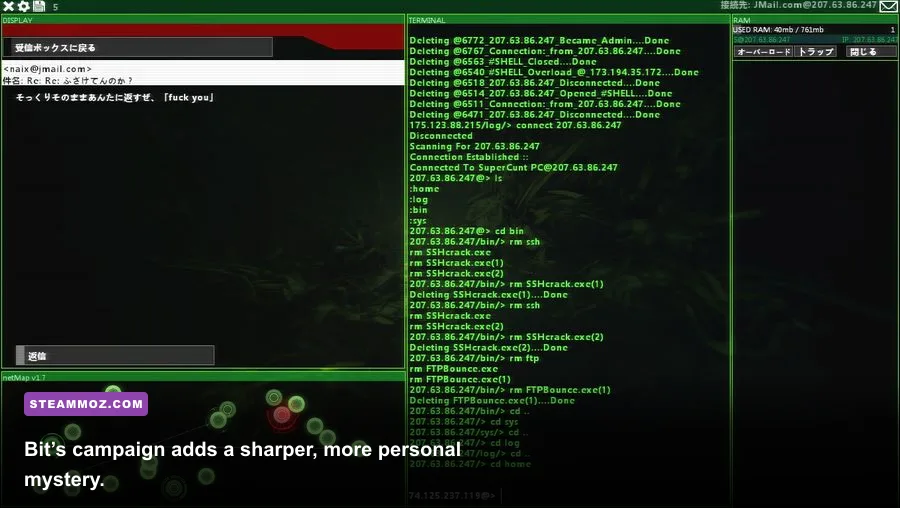
Hacknet’s main campaign begins with a message from Bit, a hacker who apparently died while trying to expose a dangerous security flaw. You are recruited to investigate, and the mission chain gradually connects corporate secrets, activist groups, financial systems, and the larger question of what really happened to Bit.
The story works because it stays embedded in the tools. Emails, logs, file names, server labels, and mission instructions carry the narrative. You do not regularly leave the terminal for lengthy cutscenes. Instead, the fiction arrives as evidence you uncover while working. That makes discoveries feel personal: you read the file because you needed it, not because the game forced a lore dump into the hallway.
There is also a welcome streak of paranoia. Hacknet understands that digital spaces are compelling when they feel occupied. A server directory can suggest a character’s habits. A half-deleted log can reveal an argument. A mission that sounds routine can suddenly expose a much larger operation. The game does not always land every plot beat, and some supporting characters are more functional than memorable, but the mystery gives the mechanics momentum.
After finishing the main story, Labyrinths: Entropy adds another substantial campaign with a different tone and a more experimental mission structure. It is worth buying if the base game clicks with you. Hacknet’s official Steam page lists the base game and its available content, while the Labyrinths: Entropy store page gives the expansion its own details.
Difficulty, Pacing, and Accessibility in 2026

Hacknet starts gently, but its difficulty curve is deliberately uneven. Early contracts teach navigation and file searching. Mid-game jobs introduce proxies, administrative access, large networks, and objectives that require you to move between several machines. The later missions expect you to stop treating every server as a separate puzzle and start thinking in terms of routes, dependencies, and trace management.
The game is forgiving in the right ways. You can usually retry a mission, and failure rarely destroys hours of progress. There is no character-stat system, loot grind, or arbitrary skill tree standing between you and the next tool. Your progression is entirely knowledge-based. When you improve, it is because you understand the game’s language better.
That also creates the biggest accessibility issue: the interface can be intimidating at first. The screen is dense, the text is small on some displays, and a few commands are not obvious until you experiment. Play with a keyboard and mouse if possible. A larger monitor helps, and increasing operating-system scaling can make long sessions more comfortable. Hacknet is not mechanically demanding, but reading terminal output for several hours can still cause eye fatigue.
| Progression Stage | Typical New Idea | Pressure Level | Best Player Habit |
|---|---|---|---|
| Opening contracts | Scanning, connecting, reading files | Low | Use help freely and learn the shell |
| Early investigation | Port-specific tools and basic traces | Moderate | Check ports before launching exploits |
| Mid-campaign | Proxy systems and linked machines | High | Plan the route before connecting |
| Late campaign | Layered objectives and tighter timing | Very high | Disconnect immediately after each task |
| Entropy content | More unusual mission structures | Variable | Read every email and log twice |
One practical warning: do not rush because a mission sounds urgent. Hacknet’s writing creates pressure, but pausing to inspect your notes is usually the correct move. Keep a small list of commands and remember the names of important systems. The game rewards deliberate play much more than frantic typing.
Performance, System Requirements, and Modern PC Play
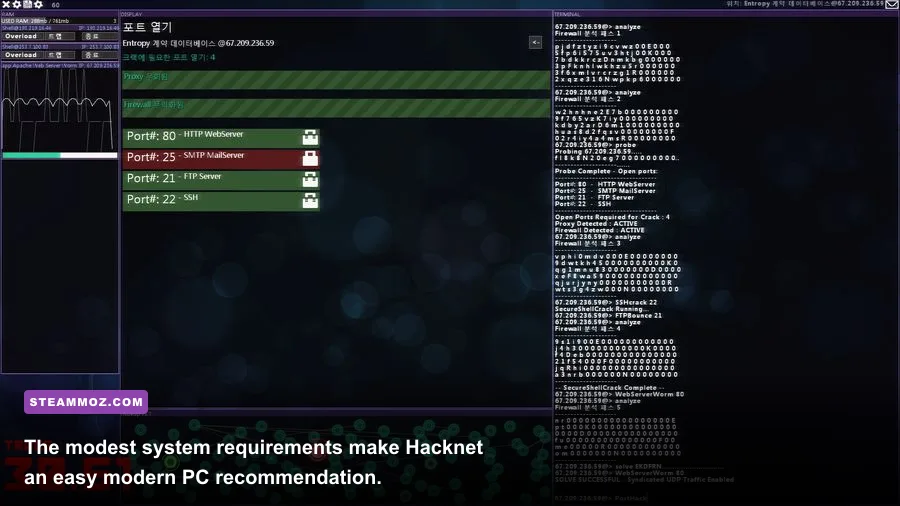
Hacknet is one of the easiest games to run on a current PC. Its official requirements are tiny: the Steam listing names a 1.2 GHz processor, 1 GB of RAM, and roughly 300 MB of available storage for Windows. The game is built around a 2D terminal presentation rather than demanding 3D rendering, so modern hardware has no trouble maintaining a smooth experience.
There are no meaningful ultra-versus-low graphics trade-offs to analyze. You are not gaining competitive advantage by lowering shadows, and there is no ray tracing, texture streaming, or GPU-heavy effects stack. The settings are primarily about display behavior, window mode, and comfort. A stable 60 frames per second is easy for practically any supported machine, though the real bottleneck may be text readability rather than performance.
| Component | Minimum Listed Spec | Recommended in 2026 | Practical Result |
|---|---|---|---|
| Processor | 1.2 GHz CPU | Any modern dual-core CPU | Negligible CPU load |
| Memory | 1 GB RAM | 4 GB RAM or more | Leaves plenty of room for multitasking |
| Storage | About 300 MB | Any SSD with spare space | Near-instant loading |
| Graphics | Basic compatible graphics | Integrated graphics is sufficient | No dedicated GPU required |
| Display | Standard supported resolution | 1080p or larger with readable scaling | Better comfort during long sessions |
For the exact current listing, check the official Hacknet website and Steam’s requirements section before buying on an unusual operating system. If your concern is general PC troubleshooting rather than raw hardware, Steamoz’s guide to crashes, stutter, and low FPS fixes is a useful companion resource, although Hacknet itself is far less demanding than most modern games.
What Hacknet Gets Wrong
Hacknet’s weaknesses are mostly the flip side of its strengths. Its fictional operating system is convincing enough to create immersion, but not deep enough to support endless experimentation. Once you understand the command vocabulary, many missions become variations on scanning, exploiting, searching, and deleting. The story disguises repetition well, but it cannot eliminate it.
The game also has limited replay value. You can revisit missions, try different routes, or hunt for optional material, yet there is no procedural campaign and no competitive layer. A second playthrough is more about appreciating clues than discovering a radically different game. If you need a 100-hour sandbox, Hacknet will feel slight.
Some puzzles are opaque in ways that feel less like clever design and more like interface guesswork. A required file may be hidden behind a naming convention you have not encountered, or an objective may depend on reading a particular email with unusual care. You can solve these moments, but the game occasionally tests patience rather than reasoning.
Finally, Hacknet’s realism is deliberately theatrical. The game borrows the look and vocabulary of actual computing, but its tools are abstractions. That is a feature for most players, not a flaw, but anyone expecting a genuine penetration-testing training program should look elsewhere. Hacknet is closer to a cyberpunk detective story played through a shell.
Is Hacknet Worth Playing in 2026?
Hacknet is worth playing in 2026 if you want a compact, atmospheric puzzle game with unusually tactile storytelling. It remains a great recommendation for players who enjoy Her Story, Uplink, Orwell, The Case of the Golden Idol, or the investigative side of immersive sims. The commands are approachable, the campaign respects your intelligence, and the fictional terminal still produces that rare “I actually did something” rush.
It is less suitable if you dislike reading, want constant action, or expect authentic cybersecurity procedures. The game asks you to spend time inside text logs and system directories. That is the point, but it is also a hard filter. You either enjoy the sound of a successful connection and the sudden appearance of a new file, or you will find the whole experience closer to homework than entertainment.
| Player Type | Verdict | Why |
|---|---|---|
| Narrative puzzle fan | S-Tier recommendation | Strong atmosphere and clues embedded in play |
| Terminal-curious beginner | A-Tier recommendation | Teaches its own readable command system |
| Competitive action player | C-Tier fit | Slow, text-heavy, and almost entirely solo |
| Cybersecurity student | Conditional | Useful fiction and vocabulary, not real training |
| Completionist | A-Tier with Entropy | Extra missions deepen the mystery and mechanics |
My recommendation is simple: buy the base game during a sale, play it with headphones, and resist searching for solutions during the first few contracts. Hacknet is at its best when you make a mistake, learn why it happened, and recover before the trace reaches 100 percent. Add Labyrinths: Entropy afterward if you want more of the same strange, satisfying terminal magic.
Seven years after release, Hacknet still understands a truth many larger games miss: interaction creates immersion faster than spectacle. Give it a keyboard, a quiet evening, and a willingness to read. In 2026, that is still enough to make a fictional computer feel dangerously real.