
Filament doesn’t have character levels, weapons, armor, or a conventional starting build. The best beginner setup is a method: play with a controller or precise mouse input, keep the hint system available, solve the shortest obvious cable route first, and leave any puzzle that starts consuming guesses. That approach lets you learn Filament’s rules without turning the Alabaster into a wall of unsolved boards.
That distinction matters because the phrase “Filament best starting build” can send new players looking for a stat spread that simply doesn’t exist. Beard Envy’s puzzle adventure is built around Juniper, the stranded engineer aboard the Alabaster, and the dozens of cable-routing challenges blocking your progress. Your real progression is knowledge. You unlock access to new areas by understanding puzzle rules, not by grinding experience or buying stronger equipment.
This guide treats “build” as a beginner playstyle: the input setup, solving order, hint discipline, and route through the ship that make the opening hours far less intimidating. It also explains which habits scale into Filament’s hardest chambers, where a single careless assumption can make a board look impossible.
The best beginner build for Filament

Start with a conservative, observation-first setup. Use whichever input device lets you place the cursor accurately, keep the game’s hint tools enabled, and don’t commit to a puzzle until you understand what its endpoints and blocked spaces are asking you to do. This sounds cautious, but it’s actually the fastest route through the game because Filament rarely rewards frantic experimentation.
Your first “stats” should be three habits:
- Observation: identify every cable endpoint, obstacle, loop, and locked target before touching the board.
- Route discipline: build a path in your head from a forced starting point instead of randomly connecting nearby tiles.
- Reset confidence: restart early when a route becomes messy. A clean reset costs seconds; dragging a broken idea across the entire board costs much longer.
There’s no permanent penalty for testing solutions, so beginners shouldn’t fear pressing buttons. The danger is mental clutter. Once you’ve laid several incorrect cables, it becomes easy to mistake an accidental connection for a useful clue. Resetting removes that noise and gives you a clean read of the board.
| Build element | Recommended beginner choice | Why it works | When to change it |
|---|---|---|---|
| Input | Mouse and keyboard or a precise controller | Accurate tile selection prevents accidental turns | Switch if cursor movement causes misinputs |
| Hints | Keep available from the start | Hints teach rules without requiring a walkthrough | Delay them only when practicing deduction |
| Solving order | Forced paths first | Reduces the board before branching choices appear | Use edge routes when the center is ambiguous |
| Session length | Short puzzle batches | Protects concentration and visual memory | Stop immediately when you’re guessing |
If you enjoy games where progression comes from decisions rather than levels, Steamoz’s Deponia progression guide covers a similar idea from a very different angle. Filament is even purer: every upgrade is something you learn.

🎮 Filament
Looking to experience this game? Grab your digital key directly on our store for $3.39.
View on Steammoz Store →How Filament’s cable puzzles actually work
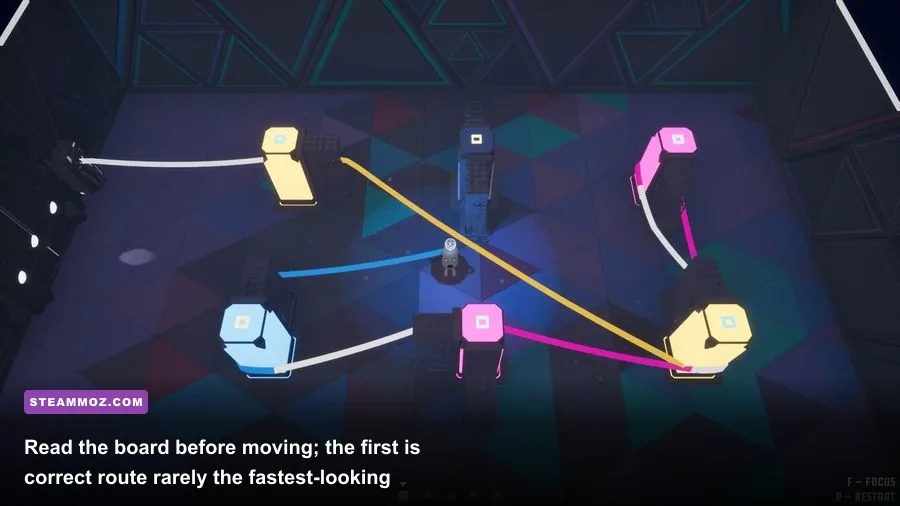
Filament’s central interaction is simple to describe and surprisingly deep to execute. You guide a cable through a grid, turning it around corners and threading it through the available space to satisfy the board’s objectives. The exact visual rules can vary between puzzle families, but the universal challenge is spatial planning: one route often blocks another, and the most direct-looking line may strand the cable before it reaches its target.
Before making a move, scan the board in this order:
- Find the start and endpoint. Trace the cable’s origin and locate the destination it must reach. Don’t assume the nearest glowing tile is the correct target.
- Mark dead ends. A tile with only one practical exit usually creates a forced move. Solve these first because they shrink the number of legal routes.
- Check the walls and blockers. A route that appears open at one angle may be sealed by a barrier or a previously occupied tile.
- Look for crossings and loops. If the puzzle allows the cable to pass around a shape but not through it, plan the whole perimeter before entering the loop.
- Reserve turning space. Don’t consume the only corner needed to bring the final section back toward its target.
The key beginner mistake is solving locally. You see an available turn, take it, and feel progress because the cable has moved closer to a target. Filament wants you to think globally. Ask whether the move preserves a route for the remaining unconnected objectives. If it doesn’t, the move is not progress; it’s delayed failure.
When a puzzle has multiple apparent starts, begin with the most constrained one. A cable trapped against a wall or surrounded by blocked tiles has fewer legal options than a cable in open space. Solving the flexible section first can accidentally remove the only route available to the constrained section.
Skill priorities for your first hours
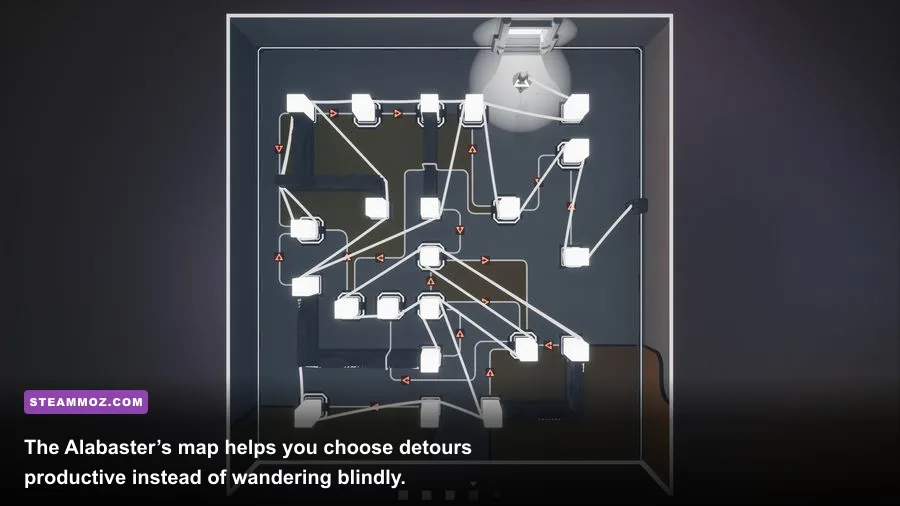
Filament has no skill tree, but a good beginner still has a progression curve. Your first priority is learning to separate rule discovery from solution execution. Early puzzles exist to teach how a mechanic behaves. Once you understand the mechanic, stop treating every later board as a brand-new mystery and search for the same structure at a larger scale.
Priority one: read the board without moving
Take a few seconds to inspect the entire chamber. Identify repeated symbols, colored elements, blocked cells, and any route that looks mandatory. This pause is not wasted time. It prevents the classic Filament trap where an early move looks harmless but permanently consumes the board’s only useful corridor.
Priority two: solve constraints, not decorations
Some visual elements are there to communicate the puzzle rule; others are simply atmosphere. Focus on what restricts movement. A glowing panel may be important, but its position only matters if the cable must reach it, pass around it, or activate it in a particular order. Learn to ask, “What does this object force me to do?” rather than “What does this object look like it wants me to do?”
Priority three: use hints as a learning tool
Using a hint isn’t failure. It’s useful when you’ve spent enough time proving that your current interpretation is wrong. The best moment to ask for help is after you can explain the obstacle but can’t see the next legal move. That way, the hint teaches a rule or route instead of replacing all your thinking.
For a strong practice rhythm, attempt a board unaided, reset once if your route collapses, then use the lightest available assistance. Don’t immediately search for a full solution online. A complete answer may get Juniper through one chamber while teaching you nothing about the next ten.
| Situation | Best response | Reason | Beginner mistake to avoid |
|---|---|---|---|
| One route is forced | Lock it mentally first | Forced segments define the rest of the board | Starting with the open center |
| Two routes look equally possible | Check the final approach | Endgame space often decides the correct branch | Choosing the prettier path |
| Several tiles are occupied | Reset and rescan | Visual clutter hides the original constraints | Continuing from a bad assumption |
| No progress after repeated attempts | Use a hint or leave the puzzle | Fresh context restores pattern recognition | Turning frustration into random moves |
This mindset also pairs well with Steamoz’s Dins Curse survival tips: both games punish panic, though Filament replaces combat pressure with spatial pressure.
The safest route through the Alabaster
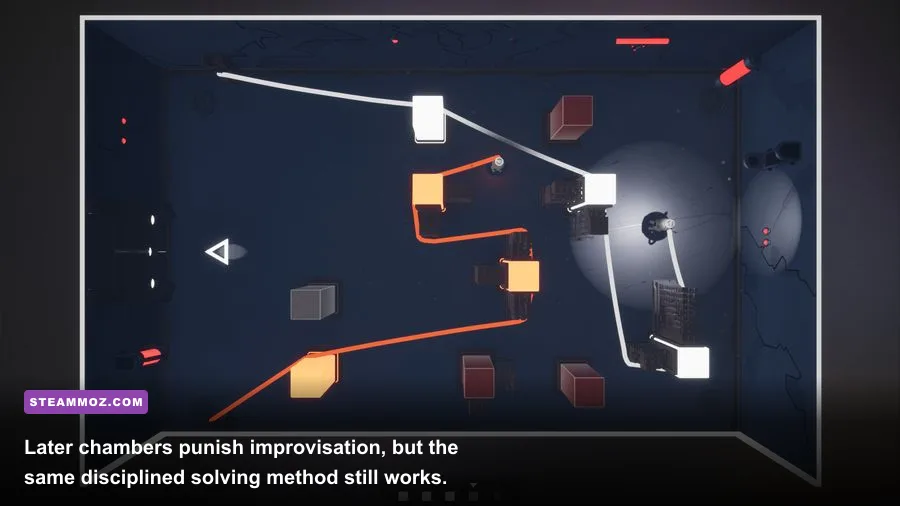
Don’t treat the Alabaster like a linear campaign with one correct hallway. Filament gives you room to explore, and that freedom is part of the design. If a chamber is chewing through your concentration, move elsewhere and return later. The game’s puzzles are often easier after you’ve learned a new visual language in another section.
A productive route has three stages. First, clear the approachable boards near your current access point. These establish the local mechanic and give you a quick confidence boost. Second, sample one harder chamber without demanding a solve. Your goal is to identify what it introduces. Third, return to the medium boards and apply what you’ve learned. That loop is more efficient than forcing the hardest visible puzzle until you’re exhausted.
Keep a tiny notebook or a text file for mechanics that confuse you. Write notes such as “blue cells must remain connected” or “the outer lane is needed for the final turn,” but don’t record complete solutions unless you’re building a personal archive. The act of describing a rule in your own words often reveals the missing step.
Use the map as a planning tool rather than a checklist. If several unsolved rooms cluster together, clear the easiest one first and let its mechanic inform the others. If one room has no obvious relationship to the surrounding area, mark it as a later return. Filament is at its best when you follow curiosity without letting one stubborn board dictate the entire session.
For comparison, Steamoz’s Dungeon Siege retrospective looks at a much more traditional RPG structure. Filament deliberately strips that structure away, so your map knowledge matters more than character power.
Settings, comfort, and performance for puzzle solving
Filament isn’t a demanding action game, so performance tuning is less about competitive frame rates and more about keeping the board readable. A stable presentation helps you distinguish cable segments, endpoints, and subtle blockers. If the image feels soft or the interface is hard to parse, fix that before you blame your solving ability.
| Setting or setup | Recommended value | Gameplay impact | Best use |
|---|---|---|---|
| Display mode | Fullscreen or borderless | Reduces interruptions and focus loss | Long puzzle sessions |
| Resolution | Native monitor resolution | Keeps small grid details sharp | Any desktop or laptop |
| Frame rate | Stable 60 FPS where available | Makes cursor movement feel consistent | Mouse-focused play |
| Brightness | Raise slightly only if blockers blend in | Improves visual separation | Dark rooms or IPS displays |
| Input sensitivity | Comfortable, not maximum | Prevents overshooting tiles | Controller or trackpad use |
| Audio | Keep effects audible | Preserves feedback from interactions | Headphones or quiet rooms |
The important accessibility setting is the one that reduces fatigue for you. Puzzle games expose eye strain quickly because you’re comparing repeating patterns for long stretches. Play at a sensible brightness, sit close enough to see the grid clearly, and take a break after a difficult chamber rather than trying to brute-force it while tired.
On PC, consult the official Filament Steam page for current platform information and updates. The Beard Envy developer site is also the right place to check the studio’s official news rather than relying on outdated forum posts.
Advanced habits that make hard puzzles manageable
Once the introductory puzzles stop feeling mysterious, upgrade your method. The strongest Filament players don’t necessarily visualize every route instantly; they reduce the number of possibilities until only a few remain. You can do the same with three advanced habits.
Work backward from the destination
If the starting area offers too many branches, begin at the endpoint. Ask which tile must connect to it, then which tile can feed that connection, and so on. Backward solving is especially effective when the destination sits in a corner or behind a narrow approach. The ending often has fewer legal routes than the beginning.
Protect bottlenecks
A bottleneck is a corridor, corner, or turning tile required by multiple parts of the solution. Treat it as reserved space until you know which cable needs it. Many failed attempts happen because the player spends a bottleneck on the first route they notice, then discovers that the remaining cable has nowhere to pass.
Separate certainty from possibility
Mentally label moves as forced, likely, or speculative. Commit the forced moves immediately. Test likely moves only after checking their endgame consequences. Treat speculative moves as disposable. This simple classification prevents a common mistake: becoming emotionally attached to a route just because it took time to build.
Filament’s hardest boards can feel like they require supernatural spatial memory, but they’re usually asking for cleaner bookkeeping. Reduce the board, preserve the bottlenecks, and restart before the visual state becomes unreadable. If you follow that process, your “starting build” naturally evolves from cautious beginner to efficient solver without any artificial leveling system.
That’s the real reason Filament remains so satisfying. There’s no overpowered class to unlock and no rare item to farm. The reward is the moment a board that looked tangled suddenly becomes obvious. If you want another Steamoz guide built around choosing a strong opening approach, check out DeltaZeal’s best starting build—then return to the Alabaster and put the more important upgrade to work: better questions.