
The fastest way to survive EVERSPACE 2: Wrath of the Ancients is to treat it like a positioning game, not a pure loot chase. Keep your ship moving, match weapons to enemy resistances, save devices for the dangerous phase of an encounter, and investigate every Ancient site before leaving. These 10 tips cover the mistakes that routinely waste credits, equipment, crafting materials, and lives for new pilots.

1. Finish Your Core Progression Before Chasing Ancient Loot
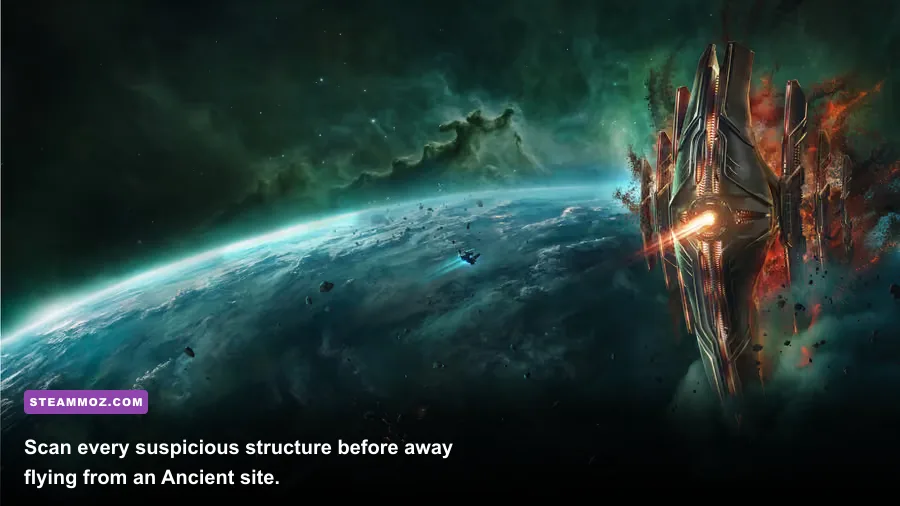
Wrath of the Ancients adds new story content and late-game threats, but it doesn't erase the value of the base campaign's progression. A new character should first unlock the main ship systems, improve the hangar, and build a comfortable supply of credits. The expansion's combat is far less forgiving when you're flying a barely upgraded starter ship with empty device slots.
Follow the main missions through Ceto and Union instead of treating every optional marker as mandatory. Side missions are worthwhile when they unlock vendors, companions, ship services, or repeatable activities, but random distress calls can become expensive detours early on. Your first practical milestone is a ship with a complete primary weapon set, at least two useful devices, and equipment that is close to your current level.
Don't dismantle every old item immediately. Keep one spare weapon of each damage type until you understand the enemies in the new content. The extra cargo space is a small price for avoiding a forced return to a station when a resistance-heavy encounter exposes a hole in your build.
For hidden caches and off-route loot, Steamoz's EVERSPACE 2 secret locations guide is a useful companion. Grab the easy rewards, but don't let completionism drain your repair budget before the next story mission.
🎮 EVERSPACE 2 - Wrath of the Ancients
Looking to experience this game? Grab your digital key directly on our store for $14.99.
View on Steammoz Store →2. Build Around a Job, Not Five Favorite Weapons
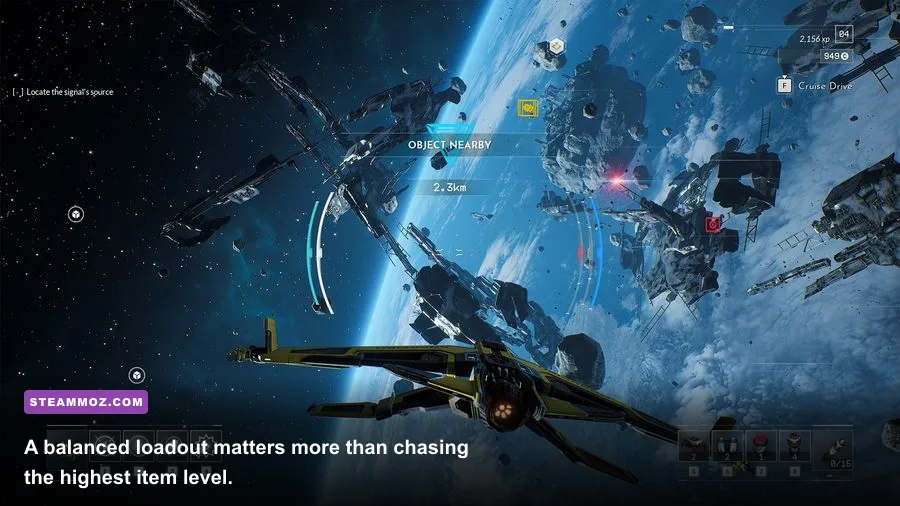
EVERSPACE 2 lets you carry multiple weapon types, but a loadout works best when each slot has a clear purpose. A rapid-fire weapon such as the Pulse Laser is dependable against shields and general targets. The Autocannon delivers strong sustained hull damage but demands closer range and better aim. The Flak Cannon is excellent when agile enemies make precision fire frustrating, while the Gauss Cannon rewards pilots who can hold a firing solution at distance.
For a first Wrath of the Ancients run, use one shield-focused weapon, one hull-focused weapon, and one flexible option. Match the weapon's damage type to the target rather than blindly equipping the item with the largest displayed number. Thermal, kinetic, and energy damage interact differently with enemy defenses, and a lower-level weapon with the right damage profile can outperform a higher-level weapon that is hitting a resistant layer.
Devices should cover an emergency, a damage window, and mobility. Teleporter gives you a panic button and a way to break a bad angle. EMP Generator temporarily disables targets and creates a clean opening for heavy fire. Cruise Mode's boost is also more than a travel tool: it helps you disengage, reset shields, and choose the next approach.
| Loadout Slot | Beginner Choice | What It Solves | When to Replace It |
|---|---|---|---|
| Primary | Pulse Laser | Reliable shield pressure and easy tracking | When a build specializes in close-range hull damage |
| Secondary | Autocannon | Fast hull damage against exposed targets | When range or accuracy becomes a problem |
| Utility | Flak Cannon | Groups of agile ships and drones | When ammunition efficiency matters more than burst |
| Device 1 | EMP Generator | Creates a safe damage window | Against enemies immune to disable effects |
| Device 2 | Teleporter | Escapes traps and bad positioning | Only after you have another dependable escape tool |
This is a starting framework, not a mandatory meta build. If you prefer a Vindicator, Sentinel, or Scout, lean into the ship's strengths rather than trying to make it perform like a different class. A Scout wants range and careful target selection; a Vindicator gets more value from drones, survivability, and sustained engagements.
3. Watch Enemy Defenses Before You Commit

The most common new-player mistake is opening fire before reading the target. Look at the enemy's health bars and status effects, then decide whether to strip shields, break armor, or disrupt a device. A weapon that feels weak is often simply attacking the wrong layer.
Use rapid energy fire to pressure shields, then swap to a hull-oriented weapon once the shield bar collapses. Don't waste a full magazine of kinetic ammunition into a target whose armor is still intact. Conversely, don't keep firing a shield weapon after the blue bar is gone just because it has a comfortable range.
Ancient encounters add another reason to be disciplined: many fights are built around short vulnerability windows. If you spend EMP Generator, Missile Defense System, and your ultimate-style device at the opening, you may have nothing ready when the real attack begins. Start with primary weapons, identify the telegraph, and use cooldowns when they either interrupt danger or multiply damage.
Enemy movement is readable once you stop staring only at the reticle. A sudden lateral drift often precedes a strafing pass; a bright charge effect usually means you should break line of sight or boost away. Turrets and large structures reward a circular approach. Stay mobile, but don't fly in a straight line at maximum speed unless you're deliberately disengaging.
4. Treat Ancient Sites Like Puzzles, Not Arenas
Ancient locations are designed to pull you away from the obvious combat route. Slow down and scan the room before grabbing the first container. Look for movable objects, power nodes, narrow gaps, destructible barriers, and doors that only become useful after you activate a nearby mechanism.
Your ship's tractor beam is one of the most important exploration tools in the game. Use it on glowing interactable objects and loose power cells, then watch how the environment reacts. If a door doesn't open, don't assume the objective is bugged. Check nearby platforms and side chambers for a switch, container, or energy source that needs to be repositioned.
Keep enough cargo capacity for exploration. Ancient areas frequently reward curiosity with equipment, crafting components, and containers that are awkward to revisit. Selling low-value junk at the first station is better than leaving behind a unique upgrade because your cargo hold is full.
Save before entering a clearly staged arena or puzzle room. A manual save lets you test a route without turning one missed jump or wasted device charge into a long trip back. If you're hunting every reward, mark completed locations mentally by their system and sector rather than assuming the map's general icon tells you which container remains.
5. Use Devices in a Deliberate Combat Rotation
New pilots often activate every device the second it becomes available. That feels powerful for five seconds and leaves you helpless for the next thirty. A better rotation is simple: disable, expose, burst, reposition.
Open with EMP Generator when a dangerous elite or drone group enters range. While the target is disabled, use your strongest weapon against the vulnerable defense layer. If several enemies converge, deploy a device that creates space rather than standing still to finish one target. Teleporter is strongest when used before your shields disappear, not after the hull is already burning.
Missile Defense System is another ability worth saving. It can turn a lethal missile pattern into a manageable one, but only if you notice the incoming warning and activate it before the projectiles are at point-blank range. Keep an eye on the combat interface rather than tunnel-visioning on a single boss.
For a simple encounter rhythm, eliminate small support ships first, disable the most dangerous special unit, then focus the main target. Leaving healers, drone producers, or missile platforms alive usually makes the fight harder than attacking the big health bar immediately. The exception is an arena where the main enemy's telegraph becomes more dangerous over time; in that case, use burst windows aggressively and retreat to recharge.
| Combat Problem | Best Response | Why It Works | Common Mistake |
|---|---|---|---|
| Shielded elite | Energy weapon, then hull weapon | Prevents damage being wasted on resistance | Using one weapon for the entire encounter |
| Missile swarm | Missile Defense System and lateral boost | Combines interception with a changed flight path | Boosting in a straight line toward the attacker |
| Close-range rush | EMP Generator, then Teleporter | Stops the first impact and creates distance | Waiting until hull damage has already started |
| Large target with adds | Remove support ships first | Reduces incoming fire and disables | Ignoring drones while chasing damage numbers |
6. Upgrade Equipment by Synergy, Not Item Level
Higher-level gear is tempting, but raw item level doesn't tell the whole story. A weapon with useful modifiers, a matching damage type, and a perk that supports your ship can be more effective than a nominally stronger drop. Compare damage against shields and hull, range, energy consumption, rate of fire, and any bonus that fits your rotation.
Perks are where a build starts feeling intentional. A long-range Scout benefits from accuracy, critical-hit consistency, and bonuses that reward distance. A close-range Gunship wants survivability and sustained weapon output. A Vindicator can turn drone bonuses and cooldown improvements into a steady stream of pressure. Don't spend rare components rerolling every imperfect item; wait until the equipment is close to your current endgame level.
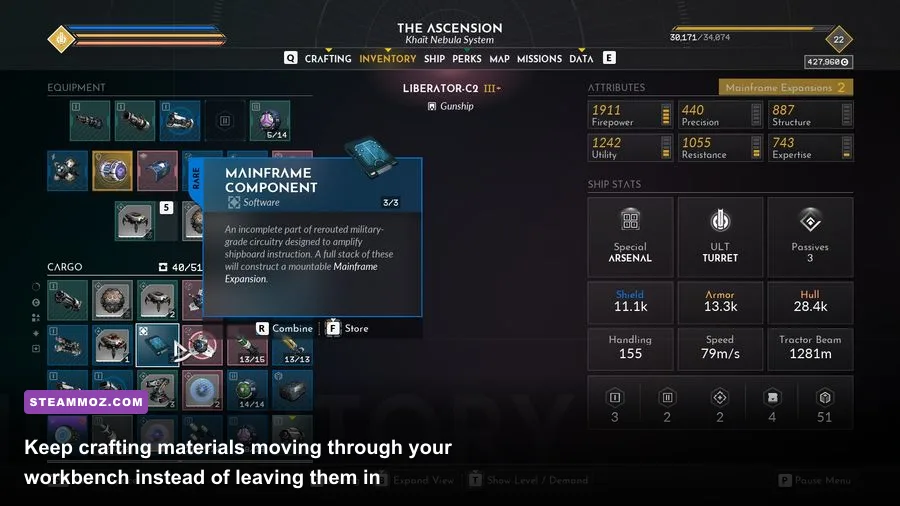
Crafting is most useful when it fixes a specific weakness. Upgrade a weapon that you use in every encounter, improve a device that defines your survival plan, or create a missing damage type before a difficult story mission. Crafting five small upgrades across five temporary items usually gives less value than one meaningful improvement to a core weapon.
Keep a reserve of common materials, but sell excess trade goods when credits are tight. You need money for repairs, ship services, and worthwhile vendor items. Storage is not a trophy cabinet; if an item has a bad perk, the wrong level, and no role in your next build, dismantle it or sell it.
7. Spend Perk Points to Fix Your Actual Weakness
Don't copy a late-game build before you know how you play. Early perk points should make your most frequent loop smoother. If you constantly run out of energy, prioritize energy capacity or regeneration. If your shields collapse during every close pass, choose defensive bonuses or change your approach instead of stacking more damage and hoping the problem disappears.
Companions and perks also reward specialization. Adam's campaign progression opens more options as you complete missions, so revisit available services after major story beats. A perk that looks modest on paper can become excellent when it affects every weapon burst or every device cycle. Conversely, a highly specific bonus may be dead weight if your loadout rarely triggers it.
Use the ship's mobility as a defensive stat. Thrusters, boost capacity, and handling are not luxuries in Wrath of the Ancients. Better movement lets you avoid damage, reach weak points, and disengage without burning a defensive cooldown. A slightly lower damage build that stays on target and survives longer will usually beat a glass cannon that spends half the fight repairing.
8. Manage Fuel, Repair Costs, and Cargo Before Leaving
Before departing a station, repair the ship, refill anything your next mission actually needs, and check cargo space. This sounds basic, but expansion missions can chain exploration and combat in ways that punish pilots who leave with a damaged hull and a full hold.
Don't repair after every tiny scratch if you're safely operating near a station, but never enter a difficult objective with hull damage you can't afford to absorb. Shields regenerate and can be restored through combat tactics; hull damage is a credit problem. If your route crosses several sectors, keep a buffer for repairs rather than spending every credit on a flashy weapon.
Fuel management matters most when you leave the main travel lanes for optional locations. Plan a return path and avoid using travel resources casually while chasing a low-value marker. If the map offers several objectives in one region, group them into a single trip. You will save time, fuel, and unnecessary exposure to random encounters.
9. Tune PC Settings Before Blaming Your Ship
EVERSPACE 2 can look spectacular during large fights, but dense effects and volumetric lighting may create frame-time spikes even when the average FPS looks healthy. On a mid-range PC, start at 1440p or 1080p with textures on High, then reduce expensive effects before lowering texture quality.
Motion blur is the first setting I disable for combat clarity. Reduce volumetric effects, shadows, and reflections if crowded Ancient arenas stutter. Keep texture quality high when your GPU has enough VRAM; dropping textures often makes the image look worse without fixing CPU-side frame pacing. Use a sensible frame cap below your monitor's maximum refresh rate if uncapped FPS causes uneven delivery.
| Setting | Recommended Starting Value | Performance Impact | Visual Trade-Off |
|---|---|---|---|
| Resolution | Native 1080p or 1440p | High | Lowering it is the biggest FPS gain but softens the image |
| Textures | High | Low to medium | Keep high unless VRAM is exhausted |
| Shadows | Medium | Medium to high | Less depth in stations and large wrecks |
| Volumetric Effects | Medium or Low | High in dense scenes | Smoke, haze, and lighting beams look simpler |
| Reflections | Medium | Medium | Surfaces lose some richness |
| Motion Blur | Off | Small | Sharper target tracking |
If you're dealing with crashes rather than low FPS, update your GPU driver, verify the installation, disable unstable overlays, and test without aggressive overclocking. Steamoz's Wrath of the Ancients crashing and FPS fixes covers the troubleshooting sequence in more detail. The official EVERSPACE 2 Steam page is also the right place to confirm current patches and system requirements.
10. Save Before Every Major Ancient Encounter
Manual saves are not cowardice; they're part of the expansion's learning curve. Save before entering a new Ancient structure, before starting a clearly marked boss sequence, and before spending rare materials on a new build. The first attempt teaches you the arena. The second attempt is where your preparation pays off.
On that first attempt, don't chase victory immediately. Watch the boss's attack pattern, identify what creates the vulnerability window, and note whether reinforcements arrive at a health threshold or after a timer. If the arena has cover, use it. If the target has a beam attack, learn the sound and visual cue that comes before the beam instead of reacting only after damage appears.
Keep your escape route visible. Ancient arenas can make you focus on the central target while a wall, gravity field, or group of adds closes behind you. Fight near open space whenever possible, and boost across the arena rather than orbiting directly beside the boss. Your goal is to preserve options: a cooldown, a clear line, and enough distance to choose the next move.
For current patch notes, expansion details, and developer announcements, check ROCKFISH Games' official site and the official EVERSPACE 2 Steam news feed. Balance changes can shift the best perk or weapon choice, but the fundamentals won't change: read the defense layer, control distance, and make every device charge count.
The Short Version for Your First Expansion Run
Start with a stable ship and a mixed weapon loadout. Carry one shield answer, one hull answer, and one tool for agile targets. Use EMP Generator to create openings, Teleporter before disaster rather than after it, and Missile Defense System when the warning appears. Search Ancient sites methodically, leave cargo room for exploration, and spend crafting materials only on gear you expect to keep.
Most importantly, don't measure progress only by damage numbers. A pilot who understands enemy telegraphs, keeps a repair-credit buffer, and arrives with cooldowns ready will outperform a richer pilot who unloads every ability into the first target on screen. Wrath of the Ancients rewards patience, and once the rhythm clicks, its toughest encounters become some of EVERSPACE 2's best fights.