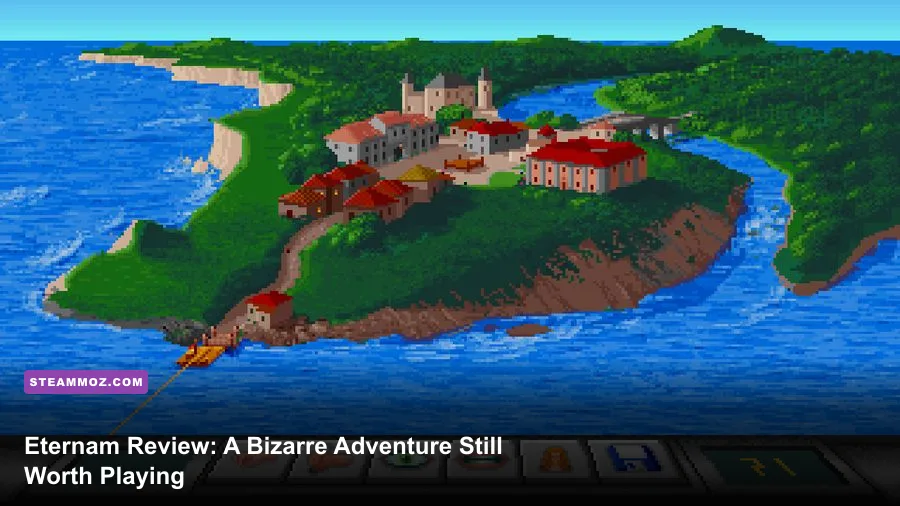
Yes, Eternam is worth playing in 2026—but only if you enjoy abrasive old-school adventure design, surreal comedy, and the occasional puzzle that seems to have been invented during a very long lunch. Delphine Software's 1992 PC adventure is not a lost masterpiece in the tidy, universally enjoyable sense. Its interface is dated, its humor can be painfully juvenile, and its puzzle logic regularly wanders off the map. Yet J.C. Gasser's bizarre journey remains unusually memorable because Eternam commits completely to its own fever dream. If you can tolerate trial and error and run it through a sensible DOS compatibility setup, this is a funny, colorful, historically interesting adventure that deserves more attention than its obscurity suggests.
That recommendation needs a big asterisk. Eternam isn't a modern remaster, isn't balanced around contemporary convenience, and doesn't offer the smooth onboarding you'll find in newer narrative adventures. Think of it as a time capsule from the era when developers threw every visual idea, pun, pop-culture reference, and inventory experiment into one box. Sometimes that box is brilliant. Sometimes it contains a rubber chicken with absolutely no explanation.
What Eternam Actually Is
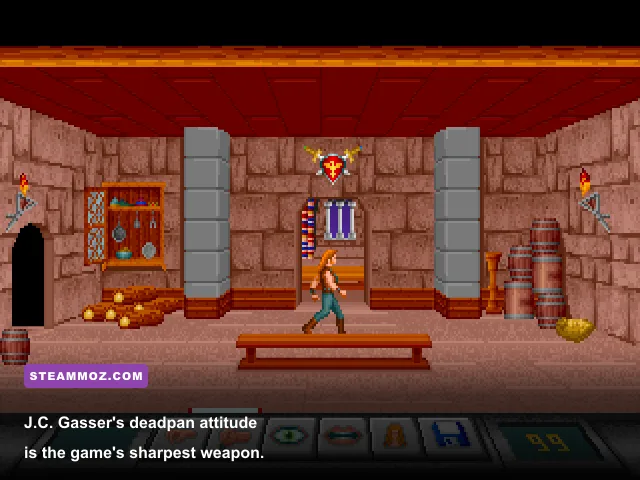
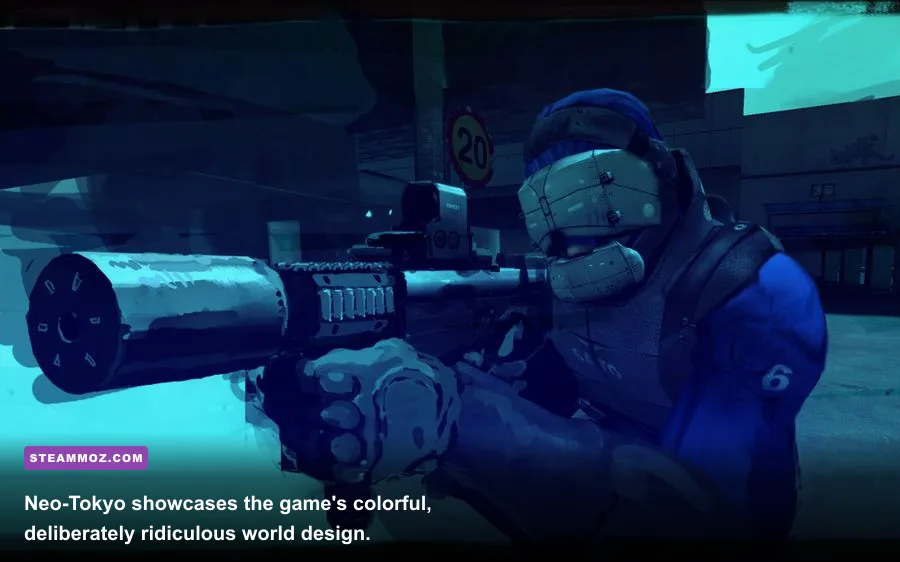
Eternam follows J.C. Gasser, an adventurer who has been away from Earth for an extraordinarily long time and returns to a world that has become a collage of futuristic cities, prehistoric landscapes, fantasy settings, and comic-book absurdity. The premise is deliberately loose because the game cares more about momentum and surprise than clean science-fiction worldbuilding. Gasser moves through locations including Neo-Miami, Dino Island, and Neo-Tokyo, meeting characters who behave as if this impossible mash-up is perfectly normal.
The game's core is classic point-and-click adventure interaction. You explore a screen, talk to characters, collect objects, inspect suspicious scenery, and combine inventory items to remove obstacles. Eternam's presentation is colorful rather than technically lavish: chunky character sprites, bright backdrops, and a visual style that feels closer to an interactive comic strip than a serious role-playing game. There are no skill trees, weapon stats, XP levels, or combat builds to optimize. Your real progression is knowledge.
That distinction matters in 2026. If you're searching for a game with modern progression systems, Eternam has nothing to offer. If you like the satisfaction of realizing that an apparently useless object has a second purpose three screens away, it still has teeth.
| Feature | What Eternam Offers | 2026 Reality Check |
|---|---|---|
| Genre | Comedy point-and-click adventure | Best approached as a historical classic |
| Progression | Inventory, conversations, puzzle knowledge | No levels, stats, or character builds |
| World design | Neo-Miami, Dino Island, Neo-Tokyo, fantasy locations | Imaginative but structurally uneven |
| Combat | Limited adventure-game hazards rather than action combat | Don't expect an arcade or RPG system |
| Playtime | Roughly 10–20 hours depending on hint use and backtracking | Highly variable for first-time players |

🎮 Eternam
Looking to experience this game? Grab your digital key directly on our store for $1.74.
View on Steammoz Store →The Writing Is Wild, Uneven, and Impossible to Ignore
Eternam's strongest quality is its voice. J.C. Gasser is not a blank avatar waiting for you to supply a personality. He's sarcastic, impatient, and frequently aware that the world around him makes no sense. His reactions give the game a consistent comic rhythm, even when the underlying puzzle design loses focus. That makes the long walks and repeated conversations more tolerable than they would be in a quieter adventure.
The comedy draws from slapstick, parody, anachronism, and the anything-goes sensibility of early-1990s PC games. Neo-Miami's futuristic imagery can sit beside prehistoric gags; a supposedly dramatic fantasy encounter may end with a joke that detonates the scene's tension. Some of this lands surprisingly well because the art and dialogue are committed to the same ridiculous premise. Some jokes have aged badly. Others simply aren't jokes anymore unless you are fascinated by the era's idea of edgy humor.
This is where your mileage will vary more than with almost any technical issue. Players who enjoy the grim but highly focused stealth writing of Desperados III may find Eternam scattered and noisy. Players who enjoy games that lean into deliberate weirdness will probably forgive a lot. The writing has personality, and personality is exactly what many anonymous retro adventures lack.
Why the setting still works
Eternam doesn't build a coherent world in the modern sense. It builds a sequence of comic set pieces. The reward isn't learning the geopolitical history of Gasser's universe; it's seeing what strange visual idea appears after the next transition. That structure makes the game feel closer to a road trip through a developer's imagination than a plotted epic.
Puzzles Are the Make-or-Break Problem
The puzzles are where Eternam earns both its cult reputation and its warnings. The game expects you to test objects aggressively, revisit earlier screens, and accept that a solution may depend on a tiny conversational detail rather than an obvious visual clue. There is little modern signposting. A character's throwaway line can be the key, while a glowing object may be pure decoration.
The biggest issue isn't difficulty by itself. Hard puzzles can be satisfying. Eternam's problem is inconsistent logic. Some solutions follow a fair chain of observation and experimentation. Others feel like the designer has assumed you'll try every inventory item on every hotspot. The game also enjoys making you carry objects for long stretches, so inventory management becomes part of the challenge even though the interface does not make that process especially friendly.
My practical advice is to keep a written notebook. Record every character's requests, every locked door, and every object that produces a suspicious response. Don't immediately brute-force every puzzle with a walkthrough, because the best moments come from connecting clues yourself. But don't treat outside help as failure. Eternam was built for a world of printed hints, magazines, and friends shouting solutions across a room.
| Puzzle Situation | Common Trap | Better Method | When to Use a Hint |
|---|---|---|---|
| New location | Leaving before inspecting every hotspot | Talk twice and examine unusual scenery | After exhausting visible dialogue |
| Inventory obstacle | Assuming the newest item is the solution | Test older objects and note alternate responses | When three or more combinations fail |
| Locked route | Searching only the immediate screen | Revisit prior areas for a missing conversation | When the route has no visual clue |
| Recurring character | Ignoring changed dialogue | Return after major item or area progress | When dialogue repeats without variation |
That advice also applies to other classic adventures, including Deponia's progression puzzles, though Deponia is substantially more polished and readable by modern standards.
How It Feels to Play on a Modern PC
Hardware is not the obstacle. Eternam is a DOS-era game, so the real challenge is getting a stable, comfortable presentation. A virtual machine or DOSBox build can handle the original program easily, but configuration quality matters. You'll want proper scaling, a responsive keyboard layout, and frequent saves. The original low-resolution presentation can look wonderfully crisp with integer scaling, while aggressive smoothing turns the art into a muddy smear.
There is no meaningful frame-rate tuning in the modern PC-gaming sense. Eternam's performance depends more on emulation timing and input behavior than on your graphics card. Keep the emulated CPU conservative if animations or text advance too quickly, and avoid assuming that a faster host machine automatically improves compatibility. Old software often cares more about timing than raw horsepower.
| Setup Choice | Recommended Value | Performance Impact | Visual or Control Note |
|---|---|---|---|
| Display scaling | Integer scaling | Negligible | Keeps pixel edges clean |
| Aspect ratio | Original ratio | Negligible | Avoids stretched character art |
| Filtering | Nearest-neighbor | Negligible | Sharper than bilinear filtering |
| Emulation speed | Default or conservative cycle setting | Stability-focused | Prevents rushed animation and text |
| Save strategy | Several rotating save slots | No FPS impact | Protects against missed items and dead ends |
For a clean starting point, consult the official DOSBox site and the ScummVM compatibility database before downloading a random preconfigured package. The Steam client itself is not evidence that Eternam has a current native Steam release, so check the storefront listing carefully rather than trusting an old search result.
What Has Aged Well—and What Hasn't

The visual identity has aged better than the interface. Eternam's environments are busy, but that busyness gives them character. Neo-Miami feels like a deliberately overdecorated future, while Dino Island provides a sharp tonal shift instead of recycling the same background language. Character designs are expressive enough that Gasser's reactions remain readable even when the text is doing most of the comedic work.
The controls are less forgiving. Classic point-and-click interfaces can make basic actions feel like negotiations. You may need to select the right verb, target the precise part of an object, or repeat an interaction after the game has updated its internal state. Modern players used to contextual interaction will need patience. The lack of quality-of-life features—clear objective tracking, generous hint systems, automatic dialogue history, and convenient backtracking—creates friction before the actual puzzle begins.
Audio is similarly period-specific. Expect functional effects and an old computer-game atmosphere rather than a sweeping cinematic score. That isn't a deal-breaker, but it means the game's personality comes primarily from its art, dialogue, and strange situations.
Who Should Play Eternam in 2026?
Eternam makes sense for a specific audience. If you've already enjoyed classic adventure games and want something less familiar than the usual LucasArts recommendations, this is a compelling excavation. It also suits players interested in Delphine Software's design history and the experimental tone of European PC games from the early 1990s. The game is short enough to sample, distinctive enough to remember, and flawed enough to generate conversation.
It is a weaker recommendation for newcomers who want their first adventure game to demonstrate the genre at its most welcoming. Start with something more readable, then come back when you understand how older titles hide information in dialogue, scenery, and item reactions. The same principle applies to older RPGs such as Dungeon Siege: historical importance doesn't automatically erase dated design.
| Player Type | Verdict | Why |
|---|---|---|
| Retro adventure veteran | Strong Buy or Play | The odd setting and comedy are worth the puzzle friction |
| First-time adventure player | Conditional | Start with a more forgiving modern classic |
| Story-focused gamer | Maybe | Great personality, loose plotting, uneven jokes |
| Puzzle completionist | Conditional | Memorable solutions, but inconsistent logic |
| Action gamer seeking combat | Skip | There is no meaningful action or build system |
If you're already comparing it with newer strange adventures, our coverage of Don't Be Afraid 2 shows how much modern horror-adventure design has changed in terms of pacing and guidance. Eternam is a different beast: more colorful, more comic, and much less interested in explaining itself.
Final Verdict: Worth Playing, With Patience
Eternam is worth playing in 2026 because it has something better than polish: a recognizable personality. J.C. Gasser's trip through Neo-Miami, Dino Island, Neo-Tokyo, and the game's other genre collisions is messy, funny, occasionally irritating, and unlike most adventure games you'll play today. Its puzzles can be unfair, its interface demands old-school tolerance, and several jokes have not survived the journey intact.
Still, writing off Eternam as merely obsolete would miss the point. This is a compact artifact of a period when adventure games could be gloriously strange without worrying about franchise consistency or onboarding metrics. Use DOSBox, save often, keep notes, and allow yourself a walkthrough when the logic stops being fun. With those concessions, Eternam becomes a rewarding weekend trip into a very peculiar corner of PC gaming history.
Steamoz verdict: 7/10. Play it for the imagination, the visual variety, and J.C. Gasser's wonderfully irritating charm. Skip it if you need fair puzzle logic, modern controls, or a game that respects your time at every turn.