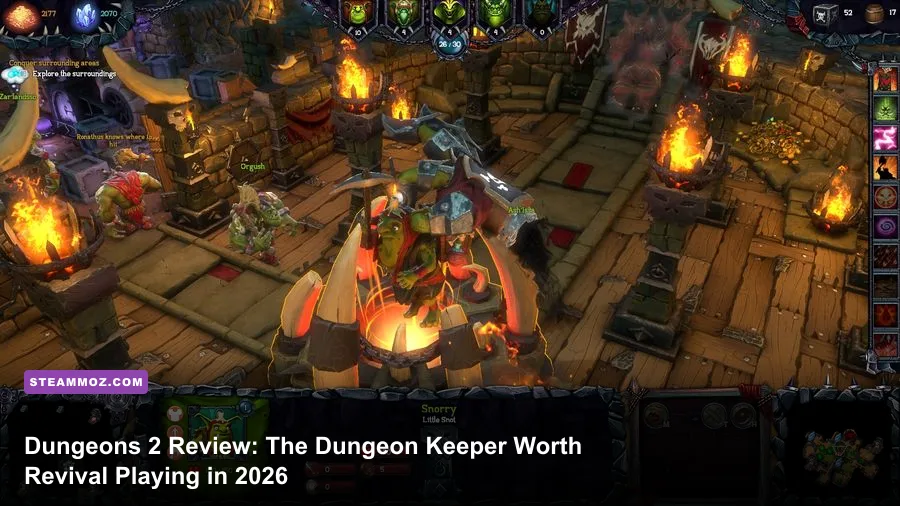
Dungeons 2 is still worth playing in 2026 if you want a compact, funny dungeon-management strategy game with real-time combat, but it isn't a perfect Dungeon Keeper substitute. Its best ideas remain sharp: carving rooms into the earth, hiring specialized minions, laying traps for invading heroes, and switching between underground management and overworld warfare. The rough edges are just as familiar, though. The AI can be clumsy, the interface feels dated, and the tactical layer never reaches the depth of its dungeon-building half. At its current PC price, especially during a Steam sale, Dungeons 2 is an easy recommendation for strategy fans. At full price, it's a more conditional buy.
That verdict matters because Dungeons 2 occupies a very specific niche. This is not a modern city builder, not a pure real-time strategy game, and not a heroic fantasy campaign where you save the kingdom. You play the Dungeon Lord, an over-the-top villain whose goal is to conquer the overworld and crush the forces of good. The game is deliberately cheeky, borrowing the tone and management structure of classic evil-lair games while adding controllable armies and a story campaign.
What Dungeons 2 Actually Does Well
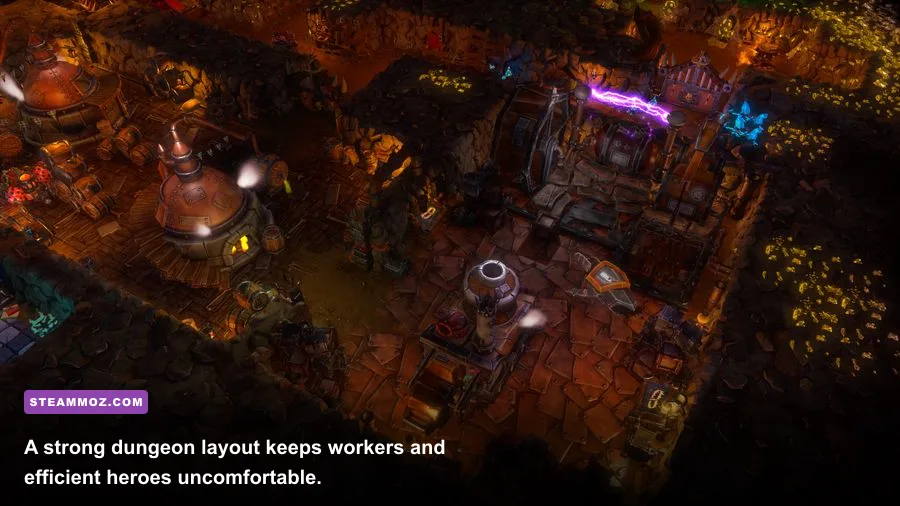
Dungeons 2's underground layer is the reason to play it. You begin with a Dungeon Heart, a limited amount of territory, and a handful of workers. From there, you dig tunnels, uncover gold seams, secure mana, and place rooms that turn a hole in the ground into a functioning fortress. The basic loop is wonderfully readable: expand, gather, research, recruit, defend, then expand again.
Room placement has practical consequences rather than being purely decorative. The Treasury stores gold, the Library generates research, the Workshop lets Goblins produce traps, and the Prison holds captured heroes for later use. A well-planned corridor between your Heart, resource rooms, and defensive chambers means minions spend less time wandering and more time doing useful work. That sounds simple, but the difference between a compact, connected base and a sprawling maze becomes obvious once enemy raids begin.
The game also understands that an evil dungeon should have personality. Torture Chambers process prisoners, Taverns keep certain minions occupied, and rooms visually evolve as you invest in them. The humor is broad, frequently fourth-wall-breaking, and unmistakably inspired by the old Dungeon Keeper school of design. It won't land for everyone, but it gives the campaign a lighter rhythm than the grim fantasy setting suggests.
There is a satisfying physicality to interacting with the dungeon, too. The Dungeon Lord can possess minions directly, letting you take control of a unit instead of merely watching the battle from above. Possession is most useful for positioning, triggering abilities, or breaking through a dangerous target before returning to management mode. It isn't a full character-action system, but it adds just enough hands-on control to prevent the game from feeling like a passive spreadsheet.
The campaign is also structured well for modern players with limited time. The main story is divided into missions with clear objectives, new rooms, and faction unlocks arriving at a steady pace. You aren't asked to manage a giant empire for dozens of hours before seeing a new mechanic. The result is a game that feels brisk, even when individual missions become chaotic.
A familiar formula with its own personality
Players coming from A Year of Rain or other classic PC strategy games will recognize the appeal immediately: readable objectives, resource bottlenecks, and constant pressure to make the next expansion pay for itself. Dungeons 2 is less granular than a serious competitive RTS, but it has stronger character than many mechanically cleaner strategy games.
| Core System | What You Manage | Why It Matters |
|---|---|---|
| Dungeon construction | Tunnels, rooms, chokepoints | Controls minion efficiency and enemy access |
| Resources | Gold, mana, research | Funds rooms, units, upgrades, and traps |
| Minion roster | Horde, demons, undead | Determines combat roles and available tools |
| Hero defense | Traps, guards, torture, patrols | Stops raids before they reach the Dungeon Heart |

🎮 Dungeons 2
Looking to experience this game? Grab your digital key directly on our store for $4.99.
View on Steammoz Store →Dungeon Building, Traps, and Hero Raids
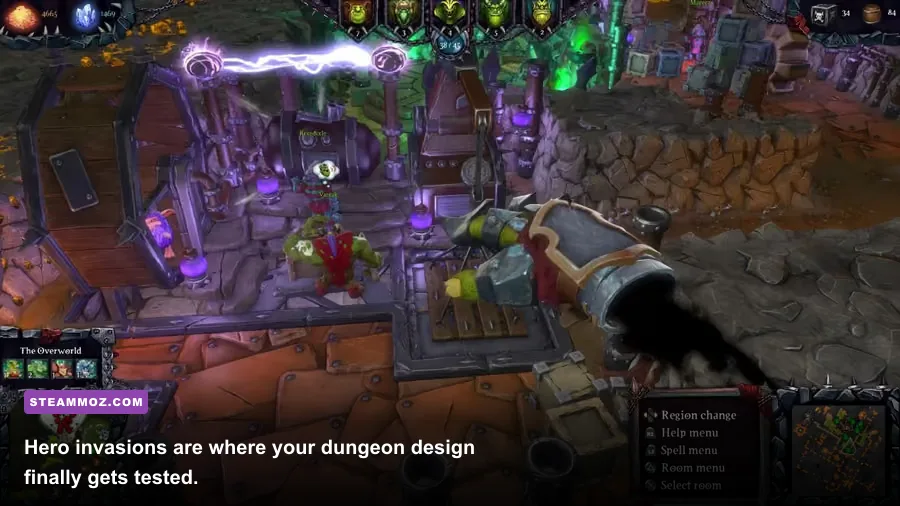
The strongest moments in Dungeons 2 happen when your base design solves a problem before you need to micromanage it. Heroes usually enter through predictable routes, and that makes corridors valuable. A narrow passage lined with traps buys time, separates melee attackers from support units, and creates a natural place for your minions to concentrate their damage.
Don't build every room as soon as it becomes available. Early gold is precious, and overbuilding creates walking problems. A compact first base with a Treasury, Workshop, Library, and one reliable defensive route is usually better than a decorative sprawl. Keep the Dungeon Heart protected behind several layers of accessible space rather than burying it at the end of an awkward tunnel. Your minions need to reach it quickly when repairs or reinforcements are required.
Traps are at their best when they complement troops instead of replacing them. A trap that damages a hero once is useful; a trap that forces that hero into the attack range of your strongest minions is much better. Use slowing and control effects near corners, then put direct-damage devices where enemies are likely to bunch together. The exact room and trap availability changes across missions, so the general principle is more valuable than memorizing one universal layout.
Captured heroes are another system that deserves more attention than it initially receives. Throwing prisoners into the Torture Chamber can produce information and benefits, but it also creates a management question: is the room generating enough value to justify the space and minion time? In difficult missions, the answer is often yes, particularly when the extra research helps you reach stronger units or defensive upgrades before the next raid.
The defense problem becomes trickier because heroes don't always behave like predictable RTS units. They may split, chase workers, or attack a room that you expected them to ignore. This is where over-specialized bases fall apart. Leave enough open space for reinforcements to move, keep a reserve near the Heart, and don't assume one trap corridor will handle every invasion. Dungeons 2 rewards controlled inconvenience, not an elaborate death maze that your own minions can't navigate.
| Defensive Priority | Recommended Approach | Common Mistake | Best Use |
|---|---|---|---|
| Corridors | Short, connected routes with corners | Building long dead-end tunnels | Delaying and grouping heroes |
| Traps | Mix control and direct damage | Stacking one trap type everywhere | Supporting minion focus fire |
| Dungeon Heart | Protect it with layers, not distance | Hiding it beyond unreachable rooms | Emergency defense and repairs |
| Worker routes | Keep resource rooms close together | Spreading gold and mana too far apart | Maintaining steady production |
If you enjoy making defensive spaces and tuning routes, Dungeons 2 has more in common with a mischievous base-building sandbox than a standard RTS. If your favorite strategy games are all about perfect build orders and competitive micro, its loose pathfinding will test your patience.
Overworld Combat Is Fun, but Less Convincing
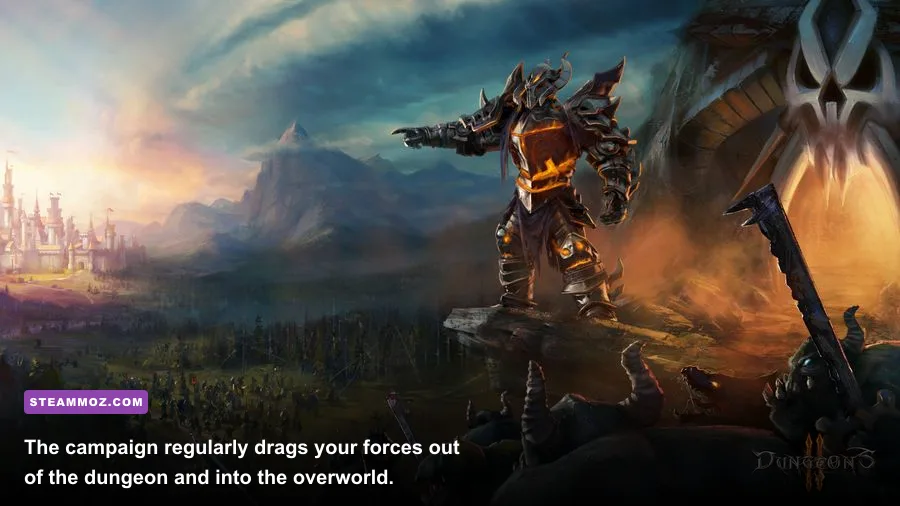
Dungeons 2's big differentiator is the overworld. At various points, the Dungeon Lord sends forces above ground to attack settlements, destroy objectives, and gather resources. The camera shifts into a more conventional real-time strategy perspective, and you command a horde of minions across open terrain. This gives the campaign a useful change of pace, but it also exposes the game's weakest systems.
The overworld battles are generally about group composition and target priority rather than advanced tactical maneuvering. Melee units absorb punishment, ranged units contribute sustained damage, and support abilities can swing an engagement when used at the right moment. The roster includes recognizable roles across the Horde, Demons, and Undead factions, but the game doesn't provide the huge unit variety or counter web found in a dedicated RTS.
That simplicity makes the missions approachable. You can usually understand why a fight went badly: you pushed too far, left a vulnerable ranged unit exposed, or attacked without enough frontline support. But it also means the combat rarely becomes a true strategic puzzle. Once you have a strong group and a sensible upgrade path, many encounters become exercises in moving from one objective to the next.
Possessing a unit helps inject some energy into these battles. Taking direct control of a powerful minion lets you focus fire, activate an ability, or pull a damaged unit away from danger. The system is entertaining during a campaign push, especially when a tight fight is decided by one well-timed intervention. It doesn't fully solve the AI's occasional tendency to path around terrain badly or ignore an ideal target.
The overworld is therefore best treated as a complement to the dungeon rather than the main attraction. It gives the Dungeon Lord a reason to expand and makes the campaign feel like a conquest instead of a series of disconnected bases. Still, players looking for the tactical richness of a dedicated game such as Company of Heroes or StarCraft should keep expectations in check.
| Faction | Combat Identity | Strength | Weakness |
|---|---|---|---|
| Horde | Direct, durable frontline force | Reliable pressure and straightforward control | Less subtle than specialized factions |
| Demons | Magic and aggressive abilities | Strong burst potential | Can demand more resource planning |
| Undead | Attrition and disposable forces | Good staying power in prolonged fights | Less forgiving when production stalls |
Campaign, Skirmish, and Multiplayer in 2026
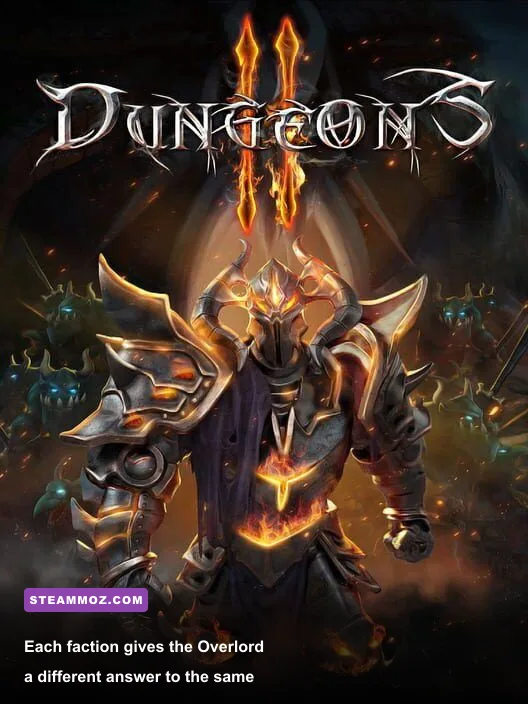
The single-player campaign remains Dungeons 2's safest selling point. It introduces systems gradually, provides a steady stream of objectives, and uses the Dungeon Lord's narration to keep missions moving. The writing is knowingly silly, with frequent jokes about fantasy conventions and villain theatrics. Some players will find the humor charming; others may want a mute button after a few hours.
Mission variety is decent rather than extraordinary. One scenario may emphasize dungeon defense, while another pushes you toward overworld conquest or resource control. The best missions force you to balance both halves at once: your dungeon needs enough protection to survive raids, but your active army also needs enough investment to complete the external objective before the map becomes saturated with threats.
Skirmish gives the systems more room to breathe. These maps are where you can experiment with different layouts, faction combinations, and defensive patterns without the campaign constantly handing you a new tutorial objective. The AI provides a reasonable casual challenge, but it isn't a substitute for human competition. Its priorities can be exploitable, and experienced players will eventually identify reliable openings.
Multiplayer is the biggest 2026 caveat. Depending on the platform, region, and time of day, finding active opponents may be difficult. You should buy Dungeons 2 for its campaign and skirmish content, not because you expect a thriving online ladder. If multiplayer is essential, check the current Steam community activity before purchasing and treat any online mode as a bonus.
The game's age also shows in its onboarding. Tooltips explain the basics, but some interactions are not as transparent as they should be. A new player can lose time wondering why a room isn't producing efficiently or why a minion is taking an absurd route around a wall. The good news is that the learning curve is gentle enough to forgive experimentation. You don't need an optimized build order to finish the campaign; you need a coherent base and enough patience to correct inefficient layouts.
For a broader look at older games that remain easy to recommend, our roundups of games like 10 Second Ninja X and games like Far Cry Primal make a similar case for compact, focused experiences over bloated modern releases.
PC Performance, Controls, and Value
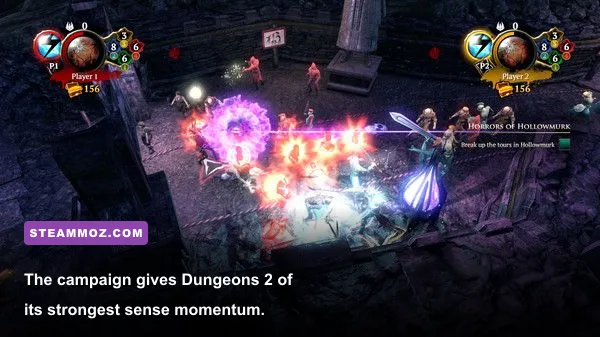
Dungeons 2 is not a demanding PC game by modern standards. Its stylized visuals, fixed-perspective management view, and older rendering technology mean most current gaming PCs can run it comfortably. The bigger issue isn't raw performance; it's presentation. Menus, camera movement, and unit selection feel like products of the mid-2010s, and a high-refresh display won't transform the game into a modern interface showcase.
For a smooth 2026 setup, prioritize stable frame pacing and readable cursor movement over maximum visual quality. The game is usually happiest at 1080p or 1440p with moderate-to-high settings. If you experience stutter, lower shadows first and disable unnecessary background applications before dropping resolution. The visual difference is small, while the improvement in crowded fights can be noticeable on older hardware.
| Setting or Component | Minimum Practical Target | Recommended 2026 Target | Performance Note |
|---|---|---|---|
| Resolution | 1280x720 | 1920x1080 or 2560x1440 | Resolution has a moderate GPU impact |
| Graphics preset | Low to Medium | High | High is suitable for most modern PCs |
| Shadows | Low | Medium | First setting to reduce during busy battles |
| Memory | 4 GB RAM | 8 GB RAM or more | Extra memory helps background multitasking |
| Storage | Hard drive | SSD | SSD improves loading and map transitions |
Steam Deck owners should also approach it as an older PC strategy game rather than a seamless console-style experience. The game is playable, but small text, cursor precision, and camera control can be less comfortable than on a mouse-and-keyboard setup. A Bluetooth mouse or docked play makes a real difference during complex base management. Before buying, consult the current Dungeons 2 Steam page for the latest compatibility information, sale pricing, and community reports.
There is also a useful value comparison here. Dungeons 2 is frequently discounted, and at that price it offers a focused campaign with enough replay potential to justify the purchase. It becomes harder to recommend when bundled with expectations of deep multiplayer, flawless AI, or a huge endgame. The game gives you a complete experience; it just doesn't pretend to be an endlessly expanding live-service strategy platform.
Is Dungeons 2 Worth Playing in 2026?
Yes, with the right expectations. Dungeons 2 is worth playing in 2026 because its central fantasy still works: build an evil underground headquarters, make heroes regret entering it, and then march your minions across the overworld to ruin somebody else's afternoon. The room-building loop is clear, the campaign is approachable, and the combination of management and direct control gives it more personality than a simple Dungeon Keeper clone.
It isn't worth playing if you need modern quality-of-life design, competitive RTS depth, or a busy multiplayer community. The AI occasionally makes questionable decisions, pathfinding can undermine carefully designed spaces, and the overworld battles are much shallower than the dungeon layer. Those problems don't destroy the game, but they stop it from becoming a genre classic.
My recommendation is straightforward: buy Dungeons 2 on sale if you enjoy base-building strategy, older PC management games, or villainous fantasy campaigns. Play the campaign first, keep your initial dungeon compact, use traps to shape enemy movement rather than relying on them alone, and treat overworld combat as a change of pace. If you want another unusual strategy experience afterward, Steamoz's coverage of games like Bus Simulator 16 is a reminder that focused simulation games can still be surprisingly compelling.
Players who prefer a darker, more aggressive action atmosphere may also enjoy our recommendations for games like F.E.A.R. 2, though they offer a very different kind of pressure. Dungeons 2's charm is that its violence is wrapped in logistics: every invasion is partly a combat problem and partly a question of whether you built your evil empire intelligently.
| Player Type | Recommendation | Reason |
|---|---|---|
| Dungeon Keeper fan | Buy on sale | The room-building and villain perspective still deliver |
| Modern competitive RTS player | Try before buying | Overworld combat lacks serious competitive depth |
| Strategy newcomer | Recommended | Campaign teaches systems without demanding perfection |
| Multiplayer-first player | Skip or verify activity | Online population may be inconsistent in 2026 |
| Steam Deck player | Playable with caveats | Mouse controls and small interface elements matter |
Dungeons 2 has aged into a charming, imperfect strategy game rather than a definitive one. That's still enough. When the Dungeon Heart is under attack, minions are scrambling through a corridor you designed, and a perfectly timed trap turns a heroic assault into a panicked retreat, the old-school magic is absolutely there. Just don't mistake that magic for polish the game never had.
For official background, you can also visit the Kalypso Media website, check Realmforge Studios, and review the game's Steam community discussions for current technical and multiplayer reports.