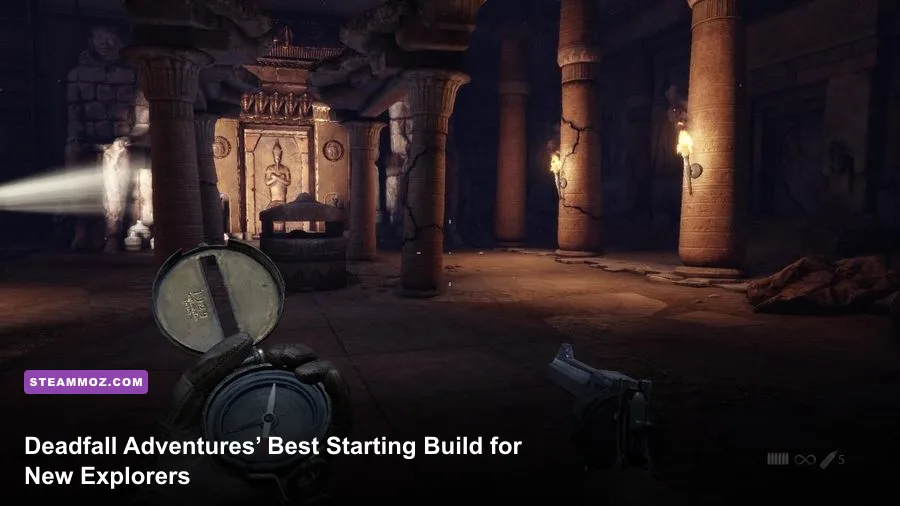
The best beginner build in Deadfall Adventures Digital Deluxe is a balanced explorer loadout: keep the revolver ready for precise headshots, use the shotgun as your panic button, save the machine gun for clustered human enemies, and carry dynamite for armored targets or blocked routes. The game has no RPG skill tree, stat allocation, or class system, so your “build” is really a weapon rotation, ammunition plan, and exploration habit built around James Lee Quatermain’s campaign.
That distinction matters. If you approach Deadfall Adventures expecting a modern looter-shooter with damage numbers and talent trees, you’ll spend the first hour looking for systems that simply aren’t there. The Digital Deluxe Edition doesn’t add a new class or combat progression path either; its main extras are the soundtrack and digital artbook. The smart way to play is to make each weapon do one job, avoid wasting rare ammunition, and use the environment before you start spraying bullets.
The beginner build that works from the first mission
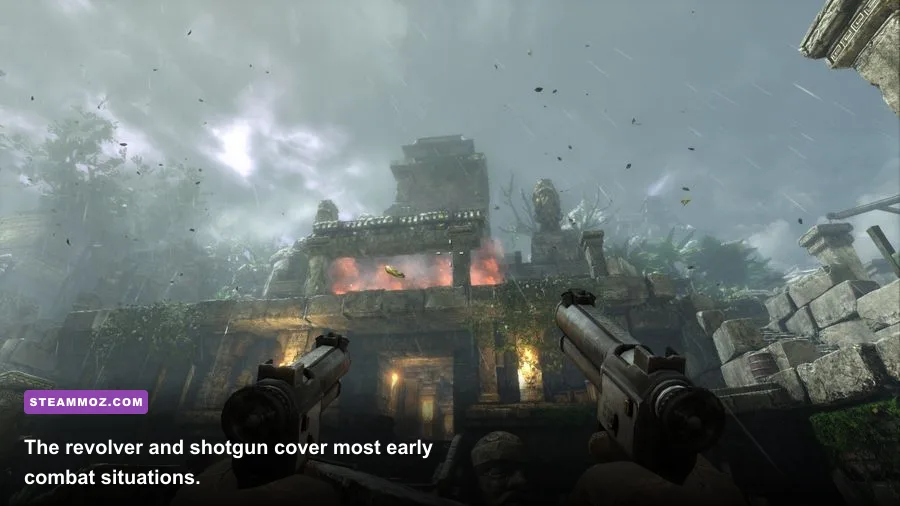
Start with the revolver as your default weapon. It is the safest tool for learning enemy placement because it encourages deliberate shots, preserves ammunition, and remains useful when a room turns into a long-range exchange. Keep the shotgun as your second weapon whenever you expect tight corridors, surprise attacks, or supernatural enemies that can close distance quickly.
This setup is deliberately boring—and that’s why it works. Deadfall Adventures frequently shifts between archaeological exploration, human firefights, and close-range encounters with occult enemies. A precision sidearm plus a high-impact close-range weapon gives you an answer without forcing you to burn through your machine-gun ammunition every time a cultist appears.
| Build Slot | Recommended Choice | Primary Job | Beginner Reason |
|---|---|---|---|
| Default weapon | Revolver | Headshots and distant targets | Reliable accuracy and economical ammunition use |
| Close-range weapon | Shotgun | Rushers and corridor fights | Stops threats before they reach melee range |
| Emergency weapon | Machine gun | Groups of human enemies | Fast burst damage when several targets expose themselves |
| Special tool | Dynamite | Heavy targets and clustered enemies | High burst damage without prolonged exposure |
| Utility weapon | Crossbow or rifle | Quiet or long-range engagements | Useful when the encounter rewards patience |
There’s no need to obsess over a mythical “best” numerical setup. Deadfall Adventures does not present traditional weapon damage, armor, or scaling statistics in the way an RPG does. Its practical weapon stats are feel-based: accuracy, range, rate of fire, reload time, magazine capacity, and the amount of ammunition you can afford to spend. Your build succeeds when it keeps those roles separate.
Players who enjoy the planning side of games such as Dungeon Siege’s classic RPG combat should adjust expectations here. Deadfall Adventures rewards positioning and resource control rather than character-sheet optimization.

🎮 Deadfall Adventures Digital Deluxe
Looking to experience this game? Grab your digital key directly on our store for $6.24.
View on Steammoz Store →How to rotate weapons without wasting ammo

Your basic combat loop should be simple: open with the revolver, switch to the shotgun when an enemy crosses your comfort range, then pull out the machine gun only when multiple targets are visible or a protected enemy refuses to give you a clean shot. That rotation prevents the most common beginner mistake—emptying the loudest weapon into the first enemy you see.
Use the revolver for information
The revolver isn’t just a damage tool. It lets you read the arena. Fire one accurate shot at a visible enemy, relocate, and watch which routes the remaining enemies use. Human opponents often expose themselves around cover, while supernatural enemies tend to pressure your position more directly. If you start with automatic fire, muzzle flash and recoil can hide those movement cues.
Aim for the head whenever the target is standing still or stepping through a doorway. Don’t chase perfect headshots while retreating, though. A body shot that buys space is better than a missed shot followed by a melee hit. The game’s older shooting model can feel less forgiving than modern shooters, especially if you’re playing at an unstable frame rate.
Save the shotgun for commitment range
Switch to the shotgun when the fight becomes close enough that a miss would still connect with the spread. It shines in temple hallways, stairwells, and scripted ambushes. Fire, backpedal, and reload behind cover rather than standing still after every blast. The shotgun’s value is not just its damage; it compresses the time an enemy has to attack.
Control the machine gun
The machine gun is the weapon most likely to wreck your ammunition economy. Use short bursts instead of holding the trigger. A three- to five-round burst keeps recoil manageable and is usually enough to finish a wounded human enemy. Save sustained fire for moments when two or more targets are exposed or when you’re trapped in an open arena with no safe reload route.
| Encounter | First Choice | Follow-Up | What to Avoid |
|---|---|---|---|
| Single distant guard | Revolver | Relocate after the shot | Automatic fire across the whole arena |
| Two or three human enemies | Revolver opener | Machine-gun burst | Reloading in the open |
| Enemy rushing a corridor | Shotgun | Backpedal and reload behind cover | Trying to duel with the revolver at point-blank range |
| Heavy or clustered enemies | Dynamite | Shotgun cleanup | Throwing explosives at a lone, weak target |
| Long sightline | Rifle or revolver | Machine-gun burst if rushed | Crossing exposed ground while reloading |
The crossbow and rifle are situational rather than mandatory. Use them when the level gives you time to line up a shot or when you want to conserve conventional ammunition. Don’t force a stealthy approach if the arena is clearly designed around a firefight; Deadfall Adventures is at its best when you flow between weapons instead of committing to one gimmick.
Build around enemy behavior, not weapon rarity

Deadfall Adventures mixes human enemies with supernatural threats, and each category demands a different response. Human opponents are generally easier to manage with cover, headshots, and controlled bursts. They often announce their presence with gunfire, shouted dialogue, or movement around predictable cover positions. Your first priority is to identify the firing angle, not to sprint toward the nearest target.
Supernatural enemies change the rhythm. Mummies and other occult threats can make close spaces dangerous because they pressure your position instead of politely trading shots. The shotgun is the correct answer when one reaches melee distance, but the better answer is to notice the approach early. Keep your camera moving at corners, listen for audio cues, and avoid backing into unexplored rooms during a retreat.
Dynamite deserves a special mention. Treat it as a space-control tool, not a flashy finisher. Throw it at a group entering a doorway, around a corner where enemies are funneling, or near a heavy target whose movement is easy to predict. The explosion is most valuable when it damages several threats or forces them away from a chokepoint. If you throw it at a single weak enemy, you’re paying a steep resource cost for convenience.
The three-second combat rule
Every time you enter a new room, spend roughly three seconds scanning before firing. Look for elevated positions, side passages, explosive objects, cover that can be used during reloads, and the route back to the previous room. This is especially important in Deadfall Adventures because exploration spaces and combat spaces often blend together. A doorway that looked decorative a moment ago may become your only escape route.
When a fight starts, use this order:
- Identify the nearest threat. If something can reach you quickly, pull out the shotgun.
- Break the enemy formation. Move sideways or retreat through a doorway instead of standing in the center.
- Remove the dangerous angle. Use the revolver on exposed shooters and machine-gun bursts when several enemies overlap.
- Spend explosives only when they change the fight. One good throw should create breathing room or remove multiple targets.
- Reload after the room is safe. Entering the next corridor with half a magazine is a classic way to lose health.
This approach is closer to the careful route planning in Everspace 2’s secret-location hunting than to a conventional run-and-gun shooter. You’re constantly deciding whether the next room is worth your ammunition and whether a safer route is hidden nearby.
Exploration upgrades your real build
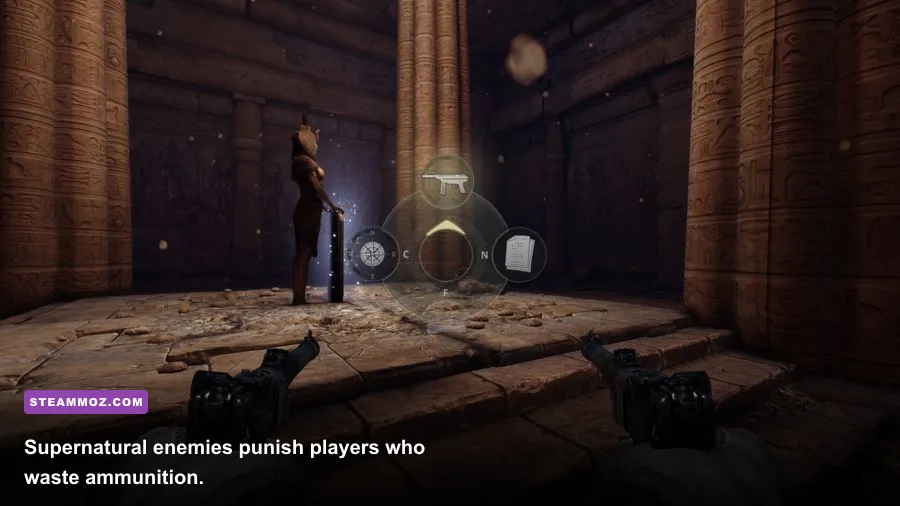
The strongest beginner upgrade is not a weapon—it’s better exploration. James Lee Quatermain’s campaign is packed with puzzles, relic hunting, hidden passages, and environmental clues. Rushing from objective marker to objective marker leaves you underprepared because you miss ammunition, health supplies, and useful side discoveries.
Pay attention to lighting and visual repetition. Ancient symbols, unusual wall panels, statues, and objects that look deliberately placed are often more important than the obvious path. When a room contains a puzzle, stop treating it like a shooting arena. Search the edges, inspect nearby mechanisms, and note symbols before interacting. The game frequently expects observation rather than a combat solution.
Collectibles also make the campaign feel more generous on repeat runs. You don’t need to turn your first playthrough into a flawless completionist sweep, but checking side alcoves helps stabilize your ammunition supply. That matters more than shaving a few seconds off a corridor because the game’s difficult moments usually punish resource shortages, not slow movement.
| Progression Point | Priority | Action | Why It Matters |
|---|---|---|---|
| Opening areas | High | Learn revolver aim and locate cover | Builds accuracy before larger fights |
| First repeated ambushes | High | Keep shotgun ammunition available | Prevents close-range panic deaths |
| Large human firefights | Medium | Use machine-gun bursts, not full magazines | Preserves ammunition for later rooms |
| Puzzle-heavy ruins | High | Search side chambers and inspect symbols | Finds supplies and avoids unnecessary combat |
| Supernatural encounters | High | Keep an escape route behind you | Stops melee enemies from cornering you |
Difficulty changes how much punishment you can absorb, but it doesn’t replace good habits. On a first run, Normal is the cleanest way to learn the campaign’s puzzle logic and encounter scripting. Hard becomes much more enjoyable after you know where ambushes happen and which rooms provide reliable cover. If you like optimizing routes, the game is a good candidate for a second playthrough rather than a blind high-difficulty start.
For comparison, players who enjoy hunting hidden rewards can borrow the mindset from Dragonkin’s hidden-reward guide: investigate spaces that look slightly too deliberate, and don’t assume the main path contains everything useful.
PC settings that protect your aim
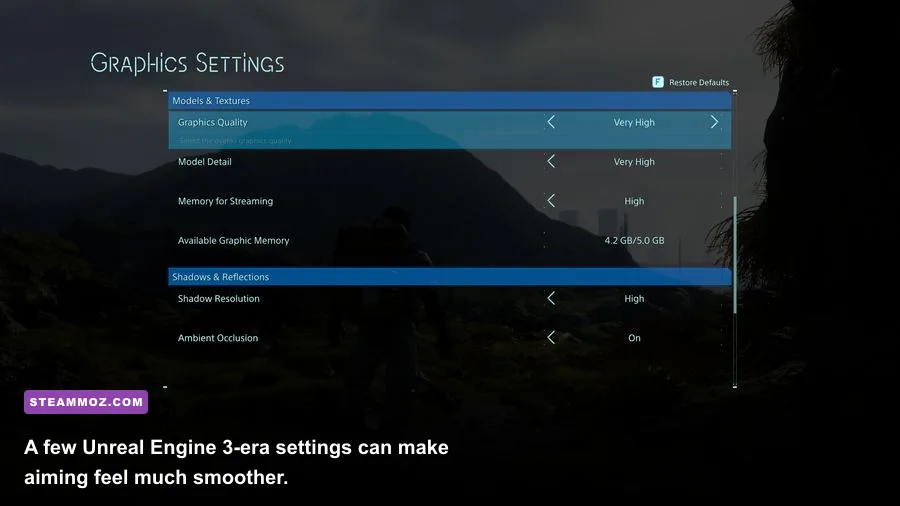
Deadfall Adventures is built on Unreal Engine 3, so modern hardware can run it comfortably, but frame pacing and mouse feel matter more than chasing maximum texture quality. The key beginner target is a stable 60 frames per second at 1080p. A locked, consistent image makes revolver headshots and shotgun timing feel dramatically better than an unstable higher setting.
| Setting or Profile | Recommended Value | Performance Impact | Visual Trade-Off |
|---|---|---|---|
| Resolution | 1920×1080 | Moderate | Sharp image without unnecessary 4K overhead |
| Texture quality | High | Low to moderate | Keeps temple surfaces and character detail clear |
| Shadow quality | Medium | Moderate to high | Reduces costly dark-room shadow rendering |
| Anti-aliasing | Medium or High | Moderate | Smoother weapon edges and geometry |
| Post-processing | Medium | Moderate | Less blur while preserving atmosphere |
| V-Sync | On for stable 60 Hz displays | May add input latency | Removes tearing; disable if latency bothers you |
| Resolution scale | 100% | Baseline | Maintains intended image clarity |
If performance dips during effects-heavy fights, lower shadows and post-processing before textures. That usually protects image clarity while reducing the settings most likely to cause distracting frame drops. Players with ultrawide monitors should also check the field of view and HUD behavior manually; older PC releases can behave inconsistently outside standard 16:9 resolutions.
Mouse sensitivity should be set low enough for controlled revolver shots but high enough to turn when a supernatural enemy reaches your flank. Start around the middle of the available slider, test a full 180-degree turn, and adjust from there. Don’t copy a sensitivity number from another shooter blindly—Deadfall Adventures’ input feel is its own thing.
If the game refuses to launch, crashes, or behaves badly on a modern system, check the current Deadfall Adventures Steam page for community fixes and compatibility notes. The publisher’s official Deadfall Adventures page is also worth checking before downloading unofficial patches. Steam’s community guides can help with controller and widescreen issues, but back up configuration files first.
Final loadout and the mistakes to avoid
For a first playthrough, keep the revolver equipped while exploring, switch to the shotgun before entering narrow rooms, and use the machine gun only when the encounter justifies its ammunition cost. Carry dynamite into suspiciously large arenas, but don’t spend it before you understand how enemies enter. Search side rooms, reload between encounters, and treat cover as part of your weapon system.
The biggest mistakes are predictable. New players sprint through puzzles, burn machine-gun ammunition on isolated targets, reload in the open, and back into unexplored spaces while fighting supernatural enemies. Fix those four habits and the campaign becomes far less chaotic. If you’ve played ELEX on PC, the same practical rule applies: stabilize the technical experience first, then judge the combat on its intended terms.
Deadfall Adventures Digital Deluxe is an old-school adventure shooter, not a build-crafting RPG. Its best beginner build is therefore a disciplined rhythm: accurate revolver shots, decisive shotgun blasts, controlled automatic fire, and explosives reserved for moments that genuinely turn the fight. Once that rhythm clicks, James Lee Quatermain’s temples feel less like ammunition traps and more like carefully designed expeditions.
For more PC-focused optimization advice, Steamoz’s Dragonkin settings guide offers the same performance-first approach: keep the image clear, protect frame consistency, and never let flashy settings undermine your aim.