The fastest Dead Pets leveling and gold farming route is a profit-first daily loop: complete guaranteed-pay work early, use rehearsal only when it unlocks a better gig, then spend the remaining time on the highest-value performance or relationship objective. The game rewards planning rather than repeating one task until a bar fills. Protect your energy, avoid vanity purchases during the opening stretch, and treat every day as a small budget: time, stamina, and cash all need to come back positive.
That distinction matters because Dead Pets is a punk-rock slice-of-life sim, not a conventional RPG with a monster zone and an endless stream of enemies. Your progression comes from completing activities, improving access to better opportunities, maintaining relationships, and turning preparation into better-paying gigs. If you keep rehearsing without checking what the next performance actually pays, you can easily finish a day poorer than you started.
The Best Daily Loop for Fast Progress
Start each in-game day by checking the activity board, calendar, or objective tracker before moving anywhere. Look for three things: a guaranteed-income task, a progression task, and a performance or event with a clear payout. The ideal day contains all three. Work supplies immediate cash, progression raises your future ceiling, and the event converts preparation into a larger reward.
Morning: secure money first
Take the reliable paid activity before spending stamina on optional conversations or shopping. This is the safest way to avoid the classic early-game trap: buying a cosmetic item, paying a travel cost, then discovering that the next required rehearsal or gig needs money you no longer have. If a work task consumes most of the day, it can still be correct when your wallet is nearly empty. A failed progression chain costs more than one missed social interaction.
Afternoon: prepare only for a payout
Use rehearsal, practice, or other skill-building actions when they satisfy a visible requirement for a scheduled performance. If the next event does not unlock a new reward tier, bank the stamina and take another paid activity instead. Progression actions are strongest when they cross a threshold; they are weak when performed simply because the button is available.
Evening: cash out or build the next day
Finish with the activity that either pays immediately or creates a guaranteed advantage tomorrow. A successful gig is usually the best closer, but not if its entry cost consumes your entire reserve. Keep enough money for mandatory purchases, transport, food, or event fees. A useful opening reserve is the cost of one required expense plus a small emergency buffer; spending down to zero makes the next morning inefficient.
| Daily Priority | When to Choose It | Why It Levels Fast | Gold Result |
|---|---|---|---|
| Guaranteed paid work | Wallet is low or a bill is due | Protects the progression chain from a cash lock | Reliable, modest income |
| Rehearsal or practice | A gig objective requires it | Raises access to higher-value events | Usually no immediate profit |
| Live performance | Preparation requirement is complete | Converts progress into a reward spike | Best planned payout |
| Relationship activity | It unlocks a reward, location, or task | Expands the activity pool | Indirect income |
| Shopping | Only when an item changes access or performance | Prevents wasted days caused by missing tools | Negative short-term value |
For more general route-planning ideas, Steamoz's progression guide for Deponia makes a similar point: when a game has no traditional combat grind, the fastest route is usually the one that removes dead time between objectives.
🎮 Dead Pets: A Punk Rock Slice of Life Sim
Looking to experience this game? Grab your digital key directly on our store for $11.99.
View on Steammoz Store →How Leveling Actually Works in Dead Pets

Don't read progression as a single character level. Dead Pets' meaningful advancement is divided between activity completion, skill or performance improvement, relationship development, and access to new events. That means the strongest player is not the one who repeats the same profitable action forever. It's the player who turns today's small reward into tomorrow's larger activity.
Prioritize unlocks over tiny improvements
A task that unlocks a new venue, a better-paying gig, or another part of the neighborhood has more value than a task that gives a minor improvement with no immediate follow-up. Early on, favor objectives that open new content even when their direct reward looks underwhelming. New options increase your future earnings ceiling, while a one-off cash bonus disappears immediately.
Track requirements manually if the interface does not make them obvious. Note which actions improve performance, which characters open new activities, and which expenses are mandatory. The goal is to avoid paying twice for the same preparation. For example, if one rehearsal satisfies the next gig requirement, doing a second rehearsal before performing is usually inefficient unless the game clearly increases the payout or success chance.
Use social progression as an investment
Conversations and relationship activities can look unproductive beside paid work, but they often create the best long-term returns by unlocking tasks, locations, and event chains. Schedule them on days when no high-paying gig is available. If a social objective is required for a new venue, complete it before farming money aggressively; otherwise, you may spend several in-game days earning from the same low-value activity.
Save before major choices when the game allows it. Not every branch pays in cash, and some rewards are access-based rather than financial. Reloading should not replace learning the system, but it is useful when an expensive choice produces no visible progression and you are still establishing your first reserve.
| Progression Type | Best Early Priority | Common Mistake | Efficient Check |
|---|---|---|---|
| Performance improvement | Reach the next gig requirement | Repeating practice after the requirement is met | Check the event objective before rehearsing |
| Relationship progress | Target characters tied to new activities | Spending every free slot on optional dialogue | Look for unlocks, not just affection points |
| Location access | Open areas containing better-paying tasks | Farming the starting area too long | Move on once a new route becomes available |
| Cash reserve | Keep enough for mandatory costs | Buying cosmetics at the first shop visit | Reserve the next required expense first |
Gold Farming That Doesn't Collapse Your Economy

The best gold farm is not necessarily the activity with the biggest headline reward. Measure profit after preparation, travel, and recovery costs. A gig paying more than work can still be worse if it requires several unproductive rehearsals and a purchase you would not otherwise make.
Use this simple calculation: net gold equals reward minus entry costs, required purchases, and the value of time spent preparing. You don't need a spreadsheet, but you should compare two or three complete days rather than judging one action in isolation. If a gig gives a large payout but delays the next paid task, its real advantage may be smaller than it appears.
Farm in cycles, not endlessly
Run a short cycle: earn enough to cover the next required expense, complete the unlock objective, then perform the highest available event. Repeat that cycle after each new venue or activity opens. This beats sitting on the first reliable job because every unlock can improve the reward per unit of time.
Sell or avoid low-value purchases unless the item has a direct mechanical use. In a slice-of-life game, decoration and clothing can be tempting, especially when the shop puts new items in front of you, but early gold is working capital. Buy a functional item when it removes a blocker, improves a performance check, or unlocks a profitable action. Otherwise, delay it until your income is stable.
Watch for rewards that arrive as items, favors, or access rather than coins. Those rewards can be more valuable than a small cash payment if they remove a later cost. The strongest farming route often looks less flashy because it converts several minor rewards into one new earning opportunity.
Gig Preparation and the Biggest Profit Traps
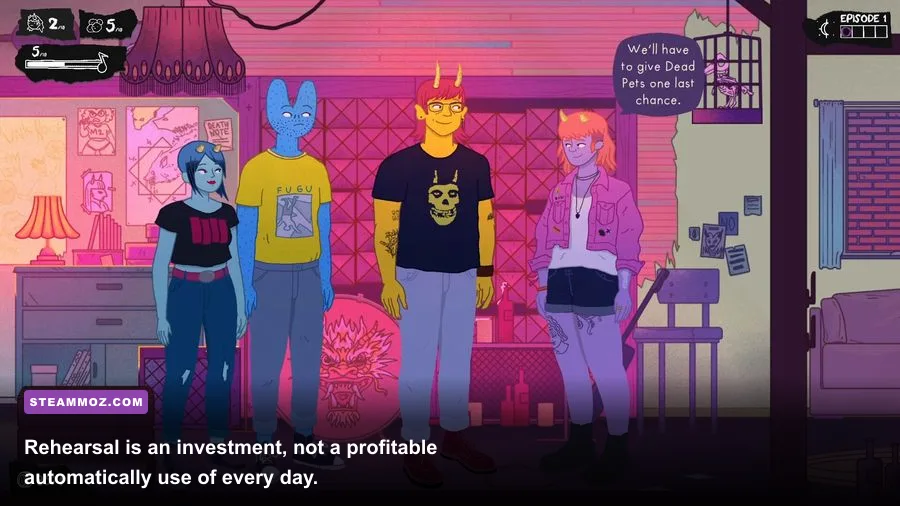
Before committing to a performance, inspect every visible requirement. Dead Pets can punish premature event attempts with lost time, wasted stamina, or a disappointing payout. Preparation should be deliberate: complete the minimum requirement, verify that the event is still available, and reserve enough energy to finish the day without missing a guaranteed task.
Don't over-rehearse
Practice is valuable when it changes the result. Once the next gig's requirement is satisfied, the marginal value of another rehearsal drops sharply unless the game provides a higher reward, better rating, or new dialogue for doing so. This is the single easiest habit to fix if your character feels permanently broke.
Separate safe gigs from showcase gigs
A safe gig should fund the next few days. A showcase gig should unlock something or produce a meaningful progression jump. Treat them differently. Take safe work when your reserve is thin, and schedule showcase events when your preparation is complete and your next expense is already covered.
| Event Situation | Risk | Correct Response | Expected Value |
|---|---|---|---|
| Requirement incomplete | Lost stamina or failed attempt | Return to the exact missing preparation activity | Low until requirement is met |
| Requirement complete, reserve low | Next day becomes cash-starved | Take paid work before performing | Stable rather than explosive |
| Requirement complete, reserve healthy | Opportunity cost only | Perform and pursue the unlock | Highest progression value |
| Optional extra practice | Consumes a profitable time slot | Skip unless it changes payout or access | Usually poor early value |
That mindset also applies to other systems-heavy games. Steamoz's Dins Curse survival tips and Don Duality starter build guide both reward the same principle: spend resources on actions that prevent a larger future loss.
Performance Settings and a Clean Farming Routine
Fast farming depends on seeing timers, prompts, and activity transitions clearly. Use the game's lowest stable input latency rather than chasing visual quality. If your system struggles, lower resolution scale, shadows, reflections, and effects first. A stable frame rate makes minigames and timed interactions more reliable, especially during crowded performances.
| Setting | Recommended Value | FPS Impact | Visual Trade-Off |
|---|---|---|---|
| Frame-rate limit | Stable target matching your monitor | Improves consistency | May cap peak performance |
| Resolution scale | 100%, then reduce if needed | High impact when lowered | Softer image |
| Shadows | Medium | Medium impact | Less depth in scenes |
| Reflections | Low or Medium | Medium impact | Reduced surface detail |
| Effects quality | Medium | Low to medium impact | Fewer concert and environment effects |
| Motion blur | Off | Minimal FPS change | Sharper movement and prompts |
For the current build, check the official Steam listing search, the game's Steam Community discussions, and any developer announcements linked from the store page. Balance patches can change rewards, stamina costs, and event requirements, so confirm numbers after a major update rather than blindly copying an old route.
Finally, keep a tiny route journal for the first few in-game weeks. Record the activity, its payout, its cost, and what it unlocked. After three or four cycles, the best farm becomes obvious. You'll know which work task is the reliable fallback, which rehearsal is mandatory, which gig actually pays, and when shopping stops being a drain. Dead Pets' economy rewards that kind of attention: build the band, unlock the better opportunities, and only then spend like a rock star.
If you're comparing progression systems across indie games, Steamoz's Decay: The Mare progression guide and Dungeon Siege retrospective offer useful contrasts. Dead Pets is slower, stranger, and much more schedule-driven—but once you stop treating every activity as equally valuable, its leveling and gold farming loop becomes remarkably predictable.