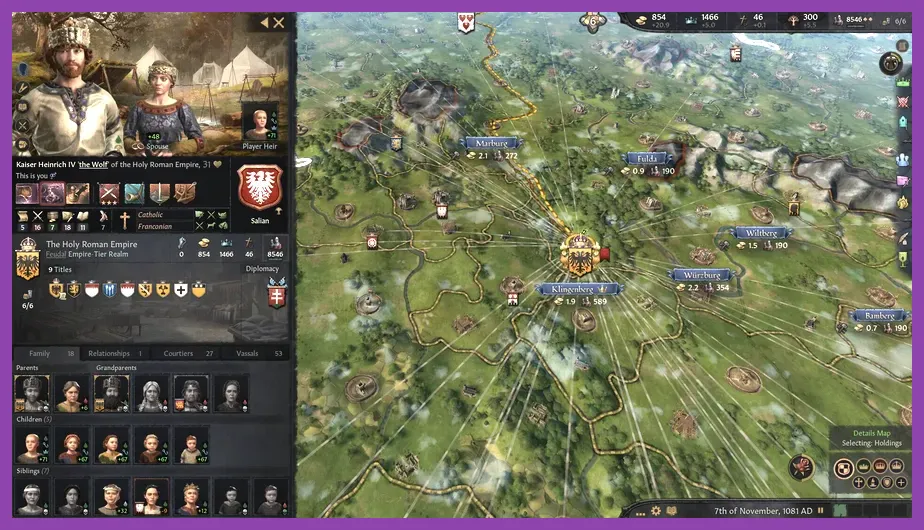
The best Crusader Kings 3 team comp synergy is a three-part army built around Armored Footmen, Bowmen, and Mangonels, supported by high-prowess knights and a commander whose trait matches the campaign. Use Armored Footmen as your dependable damage core, Bowmen to counter enemy Skirmishers, and Mangonels to shorten sieges; then switch toward Pikemen, Crossbowmen, or Horse Archers when your enemy and terrain demand it. CK3 has no fixed five-character party, so “team comp” means coordinating men-at-arms, knights, commander traits, council support, and supply.
This approach is stronger than filling every regiment slot with a different unit. Men-at-arms counters, toughness, pursuit, siege ability, and terrain modifiers all interact with the battle screen. Before hiring anything, check your culture’s innovations, your domain income, regiment limits, and the enemy army’s unit icons. The official Crusader Kings III Steam page remains a useful reference for the base game and available expansions, but your current patch and DLC can change which specialized options are available.
Best Overall CK3 Team Composition
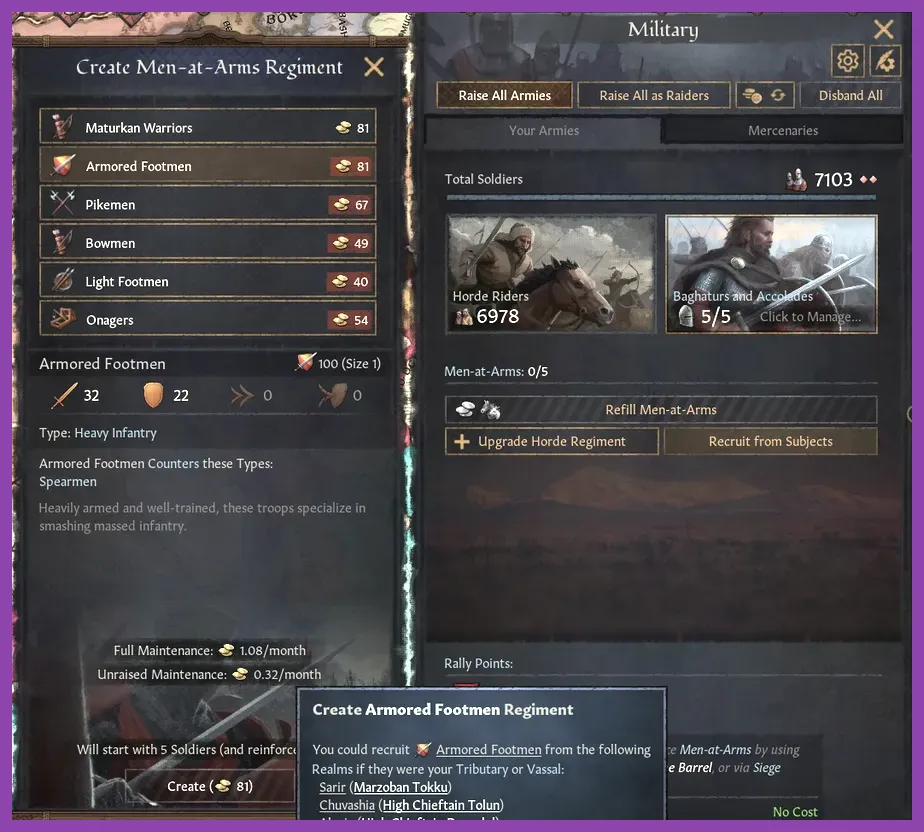
S-Tier: Armored Footmen, Bowmen, and Mangonels
For a stable feudal or tribal transition army, run Armored Footmen as the frontline, Bowmen as the counter unit, and Mangonels or your best available siege weapon as the fourth priority. Armored Footmen are Heavy Infantry: they offer high damage and toughness and are not hard-countered by the most common early-game unit, Skirmishers. Bowmen are Skirmishers and counter Light Footmen, while also adding useful ranged damage. Mangonels are not there to win the field battle; their job is increasing siege progress so the army reaches the next battle faster.
A practical early roster is two Armored Footmen regiments, one Bowmen regiment, and one Mangonel regiment, adjusted to your available regiment cap. Do not copy the number literally if your ruler has only two slots. The synergy is the ratio: roughly half frontline, one-quarter counter damage, and one-quarter siege capacity once the army is large enough. If you are fighting a realm that relies on Bowmen, replace one Bowmen regiment with Pikemen or Light Horsemen rather than mirroring its composition.
Why This Comp Works
The frontline prevents your army from collapsing while the counter unit punishes a predictable enemy. Siege weapons solve CK3’s most expensive non-combat problem: long sieges drain supplies, create attrition, and give hostile allies time to arrive. The composition also scales well with ordinary levies. Levies provide numbers, while your specialized regiments supply the actual combat identity.
Keep your best regiments raised together. Splitting one Armored Footmen regiment into several tiny armies weakens the counter system and makes each group easier to defeat. For performance tips when managing large wars, our guide to optimizing games on low-end PCs has broader settings advice that also applies to busy CK3 campaigns.
Best Commander, Knights, and Council Synergy
S-Tier Commander Traits
Choose a commander for the war you are actually fighting, not simply the character with the highest Martial score. Organizer is excellent for offensive campaigns because its movement-speed bonus helps you catch weaker armies and escape larger ones. Logistician is ideal for long campaigns because it improves supply handling and reduces the danger of attrition. Military Engineer belongs on a siege-focused army because it improves siege progress. Unyielding Defender is a strong defensive pick when you can force the enemy to attack into hills, mountains, or a fortified position.
Military education traits also matter. A Strategist is usually the safest general-purpose ruler or heir commander, while a Logistician or Overseer can be more useful for a campaign where supply and control are the real limitations. Compare the actual advantage number, terrain modifier, commander trait, and army quality in the battle preview before locking in the fight. A smaller army with a strong defensive commander can beat a larger force attacking across a river or into mountains.
Knights: The Hidden Damage Multiplier
Knights contribute damage based primarily on Prowess and your realm’s Knight Effectiveness. A knight with 15 Prowess is valuable; a knight with 25 or 30 Prowess can be decisive when your effectiveness bonus is high. Recruit characters with high Prowess, but do not ignore personality, succession risk, or hooks. A powerful knight who hates your ruler can become a faction leader or assassination threat.
Raise the number of knight slots through court positions, artifacts, cultural bonuses, and relevant buildings where possible. Assign only reliable characters to the knight list, and forbid low-Prowess courtiers from fighting when a dangerous battle is approaching. Your Marshal’s Train Commanders task can also improve the military quality of your realm over time, while Organize Levies and Increase Control address different weaknesses. The best council is therefore not five high-stat characters sitting idle: it supports the exact bottleneck in your war.
Men-at-Arms Tier List for Team Comp Synergy
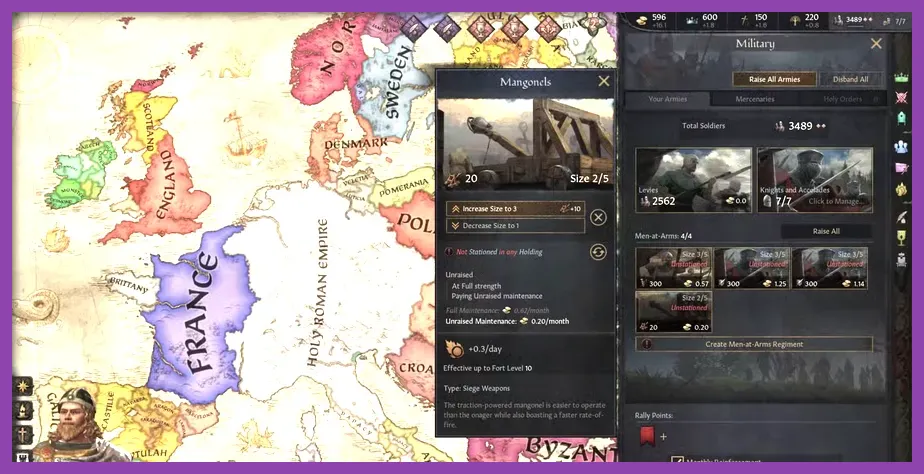
S-Tier: Armored Footmen, Pikemen, Crossbowmen, and Siege Weapons
Armored Footmen are the safest all-purpose core. They are particularly good when you lack information about the enemy or need a durable unit that works across several regions. Pikemen become S-Tier against Heavy Cavalry and are especially useful for realms expecting opponents with Horse Archers or armored cavalry. Crossbowmen are powerful against Heavy Infantry and Heavy Cavalry once your culture has access to them. They fit naturally into a late-medieval counter roster alongside Pikemen.
Siege Weapons are always strategically valuable, even when their battlefield damage is limited. One dedicated regiment can save months on every castle, temple, or city holding. Do not overinvest in siege units if an enemy can immediately intercept you, but never expect levies alone to conduct an efficient conquest of a fortified duchy.
A-Tier: Bowmen, Light Horsemen, and Horse Archers
Bowmen are excellent early because they counter Skirmishers and cost less than many heavy options. Their value falls when every nearby ruler fields armored troops. Light Horsemen excel at pursuit and counter Skirmishers, making them useful after the main battle has already been won. They are less impressive when forced into a frontal fight against durable Heavy Infantry.
Horse Archers can be A-Tier or S-Tier for cultures that support them, particularly on open terrain. They combine mobility, ranged pressure, and strong pursuit, but they become less comfortable in forests, hills, wetlands, and mountains. Their upkeep can also strain a small economy. If your realm is built around Horse Archers, pair them with a commander who can exploit movement and avoid unfavorable terrain instead of treating them like stationary Heavy Infantry.
B-Tier: Light Footmen and Narrow Counter Picks
Light Footmen are affordable and can be useful early, but they are usually a temporary solution rather than the centerpiece of a long campaign. They struggle into Bowmen and often lack the staying power of Armored Footmen. Keep them when money is tight or when a specific regional opponent makes their counter profile useful; replace them as your economy and innovations improve.
Remember that the in-game counter system is more important than a universal ranking. Open the enemy army tooltip, identify its largest regiment type, and select the unit that counters it. CK3’s unit counters are not a simple damage bonus that erases all other variables: advantage, toughness, terrain, commander traits, supplies, and numbers still decide battles.
Three Specialized CK3 Team Comps
1. Anti-Cavalry Defensive Comp
Use Pikemen as the core, add Crossbowmen when available, and bring a siege regiment for the objective. Place the army in hills, mountains, or a fort and use an Unyielding Defender if possible. This is the best answer to a neighboring empire that repeatedly attacks with Heavy Cavalry. Avoid chasing retreating enemies across bad terrain; let them attack your prepared position, then counterattack after their main stack is weakened.
2. Steppe and Open-Field Comp
For a Horse Archer culture, combine Horse Archers with Light Horsemen and enough siege weapons to keep conquests moving. Use an Organizer commander to catch isolated armies and avoid forests, wetlands, and mountains. This comp wins through mobility and pursuit rather than a slow grind. Keep supply limits visible because a fast army that outruns its reinforcements can still lose to attrition before the battle begins.
3. Late-Game Counter Comp
Against a developed imperial rival, use Pikemen to answer cavalry, Crossbowmen to answer Heavy Infantry, and a smaller number of Armored Footmen as a resilient general-purpose core. Add siege weapons according to your regiment limit and campaign objective. This roster is less flashy than a mono-unit build, but it remains effective when the enemy changes commanders or mixes several men-at-arms types.
Do not treat “team comp” as a reason to ignore the map. A theoretically perfect army loses if it fights while disorganized, out of supply, recently disembarked, or attacking through a river. Pause before engagement, inspect the battle preview, and wait for allies if their arrival will change the advantage calculation. Our article on co-op build synergy covers a different game, but its central lesson applies here: assign every part of the team a clear job.
How to Upgrade and Adapt Your Army
Start by checking your culture’s available innovations and your ruler’s income. Men-at-arms cost monthly gold while raised, and an impressive roster that bankrupts the realm is not a winning composition. Upgrade economic buildings in your domain, then improve military buildings that directly support your chosen core. Military Academies, Barracks, and Warrior Lodges can improve relevant troop performance depending on your holdings, culture, and available building tier.
Next, inspect enemy composition before every major war. If the target has many Skirmishers, Armored Footmen or Light Horsemen become more attractive. If it fields Heavy Infantry, Crossbowmen are a strong response. If it uses cavalry, recruit Pikemen. If the war is taking place across several castles, preserve at least one siege regiment. You can use the same principle found in our weapon tier-list methodology: rank equipment by the encounter it must solve, not by popularity alone.
Finally, update the roster after succession. A new ruler may lose knight effectiveness, commander quality, cultural access, or the income needed to support expensive regiments. Recheck knight eligibility, replace dead or imprisoned commanders, and avoid sending the ruler into battle unless the risk is justified. The official Paradox Crusader Kings III forums are useful for checking patch-specific balance changes, while the Paradox game page lists major content updates.
The strongest CK3 team comp is therefore flexible rather than universal: Armored Footmen, Bowmen, and Mangonels form the best general foundation; Pikemen and Crossbowmen handle late-game counters; Horse Archers dominate open terrain for the right culture; and commander traits, knights, supply, and terrain complete the strategy. Build for the enemy in front of you, then let your economy and innovations determine how aggressively you specialize.