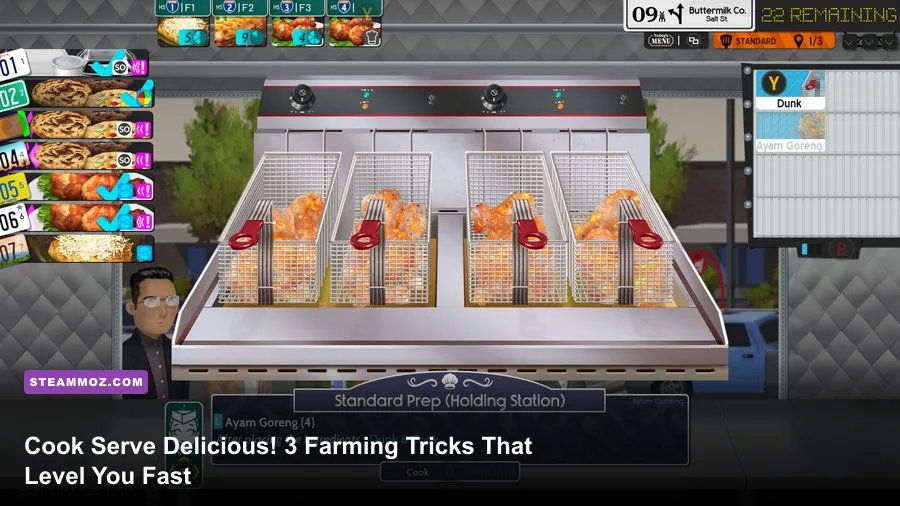
The quickest Cook Serve Delicious! 3 leveling and gold-farming method is to replay short campaign stages with a low-error menu, keep your combo alive, and reinvest the payout into recipe and truck upgrades that make the next run safer. The game does not really use traditional RPG gold; your practical farming currency is the money earned from successful shifts. You also build progression by clearing stages, earning better ratings, unlocking recipes, and improving the food truck. The winning loop is simple: prepare a dependable menu, choose a short route, finish with few mistakes, and repeat only the stages you can execute almost automatically.
That sounds less glamorous than loading a super-difficult stage and hoping for a huge payout, but it is much faster in practice. Cook Serve Delicious! 3 rewards consistency. A perfect or near-perfect run with familiar foods beats a messy attempt at a late-game stage where every second is spent hunting for commands. This guide focuses on that reliable loop, including menu construction, station priority, campaign routing, upgrade spending, and the common farming mistakes that quietly destroy your earnings.
What Actually Increases Your Earnings
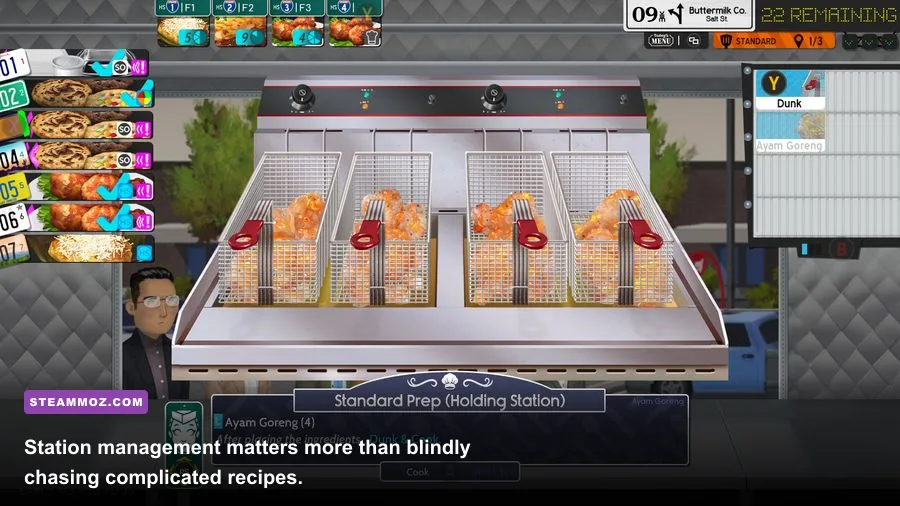
Every shift is a score-and-cash exercise built around three things: completed orders, order quality, and mistakes. Serving quickly helps, but speed is only useful when it doesn't cause burned food, missed ingredients, incorrect portions, or abandoned customers. A broken combo is especially costly because it lowers the quality of the run and makes the next orders harder to manage mentally.
Before farming, separate progression into three buckets. Money pays for permanent improvements and recipe-related purchases. Stage ratings show how efficiently you handled a route and can encourage you to revisit earlier levels. Recipe and campaign unlocks expand your options, but they are not automatically better for farming. A complicated dish can be excellent during a normal campaign push and terrible for repeat runs.
| Progression Target | Best Way to Build It | Main Risk | Farming Advice |
|---|---|---|---|
| Money | Replay short, familiar shifts | Long stages with avoidable errors | Prioritize consistency over maximum theoretical payout |
| Stage Rating | Protect the combo and serve accurately | Taking an unfamiliar menu | Use a clean menu you can execute without hesitation |
| Recipe Unlocks | Advance through campaign objectives | Buying too many difficult foods | Unlock variety, then farm with your safest recipes |
| Truck Progression | Reinvest earnings into useful upgrades | Spending on convenience too early | Buy upgrades that remove bottlenecks first |
The important takeaway is that the largest improvement usually comes from reducing mistakes, not shaving a fraction of a second from every command. If your current run loses its combo twice, a slower but safer menu will generally outperform your high-speed setup.

🎮 Cook Serve Delicious! 3
Looking to experience this game? Grab your digital key directly on our store for $4.99.
View on Steammoz Store →Build a Farming Menu You Can Run on Autopilot

For farming, treat recipes as jobs in a production line. You want a menu that spreads its pressure across different stations instead of stacking every difficult action at the same moment. Cook Serve Delicious! 3's kitchen gets dangerous when several foods demand timed attention, multiple ingredients, or long chains of commands together.
Start with the recipes you have already mastered. Burgers, hot dogs, tacos, pizza, chicken, and other familiar categories can all work, but the exact best selection depends on which commands feel automatic to you. Don't choose a dish merely because its payout looks attractive. Choose it because you know its preparation sequence, its finish condition, and the moment at which it becomes unsafe to leave unattended.
A strong farming menu normally contains three types of workload:
- Immediate orders: Foods that can be assembled or served quickly and help you clear a sudden queue.
- Timed orders: Foods that cook or process while you handle another station. These create rhythm but punish neglect.
- Low-attention orders: Foods with a predictable sequence that can be parked mentally while a high-pressure ticket is completed.
Avoid filling every slot with foods that require constant tapping. That setup feels fast for the first minute, then collapses when multiple timers overlap. Also avoid menus built entirely around long-cook foods. You need quick orders to absorb bursts of customers and prevent the queue from becoming a wall of red warning indicators.
| Menu Role | Useful Recipe Profile | Why It Helps | What to Avoid |
|---|---|---|---|
| Queue stabilizer | Quick assembly or serving | Clears urgent orders immediately | Long ingredient chains |
| Timer filler | Food with a predictable cook cycle | Uses downtime productively | Several overlapping timers |
| Combo protector | Low-input familiar recipe | Prevents hesitation during pressure | Newly unlocked foods |
| High-value slot | Reliable recipe with good payout | Raises earnings without gambling the run | Any dish you still misread |
Use the practice mindset
Run your intended menu once without caring about money. Notice which station causes the first mistake. If ovens, grills, prep commands, or finishing steps are the problem, replace one recipe rather than rebuilding everything. This makes the menu easier to tune and reveals whether the problem is the food itself or the order in which you are checking stations.
The Best Fast-Leveling Route Is Usually a Short Replay
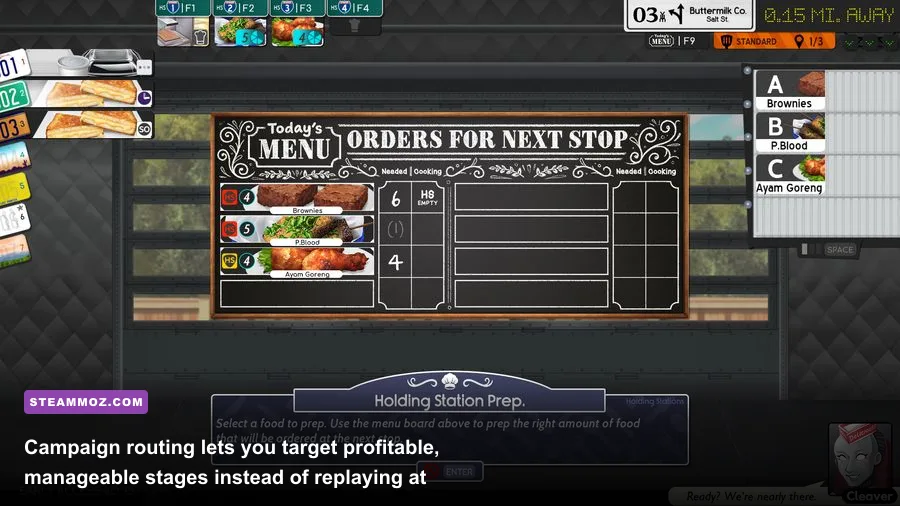
Don't automatically farm the latest mission you unlocked. The best stage is the one with a short completion time, a predictable customer rhythm, and no section that regularly breaks your combo. Early and mid-campaign levels are often excellent because you already know their pacing and can finish them with fewer mental resets.
Use the campaign map as a testing board. Clear a stage normally, then mark it mentally as a candidate if you completed it with almost no mistakes. Replay that stage with your farming menu. If the run feels calm and the payout is respectable, repeat it three times. Three clean repetitions give you a much better picture of its value than a single lucky attempt.
When comparing stages, measure money per minute, not just money per shift. A long mission with a larger final reward can still lose to a compact stage that you finish quickly and accurately. Include loading, menu navigation, and failed attempts in your mental calculation. Farming is supposed to reduce friction, so a route that requires constant concentration is not a good route even if its headline payout looks stronger.
- Choose a familiar stage with a manageable customer pattern.
- Run it with your safest menu and note where the queue becomes dangerous.
- Remove the recipe responsible for repeated mistakes.
- Replay the adjusted version three times.
- Keep the route if your combo remains stable and the earnings feel consistent.
- Move to a harder stage only when the current run becomes effortless.
This is also the cleanest way to level quickly. You are practicing the same input patterns while earning rewards, rather than switching menus every run and relearning the kitchen from scratch.
Station Priority Wins More Runs Than Raw Speed

The best players are not simply fast; they check the right danger first. Learn to scan the kitchen in priority order. First, rescue food that is about to burn or expire. Second, complete orders already close to serving. Third, start or advance timers that need attention. Fourth, prepare low-pressure ingredients and refill whatever your menu consumes most.
That order protects both the queue and your combo. A common beginner mistake is finishing a comfortable order while a time-sensitive food is silently dying at another station. Another is starting a new recipe before serving one that is already complete. Completed orders are valuable because they convert preparation into money and clear space for the next customer.
A reliable shift rhythm
At the start of a stage, scan every active station instead of immediately hammering the first visible order. Establish which foods are cooking, which ingredients are ready, and which ticket has the tightest timing. Then rotate through stations in a loop. The loop should be short enough that no timer can surprise you, but not so frantic that you lose track of the current order.
When the queue surges, stop starting new long recipes. Finish what is nearly done, serve the fastest safe orders, and let the queue settle. This is where a farming menu proves its worth. The stable setup gives you emergency buttons; the flashy setup gives you more work.
| Situation | First Action | Second Action | Bad Habit |
|---|---|---|---|
| Food is close to burning | Handle the threatened station | Serve or store it immediately | Starting another recipe first |
| Several orders are ready | Serve the most urgent ticket | Clear the next completed order | Continuing preparation unnecessarily |
| Queue suddenly grows | Use quick, familiar recipes | Stabilize the station rotation | Beginning multiple long timers |
| Quiet period | Start timed foods | Refill and prepare ingredients | Waiting without setting up |
Spend Money on Bottleneck Upgrades, Not Novelty
Early earnings disappear quickly if you buy every recipe or cosmetic option as soon as it appears. For a farming build, upgrades should answer one question: does this remove a mistake I make repeatedly? If an upgrade shortens a troublesome preparation step, gives you more breathing room, or makes a frequently used recipe easier to execute, it has a direct return on investment.
Prioritize the recipe upgrades attached to your farming menu. After that, improve the station that causes your failures most often. If your runs die because cooking timers overlap, improve the relevant cooking workflow. If you lose accuracy during assembly, spend on the recipe or station that simplifies those commands. A purchase that saves one error every shift can be more valuable than a higher theoretical payout you rarely collect.
Don't ignore the value of unlocking a recipe and then benching it. New foods are useful for campaign variety, but they are not compulsory parts of your farm. Keep a small stable of dependable recipes and experiment outside your money runs. That separation lets you enjoy the game's wider menu without sacrificing your progression pace.
When to move to a harder stage
Move on when your current route no longer tests you. If you can finish it while watching the station cycle rather than reacting to emergencies, the next difficulty tier may produce better money per minute. Make the jump gradually, though. Add one unfamiliar recipe or one harder stage variable at a time. Changing the route, menu, and upgrade plan together makes it impossible to identify what caused the drop in performance.
Common Farming Mistakes That Waste Your Time
Grinding the longest stage: Longer does not mean better. Fatigue creates errors, and errors undermine both ratings and earnings.
Using every unlocked recipe: Unlocks expand the game; they don't dictate your farming menu. Keep difficult foods for learning sessions.
Chasing speed after a mistake: Once the combo breaks, slow down and rebuild control. Panic creates a second and third error.
Ignoring setup: Starting a shift without knowing which foods require timers turns the first customer wave into a surprise test.
Buying upgrades randomly: Track the station responsible for your failures and invest there. A targeted upgrade beats three unrelated purchases.
Never testing the route: A stage can look profitable and still feel awful with your chosen menu. Run it repeatedly before committing to the grind.
A Practical 30-Minute Farming Routine
Use the first five minutes to select a short, familiar campaign stage and lock in your safest menu. Spend the next ten minutes running it twice, focusing on a clean station rotation rather than maximum speed. If both attempts are stable, continue for another ten minutes. Use the final five minutes to buy one bottleneck upgrade, test one recipe outside the farm, and decide whether the route is ready to replace.
This routine keeps farming from becoming mindless repetition. You are building execution, checking money per minute, and improving the exact weakness that limits the next run. It also prevents a classic trap: grinding for an hour with a flawed menu, then realizing every attempt failed in the same place.
For broader progression advice, Steamoz readers can compare this approach with our fast leveling and gold farming guide or browse the cash and progress farming breakdown. The same principle carries over: reduce wasted attempts before trying to maximize the reward.
Final Verdict on Fast Leveling and Gold Farming
Cook Serve Delicious! 3 rewards a controlled kitchen, not a reckless one. Build your farm around a short campaign stage, a menu of recipes you can execute without hesitation, and upgrades aimed at your most common failure. Protect the combo, prioritize endangered food, serve completed orders before starting new work, and measure money per minute instead of admiring a single large payout.
The game calls for restaurant management, but the best farming strategy feels closer to speedrunning a practiced route. Learn the order rhythm, remove the dish that causes trouble, and repeat until the shift becomes muscle memory. For official details, check the Cook Serve Delicious! 3 Steam page, the Vertigo Gaming website, and the developer's official social feed for updates and announcements.
Once your route is stable, the money comes quickly. More importantly, every run makes the next one cleaner. That is the real shortcut through Cook Serve Delicious! 3's progression: don't cook harder than necessary; cook the same profitable shift brilliantly.