
The biggest secret in City of Gangsters: Atlantic City is that the map does not work like a traditional open-world checklist. There are no glowing treasure chests waiting behind every landmark. The valuable hidden rewards come from rumor chains, favors, special customers, restricted suppliers, and businesses that only become visible after you build the right relationships. To uncover them, keep neighborhood contacts alive, investigate every new rumor, and avoid expanding so quickly that upkeep buries your cash flow.
This guide explains where Atlantic City hides its best opportunities, how to trigger them, which rewards are worth prioritizing, and why some apparently secret locations never appear on a fresh map. The short version is simple: explore with influence, not just vehicles. A crew that can move goods but cannot call in favors will miss much of what makes this scenario special.
If you are new to the series, Steamoz’s best starting build for first-time dons covers the fundamentals of building a stable operation. For official reference material, check the City of Gangsters Steam page and the SomaSim website.
How Atlantic City’s secret system really works

Atlantic City’s hidden content is driven by discovery conditions rather than fixed collectibles. A contact may mention a new source only after you complete a favor. A blocked business may become available when you meet a local intermediary. A special supplier may remain invisible until your organization has enough influence, cash, or reputation in that neighborhood. That is why two campaigns can reveal different opportunities at different times.
Watch the left-side notification stream and the conversation log. New rumors are easy to overlook when several deliveries complete on the same turn. When a character offers a favor, read the entire chain before accepting. Some tasks consume a scarce resource, require a specific product, or force you to send a crew member away for several turns. The reward can be excellent, but taking the job at the wrong moment can stall your entire operation.
Atlantic City also punishes blind expansion. A hidden business is not automatically profitable. If it requires a product you cannot manufacture, a route through hostile territory, or a specialist you have not recruited, opening it early simply creates another expense. The table below shows how to judge a discovery before committing.
| Discovery Type | What Usually Reveals It | Immediate Value | Best Response |
|---|---|---|---|
| Rumor or local lead | Conversation, favor, or neighborhood contact | Reveals a new interaction or business | Record the requirement before spending resources |
| Special supplier | Relationship progress and repeated contact | Improves access to a scarce good | Protect the route and avoid overbuying |
| Restricted front | Mission chain or local influence | Creates a strong outlet or production option | Open it only when demand is ready |
| Character reward | Completing a favor without abandoning it | Recruitment, access, or operational support | Keep the character useful rather than relocating them immediately |

🎮 City of Gangsters: Atlantic City
Looking to experience this game? Grab your digital key directly on our store for $2.99.
View on Steammoz Store →Atlantic City locations worth checking first
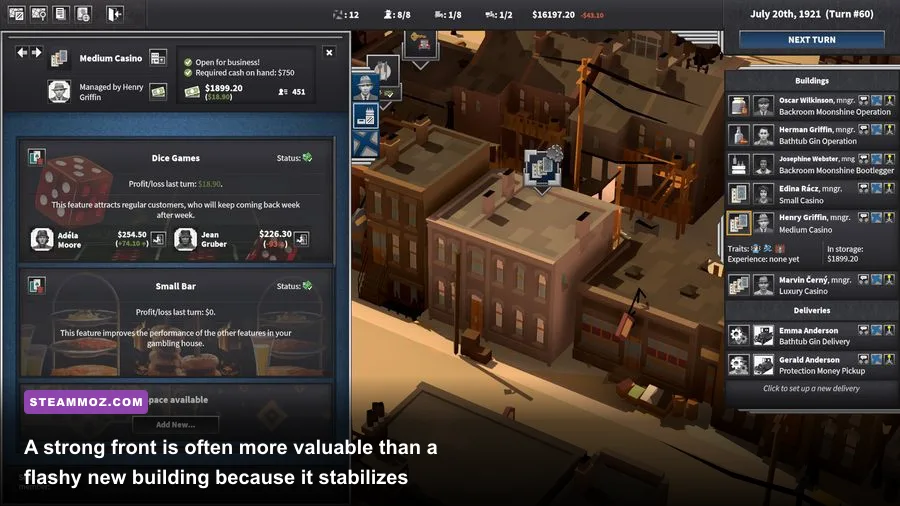
There is an important distinction between recognizable Atlantic City landmarks and secret gameplay locations. Landmarks help you orient yourself, but the game’s rewards are attached to interactions around districts, businesses, and contacts. You should sweep the boardwalk-facing area, the denser commercial blocks, and the less glamorous outer streets instead of assuming the most famous location contains the best prize.
The boardwalk and tourist-facing businesses
The boardwalk is attractive because it promises customers and visibility, but it is also expensive real estate. Check every nearby business interaction after the first round of local introductions. Tourist-facing operations can expose high-value demand, unusual customers, or a new favor chain. The catch is that these opportunities often need reliable deliveries and a broad product mix. Do not pour your starting cash into several fronts here. Establish one dependable outlet, then use the revenue to fund exploration elsewhere.
Commercial blocks and established fronts
Dense commercial areas are where hidden rewards become practical. Existing businesses can point toward suppliers, delivery partners, or contacts who dislike a rival. These locations are especially valuable because they reduce travel time. A secret supplier two blocks from your main production building is worth more than a theoretically better supplier across the map.
Outer neighborhoods and overlooked streets
Players often ignore the edge of the map because the buildings look less profitable. That is a mistake. Outer neighborhoods can contain cheaper operating space, safer routes, and contacts who are easier to satisfy. They are also useful for hiding low-profile production away from the busiest rival corridors. Check them whenever a rumor mentions a local worker, independent operator, or unusual source.
Do not waste turns clicking every decorative object. If a location has no interaction icon, no contact, and no relevant route connection, it is usually scenery rather than a secret reward. Atlantic City’s real secrets are signposted through people and business information.
| Area Type | Likely Opportunity | Main Risk | Recommended Timing |
|---|---|---|---|
| Boardwalk-facing district | Demand, customers, premium outlets | High overhead and exposed routes | After your first stable supply chain |
| Commercial center | Contacts, fronts, nearby deliveries | Competition and traffic congestion | Early to mid game |
| Outer neighborhood | Cheap space, quieter production, local favors | Longer routes and lower initial demand | Early scouting or specialist expansion |
| Rival-heavy corridor | Information and high-value customers | Retaliation, blocked access, wasted movement | Only with a reliable crew |
Hidden rewards from favors and rumor chains
Favors are the closest thing Atlantic City has to a secret-location key. The reward is rarely delivered immediately. Instead, a favor changes who will talk to you, what they will sell, or which operation becomes available. That delayed payoff is why players sometimes conclude that a mission gave them nothing.
Keep a simple note of every contact, their requested goods, and the district where you met them. This matters because a favor can become much easier after your supply network improves. If someone asks for a product you cannot currently produce, do not automatically reject the request. First check whether the item can be purchased, traded, or obtained through another contact. Abandoning a chain may remove the most useful follow-up.
Which rewards deserve priority?
Prioritize rewards that improve access rather than rewards that merely add another place to spend money. A new supplier, route shortcut, specialist, or dependable outlet can compound across the campaign. A one-time cash payment is helpful during the opening, but it will not fix a weak production chain.
Recruitment rewards are particularly valuable when they cover a role you are currently forcing another crew member to perform. A driver who improves delivery reliability, a negotiator who makes interactions cheaper, or a worker who unlocks a production option can save more money over time than a small immediate payout. Always compare the reward against your current bottleneck.
| Reward | Why It Matters | Best Campaign Stage | Common Mistake |
|---|---|---|---|
| New supplier access | Removes a production bottleneck | Early and mid game | Buying more than current demand supports |
| Specialist or recruit | Improves a weak crew role | Whenever a key task is failing | Hiring without checking upkeep and availability |
| New front or outlet | Creates another sales channel | After production is stable | Opening it before securing stock |
| Route or access advantage | Reduces delivery time and exposure | Mid to late game | Ignoring nearby protection and rival pressure |
| Cash or goods payout | Provides short-term liquidity | Opening turns or emergency recovery | Treating a temporary boost as a permanent solution |
The best way to trigger every discoverable opportunity
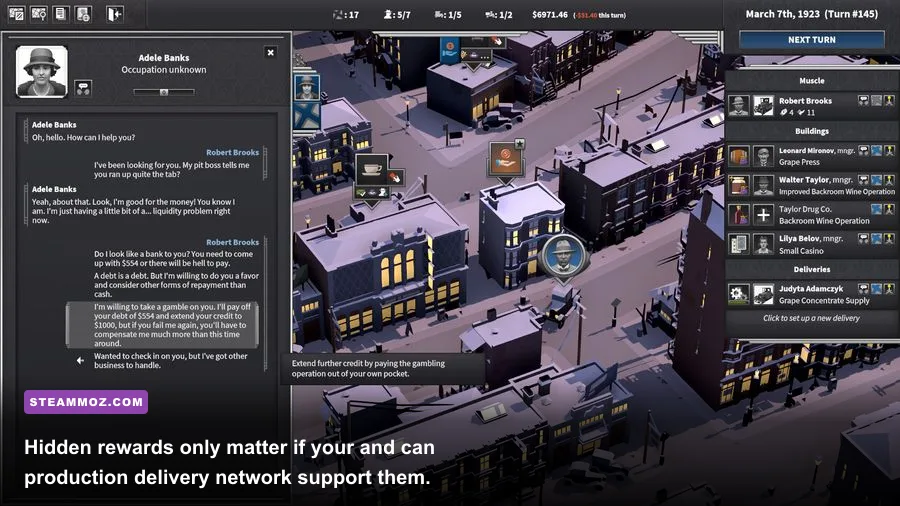
Start by building one compact operation instead of scattering buildings across Atlantic City. Put production, storage, and your first sales outlet close together. This gives you enough breathing room to spend turns on conversations and exploration. A sprawling empire looks impressive, but every unnecessary route creates another place for expenses and interruptions to hide.
Step 1: Establish a reliable core
Choose a product chain you can maintain with the suppliers currently visible. Keep enough stock for your existing customers, but do not fill every storage slot with goods that have no confirmed buyer. The goal is predictable income. Secret rewards are much easier to pursue when one failed delivery will not bankrupt you.
Step 2: Rotate contacts instead of ignoring them
When a contact appears, interact with them more than once if the game offers another conversation or favor. Several chains are gated behind relationship progress. You do not need to spam the same character every turn, but you should not leave a promising lead untouched while expanding into another district.
Step 3: Match the crew member to the job
Use the character best suited to the favor or interaction. A crew member who is excellent at moving goods may be a poor negotiator, while a social specialist may not be the person you want carrying a valuable shipment through hostile territory. Sending the wrong person can increase the cost, extend the task, or expose your operation.
Step 4: Keep one exploration slot open
Do not assign every available crew member to deliveries. Reserve at least one person for conversations, scouting, and sudden opportunities. This is especially important after a successful favor reveals a location that must be visited before the lead expires. The lost income from one idle turn is usually smaller than the value of a missed chain.
Step 5: Revisit old neighborhoods
Atlantic City changes as your reputation and network grow. Recheck earlier districts after major milestones, new recruits, and completed favor chains. A neighborhood that seemed empty at the beginning may now contain a new interaction because your organization can finally meet the requirement.
For a broader look at managing criminal networks, our secret locations and hidden rewards guide uses a similar principle: revisit areas after progression changes rather than treating the first visit as final. The same habit works here.
How to protect a hidden reward once you find it
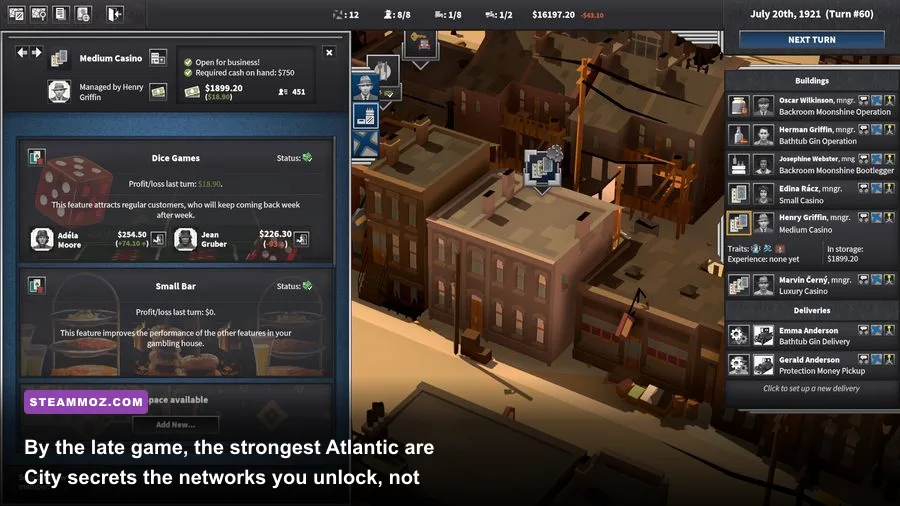
Finding an opportunity is only half the job. Atlantic City’s strongest rewards can damage your economy if you activate them before preparing the support network. Before opening a newly discovered front, check four things: incoming supply, customer demand, route length, and rival pressure.
Stock the minimum useful amount first. A new outlet that consumes a large delivery and sells slowly can tie up cash for several turns. Watch the sales rhythm, then expand only when the outlet proves it can pay for itself. If the reward is a specialist, make sure you have a task ready for them. Idle payroll is still payroll.
Protect the route, too. A hidden supplier is not valuable if every delivery crosses a rival’s strongest area. Shorter routes generally beat impressive-looking production bonuses because they reduce travel time and the number of turns during which something can go wrong. Build outward from your existing network rather than jumping to the opposite side of the map for a single reward.
| Before Activating a Reward | What to Check | Safe Target | Warning Sign |
|---|---|---|---|
| Supplier | Storage, demand, delivery frequency | Confirmed buyer and spare transport capacity | Goods will sit unused |
| Front | Upkeep, stock requirement, customer access | Existing production can support it | You need emergency purchases to open |
| Recruit | Role, upkeep, availability | Clear task that fixes a current bottleneck | Another specialist already covers the role |
| New route | Distance, rival territory, protection | Short route with a dependable return path | One interruption breaks the chain |
Common reasons a secret location seems missing
If a guide tells you to visit a landmark and nothing happens, the problem is usually not a bug. First, confirm that you are playing the Atlantic City content and not another map. Next, check whether the relevant rumor or favor was completed rather than merely accepted. Some opportunities do not activate until the character’s follow-up conversation is finished.
Also check the map at the correct zoom level. Dense districts can hide an interaction under building labels, especially after you establish several fronts close together. Pause the game, inspect the neighborhood one block at a time, and look for contacts rather than decorative landmarks.
Another common issue is a missing prerequisite. You may need the right product in storage, an available crew member, sufficient cash, or a relationship milestone. The game does not always present these requirements as a neat checklist, so read the conversation text carefully. If an interaction mentions a supplier, customer, or local operator, search for that person before searching for a literal secret building.
Finally, avoid save-scumming every conversation immediately. Some rewards are shaped by the choices and timing of the chain. Keep a manual save before a major favor if you want to test outcomes, but let the campaign breathe. Atlantic City is more interesting when you treat its rumors as a living network instead of a sequence of coordinates.
A clean completion route for Atlantic City
For the smoothest run, spend the opening on one compact production chain and basic cash flow. During the next phase, scout the boardwalk-facing businesses and nearby commercial blocks while maintaining your first outlet. Once you have a reliable reserve, begin accepting favors that reveal suppliers, specialists, and restricted fronts. Leave the outer neighborhoods for opportunities that require local influence or a longer route.
In the mid game, revisit every contact who helped you earlier. This is where many hidden rewards appear because your organization now has enough reach to satisfy more demanding requests. Open only the fronts that fit your existing supply chain, and use new recruits to remove the weakest role in your crew rather than simply increasing headcount.
By the late game, consolidate. Upgrade the routes that carry your most valuable goods, remove redundant outlets, and keep enough cash to handle sudden favor costs. The best Atlantic City campaign is not the one with the most icons on the map. It is the one where every front has a purpose and every secret reward strengthens a functioning network.
That measured approach also makes the scenario feel far less punishing. If you enjoy management games where small decisions snowball, Steamoz’s Dungeons 3 strategy tips and fast leveling and farming guide are worth a look.
So, the final answer to the “all secret locations” hunt is less glamorous but much more useful: inspect every meaningful contact, complete favor chains, revisit districts after progression milestones, and treat landmarks as orientation points rather than treasure markers. Atlantic City’s hidden rewards are buried in relationships and logistics. Build both, and the map will gradually give up nearly everything it has.