
Children of the Sun has one weapon: the Girl’s rifle. That means the best equipment ranking is really an ability tier list, with the standard rifle sitting in S-Tier and bullet-manipulation powers deciding whether a level collapses in one elegant chain or turns into a restart loop. There are no assault rifles, sniper variants, armor sets, damage attachments, or loot rolls to compare. Your “loadout” is the rifle plus the bullet abilities the current puzzle gives you.
That distinction matters. Treating this like a conventional shooter leads to the wrong questions: there is no higher-damage barrel to unlock and no scope that improves a hidden accuracy stat. Every shot is lethal when it lands correctly. The real ranking is based on control, routing value, reliability, and how many different level layouts an ability can solve. This guide ranks the rifle, the major ability types, and the practical combinations that make Children of the Sun tick.
For the official baseline, check the Children of the Sun Steam page and the developer’s official game information hub. If you enjoy puzzle-heavy stealth, Steamoz’s thoughts on Desperados III’s stealth design are a useful companion read.
Children of the Sun weapon tier list at a glance
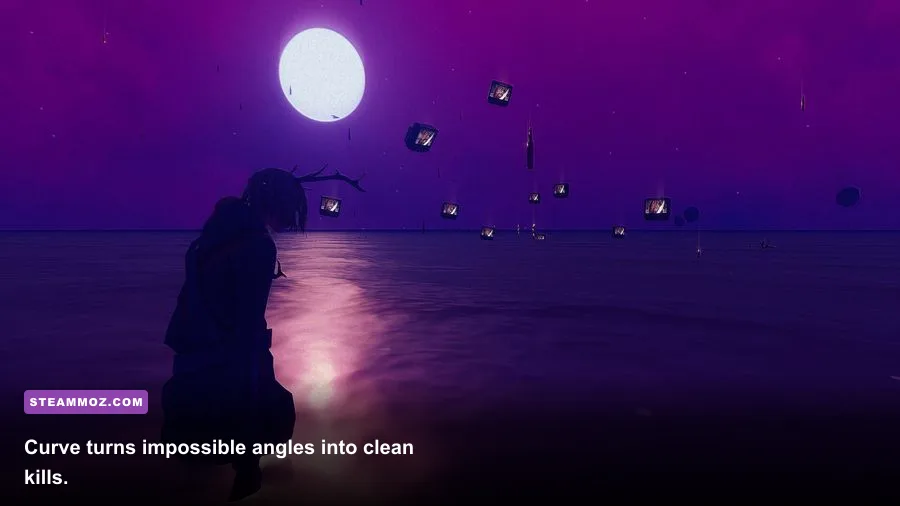
The rifle earns S-Tier because it is lethal, precise, and inseparable from the game’s central mechanic: controlling a fired bullet after the trigger pull. Calling it “basic” undersells it. The rifle is simultaneously your sniper, puzzle key, traversal tool, and resource-management system.
The most important point is that Children of the Sun does not use conventional weapon statistics. You will not find damage numbers, fire-rate upgrades, reload-speed attachments, rarity colors, or weapon level requirements. A cultist dies when the bullet reaches a valid hit location; a vehicle, explosive object, or environmental target behaves according to the puzzle’s rules. Ranking an imaginary shotgun or SMG would be misleading.
| Rank | Weapon or equipment type | Why it ranks here | Best use |
|---|---|---|---|
| S-Tier | The Girl’s rifle | Always lethal, precise, and central to every puzzle | Opening the chain and delivering the final hit |
| S-Tier | Bullet control abilities | Rewrite trajectory after firing and solve blocked angles | Redirecting shots through layered target routes |
| A-Tier | Reload or bullet-refill effects | Creates a second attempt inside a single solution | Recovering from a spent bullet or extending a chain |
| A-Tier | Piercing effects | Converts enemy alignment into multiple kills | Rows of targets and dense compounds |
| B-Tier | Scope and precision aids | Helpful for lineups, but does not solve bad routing | Long sightlines and tiny target windows |
| C-Tier | Imaginary weapon upgrades | They do not exist in the game | Do not waste time looking for loot or attachments |
This ranking is less about “power” than flexibility. A piercing shot can look stronger than a curve, but it only shines when targets line up. A curve can solve a wider range of layouts because it changes the geometry of the entire shot. Refill effects are less flashy, yet they can be the difference between a clean level clear and a failed run when your first target order was wrong.

🎮 Children of the Sun
Looking to experience this game? Grab your digital key directly on our store for $5.99.
View on Steammoz Store →S-Tier abilities: curve and bullet control
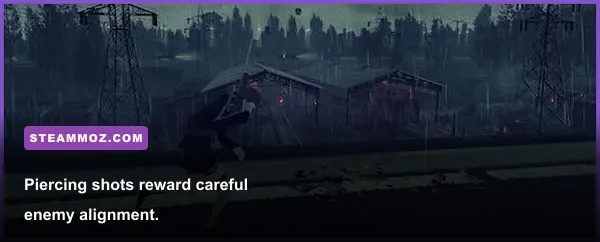
Curve is the standout ability in the Children of the Sun weapon tier list. It lets you bend the projectile’s path after firing, creating a controllable arc around cover, across a gap, or toward a target that the initial sightline could never reach. The best players don’t use it as a panic correction. They fire with the curve already imagined, then make a deliberate adjustment at the moment the bullet needs to turn.
Its strength comes from solving two problems at once. First, it fixes an awkward angle. Second, it lets you plan a route through multiple targets rather than treating each cultist as an isolated shot. A bullet may begin on one side of a structure, curve around the obstruction, strike a target, and continue into the next part of the puzzle. That makes curve the most broadly useful ability, especially on levels built around buildings, elevation changes, and concealed enemies.
Bullet control is similarly S-Tier because it changes the relationship between aim and timing. The initial shot only begins the solution. Once the projectile is in flight, you can steer it toward a target, adjust around geometry, and make a late correction that a normal sniper game would never permit. This is why the rifle feels more like a cursor for a physics puzzle than a traditional firearm.
There is a catch: control is not free from mistakes. A late turn can send the bullet past the intended hitbox, clip the wrong object, or break the order needed to activate the next opportunity. Before firing, identify the first target, the likely continuation, and the point where the bullet must change direction. If you cannot describe that route in your head, the shot probably isn’t ready.
For a practical routine, start with the target that gives the bullet the most useful future angle. Don’t automatically shoot the nearest cultist. Kill the enemy whose position opens the route to the vehicle, explosive object, elevated platform, or second target you need next. This “route first, kill second” mindset is the biggest jump between early attempts and expert clears.
A-Tier equipment: piercing and refill effects

Piercing sits just below curve because its ceiling is enormous but its conditions are narrower. When enemies stand in a clean line, a piercing bullet can remove several problems with one trigger pull. It is especially valuable in compounds where guards overlap from your firing position or where the level clearly presents a row of targets as a geometric clue.
The mistake is assuming piercing automatically makes every shot better. A multi-kill route still needs correct sequencing. If the first enemy’s death changes the scene, blocks the projectile, triggers movement, or leaves the bullet at a useless angle, the extra penetration does not help. Think of piercing as a multiplier for a solved route, not a substitute for solving it.
Reload or refill effects are A-Tier for a different reason: they expand your margin for error. The game’s levels are designed around limited shots and exact chains, so generating another bullet can unlock a route that looked impossible one second earlier. Refill is strongest when the first shot can be spent on setup rather than a final kill—such as clearing an obstacle, activating a target, or repositioning the puzzle state.
Use refill early when it creates a demonstrable advantage. Holding it forever is a common trap. If the ability can produce another projectile only after a specific interaction, build your route around that interaction and make sure the replacement bullet has a target. An extra round without a safe angle is just a more complicated failure.
| Ability type | Tier | Strength | Common failure | Ideal setup |
|---|---|---|---|---|
| Curve | S | Handles cover, corners, and changing angles | Turning too late or overcorrecting | Obstructed targets and branching routes |
| Bullet control | S | Lets you steer after the shot | Trying to improvise without a planned route | Long chains with precise timing |
| Pierce | A | Multiple kills on a shared line | Ignoring target order and bullet exit angle | Rows of cultists or aligned targets |
| Refill | A | Extends a one-bullet solution into a chain | Saving it without a usable follow-up | Levels with a clear resupply interaction |
| Scope or precision aid | B | Improves visual confidence at distance | Confusing accuracy with a solved puzzle | Small targets and long sightlines |
How to build the best rifle loadout for each puzzle
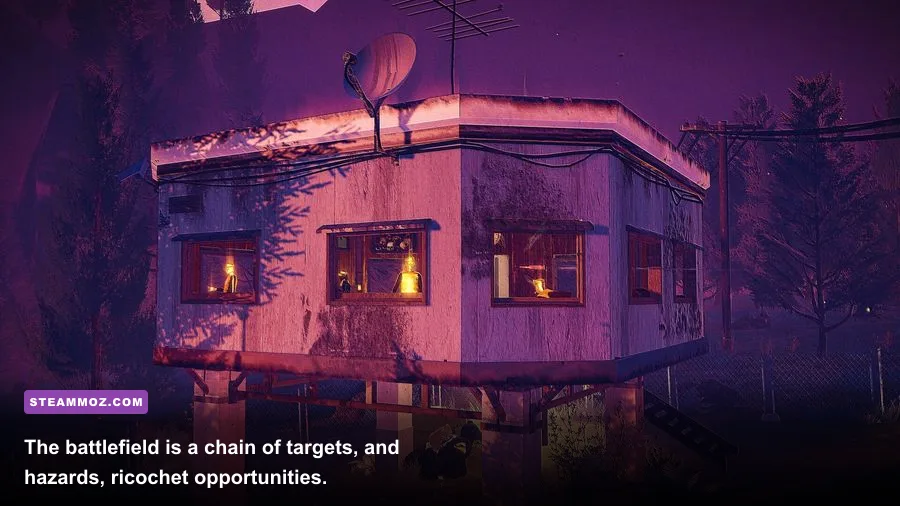
There is no permanent loadout screen, so your best build changes from level to level. The strongest “build” is a decision order: identify the required ability, map the bullet’s complete path, then fire only when every interaction has a purpose. This is closer to preparing a speedrun line than assembling a character class.
The control build
Prioritize curve and bullet control when the map contains walls, vehicles, elevated structures, or targets hidden behind cover. Start from the final kill and work backward. Ask what angle the last target requires, then determine which earlier enemy leaves the bullet in that position. This reverse planning prevents the classic error of opening with the easiest visible target and discovering that the rest of the level has no legal continuation.
The penetration build
Choose piercing when the visual layout offers alignment. Look for silhouettes that overlap, enemies standing on the same road, or targets arranged along a predictable horizontal or vertical lane. Don’t spend the piercing shot on a lone cultist unless that kill also creates the next line. The ability’s value comes from compression: one projectile, multiple confirmed hits, and fewer opportunities for the puzzle state to drift.
The recovery build
Refill belongs in levels where the first bullet can unlock a second firing opportunity. Use the opening shot as a key, not necessarily as damage. Once the resupply condition is active, switch your thinking from “How do I finish with this bullet?” to “What does the new bullet make possible?” That shift often reveals a route through enemies that were deliberately placed too far apart for a single conventional chain.
| Puzzle layout | Priority | Opening target | Winning plan |
|---|---|---|---|
| Heavy cover and corners | Curve, then control | Target that creates the best turning angle | Bend around cover and preserve the exit route |
| Several enemies in a row | Pierce | End of the line if it preserves alignment | Send one projectile through the full formation |
| Few targets but limited ammunition | Control or refill | Interaction that expands the shot count | Use setup kills to create a second opportunity |
| Long-range exposed target | Precision aid | Safest visible target | Stabilize the first hit before attempting the chain |
| Moving or timing-sensitive route | Control | Target with the most predictable telegraph | Fire on the timing cue and steer during flight |
The game’s scoring also rewards clean solutions, so avoid treating every successful clear as equally good. A route that uses fewer shots, fewer restarts, and a shorter chain is usually more robust. If you’re stuck, reset and change the first target rather than repeatedly nudging the same doomed bullet.
Enemy telegraphs, environmental hazards, and shot timing
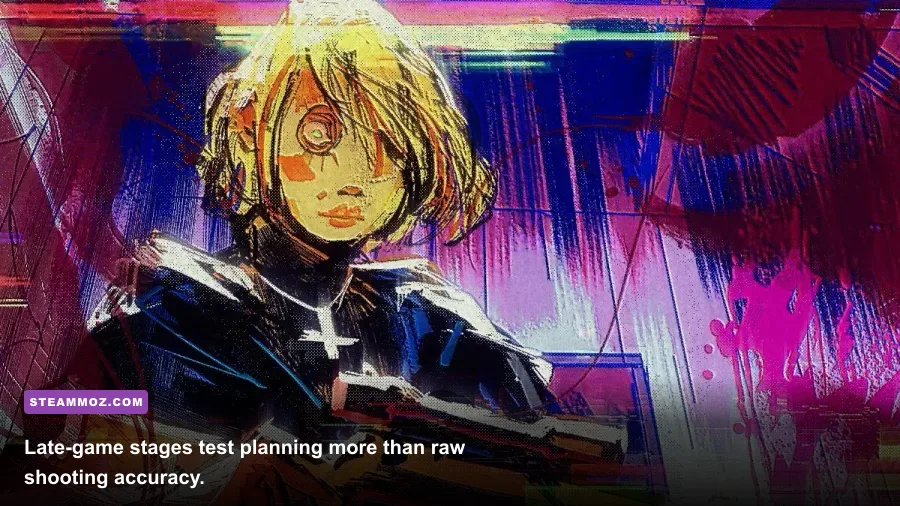
Enemies are dangerous less because they have elaborate health bars and more because their placement turns the level into a timing machine. Watch patrol routes, sightlines, vehicles, explosive objects, and any movement that can alter the bullet’s path. The correct shot is often determined by what a target will do next, not where it stands at the instant you aim.
Use the camera to inspect the whole battlefield before committing. Mark the obvious kill, then deliberately ignore it for a moment. Search for the target that can be reached only after the first impact, the object that changes the route, and the enemy whose movement creates a temporary opening. This is why blind speed is unreliable in Children of the Sun: the game wants observation before execution.
Explosive objects deserve special attention. They can function as indirect weapons, route openers, or timing tools, depending on the layout. If an explosion is part of the intended chain, confirm what it changes before firing. A spectacular detonation that removes the wrong target can be a failure even when the shot looks brilliant.
For performance, the game’s stylized presentation is generally light on hardware, but a stable frame rate still matters when steering a projectile through a narrow opening. On PC, prioritize a consistent refresh over maximum effects. Keep motion blur off if you want cleaner visual tracking, use native resolution, and cap the frame rate to a value your system can hold without spikes. The bullet’s path is deterministic; input stutter is the only thing that should feel unpredictable.
| Setting or habit | Recommended value | Gameplay impact | Why it matters |
|---|---|---|---|
| Resolution | Native display resolution | Clear target silhouettes | Small enemies and gaps are easier to read |
| Frame-rate cap | Stable monitor-matched cap | Consistent steering input | Predictable bullet control beats unstable peaks |
| Motion blur | Off | Sharper projectile tracking | Reduces visual smear during corrections |
| Mouse sensitivity | Comfortable, repeatable value | More controlled camera checks | Pre-shot scouting is as important as aiming |
| Camera inspection | Full battlefield scan | Fewer restarts | Reveals target order and environmental links |
For more PC optimization advice, Steamoz’s Dragonkin settings guide covers the same principle: stable performance is more valuable than a flashy but inconsistent preset.
The final verdict on Children of the Sun’s best equipment
If you came looking for the best gun, the answer is simple: use the rifle. It is the entire game’s weapon platform, and its fixed lethality means no sidearm can improve the fundamentals. The meaningful ranking is curve and bullet control in S-Tier, piercing and refill effects in A-Tier, and precision aids in B-Tier when the level’s geometry supports them.
The best overall setup is therefore not a damage build. It’s a route-planning build. Scout the compound, identify the final target, work backward through the required chain, and choose the ability that preserves the most options. Curve is the safest all-rounder, control is the highest-skill tool, piercing is the best specialist option, and refill is the strongest insurance policy when the puzzle offers a legitimate resupply route.
That design is also why the game stays compelling after you understand its weapons. There’s no loot treadmill to flatten the challenge. Every improvement comes from reading the level faster, choosing a smarter first shot, and steering the bullet with more confidence. If you want a progression system based on player mastery rather than equipment rarity, Children of the Sun is an unusually clean hit.
For another Steamoz progression-focused guide, see how Deponia handles progression without traditional leveling. And if you’re comparing tactical puzzle games, our Dungeons 2 weapon tier list shows just how different a conventional equipment system can feel.
Bottom line: rank the rifle S-Tier, master curve and bullet control first, reserve piercing for clean target lines, and use refill effects to extend a planned route—not to rescue random shots. In Children of the Sun, the best equipment is the ability that gives your next bullet somewhere brilliant to go.