
If you’re searching for a Chaser fast leveling and gold farming guide, here’s the crucial answer first: the 2003 PC shooter Chaser has no character-level system, no experience points, no gold currency, and no farmable loot economy. Progress comes from finishing missions, finding weapons and ammunition, learning enemy triggers, and reaching checkpoints efficiently. The fastest “farm” is therefore a clean campaign route with minimal deaths and disciplined resource use.
That distinction matters because many modern search results use RPG language for games that simply don’t have those mechanics. Chaser, developed by Cauldron and published by JoWooD, is a linear science-fiction FPS in the tradition of Half-Life and Return to Castle Wolfenstein. You don’t improve John Chaser through XP or gold. You improve your run by getting better at the firefights.
For the original release details, system information, and community patches, start with the game’s official Steam listing. If you want a broader look at older PC shooters, Steamoz’s Dungeon Siege review is also a useful contrast: that game genuinely has RPG progression, while Chaser does not.
What “Leveling” Means in Chaser
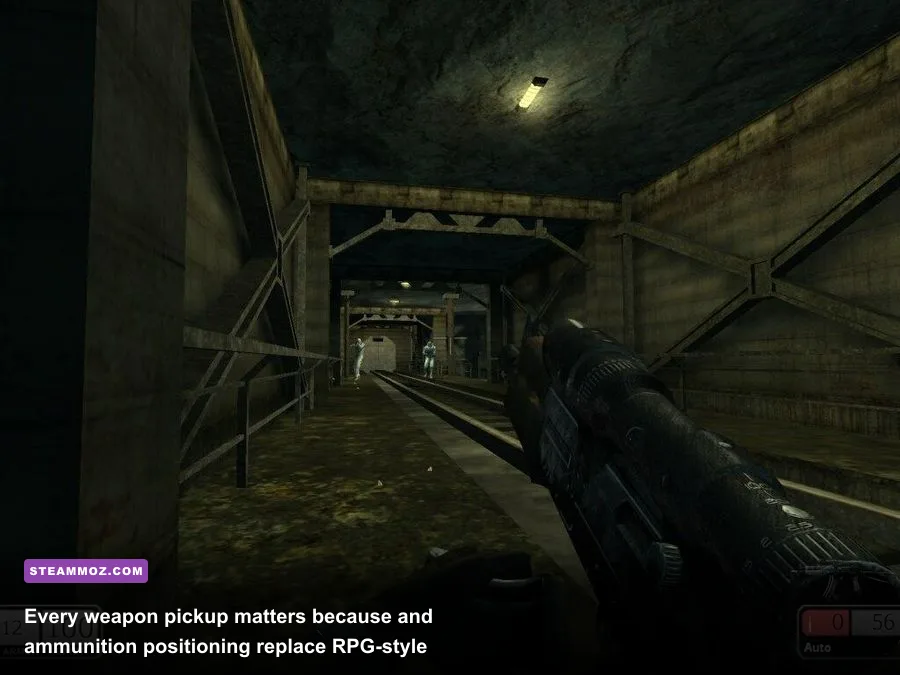
Chaser’s campaign is divided into missions and set-piece encounters rather than character levels. There is no strength, armor, accuracy, stamina, or skill-tree screen. John Chaser’s combat performance never increases numerically. A pistol at the beginning of the game remains the same pistol later on; the difference is how you use it and which enemies you’re facing.
The practical progression system has four parts:
- Mission completion: advancing objectives unlocks the next section of the campaign.
- Checkpoint progress: reaching a save point is more valuable than replaying an earlier fight for imaginary rewards.
- Weapon access: new weapons expand your options, but they are pickups, not permanent unlocks.
- Player knowledge: memorizing ambushes, explosive locations, patrol lanes, and enemy entrances is the closest thing Chaser has to leveling.
That makes the ideal route very different from an RPG grind. Replaying the same hallway will not generate XP, credits, or improved statistics. If you’re stuck, the solution is usually a better angle, a different weapon, or more conservative ammunition management—not another hour of farming.
| Modern RPG Expectation | Chaser Equivalent | Best Optimization |
|---|---|---|
| XP and character levels | Mission and checkpoint progress | Reach objectives without dying |
| Gold farming | No currency system | Preserve ammunition and health |
| Loot upgrades | Temporary weapon pickups | Match each weapon to the encounter |
| Skill build | Player route and aim discipline | Practice enemy patterns |
For comparison, Steamoz’s Empires of the Undergrowth farming guide covers a game where resource growth is real and measurable. Chaser’s economy is entirely tactical: every wasted magazine can make the next checkpoint harder.

🎮 Chaser
Looking to experience this game? Grab your digital key directly on our store for $1.24.
View on Steammoz Store →The Fastest Campaign Progression Route
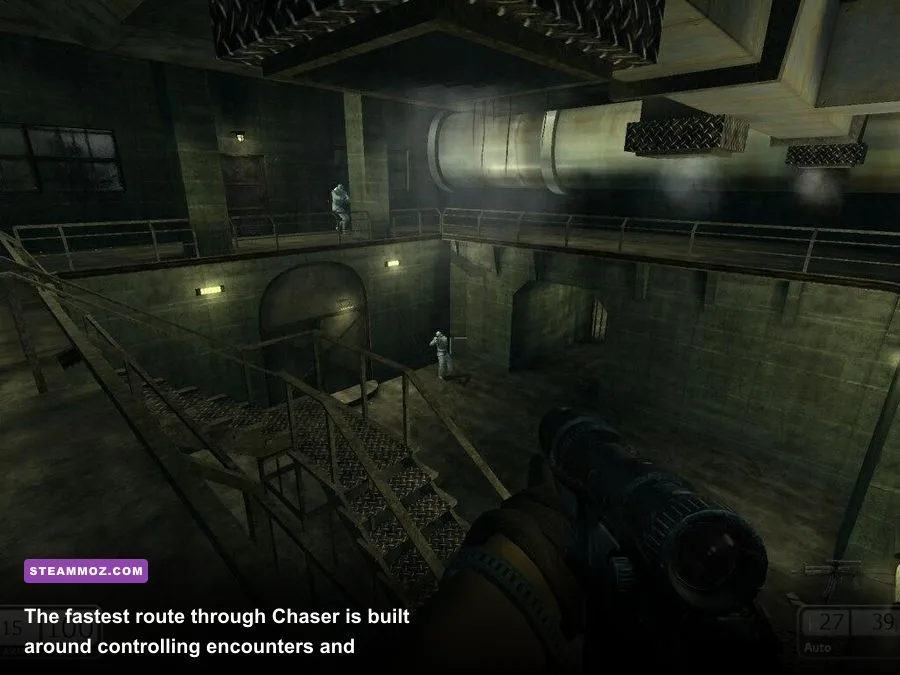
There isn’t a universal speedrun route that lets you skip the whole campaign, but there is a reliable method for moving through Chaser quickly. Play on the lowest difficulty while learning the map, then raise the difficulty only after you can clear the major encounters without burning through your reserve ammunition.
1. Push objectives, not bodies
Most ordinary enemies are not worth hunting once the route forward is open. Chaser rewards reaching the next trigger, door, elevator, or scripted event. Clear enemies that block movement, threaten your retreat, or carry useful ammunition. Ignore stragglers behind you unless the game seals the area.
2. Save before every expensive encounter
Use manual saves where the game allows them, and treat automatic checkpoints as route markers. Before a large firefight, reload until you can enter with a healthy weapon spread, a reasonable health reserve, and enough ammunition for the next room. Repeating a fight with ten health and an empty magazine is not efficient progress.
3. Learn the trigger line
Chaser frequently activates enemies when you cross a doorway, approach an objective, climb stairs, or collect a key item. Stop just before those points and reload your weapons. The best opening shot is often available before the enemy group fully spreads out.
4. Use cover that actually breaks sightlines
Thin scenery is unreliable. Concrete corners, door frames, large machinery, and heavy crates are safer than decorative railings or low barriers. Peek, fire a short burst, retreat, and reload behind cover. Chaser’s older AI can be dangerous in a group, but it becomes manageable when only one or two enemies can see you.
5. Restart bad attempts early
If you lose most of your armor or waste rare ammunition in the first half of a checkpoint, restart immediately. A fast run is not the run with the fewest reloads; it’s the run that reaches each checkpoint with enough resources to survive the next sequence.
| Encounter Type | Primary Danger | Efficient Response | Resource Rule |
|---|---|---|---|
| Open courtyard | Multiple firing angles | Move from hard cover to hard cover | Use rifle bursts, not panic spray |
| Narrow corridor | Close-range ambush | Pre-aim doorways and corners | Keep shotgun shells available |
| Scripted assault | Enemies spawning behind or ahead | Identify the retreat lane first | Save explosives for clustered targets |
| Armored target | High damage and pressure | Break line of sight and reposition | Reserve heavy weapons for confirmed threats |
Weapons That Replace a Gold-Farming Build

Chaser’s weapon progression is temporary and situational, but the arsenal still has a clear hierarchy. The Glock 17 is dependable for conserving ammunition and finishing weakened enemies. The MP5 is useful when you need controllable automatic fire, while the M4A1 gives you better reach and stopping power in open areas. The AK-47 hits hard but is less forgiving when you hold the trigger too long.
The SPAS-12 is one of the most valuable close-range tools in the campaign. Don’t waste shells on distant targets. Wait until an enemy commits to a doorway or corner, then fire and retreat. The shotgun’s real advantage is not theoretical damage; it’s the ability to end a dangerous close-range exchange before several enemies can surround you.
Heavy weapons, including the M249, M134 Minigun, and RPG-7, should be treated as encounter solutions rather than everyday equipment. The minigun is excellent against dense groups and tougher targets, but its ammunition disappears quickly. The RPG-7 is strongest when an enemy is stationary, clustered, or protected by a predictable firing position. Using a rocket on a lone unarmored soldier is the Chaser equivalent of throwing gold into a river.
| Weapon | Best Use | Weakness | Farming-Route Advice |
|---|---|---|---|
| Glock 17 | Finishing isolated enemies | Low burst damage | Use it whenever precision matters more than speed |
| MP5 | Medium-range suppression | Ammo can vanish quickly | Fire short bursts and collect compatible ammunition |
| M4A1 | Flexible open-area combat | Less efficient when sprayed | Make it your default rifle when available |
| SPAS-12 | Doorways and tight corridors | Poor long-range performance | Keep shells for ambushes and rushing enemies |
| AK-47 | High-damage mid-range fights | Recoil and spread | Tap-fire instead of holding the trigger |
| RPG-7 | Clusters and heavy threats | Scarce ammunition and splash damage | Save it for scripted pressure points |
The core loadout rule is simple: carry one accurate weapon, one close-range answer, and one emergency option. Cycling constantly between guns can leave you with several half-empty magazines and no weapon ready for the next threat.
How to “Farm” Resources Without Wasting Time
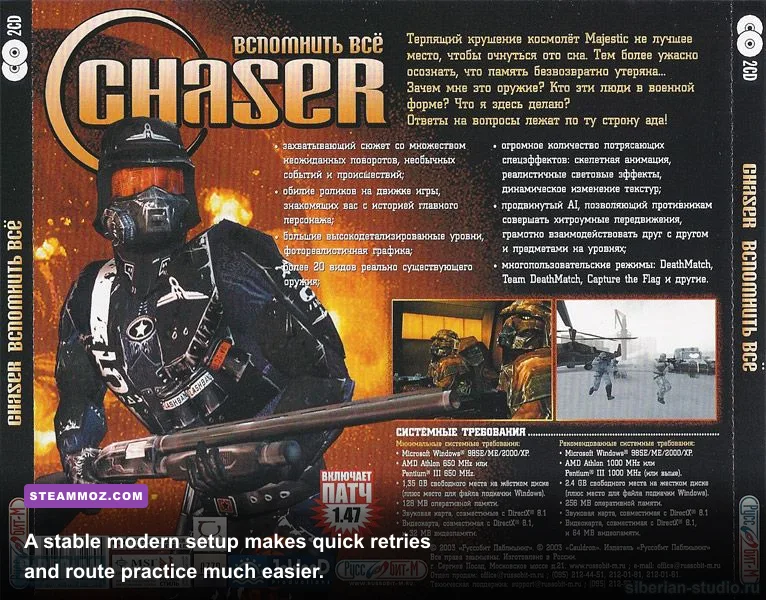
Since gold does not exist, resource farming in Chaser means manipulating what the campaign gives you. Ammunition pickups are fixed rather than randomly generated, so the most efficient strategy is to avoid spending scarce rounds where a cheaper weapon will do.
Use pistol ammunition on lone, exposed enemies whenever possible. Switch to the MP5 or M4A1 for groups at medium range, but fire in controlled bursts. The shotgun should handle enemies who cross your minimum safe distance. Explosives are most efficient when they damage multiple targets or let you skip a prolonged exchange.
Health and armor should be viewed as route insurance. Taking a small amount of damage to cross an exposed gap can be correct if stopping to trade shots would consume an entire magazine. Taking damage because you refused to use cover is not. The difference is whether the hit buys you position and progress.
Chaser’s checkpoints also create a useful practice loop:
- Enter the section and identify where enemies appear.
- Die or reload after learning the encounter’s sequence.
- Repeat the opening with weapons pre-selected and grenades ready.
- Clear the section while spending the fewest expensive rounds possible.
- Reach the next checkpoint, then save and reset your expectations for the next area.
This is especially useful on higher difficulties, where poor early decisions compound. Don’t chase a perfect no-damage run immediately. First learn the map, then optimize ammunition, then refine movement. That order saves far more time than blindly restarting.
Settings, Mods, and a Practical Progression Plan
Modern hardware can run Chaser easily, but the old engine may behave better with community fixes than with raw maximum settings. Use the Steam version as your starting point, verify the installation, and check the community hub for compatibility notes before installing unofficial files. For broader PC troubleshooting habits, Steamoz’s ELEX PC fixes guide offers useful general advice for older games.
| Setting or Habit | Recommended Choice | Why It Helps | Trade-Off |
|---|---|---|---|
| Resolution | Native monitor resolution | Cleaner target visibility | May expose UI scaling issues |
| Frame rate | Stable cap matching your display | Consistent mouse response | Less peak FPS than uncapped mode |
| Texture quality | Highest stable option | Improves enemy and weapon readability | Minimal modern performance cost |
| Background overlays | Disable unnecessary overlays | Reduces old-engine conflicts | Fewer quick-access features |
| Save routine | Save at every safe checkpoint | Protects route progress | Can create cluttered save files |
For a clean progression plan, play the first run as reconnaissance. Don’t worry about speed. Mark where the campaign hands you the SPAS-12, assault rifles, explosives, and heavy weapons. On the second run, skip optional firefights and enter every scripted encounter with the correct tool equipped. On the third, optimize movement and reload timing.
That’s the honest Chaser fast leveling and gold farming guide: there’s no currency loop to exploit and no character sheet to power up. The winning loop is knowledge, ammunition discipline, checkpoint control, and faster decisions. If you came from a game with real gold systems, Steamoz’s Dungeons 2 leveling route is the kind of guide you were probably expecting. In Chaser, though, the closest thing to getting rich is finishing a mission with bullets left in the magazine.
For archival information about the developer and the game’s original release, consult Chaser’s MobyGames record and the IGDB game page. Neither changes the central answer, but both help separate the 2003 campaign from newer games that happen to share the Chaser name.