The fastest way to level in Call of Juarez: Gunslinger is to replay short Story chapters and Arcade scenarios while chaining headshots, maintaining combos, and collecting every available skill point. The “gold farming” part needs one important correction: Gunslinger has no spendable gold currency. Its gold nuggets are collectible lore items, so the efficient route is a mix of high-XP combat runs and a chapter-by-chapter collectible sweep.
That distinction matters because a lot of modern farming advice gets pasted onto a game that simply doesn’t work that way. You aren’t saving gold to buy a better revolver, and there’s no vendor economy to exploit. Your real progression currencies are experience and skill points, while Nuggets of Truth expand the game’s historical gallery. Once you understand that loop, leveling Silas Greaves becomes much more straightforward.

What You Can Actually Farm in Gunslinger
Call of Juarez: Gunslinger has three progression targets: experience, skill points, and Nuggets of Truth. Experience fills the level bar during Story and Arcade play. When Silas levels up, you receive a skill point to spend in one of three branches: Gunslinger, Ranger, or Trapper. Nuggets of Truth are fixed collectibles hidden throughout Story chapters; they unlock entries about real people, weapons, and events from the Old West.
There’s no random loot table, weapon shop, gold counter, or repeatable contract system. A “gold run” therefore means either collecting every nugget efficiently or earning the profile progression tied to strong combat performance. If you were hoping to buy permanent damage upgrades with cash, don’t waste time searching menus. The game’s power comes from skills, weapon handling, and your ability to keep a kill chain alive.
| Progression Target | How You Earn It | What It Unlocks | Best Farming Method |
|---|---|---|---|
| Experience | Enemy kills, headshots, combos, chapter completion | Level-ups and skill points | Replay dense Story chapters and Arcade stages |
| Skill Points | Leveling up | Gunslinger, Ranger, and Trapper abilities | High-accuracy runs with long kill streaks |
| Nuggets of Truth | Hidden pickups in Story chapters | Historical gallery entries | Use chapter replays and sweep each route |
| Arcade Stars | Score, speed, accuracy, and combo performance | Arcade ranking progress | Replay short scenarios after learning spawns |
The game’s official Steam page confirms the core structure: a campaign built around bounty hunting, gunplay, and legendary outlaws rather than an RPG economy. That’s why a focused replay plan beats wandering through missions looking for nonexistent shops.
🎮 Call of Juarez: Gunslinger
Looking to experience this game? Grab your digital key directly on our store for $2.99.
View on Steammoz Store →The Fastest XP Route for a Fresh Save
Start with the Story, not random Arcade attempts
For a new save, play through Story on the difficulty that lets you land reliable headshots. The first run teaches enemy placements, scripted ambushes, and weapon pickups, all of which are more valuable than forcing a harder difficulty and repeatedly dying. Gunslinger’s enemies often appear in predictable waves, so knowledge compounds quickly on replays.
During the opening chapters, spend your first points on consistency rather than flashy dueling tricks. The Gunslinger branch is the best general-purpose starting path because it supports revolver accuracy, reload handling, and Dead Eye-style precision. The Ranger branch becomes excellent when you prefer rifles and long sightlines, while Trapper is the better choice for players who regularly use shotguns and close-range weapons.
Replay dense combat chapters
After finishing a chapter, return through the chapter-select menu and target sections with several consecutive shootouts. The ideal run has three qualities: enemies arrive quickly, the route has little walking, and you can preserve a combo between waves. Don’t restart after one missed headshot. A living combo with body shots is usually worth more than throwing away a good run chasing perfection.
Use cover as a reset button, not as a permanent parking spot. Peek, shoot, duck, reload, and move to the next angle. The game’s comic-book kill narration and brief slow-motion moments can make a firefight feel chaotic, but the underlying rhythm is simple: remove the most exposed target, identify the next spawn, and keep your reticle at head height before the wave arrives.
Switch to Arcade when your route is learned
Arcade Mode is where experienced players can sharpen the farm. It strips the campaign down to score-focused combat scenarios, making it easier to repeat a short sequence without replaying dialogue and traversal. Your best Arcade route is not necessarily the mission with the most enemies. It’s the one where you can finish quickly while preserving accuracy and a long multiplier.
| Run Type | Best For | Priority | Main Mistake to Avoid |
|---|---|---|---|
| First Story clear | Learning routes and unlocking progression | Survival, headshots, collectibles | Ignoring cover while chasing a combo |
| Story chapter replay | Reliable XP and Nuggets of Truth | Dense waves and fixed pickup routes | Repeating long chapters with little combat |
| Arcade scenario | Fast score-focused repetition | Accuracy, speed, kill streaks | Using slow weapons without a safe reload plan |
| Legendary Duel replay | Timing practice and challenge progress | Centering, draw timing, clean hits | Firing before the opponent’s tell |
For comparison, the same principle appears in our fast leveling and gold farming guide for Empires of the Undergrowth: repeatability matters more than theoretical maximum rewards. In Gunslinger, a clean five-minute scenario you can execute consistently will beat a messy, longer mission every time.
How to Build Silas for Faster Farming
Gunslinger branch: the safest all-rounder
Put early points into the Gunslinger path if revolvers are your comfort zone. Revolvers are flexible, quick to ready, and forgiving when enemies rush your position. The branch’s value is less about one spectacular ability and more about reducing the number of awkward moments: missed follow-up shots, slow reload windows, and lost combos.
Pair that path with Dead Eye whenever several enemies expose themselves at once. Don’t activate it for a single target unless that target is dangerous or about to break your cover. The best Dead Eye use is a controlled multi-kill that removes a wave before the game can surround you. Aim for the head, but prioritize guaranteed hits over cinematic overconfidence.
Ranger branch: the accuracy specialist
Ranger is ideal for open spaces, rooftops, and long lanes where rifles can work safely. It rewards players who naturally pause between shots and who can track distant targets without panic-firing. A rifle headshot can stabilize a wave before the close-range enemies start moving, but the trade-off is obvious: a missed shot costs more time than a missed revolver round.
Choose Ranger when your Arcade route has generous sightlines. If enemies constantly flank you through doorways, a pure rifle approach can slow the farm. A hybrid setup works well: use rifle precision to open an encounter, then swap to a revolver when the wave collapses into close quarters.
Trapper branch: close-range burst damage
Trapper shines when you’re comfortable letting enemies approach. Shotguns can delete a nearby threat and make cramped interiors less dangerous, but they demand better positioning. Reloading after every engagement will destroy your tempo, so pick up another weapon when the opportunity is safe and keep moving.
| Skill Path | Primary Weapons | Strength | Best Farming Situation |
|---|---|---|---|
| Gunslinger | Revolvers | Fast handling and flexible follow-up shots | Mixed enemy waves and medium-range arenas |
| Ranger | Rifles | Reliable long-range kills | Open terrain, rooftops, and elevated positions |
| Trapper | Shotguns | Heavy close-range burst | Interior fights and aggressive enemy pushes |
Don’t respec mentally every time a run goes badly. The strongest build is the one that matches your route and aim. If your accuracy is inconsistent, Gunslinger gives you the widest safety net. If you’re already landing clean rifle shots, Ranger can shorten encounters dramatically. Trapper is devastating, but it punishes careless reloads more harshly than the other two branches.
Gold Nugget Farming Without Missing Pickups
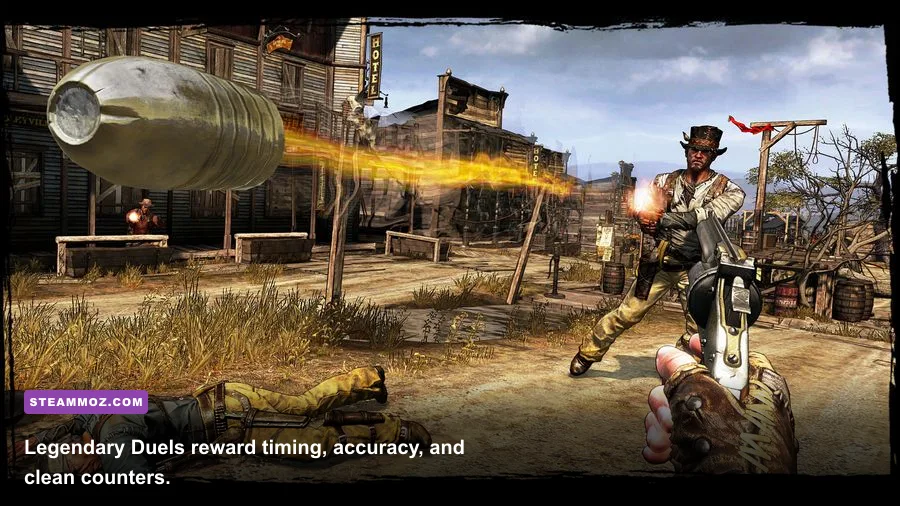
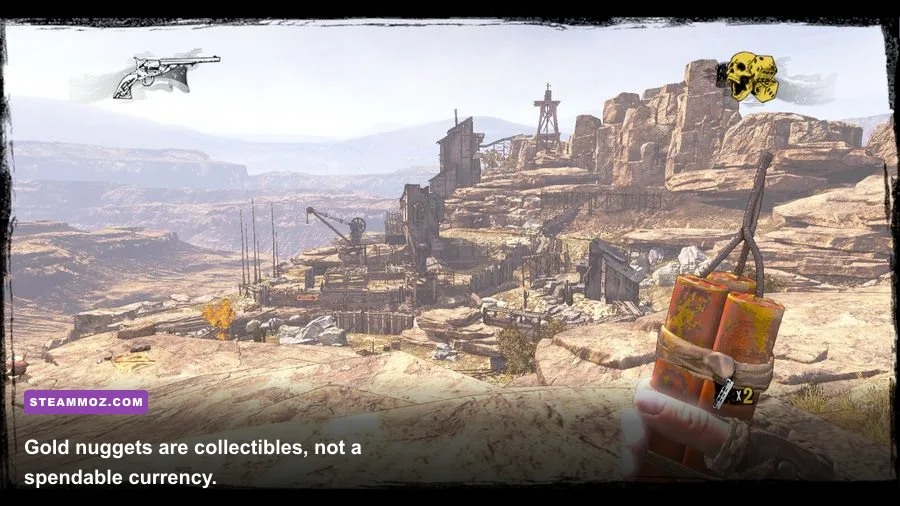
Gold nuggets are fixed collectibles, so there’s no random farming route. The efficient method is a dedicated cleanup pass after your first Story clear. Replaying chapters lets you focus on exploration instead of combat discovery, and the game’s collectible progress makes it easy to identify which chapters still need attention.
Use a two-pass system
On pass one, play normally and grab an obvious nugget whenever it sits directly on your route. Don’t abandon a good combat position to search a side room while enemies are spawning. On pass two, select each incomplete chapter and move slowly through every branch before triggering the next obvious story beat.
Look above eye level, behind cover, along dead-end paths, and inside small side rooms. Western set dressing is deliberately busy: balconies, wagons, mine tunnels, saloons, and wooden platforms can hide a pickup in plain sight. If a chapter suddenly locks you into a major arena, sweep the accessible side areas first. Once a scripted sequence begins, backtracking may not be possible.
Keep a simple checklist by chapter rather than relying on memory. The collectible hunt is much less frustrating when you know you’re missing one nugget in a specific mission instead of rechecking the entire campaign. For broader collectible-planning habits, our hidden rewards guide for Dragonkin uses the same kind of route-first approach.
Combo, Headshot, and Dead Eye Technique
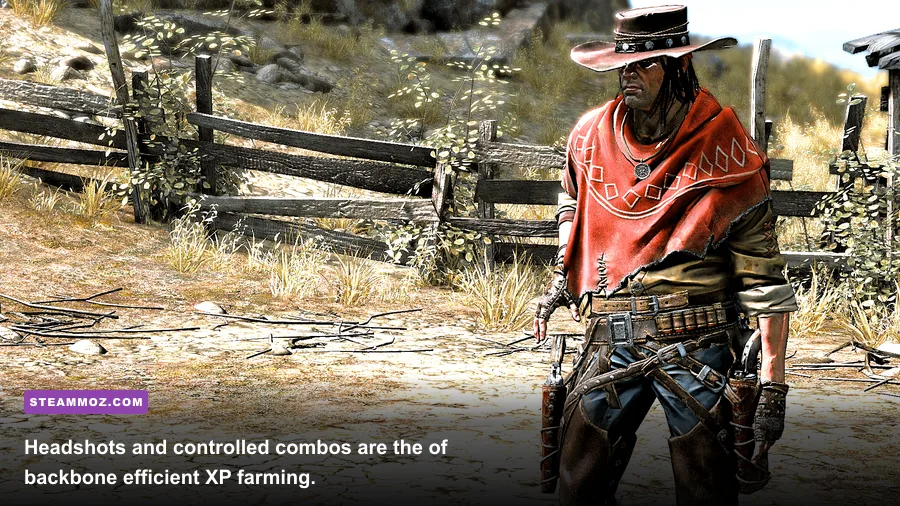
XP farming is really performance farming. A run that ends quickly but contains sloppy body shots and frequent misses won’t be as productive as a slightly slower run with steady accuracy. Start every engagement by scanning for the enemy who can force you out of cover: shotgun carriers, rushing melee attackers, and elevated shooters deserve priority over a distant pistol user.
Protect the chain instead of forcing it
Combos are fragile. A reload in the open, a blind shot through cover, or an unnecessary melee gamble can break your rhythm. When the next target is unclear, stop firing for half a second and reacquire the arena. That pause feels slow, but it’s faster than losing the multiplier and spending another minute rebuilding it.
Headshots should be your default on stationary or predictable enemies. Against a moving target, fire when the enemy reaches the end of a strafe rather than chasing the head through the entire animation. The game’s generous aim assist can help, but it won’t rescue wild reticle movement. Lower mouse sensitivity if you keep overshooting heads, and disable any smoothing option that makes micro-corrections feel delayed.
Read the duel telegraphs
Legendary Duels are timing tests, not conventional firefights. Keep your aim centered on the opponent and watch the draw animation. The key mistake is clicking as soon as the target appears. Wait for the proper opening, then fire cleanly. If you panic, you’ll waste the duel’s limited timing window and lose both accuracy and speed.
Legendary outlaws such as Jesse James and Butch Cassidy are memorable because the game turns their encounters into stylized showdowns, but the farm lesson is practical: learn the tell, repeat the timing, and don’t treat every duel like a damage race. Replaying a duel can improve your consistency, though dense Arcade firefights remain better for a broader XP routine.
Performance Settings That Make Farming Easier
Gunslinger is an older PC shooter, so modern hardware usually has horsepower to spare. The important performance goal isn’t chasing an enormous frame-rate number; it’s maintaining stable input response during explosions, large enemy waves, and slow-motion moments. A locked, consistent frame rate makes headshots and draw timing feel far more predictable.
| Setting | Recommended Value | FPS Impact | Visual Note |
|---|---|---|---|
| Resolution | Native monitor resolution | Medium to high | Keep native resolution unless GPU-limited |
| V-Sync | Off with a stable high-FPS cap | Low | Reduces latency; enable it if tearing bothers you |
| Anti-aliasing | High, lower only if needed | Medium | Smooths the game’s heavy geometry edges |
| Texture quality | High | Low on modern GPUs | Improves wood, leather, and rock detail |
| Shadows | Medium or High | Medium | Lower this first during busy fights |
| Post-processing | Medium | Medium | Preserves the comic-book look without excess blur |
| Frame cap | Stable value your PC holds | None after cap | Consistency matters more than peak FPS |
Run a short Arcade scenario after changing settings. Watch for stutter during explosive set pieces and when several enemies enter at once. If the game feels uneven, lower shadows and post-processing before reducing texture quality. Those changes usually preserve the Western atmosphere while improving frame pacing. Steamoz’s frame-focused settings guide for Dragonkin covers the same principle: tune for consistent response, not a screenshot benchmark.
A Repeatable 30-Minute Farming Routine
Here’s the routine I’d use after completing the campaign once. First, spend five minutes checking the chapter-select screen for incomplete Nuggets of Truth. Choose one chapter with missing collectibles and clear it slowly, grabbing every side-path pickup. This handles the “gold” objective without contaminating your combat runs with constant detours.
Next, spend 15 to 20 minutes replaying the shortest dense-combat Story chapter you know well. Use your preferred skill path, keep the reticle at head height, and restart only when the opening goes catastrophically wrong. Finish with one or two Arcade scenarios. By then, you’ll be warmed up, your aim will be settled, and the score-focused format will show whether your route is actually efficient.
When the run starts feeling stale, change the weapon emphasis rather than blindly repeating it. A Gunslinger revolver route teaches speed and target transitions; a Ranger route teaches patience and lane control; a Trapper route tests positioning under pressure. This keeps practice useful while still feeding the same progression loop.
For another example of route discipline, see Steamoz’s fast leveling route for Dungeons 2. The games are wildly different, but the lesson carries over: isolate the repeatable segment, remove downtime, and measure success by rewards per minute.
Finally, use the official Ubisoft game page and Techland’s games archive for publisher and developer information, while the Steam listing remains the practical reference for the PC release.
The short version: level through accurate Story replays, transition to Arcade once you know the enemy waves, and treat gold nuggets as a collectible checklist rather than currency. A Gunslinger-focused build is the safest start, Ranger is superb for open arenas, and Trapper wins cramped fights when your positioning is sharp. Keep combos alive, prioritize dangerous targets, stabilize your frame rate, and Gunslinger’s progression stops feeling grindy very quickly.