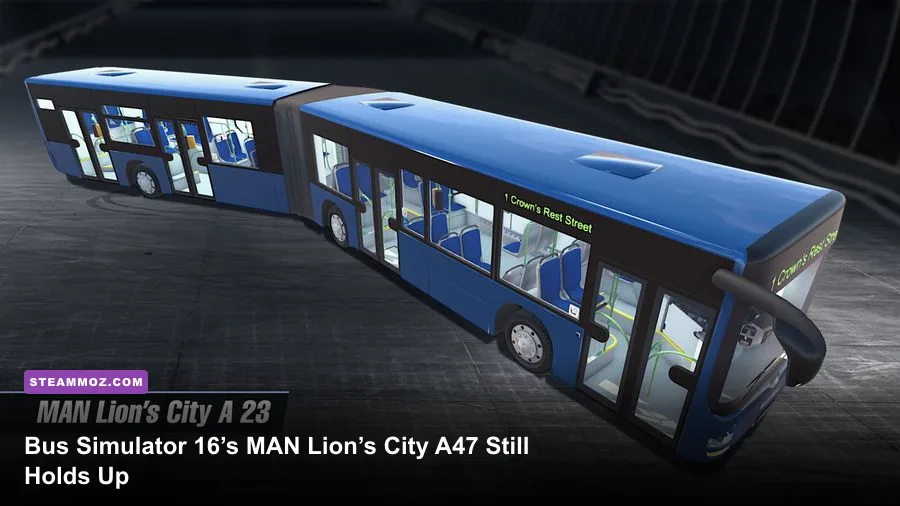
Yes, Bus Simulator 16’s MAN Lion’s City A47 is still worth playing in 2026—but only if you want a relaxed, old-school route simulator rather than a modern sandbox. The DLC adds one officially licensed MAN city bus to a game that remains charmingly focused on stopping accurately, keeping passengers happy, and building a small transport company. The A47 isn’t a transformative expansion, and Bus Simulator 16’s dated traffic, visuals, and pedestrian AI are impossible to ignore today. Still, the bus itself feels like a strong fit for the game’s compact urban routes, especially when you can grab the base game and DLC cheaply during a Steam sale.
My verdict is a cautious 7/10 for simulation fans, dropping to 5/10 if you expect the traffic density, customization, realism, or open-world scale of newer entries. The MAN Lion’s City A47 is best understood as a polished extra tool for the existing campaign, not a reason to buy the whole game blindly.
What the MAN Lion’s City A47 DLC actually adds
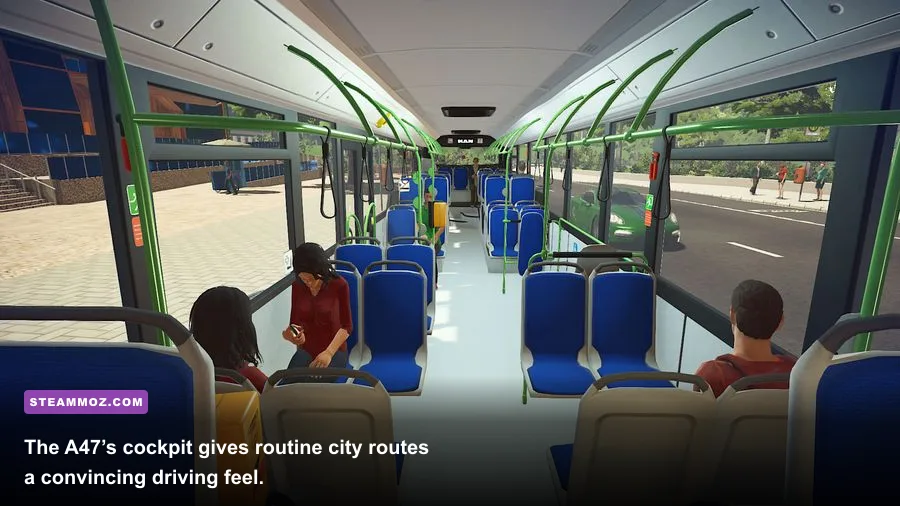
The MAN Lion’s City A47 DLC is deliberately narrow in scope. It adds the licensed MAN Lion’s City A47 bus, a compact low-floor city vehicle designed for regular urban service. There’s no separate campaign, new district, passenger profession, or major management layer attached to it. That limitation matters because the price only makes sense when the DLC is treated as a vehicle pack.
The real-world A47 is a roughly 10.5-metre, two-axle city bus, and that compact footprint translates well into Bus Simulator 16’s streets. It’s easier to place beside curbs than a longer articulated bus, less awkward on tight turns, and more forgiving when a stop sits close to a junction. Those details sound small, but they affect nearly every route: turning radius, curb alignment, camera positioning, and how quickly you can clear a busy stop.
Bus Simulator 16 does not model every technical characteristic with the depth of a specialist driving simulator. You won’t spend time configuring a detailed automatic gearbox, tire pressures, suspension maps, or engine braking curves. Instead, the A47’s value comes from its handling profile and presentation. It feels like a sensible middle-size workhorse, not a novelty vehicle that only looks good in screenshots.
| Bus Simulator 16 vehicle type | Best route role | Strength | Weakness |
|---|---|---|---|
| MAN Lion’s City A47 | Standard urban and suburban routes | Compact handling and easy stop alignment | Limited capacity compared with articulated buses |
| Shorter standard buses | Tight inner-city streets | Simple turning and low route risk | Less passenger capacity |
| Longer or articulated buses | Heavy commuter corridors | More room for passengers | Harder corners and slower maneuvering |
That makes the A47 a particularly good choice for early and mid-campaign work. You can use it while learning the map, building route confidence, and improving your reputation without constantly clipping street furniture. If your company already has a large-bus problem—overcrowded routes and passengers left behind—the A47 won’t solve it. But for routes where reliability matters more than maximum capacity, it’s a comfortable addition.
🎮 Bus Simulator 16 - MAN Lion's City A47 M
Looking to experience this game? Grab your digital key directly on our store for $0.59.
View on Steammoz Store →How the A47 drives on real Bus Simulator 16 routes
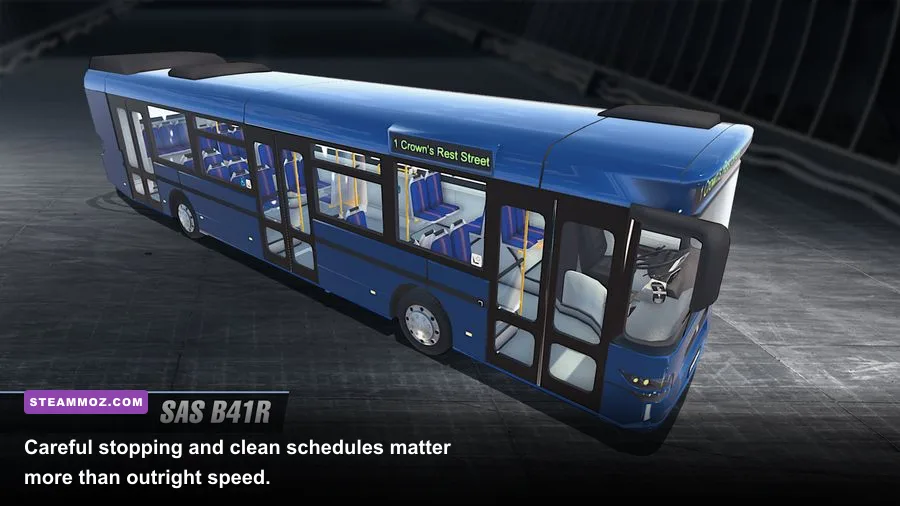
The strongest argument for this DLC is how naturally the A47 fits the game’s driving loop. Bus Simulator 16 is not trying to turn every trip into a dramatic event. Its pleasure comes from repeating a sequence until it becomes second nature: leave the depot, follow the timetable, approach the stop, position the bus, open the doors, wait for boarding, and pull away without irritating half the route.
The A47 is excellent at that rhythm. Its size gives you enough road presence to feel like you’re driving a proper city bus, while the shorter wheelbase keeps it manageable in narrow areas. On a route with several closely spaced stops, the A47 is less tiring than a bigger vehicle because you spend less time correcting your line through intersections.
Stop positioning is where the bus earns its keep
Bus Simulator 16 rewards controlled driving more than aggressive driving. Arriving too fast means braking beyond the marked area; stopping too far from the curb can make boarding feel sloppy; and catching the platform at a bad angle creates unnecessary correction work. The A47’s proportions make the “one clean move” approach easier. Start braking earlier than you think, straighten the front before the stop marker, and use small steering inputs rather than sawing at the wheel.
There’s also a useful practical advantage when routes become crowded. A shorter bus can clear a stop and rejoin traffic sooner, which reduces the chance of blocking an intersection. That doesn’t make the A47 faster in a racing sense—speeding still creates penalties and passenger complaints—but it makes the entire route feel less cumbersome.
Passenger management remains the real challenge
The A47 cannot rescue a badly designed timetable. If stops are packed too closely together, traffic is heavy, or you’ve accepted more passengers than the vehicle can comfortably handle, the bus only exposes those problems. Use it on routes with frequent urban stops, moderate demand, and enough recovery time between scheduled arrivals.
For new players, a good routine is to drive the first run slowly and treat it as a survey. Note where traffic backs up, where the road narrows, and which stops require a wide approach. On the second run, you can increase pace without sacrificing punctuality. This is much more effective than trying to make up lost time by driving recklessly, because Bus Simulator 16’s reputation system punishes collisions, harsh driving, and unhappy passengers more severely than a few seconds of lateness.
| Route condition | A47 rating | Why it works | Recommended approach |
|---|---|---|---|
| Dense inner-city stops | Excellent | Compact body is easy to place at curbs | Brake early and prioritize clean alignment |
| Moderate suburban route | Very good | Balanced size and manageable turning | Keep a steady pace and protect timetable recovery |
| High-demand commuter line | Average | Capacity can become the limiting factor | Use a larger bus when passenger queues grow |
| Tight industrial streets | Good | Shorter dimensions reduce cornering stress | Use the external camera for blind turns |
Graphics, performance, and the 2026 reality check
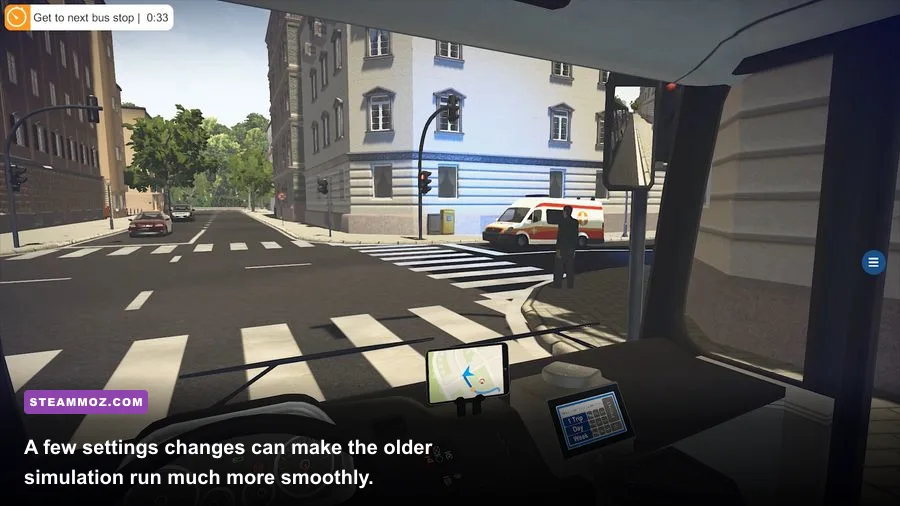
Bus Simulator 16 is an older PC game, and that’s both its advantage and its biggest warning sign. The system requirements are light by modern standards, but low hardware demands don’t automatically mean perfect performance. The game can still feel uneven in busy areas, especially when traffic, pedestrians, reflections, and weather effects stack up around major stops.
On a modern gaming PC, the sensible target is a locked 60 frames per second rather than chasing every visual option. The A47 looks fine at high settings, but the difference between high and medium shadows is much less important than consistent frame pacing while you’re steering into a stop. A stable image makes precise curb positioning easier, particularly with a wheel or controller.
Owners of integrated graphics or older laptops should start with medium settings, reduce shadows first, and avoid assuming that resolution alone is the problem. Bus Simulator 16’s city scenes can become CPU-limited when several vehicles and pedestrians are active. Lowering texture quality may improve memory usage, but it won’t always fix stutter caused by simulation load.
| Setting | Recommended value | Performance impact | Visual trade-off |
|---|---|---|---|
| Resolution | Native display resolution | High if reduced | Lower resolution makes text and road markings blurrier |
| Shadows | Medium | Medium to high | Less detailed building and vehicle shadows |
| Textures | High if VRAM allows | Low to medium | Bus interiors and road surfaces stay sharper |
| Reflections | Medium or low | Medium | Reduced glass and wet-surface detail |
| Anti-aliasing | Medium | Low to medium | Some shimmering on poles and road edges |
| View distance | High on desktop, medium on laptop | Medium | Less distant traffic and scenery detail |
The official Bus Simulator 16 Steam page remains the best place to check current platform information, controller support, and user feedback before buying. For a broader look at tuning older PC games, our guide to settings that deliver maximum FPS covers the same basic principle: remove expensive effects before sacrificing resolution and readability.
What still feels dated
The game’s visual age shows most clearly in pedestrian animation, traffic behavior, and scenery repetition. Cars can feel mechanically predictable, and the world lacks the living-city density found in newer bus simulators. Weather and lighting add atmosphere, but they don’t turn the map into a dynamic ecosystem. The A47 itself looks more convincing than many surrounding objects, which can make the contrast even more obvious.
That said, the limited scope has a benefit. You can run Bus Simulator 16 on hardware that would struggle with current simulation titles, and loading times are generally less intimidating. If you’re playing on a Steam Deck or low-power laptop, expect to experiment rather than assume a perfect preset. Lowering shadows and view distance is usually the best starting point.
Is the A47 DLC good value compared with modern bus games?
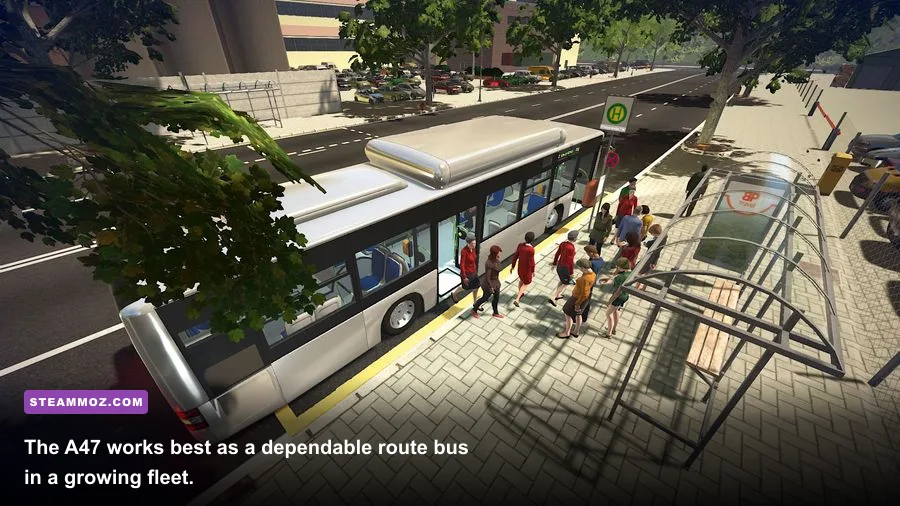
Value depends almost entirely on what you want from a bus game. If you want detailed vehicle licensing, larger maps, advanced passenger simulation, mod ecosystems, and long-term support, Bus Simulator 16 is no longer the obvious recommendation. Newer games deliver better presentation and more ambitious systems. But if you want a focused campaign where every route has a clear objective, Bus Simulator 16 remains easy to understand and surprisingly relaxing.
The A47 improves that experience by giving you a bus that feels appropriate for everyday work. It’s not the most exciting DLC on paper, but it avoids the common problem of adding a vehicle that only exists to look different. The A47 is useful. You can put it on normal routes, learn its dimensions quickly, and keep it in service throughout a meaningful portion of the campaign.
| Player type | Buy the A47? | Reason |
|---|---|---|
| Bus Simulator 16 owner who wants another route bus | Yes | It adds a practical, well-sized licensed vehicle |
| New player buying the base game at full price | Maybe | Check whether the older campaign and visuals suit you first |
| Hardcore vehicle-simulation enthusiast | Probably not | Technical modeling and systems are relatively light |
| Casual player seeking a relaxing driving game | Yes, on sale | The A47 fits the game’s calm, repeatable route loop |
| Player seeking a huge open-world sandbox | No | The DLC doesn’t expand the map or management layer |
It’s also worth comparing the purchase with other focused simulation experiences. Steamoz’s Construction Simulator 2015 equipment rankings make a similar point about older simulation games: a modest tool can be valuable when it improves the core loop, even if it doesn’t add a huge amount of content. The A47 follows that philosophy.
Replayability and community considerations
Replayability comes from route optimization rather than a deep endgame. You’ll repeat lines to improve punctuality, reduce collisions, and make better use of your fleet. That can be satisfying if you enjoy incremental mastery. It can also feel repetitive if you need constant rewards, new story beats, or dramatic progression.
Before buying, check the current Bus Simulator 16 Steam Community hub for recent compatibility reports and controller discussions. Older games can be perfectly playable while still having occasional issues with ultrawide displays, input devices, or operating-system updates. The community is often more useful than a store description for spotting those edge cases.
Final verdict: worth playing in 2026?
Bus Simulator 16’s MAN Lion’s City A47 is worth playing in 2026 if you already like deliberate driving, compact campaigns, and practical vehicle differences. It’s a good bus, not a content explosion. The A47 handles tight urban routes comfortably, looks appropriately authentic, and gives the base game a dependable middle-size option. Its compact dimensions make it especially friendly for beginners and for players who prefer clean stop approaches over brute-force capacity.
The drawbacks are just as clear. You get one bus, no new map, no fresh campaign, and no major change to the underlying simulation. Bus Simulator 16’s dated AI and presentation remain intact, and modern bus titles have moved far beyond it in scale and technical detail. Don’t buy this DLC expecting a 2026-standard simulator expansion.
Buy it during a discount, pair it with the base game, and judge it by the right standard: does it make ordinary routes more enjoyable? For me, the answer is yes. The MAN Lion’s City A47 turns routine service into the game’s most comfortable kind of work—precise, predictable, and quietly satisfying.
If you’re still deciding what to play after finishing your route network, our recommendations for strategy games with long-term replayability and games like A Monster’s Expedition offer very different but equally focused alternatives. For Bus Simulator 16 itself, though, the answer is simple: the A47 is a worthwhile small upgrade, and a good reason to return—but not a reason to overlook the game’s age.
For more background on the real vehicle, the official MAN website provides manufacturer information, while the Stillalive studios site is the developer’s official home. Use those alongside the Steam listing if you want to verify licensing and current product details before purchasing.