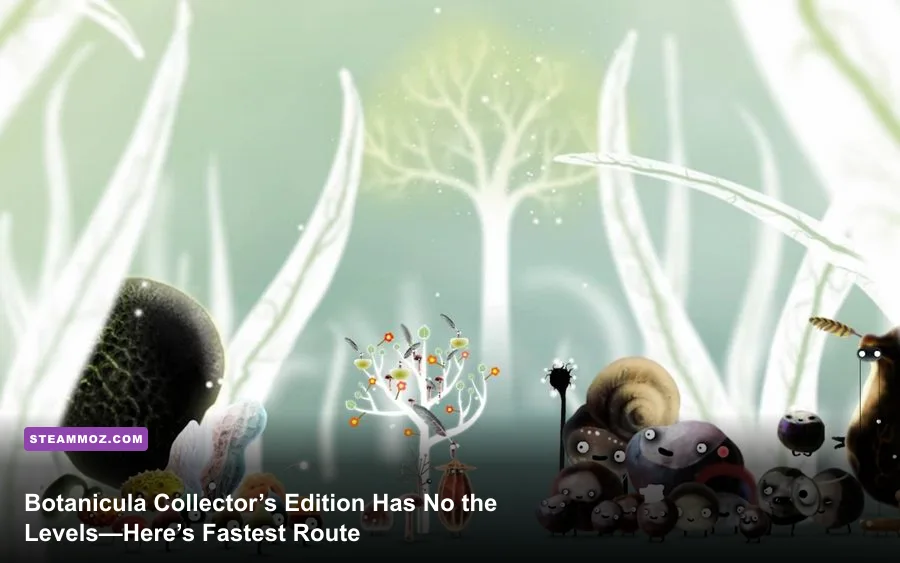
Botanicula Collector’s Edition has no character levels, gold, weapons, or farming loop. The fastest route is to follow the main path, switch between all five characters whenever an object reacts, and revisit earlier branches for missed seed cards before the finale. Treat the game as a compact puzzle adventure—not an RPG—and you’ll avoid wasting time searching for an imaginary currency system.
That distinction matters because the phrase “fast leveling and gold farming” doesn’t match Botanicula’s actual design. Amanita Design built the game around observation, playful experimentation, and optional collectibles. There are no experience points, merchant inventories, skill trees, damage values, or repeatable gold drops. The Collector’s Edition adds bonus material around the game rather than a progression economy inside it. If you’re coming from an RPG, this is less about grinding and more about getting clean puzzle solves without missing the game’s wonderfully odd secrets.
What You Actually Progress In Botanicula

Botanicula’s progression is scene-based. You move through a connected series of tree branches and enclosed spaces, solve a chain of environmental puzzles, and unlock the next route. The party consists of Mr. Lantern, Mrs. Mushroom, Mr. Twig, Mr. Pytel, and Mrs. Feather. Each character has a different silhouette and interaction style, but the game doesn’t ask you to distribute points or equip upgrades.
Mr. Lantern is the broad, glowing lead character and often acts as the easiest target for object interactions. Mrs. Mushroom’s small shape makes her useful around cramped spaces. Mr. Twig reaches into places that the others can’t, while Mr. Pytel and Mrs. Feather round out the party’s visual and puzzle reactions. The important mechanic is not a cooldown or a stat bonus: it’s trying the correct character on the correct visual clue.
| System | What Botanicula Uses | What It Does Not Use | Fastest Progress Method |
|---|---|---|---|
| Character growth | Five fixed party members | XP, levels, attributes | Test each character on active objects |
| Economy | Collected items and puzzle objects | Gold, shops, vendors | Inspect every clickable prop once |
| Combat | Brief danger sequences and reactions | Weapons, armor, damage stats | Read animations and click with purpose |
| Completion | Seeds, cards, and discoveries | Quest log XP rewards | Clear each branch before moving on |
For the official product description and edition details, check the Botanicula Steam page. It confirms the game’s point-and-click structure more clearly than any RPG-style guide title can.
🎮 Botanicula Collector's Edition
Looking to experience this game? Grab your digital key directly on our store for $2.99.
View on Steammoz Store →The Fastest Main-Story Route
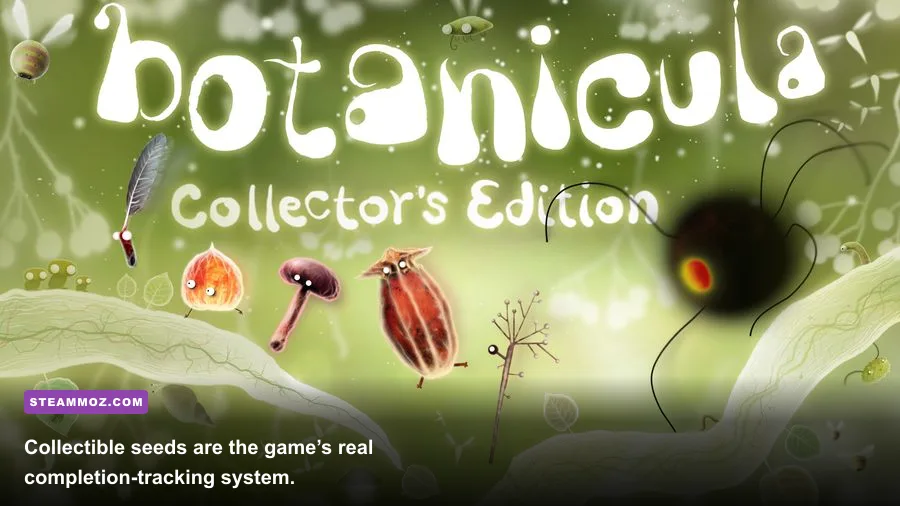
The most efficient route is a two-pass method. On the first pass, solve only what blocks forward movement. On the second, sweep the same area for optional interactions and seeds before you trigger the next major transition. This keeps the story moving while preventing the classic Botanicula mistake: reaching a new section, then realizing a collectible from a previous branch is difficult to identify.
Pass one: open the route
Start by clicking obvious environmental anchors: doors, knots, levers, nests, lamps, holes, and characters that visibly react when your cursor passes over them. If an object produces a sound, animation, or change in expression, it’s worth testing. Don’t spam every character on every object immediately. Try the character whose shape or color matches the clue first, then cycle through the party if nothing happens.
When a puzzle presents several movable objects, watch the scene after every successful action. Botanicula frequently communicates the next step through animation rather than text. A creature may crawl away, a branch may bend, or a previously static prop may begin moving. Those changes are your quest markers.
Pass two: clean the branch
Before leaving a screen, move the cursor across the foreground, background, ceiling, and lower corners. The game’s illustrated scenes hide interactions in places that don’t look like traditional buttons. Click unusual faces, dangling objects, tiny insects, and anything that changes under the cursor. A short animation can be a collectible, a joke, or a clue to a later action.
Use this same route through the middle sections rather than bouncing randomly between screens. If you hit a dead end, don’t assume you need a missing item from a distant location. First check whether a different party member can interact with the object, then inspect the most recently altered prop. Botanicula’s puzzles usually chain locally.
| Route Stage | Priority | What to Check | Time-Saving Rule |
|---|---|---|---|
| New branch | Forward progress | Doors, blocked paths, animated characters | Find the interaction that changes the scene |
| Opened room | Puzzle chain | Levers, nests, ropes, holes, movable objects | Follow animation changes after each click |
| Before transition | Collectibles | Edges, tiny creatures, background props | Perform a full screen sweep |
| Return visit | Cleanup | Previously inactive objects | Recheck only after a major puzzle change |
This approach is much faster than trying to achieve a perfect collectible run blind. For broader point-and-click pacing, Steamoz’s Edna & Harvey coverage is a useful reminder that these games reward attention, not grinding.
How To “Farm” Gold When There Is None
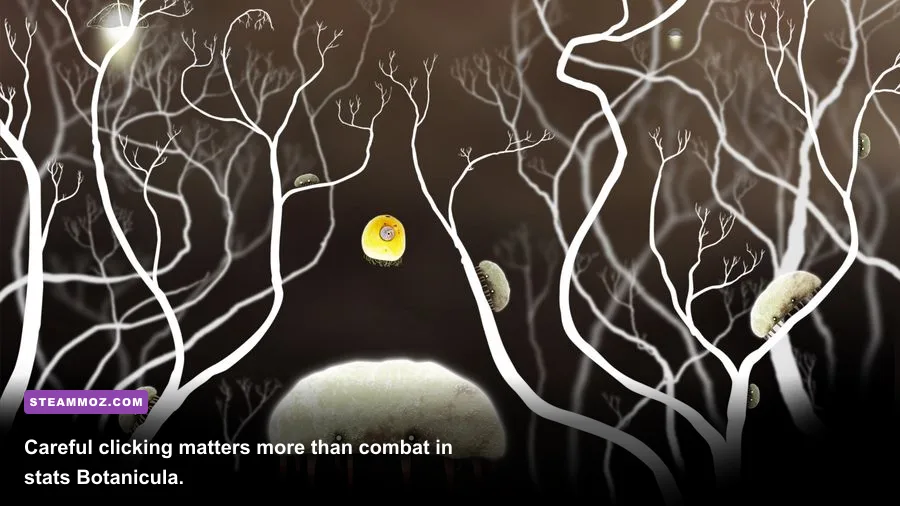
There is no gold farming method in Botanicula Collector’s Edition. You can’t sell seeds, replay a room for currency, or buy upgrades from a merchant. Any guide promising a gold exploit, an XP route, or a hidden money vendor is describing a different game—or inventing mechanics that simply aren’t present.
The closest equivalent is farming knowledge: learn which visual signals identify a useful interaction, then apply that knowledge to every new branch. The game rewards curiosity with collectible seed cards and small discoveries. Those rewards don’t increase attack power, but they are the main reason to explore beyond the critical path.
Don’t repeatedly click a harmless object expecting a random payout. Botanicula’s interactions are authored, not procedural. If a prop has already completed its animation and nothing in the room has changed, move on. Replaying the same sequence won’t generate extra rewards.
The Collector’s Edition is best treated as a preservation and bonus-content package. Look for the soundtrack and accompanying extras through the edition’s store listing rather than expecting in-game currency. The official Amanita Design Botanicula page is the safest place to verify what belongs to the game itself and what belongs to the edition’s extras.
Seed Cards And Optional Discoveries
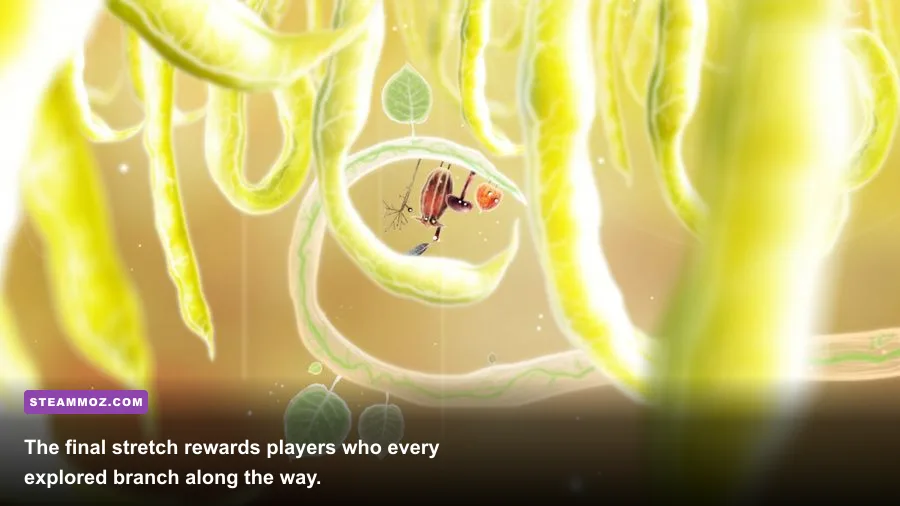
Seeds are the closest thing Botanicula has to a completionist progression track. They’re optional, easy to overlook, and often tucked into interactions that don’t look connected to the main puzzle. The fastest collector route is not to click everything forever; it’s to use disciplined sweeps and keep a simple written checklist by area.
At the start of each scene, note the number of obvious interactive clusters: the main puzzle, any side character, unusual background object, and any edge-of-screen detail. After solving the main puzzle, revisit each cluster. This two-stage scan catches most missed discoveries without turning every room into a random-click marathon.
Pay special attention to small creatures and comic interactions. Some are visible only after another object has been activated. If the scene changes—new lighting, a moved branch, an opened container, or a character leaving—scan again. That’s the moment when a previously decorative detail can become clickable.
| Collectible Situation | Best Search Pattern | Common Mistake | Correction |
|---|---|---|---|
| Visible seed or card clue | Click the object and nearby characters | Leaving after the first animation | Check what the animation revealed |
| Empty-looking corner | Sweep edges and foreground layers | Assuming artwork is noninteractive | Test unusual silhouettes once |
| Post-puzzle scene | Rescan the entire room | Immediately taking the exit | Look for newly moving details |
| Missed discovery | Return after the next route unlock | Randomly revisiting every screen | Use your area checklist |
For comparison, our Empires of the Undergrowth farming guide deals with an actual resource economy. Botanicula is the opposite: your reward is discovering the interaction, not extracting a repeatable material from it.
Performance And A Clean Completion Run
Botanicula is lightweight by modern PC standards, so performance rarely blocks progression. The useful setup is the one that makes tiny animated clues easy to see. Run the game at your monitor’s native resolution, keep scaling at 100 percent where possible, and avoid display settings that blur the illustrated edges. A stable 60 frames per second is more than enough; chasing triple-digit FPS won’t improve puzzle timing.
If the cursor feels misplaced, switch between windowed and fullscreen modes, then restart the game. On high-DPI Windows desktops, display scaling can make older adventure games feel visually offset even when the game itself is running correctly. Also disable aggressive overlays if clicks seem delayed. Steam Overlay, recording software, and screen filters can interfere with the simple cursor-driven presentation.
| Setting | Recommended Value | Performance Impact | Why It Helps |
|---|---|---|---|
| Resolution | Native monitor resolution | Low on modern hardware | Keeps tiny clues sharp |
| Display mode | Fullscreen or stable windowed mode | Negligible | Reduces cursor and focus problems |
| Frame rate | Stable 60 FPS | Minimal | Makes animations easy to read |
| Desktop scaling | 100% if cursor alignment is wrong | None in-game | Prevents apparent click offset |
| Overlays | Disable while troubleshooting | Can reduce interruptions | Avoids focus and input conflicts |
Save before entering a new major section and after solving a complicated chain. Botanicula isn’t built around punishing failure, but a manual checkpoint makes cleanup much less annoying if you accidentally move on before inspecting a branch. The Steam community hub and Amanita Design’s official site are also better troubleshooting references than unofficial “gold exploit” posts.
Finally, resist the urge to play it like a traditional RPG. There’s no optimal build, no farming circuit, and no late-game power spike waiting behind extra clicks. The winning strategy is simple: advance one local puzzle at a time, use the party members deliberately, sweep every changed scene, and record the branches you’ve cleared. That’s the real fast-leveling answer for Botanicula Collector’s Edition—and once you stop searching for gold, the game becomes wonderfully quick to read.
If you enjoy games where route planning replaces grinding, Steamoz’s Everspace 2 hidden-rewards guide offers a very different take on exploration. Botanicula’s version is quieter, stranger, and far more interested in what happens when you click the weird little thing in the corner.