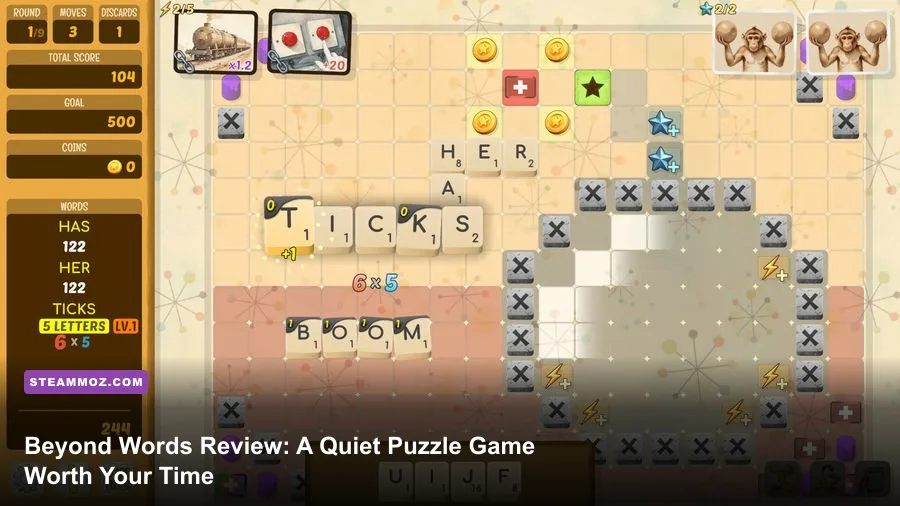
Beyond Words is worth playing in 2026 if you want a compact, thoughtful puzzle adventure that trusts you to read a scene instead of dumping dialogue on you. It isn't a long-form RPG, it doesn't have combat, and there are no stats or skill trees to grind. What it does have is a clear central idea: communication can be built from symbols, movement, sound, and context. That idea carries the game through its best puzzles, although the short runtime and occasional guesswork mean it won't land for everyone.
This is a review for players deciding whether to pick up Beyond Words on Steam in 2026. I played it as a focused narrative puzzle game rather than treating it like a traditional adventure, and that distinction matters. If you need combat depth, character builds, or dozens of hours of progression, look elsewhere. If a two-to-four-hour experience with a strong visual hook sounds appealing, Beyond Words makes a surprisingly good weekend game.
What Beyond Words Actually Does Well
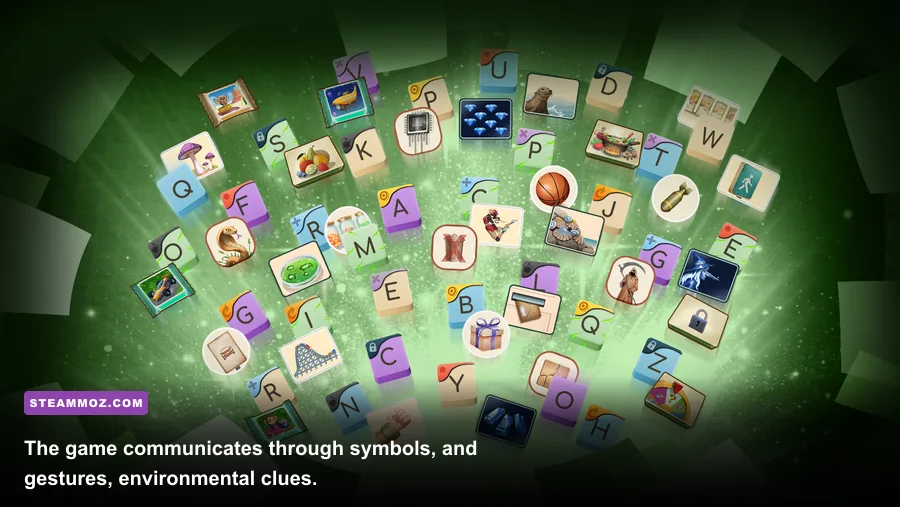
The smartest design choice is that Beyond Words makes its lack of conventional language mechanical rather than merely aesthetic. Characters don't constantly explain what they want. Instead, you learn by watching them react to objects, locations, icons, and one another. A repeated symbol may suggest a destination, an emotional response can identify the correct interaction, and a change in music often signals that the game has acknowledged your solution.
That approach creates a gentle form of detective work. You aren't solving a cryptic crossword or memorizing a dictionary. You're building a temporary vocabulary from the world in front of you. Early scenes teach the visual grammar safely, usually by presenting one interaction at a time. Later puzzles combine those ideas, asking you to remember what a shape, color, or gesture meant several rooms earlier.
There is no conventional inventory management to get in the way. The game keeps the interaction set small, which is important because the challenge comes from interpretation, not from cycling through 40 objects. The lack of combat also keeps the pacing calm. There are no enemy telegraphs, stamina bars, damage numbers, or boss phases to master; the tension comes from uncertainty and the possibility that you've misunderstood a clue.
| Core System | How It Works | Review Verdict |
|---|---|---|
| Communication | Symbols, reactions, gestures, and context replace ordinary exposition | Excellent central hook |
| Exploration | Compact spaces connect environmental clues to interactive scenes | Focused, but occasionally restrictive |
| Puzzles | Observation and sequence recognition matter more than reflexes | Strongest after the opening tutorial |
| Progression | New meanings and situations replace traditional upgrades | Elegant, though not very replayable |
The result feels closer to a playable visual poem than a standard point-and-click adventure. That description may sound pretentious, but it captures the rhythm: look, test an interaction, watch the response, and revise your understanding. Fans of Edna & Harvey: Harvey's New Eyes will recognize the appeal of expressive visual storytelling, though Beyond Words is far less dialogue-driven.

🎮 Beyond Words
Looking to experience this game? Grab your digital key directly on our store for $11.24.
View on Steammoz Store →How the Puzzles Feel After the First Hour
Beyond Words is at its best when a puzzle has a visible cause-and-effect chain. You notice an object, connect it to a symbol you learned earlier, and then use the result to change the next scene. Those solutions feel earned because the game gives you enough information without spelling out the answer. The best sequence is not difficult because of obscure logic; it works because several small observations suddenly click together.
The weaker moments come when the game expects you to infer interaction priority from visual emphasis alone. A bright object may be important, but it isn't always clear whether you should inspect it now, return after triggering another event, or combine it with a nearby environmental detail. That isn't a deal-breaking problem, but it can turn a thoughtful puzzle into a pixel-hunt-adjacent search.
There are also moments when the absence of language cuts both ways. The wordless presentation is the point, yet some scenes could use a stronger confirmation cue after a correct action. A short animation, a distinct sound, or a more obvious change in lighting would reduce uncertainty without compromising the concept. When you get stuck, the solution is usually simple; recognizing what the game considers relevant is the real hurdle.
A practical approach for new players
Don't click everything randomly. First, scan the entire scene and note repeated shapes, colors, and character reactions. Then test one variable at a time. If an interaction produces a response, remember the response rather than just the object. That habit matters later, because the game often reuses a symbol in a different physical context.
Take screenshots or use a small notebook if you enjoy solving games methodically. Beyond Words doesn't require external notes, but recording the meanings you infer can make the later sections feel more like deduction and less like memory testing. If you're playing with a controller, use the slower camera movement to inspect corners; keyboard-and-mouse players generally get faster cursor placement, but the underlying puzzle logic doesn't change.
| Player Type | Expected Experience | Best Approach | Worth Playing? |
|---|---|---|---|
| Narrative-game fan | Strong atmosphere and a memorable visual language | Play in one or two focused sessions | Yes |
| Puzzle enthusiast | Good observation challenges with a few soft spots | Track symbols and scene reactions | Yes, with reservations |
| Action-focused player | No combat, upgrades, or reflex challenges | Only buy if the premise appeals | Probably not |
| Completionist | Limited replay value after the solution path is known | Look for hidden interactions on a first run | At a discount |
If you prefer more systems and longer progression, Steamoz's Dungeon Siege review is a better recommendation. Beyond Words is intentionally the opposite: small scope, low friction, and almost no mechanical clutter.
Visuals, Audio, Accessibility, and PC Performance
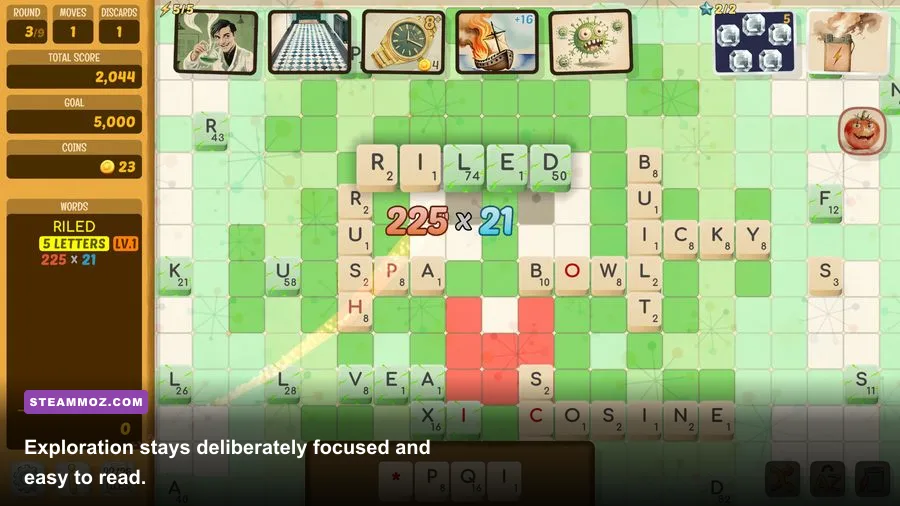
Beyond Words gets considerable mileage from restraint. Its environments are built to be read, so important silhouettes and interactive objects generally stand apart from the background. The visual style isn't aiming for photorealism or GPU showcase effects. It wants you to notice a character's posture, a recurring icon, or a small environmental change.
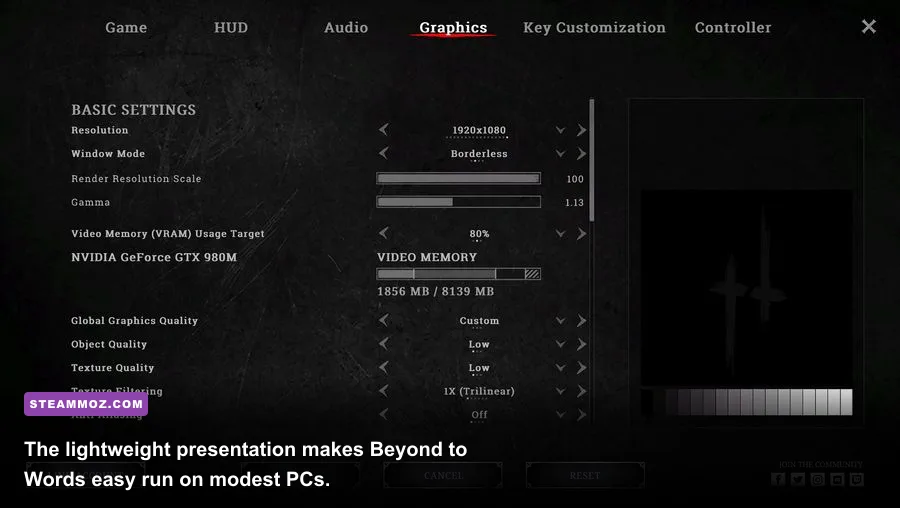
That also makes it a comfortable PC game to run. The major performance trade-off isn't about chasing ultra settings; it's about preserving clean image quality and avoiding unnecessary post-processing. On a modern integrated GPU, the game should be far less demanding than a 3D action title. Players with older laptops should still check the current Steam listing because patches and platform-specific behavior can change over time.
| Setting Profile | Recommended Use | Performance Impact | Visual Trade-Off |
|---|---|---|---|
| Native resolution, high effects | Recent desktop or gaming laptop | Low | Cleanest presentation |
| Native resolution, reduced shadows | Older dedicated GPU | Low to moderate gain | Minor loss in depth |
| Lower resolution, high contrast | Integrated graphics or handheld PC | Moderate gain | Less sharp environmental detail |
| Windowed mode, capped frame rate | Battery-focused handheld play | Best power savings | Smoother consistency over peak frames |
Don't expect a technical showcase, but don't mistake that for poor production quality. The restrained camera work supports the puzzles, and the audio design does useful narrative work. Sound cues frequently tell you that an interaction mattered before the visuals fully explain why. Headphones help, particularly in scenes where environmental audio separates a meaningful event from ordinary ambience.
Accessibility is more important here than it might be in a conventional action game. Because meaning is communicated visually, color-only distinctions can become a problem for some players. Check the game's current options and Steam announcements before buying if you need specific color filters, subtitle controls, remapping, or scalable interface elements. The official Steam Community discussions can also reveal whether a recent update changed controller or display behavior.
Is Beyond Words Worth Playing in 2026?
Yes, but only if you approach it on its own terms. Beyond Words is not secretly a huge adventure waiting to be optimized. There are no weapon tiers to rank, no build route to perfect, and no endgame loop that keeps unfolding after the credits. Its value comes from the clarity of its concept and the confidence with which it delivers that concept.
The short length is both its biggest strength and its clearest limitation. Because the game doesn't overstay its welcome, the communication system remains fresh and the visual language avoids becoming exhausting. But once you've solved the main chain of puzzles, there may not be enough new structure to justify a second full playthrough. A lower price, a bundle, or a seasonal sale makes the recommendation much easier.
In 2026, that makes Beyond Words a good fit for players who are tired of oversized open worlds and battle passes. It's ideal for a quiet evening, a Steam Deck session, or a shared playthrough where two people debate what a symbol might mean. It isn't ideal for anyone shopping for a 20-hour campaign, deep mechanical mastery, or a conventional story with fully explained lore.
| Category | Score | Why It Matters |
|---|---|---|
| Core concept | 8/10 | The communication mechanic is distinctive and consistently relevant |
| Puzzle design | 7/10 | Observational challenges are strong, though some cues are soft |
| Presentation | 8/10 | Visuals and sound reinforce the wordless structure |
| Length and replay value | 6/10 | Focused pacing comes at the cost of breadth |
| Overall | 7.5/10 | A smart, compact indie experience worth buying at the right price |
My final verdict is a qualified recommendation: play Beyond Words if you want a short puzzle game built around interpretation, atmosphere, and visual storytelling. Buy it at full price only if that premise immediately grabs you. Otherwise, add it to your wishlist and wait for a sale. Players craving something more systems-heavy can browse our Everspace 2 secrets guide or Empires of the Undergrowth leveling guide. Beyond Words has fewer moving parts, but the small number of parts it does have fit together remarkably well.
For the latest release notes, controller information, and pricing, check the official Steam search listing before purchasing. The game may be small, but its central question stays with you: how much can a world say without using words?