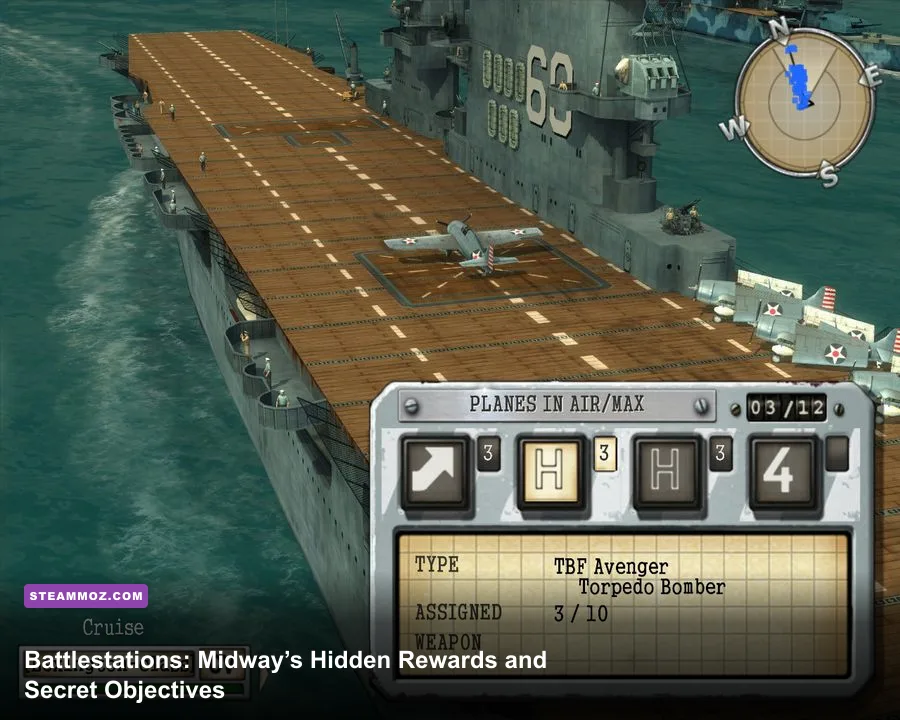
Battlestations: Midway does not hide traditional collectible pickups across its maps. The “secret locations” are concealed secondary objectives, isolated units, rescue events, and optional targets that appear only after you scout the right sector or trigger the correct event. Complete them before the mission ends and you’ll earn medals, campaign progress, achievement credit, and access to bonus challenges; ignore them and the game can look as if it has no secrets at all.
This distinction matters because many old guides call every optional objective a secret. There are no glowing crates, journal pages, or collectible flags to sweep up. Instead, the campaign hides rewards inside ordinary naval operations. A lone destroyer outside the main battle, a damaged aircraft trying to land, or a coastal installation tucked behind an island may be the real objective. This guide maps the reliable search method for every campaign chapter, explains what counts as a hidden reward, and shows how to finish objectives without sacrificing the primary mission.
How Battlestations: Midway’s secrets actually work

The game’s hidden content is tied to its objective system rather than free-roaming exploration. Primary objectives are normally displayed clearly, while secondary goals may be revealed by a radio message, a newly detected unit, a rescue prompt, or movement into an area that the opening briefing never emphasizes. Some objectives are visible from the start but easy to miss because the tactical map is crowded with red contacts.
There are four reward categories worth tracking:
- Secondary objectives: Optional tasks such as protecting a friendly vessel, destroying a support ship, or reaching a designated sector.
- Bonus targets: Enemy installations and ships that are not necessary for victory but improve your mission rating.
- Medals and performance awards: Earned for accuracy, survival, speed, protecting allied assets, or completing a mission under special conditions.
- Challenge and multiplayer unlocks: These are generally tied to campaign completion, medals, or progression, not to a hidden chest at a specific coordinate.
The safest approach is to pause after every radio transmission and inspect the full tactical map. Zoom out, look beyond the highlighted objective ring, and check for neutral or blue contacts near the map edge. The camera can make a small island appear empty even when a gun battery, transport, or patrol boat is hidden behind it. Also remember that objectives can fail. A rescued pilot, cargo vessel, or PT boat is not a permanent reward if you let it get sunk five minutes later.
| Secret type | Where to look | What reveals it | Reward value |
|---|---|---|---|
| Optional ship | Map edge, convoy lane, or island shadow | Radio update or visual spotting | Mission rating and objective credit |
| Rescue event | Near a damaged aircraft or sinking vessel | Emergency transmission | Secondary-objective completion |
| Coastal target | Behind beaches, reefs, and headlands | Recon aircraft or close approach | Bonus score and medal progress |
| Enemy support unit | Outside the main fleet engagement | Scout contact or scripted trigger | Extra combat reward and rating |
Before searching, change the way you play
Don’t rush every mission at maximum speed. Keep one scout plane, PT boat, or destroyer available for reconnaissance instead of throwing every unit into the first fleet clash. Aircraft are especially useful because their wider vision exposes batteries and ships that surface units cannot see through terrain. If a mission gives you a carrier, protect it. Losing the carrier often means losing the aircraft needed to reveal the hidden objective.
For a useful comparison, the same map-reading habit applies to other exploration-heavy campaigns; our Everspace 2 secret locations guide covers a more conventional collectible system, while Midway demands tactical scouting instead.

🎮 Battlestations: Midway
Looking to experience this game? Grab your digital key directly on our store for $0.97.
View on Steammoz Store →All campaign areas where hidden objectives appear
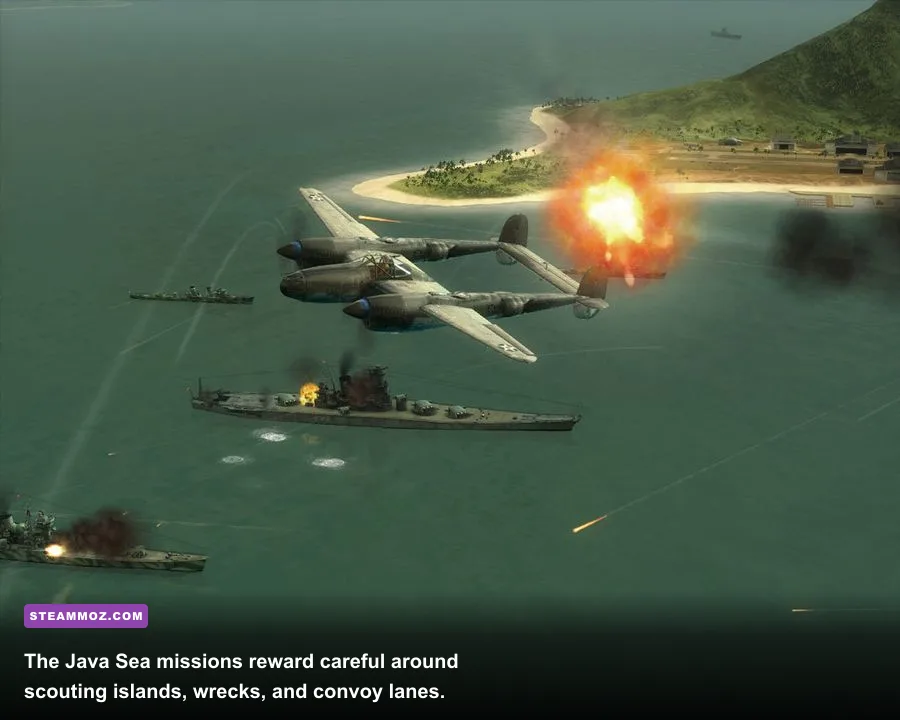
The following route is the closest thing to a complete secret-location map. Coordinates are not reliable because the game’s camera, mission scripting, and objective placement vary by scenario, but the landmarks are consistent. Search the sectors described here before advancing the primary objective.
Pearl Harbor and the opening harbor operations
Search behind the battleship rows, along the outer harbor entrances, and around the airfield approaches. The main attack naturally pulls your attention toward capital ships, but optional credit often comes from protecting or destroying smaller assets. Sweep the waterline with a destroyer rather than sending only aircraft. A low-profile ship can sit outside the obvious combat zone and remain undetected until you approach.
When the game asks you to defend an installation or intercept attackers, don’t immediately pursue the first retreating plane. Check the harbor map for additional red contacts and damaged friendly units. The hidden-objective pattern here teaches the campaign’s central trick: the next optional task may be closer to a unit you must protect than to the enemy you are currently shooting.
Wake Island and the island perimeter
At Wake, inspect the perimeter rather than staying over the central objective. The island blocks line of sight, and Japanese ships or landing forces can approach from an angle that the first camera view hides. Send a fast ship around the island’s less active side while your main force handles the visible attack. Coastal emplacements are particularly easy to miss because they blend into the shoreline.
Keep aircraft assigned to spotting instead of using every sortie for bombing. One reconnaissance pass can reveal a landing craft group or support vessel, after which your torpedo bombers can attack efficiently. If you lose the airfield too early, you may still complete the mission but lose the cleanest method for finding optional contacts.
Battle of the Java Sea
The Java Sea scenarios are built around scattered contacts, so search the channels between islands and the edges of convoy routes. Hidden targets frequently sit away from the main cruiser engagement. Use a destroyer to scout narrow water and a cruiser to provide overwatch; sending a battleship into shallow or restricted lanes wastes time and makes turning fights painfully slow.
Watch for ships that appear neutral or irrelevant at first. A contact can become an objective after a transmission, and the game may not give you a large cinematic marker. Pause, read the text, and identify the vessel by its name or color before opening fire. The worst mistake is sinking a ship that you were supposed to escort because you assumed every contact was hostile.
Battle of Midway
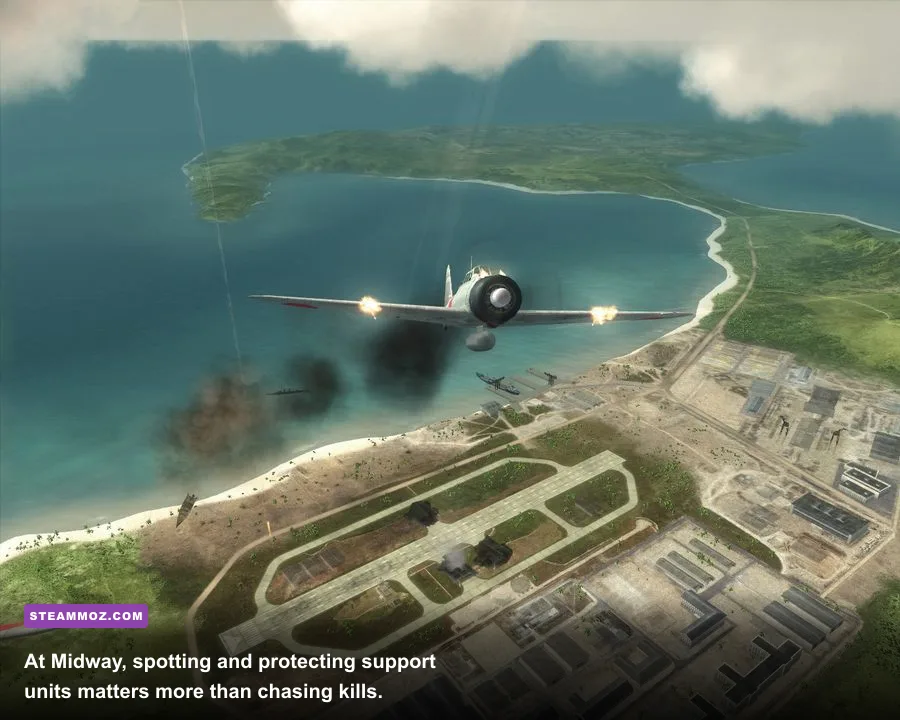
Midway’s hidden rewards are usually connected to air operations and island defense. Search around the airfield approaches, the carrier group’s flanks, and the outer edges of the engagement zone. Your carrier’s aircraft should scout ahead of the fleet, while fighters remain close enough to intercept bombers targeting the island or carrier deck.
Do not launch every aircraft at once. Keep a fighter reserve for scripted attacks and preserve at least one bomber squadron for an optional ship that may appear after the initial wave. The mission’s most common failure is winning the headline carrier battle while allowing a secondary friendly unit to be destroyed behind the formation.
Guadalcanal and the Solomon Islands
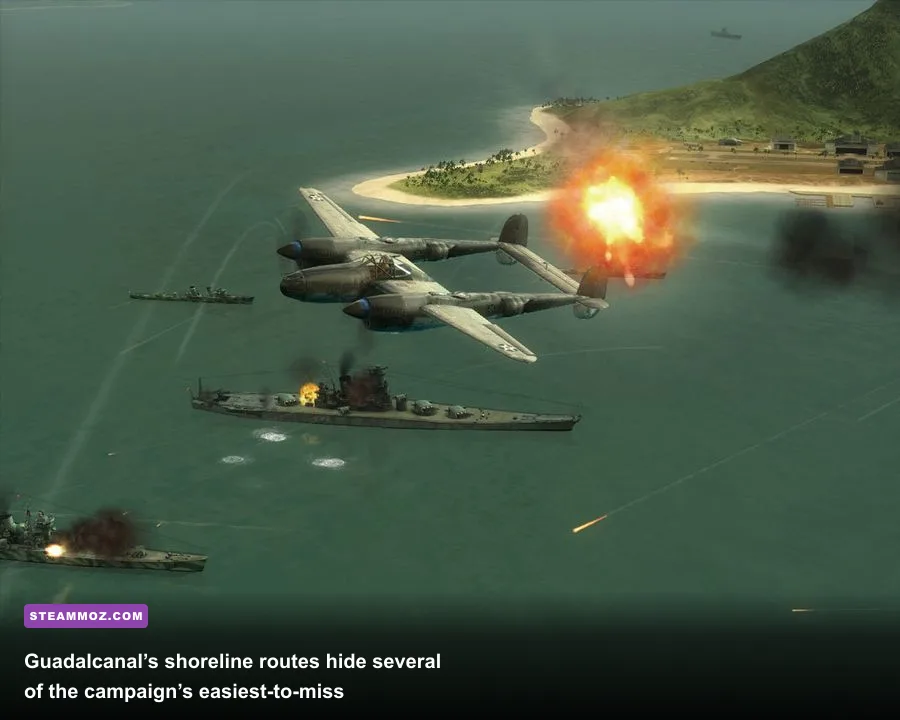
Guadalcanal hides content along the coast: PT boats, landing craft, artillery positions, and isolated patrols. Move a fast patrol unit through coves and behind headlands while your heavy ships stay in open water. Coastal guns can be destroyed from range, but first you need line of sight. A scout aircraft is safer and faster than blindly steering a cruiser toward the beach.
When an escort objective appears, place the escort at the front of the formation and your fire-support ship behind it. This seems slower, but it prevents the friendly transport from wandering into torpedo range. Use smoke, fighter cover, and manual point defense if available. Optional ships are often fragile, and the objective can fail before the game gives you a clear warning.
Santa Cruz, the Philippine Sea, and Leyte Gulf
Late missions hide fewer “secret” landmarks but punish poor preparation. Search carrier flanks, retreat routes, and the space beyond the primary fleet. Japanese support ships may enter after a scripted trigger, so don’t move your entire force to the final objective the instant it updates. Leave a fast destroyer or aircraft group behind to investigate new contacts.
At Leyte Gulf, protect your capital ships while using destroyers to screen torpedoes and scouts to identify secondary targets. The map can become saturated with aircraft, so use the tactical overview instead of relying on visual spotting alone. If you have already completed the primary goal, resist the temptation to end the mission immediately. Sweep the remaining sectors first; many players miss their final optional credit simply by choosing the extraction prompt too quickly.
| Campaign area | Primary search zone | Best scout | Main danger |
|---|---|---|---|
| Pearl Harbor | Outer harbor entrances and airfield approaches | Destroyer or fighter | Overlooking damaged friendly units |
| Wake Island | Island perimeter and hidden landing lanes | Recon aircraft | Terrain blocking line of sight |
| Java Sea | Island channels and convoy edges | Destroyer | Misidentifying an escort target |
| Midway | Carrier flanks and airfield approaches | Fighter squadron | Spending all aircraft too early |
| Guadalcanal | Coves, beaches, and coastal batteries | PT boat or scout plane | Escort vessel being torpedoed |
| Leyte Gulf | Retreat lanes and fleet support zones | Destroyer screen | Ending the mission before sweeping contacts |
How to trigger every hidden reward reliably
Most missed objectives come from bad timing, not bad aim. Use this step-by-step routine on every campaign mission.
- Read the briefing twice. The briefing often names a friendly asset or strategic area that later becomes the location of an optional task. Note every ship, island, airfield, and convoy mentioned, even if it isn’t a primary objective.
- Pause after each transmission. New objectives can arrive while you are controlling an aircraft. Pausing prevents a scripted message from disappearing under combat noise and gives you time to locate the relevant unit.
- Scout in a wide loop. Send a fast unit around the outside of the highlighted objective zone. Search behind islands, outside harbor mouths, and along likely retreat paths. Don’t zigzag randomly; use the map boundary and terrain as a checklist.
- Protect before attacking. If a secondary objective says rescue, escort, or defend, move the friendly unit away from the nearest enemy first. Then deal damage. A perfect attack run is worthless if the target you’re saving dies during your approach.
- Confirm completion. Wait for the objective text, radio confirmation, or updated checklist. A destroyed enemy may look like success even when the task required a specific unit, a time limit, or survival of an allied vessel.
- Finish with a map sweep. After the primary objective turns green, check every sector once more. This catches delayed spawns and support units that enter after the major battle.
Save before major scripted attacks when the platform version allows it. The older PC release can behave unpredictably around loading transitions and objective triggers, particularly on modern systems running unofficial compatibility fixes. If a secondary objective fails despite following the route, reload the previous checkpoint and trigger the radio event with a different unit selected. The game occasionally fails to present a prompt when you are locked into a cinematic or aircraft view.
Best unit for each kind of secret
Fast ships are the best general-purpose explorers. Destroyers turn quickly, carry useful anti-submarine weapons, and can screen a transport once the objective is revealed. PT boats are excellent around islands but are too fragile for open-water scouting. Fighters reveal aircraft threats and protect vulnerable objectives, while recon aircraft expose the largest search area. Cruisers are the safest choice when a hidden coastal battery must be destroyed under fire.
| Unit | Secret objective role | Strength | Weakness |
|---|---|---|---|
| Destroyer | Map-edge scouting and escort | Fast, agile, versatile | Low durability under concentrated fire |
| PT boat | Cove searches and surprise torpedo attacks | Excellent close-range burst | Extremely vulnerable to aircraft |
| Recon aircraft | Revealing distant contacts | Fastest broad-area discovery | Needs fighter cover |
| Fighter | Protecting airfields and rescue targets | Intercepts bombers quickly | Weak against ships |
| Cruiser | Coastal guns and support ships | Strong guns and survivability | Slow to reposition |
Medals, achievements, and rewards people often miss
Finishing a hidden objective doesn’t always produce a dramatic unlock screen. The reward may be reflected in your mission rating, medal tally, achievement progress, or access to later challenge content. That’s why it’s worth checking the campaign results screen instead of assuming a secret did nothing.
Accuracy and survival matter as much as raw destruction. A player who sinks every enemy ship but loses half the fleet can receive a weaker result than someone who completes fewer kills while protecting the required assets. Don’t burn torpedoes against tiny patrol boats if a battleship is about to enter the engagement. Save limited ammunition for targets that block the objective route.
There’s also a practical reward: learning the game’s unit economy. Hidden tasks force you to use ships outside your preferred class, and that pays off in later missions. Destroyers teach screening, aircraft teach threat prioritization, and PT boats teach approach angles. The campaign becomes much easier once you stop treating every mission as a battleship duel.
For broader achievement-hunting habits, Steamoz’s Dungeons 4 hidden-reward guide is a useful contrast: that game uses explicit exploration rewards, while Midway hides progress inside objectives and mission performance. You can verify the PC achievement list through the official Steam page.
What does not count as a secret location
Wrecks, decorative islands, ordinary enemy patrols, and every unmarked aircraft are not automatically secrets. Community maps sometimes label them because they are useful landmarks, but destroying them alone won’t guarantee an unlock. The meaningful test is whether the game adds an objective, awards completion credit, or records progress after the action.
Likewise, changing difficulty doesn’t reveal a separate set of hidden collectibles. Higher difficulty changes threat behavior, damage tolerance, and the pressure placed on your fleet; it does not turn the campaign into a different treasure hunt. Play on a lower setting for your first sweep if you want to learn triggers, then replay on a harder setting for medals.
Modern PC tips for replaying the secret routes
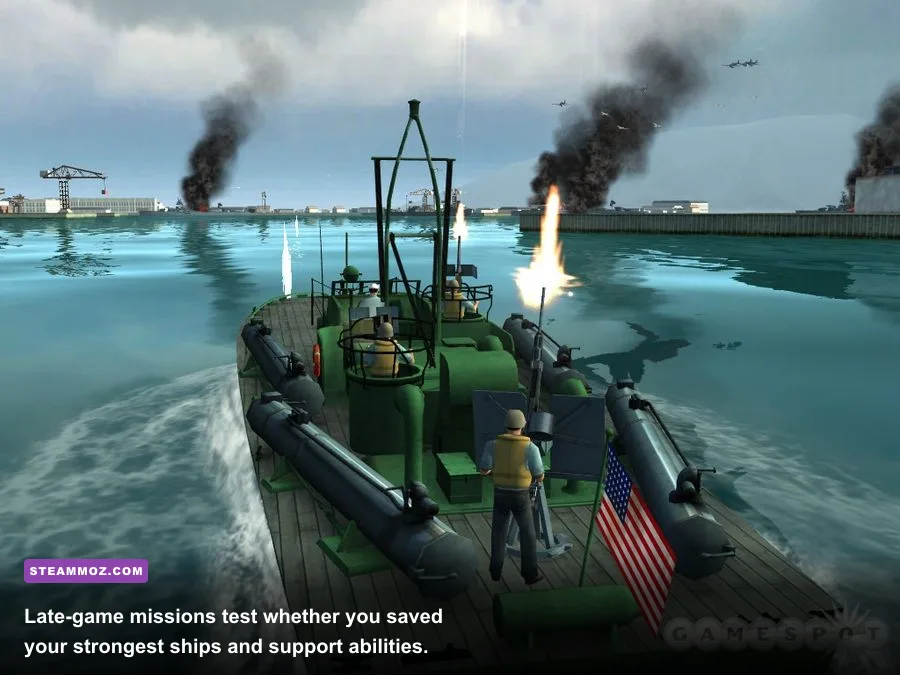
Battlestations: Midway is an older DirectX-era game, so modern hardware can create strange problems rather than simply delivering effortless performance. High frame rates may expose timing quirks in menus, input, or scripted scenes, while forced widescreen fixes can distort the tactical interface. Start with a clean install, verify the game files, and test the original configuration before stacking community patches.
For stable campaign scouting, cap the frame rate near 60 frames per second, disable overlays that hook into the game, and avoid alt-tabbing during a radio transmission. If the mouse feels too fast, lower Windows pointer acceleration before changing in-game sensitivity. A stable tactical map is more valuable than a few extra frames because missed text is one of the easiest ways to lose a secondary objective.
| Setting or fix | Recommended value | Why it helps | Trade-off |
|---|---|---|---|
| Frame-rate cap | 60 FPS | Reduces timing and menu oddities | Less headroom on high-refresh displays |
| Resolution | Native desktop resolution, tested first | Keeps the tactical interface readable | Older UI may remain stretched |
| Overlay software | Disable while troubleshooting | Avoids hook and focus conflicts | No overlay recording or counters |
| Compatibility mode | Use only if the base install fails | Can repair launch and video issues | May introduce new input problems |
| Alt-tab during objective text | Avoid | Prevents missed scripted messages | Requires uninterrupted play sessions |
If the game crashes before a secret trigger, repair stability first rather than repeatedly replaying the same mission. Steamoz’s PC crash-fix checklist covers general troubleshooting habits, and the official Steam Community discussions are still useful for version-specific compatibility reports. Keep backups of save files before experimenting with widescreen patches.
The cleanest 100-percent replay strategy
First, play each mission on normal difficulty and focus only on learning the trigger order. On the second run, assign one fast scout to the outer perimeter, preserve one aircraft reserve, and complete every optional task before the final primary objective. On the third run, chase medals and speed records with the route already memorized.
Write down the order in which objectives appear, not just their locations. Midway’s scripting means that a “secret” ship may not exist until you defend an airfield, reach a convoy, or finish the opening wave. A route that works when you rush may fail when you destroy the trigger enemy too early. If the optional marker never appears, reload and allow the scripted radio exchange to finish before moving on.
Finally, don’t confuse a clean mission with a complete secret sweep. Review the end-of-mission objective list, compare your medal results, and replay any chapter where a rescue, escort, or bonus target is missing. Once you treat the campaign as a chain of timed tactical events rather than a linear shooting gallery, every hidden reward becomes predictable. That’s the real secret to Battlestations: Midway: scout wide, protect fragile assets first, and never leave the map until the last radio message has been answered.
For official background on the game and its original PC release, consult the publisher’s Battlestations: Midway information alongside the developer and port information. Those references help separate genuine campaign objectives from fan-made collectible maps that borrow the word “secret” far more liberally than the game itself does.