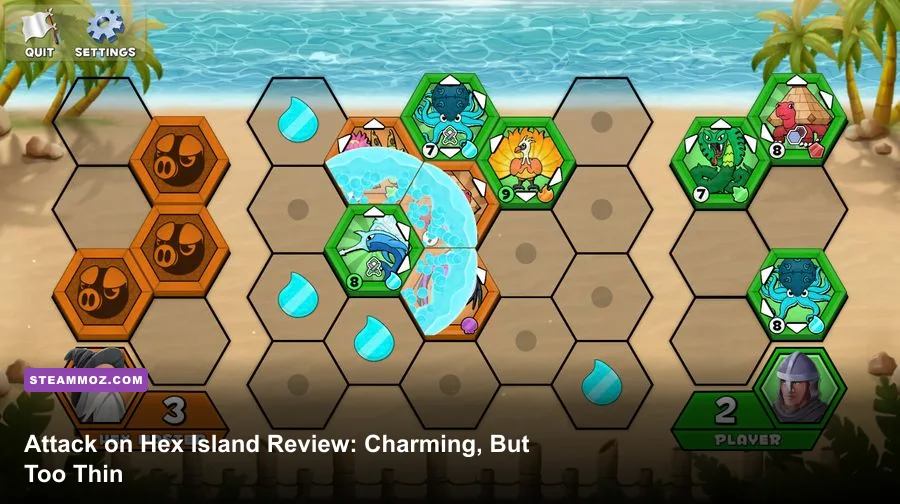
Attack on Hex Island is worth playing in 2026 only if you want a short, low-pressure hex-grid strategy game and can accept modest content. Its strongest idea is the island itself: every decision is shaped by limited space, awkward angles, and the constant need to protect useful terrain. That makes the opening hours surprisingly engaging. The problem is that the game rarely develops those ideas into a deep campaign, so experienced strategy players may finish their first serious run before the systems have time to become genuinely demanding.
This is not a disastrous release, and it is certainly not a game I would dismiss outright. The presentation is readable, the rules are easy to understand, and the compact maps create a pleasant puzzle-box rhythm. But the 2026 question matters because the market is crowded with inexpensive roguelites, tower-defense games, and tactics titles that offer far more build variety. Attack on Hex Island needs to be cheap, discounted, or specifically aligned with your taste before it becomes an easy recommendation.
What Attack on Hex Island actually does well

The central hook is straightforward: you build and defend a small island assembled from hexagonal spaces. Hexes are a better fit than a square grid for this kind of design because they create six possible directions instead of four. That sounds like a tiny rules change, but it affects everything. Threats can approach from more angles, defensive structures can cover wider arcs, and a single poorly chosen placement can make an otherwise productive section of the island difficult to protect.
That spatial pressure is the game’s best source of tension. You are not simply filling empty spaces with the strongest available option. You are weighing adjacency, approach lanes, available room, and whether an attractive tile will create a future bottleneck. The best moments arrive when a defensive layout works because of its geometry rather than because you have brute-forced the encounter with superior upgrades.
The interface also deserves credit. Attack on Hex Island communicates occupied spaces, open hexes, hostile movement, and construction limits without drowning the screen in menus. That clarity makes the game approachable for players who normally bounce off traditional tactics games. It also means the title works well in shorter sessions: you can understand the board quickly, make a handful of meaningful choices, and stop without feeling as if you abandoned a 40-hour campaign.
Players who enjoy the slow-burn map reading in Dungeon Siege’s classic progression may appreciate the same sense of incremental control here, though Attack on Hex Island is much more compact and much less character-driven.

🎮 Attack on Hex Island
Looking to experience this game? Grab your digital key directly on our store for $9.99.
View on Steammoz Store →Where the strategy starts to run out of steam
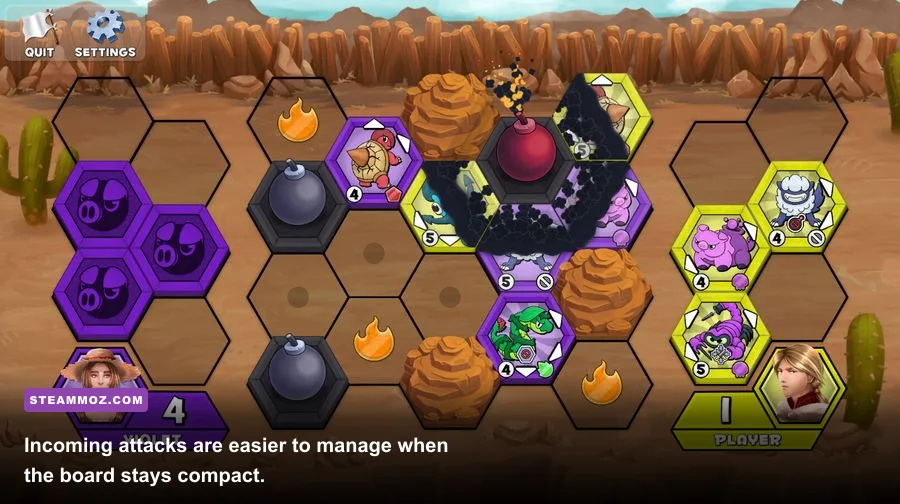
The island layout creates interesting problems, but the surrounding systems do not always give those problems enough variety. Once you understand the value of protecting central lanes and avoiding isolated construction pockets, many encounters begin to resemble earlier ones. The board changes, yet the decision-making pattern often remains familiar: establish a safe core, reinforce the most exposed approach, then spend surplus resources on efficiency.
That repetition would be easier to forgive if the game offered a large collection of radically different tools. Instead, the progression feels restrained. You are generally improving a familiar plan rather than constantly rebuilding your strategy around new rules. There is satisfaction in making a clean defensive layout, but the game does not consistently challenge you to abandon that layout and think from scratch.
This is also where the lack of transparent, granular information hurts. Attack on Hex Island does not present the kind of detailed combat breakdowns that strategy veterans expect from deeper games. Exact damage values, attack timing, range interactions, and upgrade breakpoints are not always obvious from the interface. You can learn through play, but that learning is less about mastering a rich ruleset and more about discovering what the game does not bother to explain.
| Review area | What works | What holds it back |
|---|---|---|
| Hex-grid design | Six-direction movement creates useful placement pressure | Later scenarios do not always add new spatial problems |
| Progression | Easy to understand and rewarding early | Limited build divergence reduces replay value |
| Combat readability | Threats and board state are visually clear | Exact values and timing are not always exposed |
| Session length | Works well for short play sessions | Short structure can feel slight at full price |
How to approach the early island without wasting resources
The most reliable opening is conservative. Do not rush to occupy every available hex just because the island gives you room. Empty space is valuable because it preserves flexibility. A compact cluster of useful structures is easier to defend than a scattered collection that creates several exposed edges.
Protect the center before chasing efficiency
Your first priority should be a dependable central area with clear access to multiple approach lanes. From there, expand toward positions that improve coverage rather than simply producing more resources. A slightly less productive hex that protects two routes is usually stronger than a lucrative edge tile that forces you to defend a new side of the island.
Keep one emergency lane open
Players often make the same mistake: they build a neat wall, then discover that the wall blocks their own ability to respond. Leave a route for repositioning and avoid turning the island into disconnected pockets. If the game presents a sudden pressure spike, the ability to reinforce a threatened side is worth more than a small early economic bonus.
Upgrade the structure that fixes your weakest angle
Do not automatically upgrade whatever is producing the most visible value. Upgrade the part of the layout that solves the problem most likely to end the run. If enemies are slipping through a narrow side, improve coverage there. If resources are arriving too slowly, strengthen the economy only after the island can survive the next attack. This sounds basic, but the compact maps punish greedy sequencing more severely than they punish slow growth.
| Opening decision | Recommended priority | Why it matters | Common mistake |
|---|---|---|---|
| Initial placement | Build a compact central core | Shortens response time across the island | Spreading structures across every open hex |
| First expansion | Secure a threatened approach lane | Prevents the island perimeter from growing too quickly | Taking the highest-income tile immediately |
| First upgrade | Fix the weakest defensive angle | Stops one vulnerable side from deciding the run | Upgrading the strongest structure by habit |
| Resource spending | Keep a reserve for emergencies | Lets you answer unexpected pressure | Spending every resource between attacks |
This measured approach will feel familiar to readers who enjoyed the route planning in Empires of the Undergrowth’s leveling systems. The difference is scale: Attack on Hex Island asks for fast board decisions rather than a long-term colony economy.
Performance, controls, and the 2026 PC experience
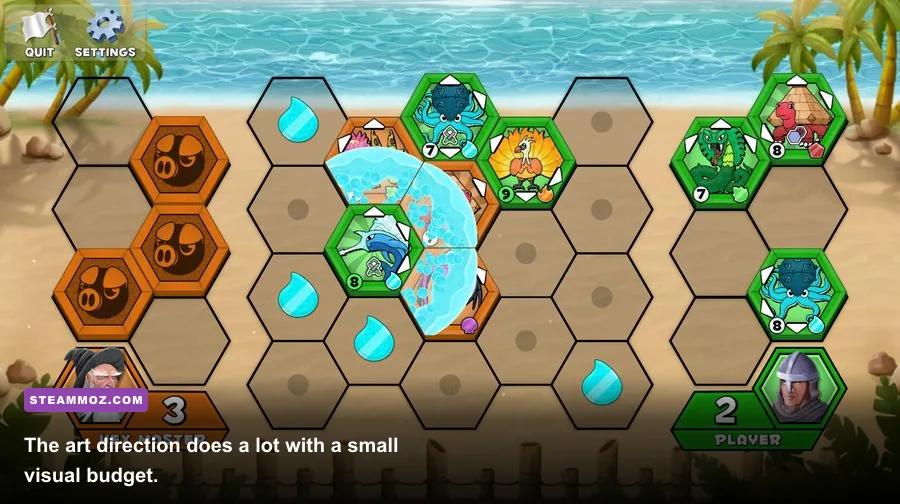
Attack on Hex Island is visually modest, which is mostly an advantage. The hexes remain readable, effects do not bury the board, and the uncluttered presentation supports the game’s tactical focus. You do not need a powerful gaming PC to enjoy it, and the limited visual complexity means performance should not be the deciding factor for most players.
The trade-off is that there is not much visual customization to chase. This is not a showcase title where lowering shadows or volumetric effects unlocks a dramatic frame-rate gain. If your system struggles, prioritize resolution, display mode, and any available effects-quality option, then disable background applications. The bigger practical issue is input comfort. Mouse control is the natural fit for placing and inspecting hexes, while players who prefer a controller should test camera movement and tile selection before committing to a long session.
| Profile | Suggested setup | Expected benefit | Best for |
|---|---|---|---|
| Quality | Native resolution, highest available effects | Sharper island presentation with minimal compromise | Modern desktop PCs |
| Balanced | Native resolution, reduced effects, capped frame rate | Stable play without unnecessary GPU load | Older laptops and mid-range systems |
| Low-power | Lower resolution, windowed or borderless mode, effects reduced | Less heat and better battery endurance | Integrated graphics and handheld PCs |
If you are troubleshooting a broader PC library, Steamoz’s ELEX crash and FPS fixes and Drawful 2 PC requirements guide cover the more useful general checks: verify files, update graphics drivers, test borderless mode, and avoid assuming that a low-spec game cannot suffer from background software conflicts.
Is Attack on Hex Island worth buying in 2026?
That answer depends almost entirely on price and expectations. If you want a compact strategy game that teaches its core idea quickly, Attack on Hex Island has a pleasant, approachable loop. Its hexagonal board is not just decoration; it produces real placement decisions, and the best runs feel like elegant little defensive puzzles. It is also a sensible choice for players who prefer short sessions over sprawling campaigns.
The recommendation weakens for anyone looking for deep replayability. The game’s systems do not always create enough dramatic variation between runs, and the limited information around combat values makes optimization less satisfying than it should be. You can understand the strategy fairly quickly, but the game does not always reward that understanding with an equally deep endgame.
Before buying, check the official Steam search listing for the current price, update history, and player feedback. The Steam Community search is useful for checking whether players are reporting controller, save, or compatibility problems, while Steam’s official news hub can help confirm whether a recent client update is affecting a game’s launch behavior.
Final verdict: Attack on Hex Island is a decent recommendation at a low price, especially for newcomers to hex-grid strategy or players who enjoy relaxing, bite-sized defensive puzzles. It is not a must-play 2026 strategy release, and it does not have the depth to replace heavier games in the genre. Buy it on sale, approach it as a focused short-form experience, and you’ll likely have a good time. Buy it expecting a long-term tactical obsession, and the island may feel smaller than advertised.
For more strategy recommendations, compare its streamlined approach with Dungeons 3’s campaign tactics or the more build-focused systems covered in Dungeons 2’s beginner build guide. Attack on Hex Island cannot match those games for breadth, but it has one thing they do not: a clean little island puzzle that gets to the point quickly.