
If you’re heading into Atomic Heart: Enchantment Under the Sea, build around the KM-4 Kuzmich, Kalash, and Zvezdochka first. That trio covers point-blank burst damage, reliable mid-range fire, and brutal melee stagger, while Frostbite and Mass Telekinesis create the control windows that make tougher underwater encounters manageable. The Railgun is still the best specialist weapon, but its ammunition economy keeps it out of the everyday top spot.
This ranking assumes a normal New Game or New Game+ run, not a fully modded save with every blueprint maxed. Atomic Heart does not publish clean numerical DPS values for every upgrade level; Nora presents damage, rate of fire, handling, and elemental effectiveness as upgrade bars, and those values change with attachments. So the useful question isn’t simply “which weapon has the biggest number?” It’s which weapon converts scarce resources, enemy openings, and P-3’s polymer abilities into kills most consistently.

The Enchantment Under the Sea weapon tier list
The table below ranks weapons by practical performance rather than showroom damage. S-Tier weapons stay useful across the DLC’s mixed encounters, A-Tier choices are excellent with the right ammunition or upgrades, and B-Tier weapons are more specialized. None of the B-Tier picks are unusable; they simply ask more from your aim, inventory, or combat planning.
| Weapon | Tier | Best role | Why it ranks here |
|---|---|---|---|
| KM-4 Kuzmich | S-Tier | Close-range burst | Deletes exposed cores and staggers dangerous machines before they can complete an attack. |
| Kalash | S-Tier | General-purpose rifle | Excellent sustained damage, flexible ammo use, and dependable performance against most robots. |
| Zvezdochka | S-Tier | Melee burst and stagger | Heavy swings punish frozen or telekinetically suspended targets and conserve ammunition. |
| Railgun | A-Tier | Elite and boss finishing | Huge single-target impact, but energy ammunition and slow firing make it a specialist tool. |
| Fat Boy | A-Tier | Groups and armored targets | Explosive splash damage is superb when several enemies overlap, though rockets are precious. |
| KS-23 | A-Tier | Early and mid-game shotgun | Strong burst for its availability, but it loses ground to Kuzmich once the DLC arsenal opens up. |
| Electro | A-Tier | Energy-efficient ranged damage | Does not consume conventional ammunition, making it valuable during long exploration sections. |
| Snowball | B-Tier | Heavy melee | Good raw impact, but slower recovery leaves P-3 vulnerable if you miss. |
| Fox | B-Tier | Fast melee attacks | Quick and comfortable, yet its lower reach and stopping power limit it against elites. |
| Dominator | B-Tier | Energy weapon specialist | Useful against selected targets, but its energy drain competes with glove abilities. |
🎮 Atomic Heart - Enchantment Under the Sea
Looking to experience this game? Grab your digital key directly on our store for $6.99.
View on Steammoz Store →Why KM-4 Kuzmich is the DLC’s best weapon
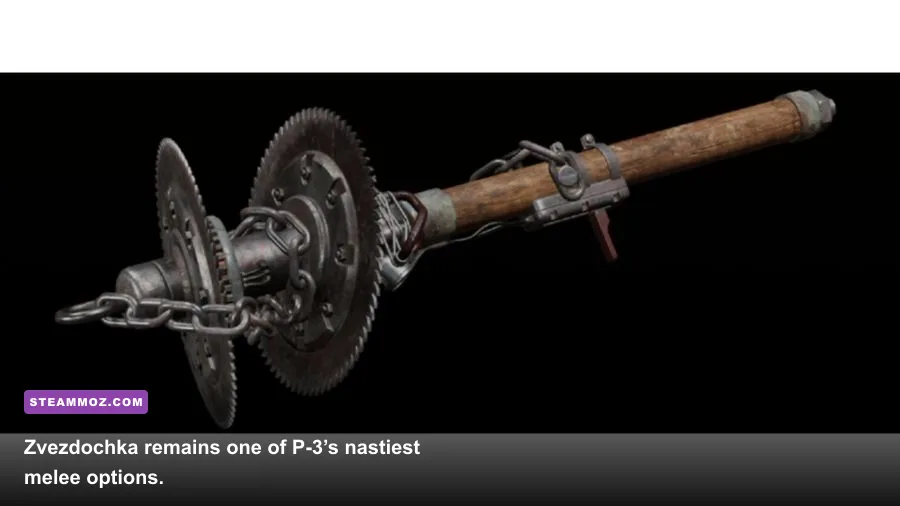
The KM-4 Kuzmich earns S-Tier because it solves the problem that makes Atomic Heart’s hardest fights irritating: enemies can survive long enough to interrupt your healing, reload, or ability animation. A properly upgraded Kuzmich compresses the fight into a few close-range blasts. That matters more than a theoretical damage-per-second figure when a robot is already winding up a charge.
Use it against enemies whose weak points are easy to reach at short distance, especially when they’re frozen, knocked down, or trapped in Mass Telekinesis. The safest sequence is simple: cast Frostbite, step inside the target’s effective range, fire into the exposed body or core, then swap to Zvezdochka for the finishing swing. Frostbite’s freeze creates the opening; Kuzmich supplies the burst; Zvezdochka avoids wasting another shell on a nearly dead target.
Don’t treat it like a universal replacement for the KS-23. Its strength depends on distance and pellet placement. At the edge of a room, spread reduces the number of pellets landing on a weak point, and every missed shot hurts because shotgun ammunition is less abundant than standard rifle rounds. Prioritize the weapon’s damage and reload upgrades at Nora, then improve handling if you find the firing recovery too sluggish.
Best Kuzmich setup
- Primary upgrade: Damage, followed by reload speed.
- Combat partner: Zvezdochka for melee executions after the first blast.
- Control power: Frostbite or Mass Telekinesis.
- Inventory rule: Carry it for elites and ambushes, not every disposable VOV-A6 worker.
S-Tier loadouts that carry the whole campaign
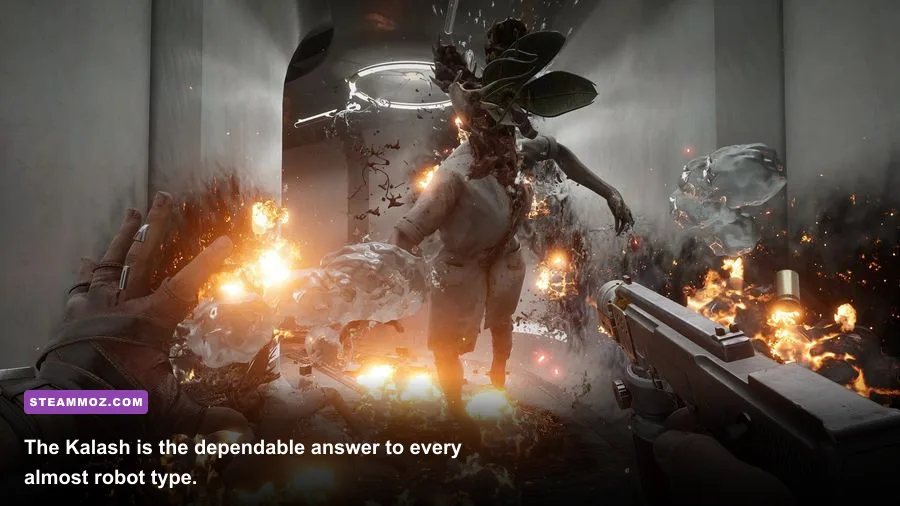
The Kalash is still the most reliable weapon in P-3’s locker. It has the range to hit cameras, limbs, and exposed robot components without forcing you into danger, and its conventional ammunition is easier to maintain than rockets or heavy energy cells. It also reacts well to the game’s upgrade system: damage improves its baseline, while recoil and handling upgrades make controlled bursts much easier during underwater facility firefights.
Use short bursts against flying targets and sustained fire only when a large machine’s weak point is exposed. Holding the trigger forever is a fast way to empty your reserve into armor. If you’re struggling with ammo, let Shok handle vulnerable machines and reserve Kalash rounds for targets that resist elemental control. The weapon’s flexibility is why it ranks above more glamorous options.
Zvezdochka is the other half of the S-Tier foundation. Its heavy attack has a pronounced wind-up, so swinging randomly in a crowd is asking to be surrounded. Instead, use it after Frostbite, Polymeric Jet, or Mass Telekinesis. The weapon shines when an enemy cannot retaliate: frozen machines take the full punishment, while suspended targets give you time to complete the animation safely.
That combination also improves resource efficiency. A Kalash handles distant threats, Kuzmich erases close threats, and Zvezdochka finishes disabled targets. You’re not spending shotgun shells on weak enemies or burning energy ammunition just because a robot is annoying. This is the kind of practical economy that makes a build feel stronger than its upgrade bars suggest.
A-Tier weapons and when to bring them
The Railgun remains the best “make this boss phase shorter” button. It’s excellent against a large exposed core or an elite that has already been stripped of defenses. The drawback is obvious: energy ammunition is limited, and the weapon’s firing cadence doesn’t forgive a missed shot. Equip it when you know a fight contains a high-value target, not as your default answer to regular patrols.
Fat Boy fills a different niche. Its explosive projectiles are devastating when multiple enemies stack around a doorway, elevator, or narrow maintenance corridor. It also gives you breathing room against groups that refuse to stagger individually. The problem is collateral chaos: firing too close to P-3 can damage you, and rockets are too expensive to spend on one low-tier target.
Electro is quietly one of the smartest weapons for exploration. It uses energy rather than conventional ammunition, so it can preserve your Kalash and shotgun reserves during routine fights. Its value rises when paired with abilities that restore or manage energy efficiently. Don’t expect it to replace the Railgun for elite burst, but it’s a superb low-cost option for finishing damaged enemies.
The KS-23 deserves respect because it arrives earlier and feels powerful immediately. It’s a terrific answer before Kuzmich enters your rotation. Once you have the DLC shotgun upgraded, though, KS-23 becomes the backup rather than the star. Snowball and Fox are similarly valid choices: Snowball hits harder, Fox swings faster. Pick based on whether you’re comfortable managing recovery frames, not on the tier label alone.
| Situation | Best weapon | Support ability | Reason |
|---|---|---|---|
| Single elite at close range | KM-4 Kuzmich | Frostbite | Freeze the target, land a full burst, then finish with melee. |
| Mixed patrol at medium range | Kalash | Shok | Control the first threat while rifle bursts remove weak points. |
| Clustered machines | Fat Boy | Mass Telekinesis | Group enemies before using splash damage, but keep explosive distance. |
| Long exploration stretch | Electro | Energy Vampire | Preserve conventional ammunition and recover energy through combat. |
| Boss core exposed | Railgun | Polymeric Shield | Shield through retaliation, then spend the high-impact shot on the opening. |
The best glove abilities for every weapon tier
Weapons don’t operate independently in Atomic Heart. Your glove loadout determines whether a weapon gets a clean damage window or leaves you standing in an enemy’s attack animation. Frostbite is the most universally useful partner for Kuzmich and Zvezdochka because freezing converts a dangerous target into a stationary damage test. Against fast enemies, that control is often worth more than another damage upgrade.
Mass Telekinesis is the best crowd-management choice. Lift a group, reposition, and use either Fat Boy or a melee heavy attack while the enemies are helpless. The ability also helps create distance when several machines breach your personal space. If you’re using the Kalash, telekinesis gives you a stable window to aim at components rather than spraying armor.
Polymeric Jet is more tactical. Its slick surface can set up elemental interactions and briefly disrupt enemy movement, but it demands more deliberate placement than Frostbite. It’s particularly effective when you know a fight will happen in a confined room. Polymeric Shield is the safer defensive option for bosses and high-difficulty runs, especially when you’re learning a new attack pattern.
Shok should remain on the glove for convenient damage and machine control, but don’t spam it without watching your energy meter. Energy management is the hidden limiter on Electro, Dominator, and the Railgun. Energy Vampire can support an energy-focused setup, while a conventional Kalash/Kuzmich build can spend more freely because its primary damage comes from physical ammunition.
Upgrade priorities, ammo economy, and combat rotation
At Nora, don’t spread resources evenly across every blueprint. Choose two primary weapons and one specialist. The strongest general route is damage and handling on Kalash, damage and reload on Kuzmich, then one high-impact upgrade path for Zvezdochka. You’ll feel the improvement immediately because those upgrades affect the situations you encounter most often, rather than a rare boss phase.
Use the following rotation for a difficult encounter:
- Scout first. Identify cameras, repair-capable machines, and environmental hazards before opening fire.
- Disable the most disruptive enemy. Shok or Frostbite should stop the target that can interrupt your reload or healing.
- Create a damage window. Mass Telekinesis groups enemies; Polymeric Shield protects a risky push.
- Spend the correct ammunition. Kuzmich for a close elite, Kalash for exposed components, and Railgun only for a valuable core.
- Finish with melee. Zvezdochka saves ammunition once the enemy is frozen, staggered, or nearly dead.
Frame rate also affects this ranking. Fast melee weapons feel more forgiving at a stable 60 frames per second because you can read recovery and dodge timing more clearly. Heavy weapons are less sensitive to small performance dips, but inconsistent frame pacing still makes aiming and animation cancels feel unreliable. If your PC struggles in the underwater facility, lower volumetric effects and shadows before textures. Keep textures high if your graphics memory allows it, since texture quality usually costs less gameplay responsiveness than heavy lighting effects. For broader optimization advice, Steamoz’s frame-focused settings guide offers a useful comparison point.
Final ranking for Enchantment Under the Sea
The cleanest loadout is KM-4 Kuzmich, Kalash, and Zvezdochka, with Frostbite and Mass Telekinesis equipped on the glove. That setup handles nearly every combat rhythm the DLC throws at you: controlled rifle fire for distance, shotgun burst when a machine closes in, and melee punishment when a polymer effect creates an opening. Add the Railgun when a boss or elite demands concentrated damage, and swap in Fat Boy only when you’re expecting dense groups.
Don’t chase a tier list blindly, though. The right weapon is the one whose range and recovery you can read under pressure. A well-upgraded KS-23 will outperform an untouched Kuzmich, and a careful Kalash user will survive fights that a reckless Railgun player turns into an ammunition crisis. Check the official Atomic Heart Steam page for the base game and DLC details, and keep Mundfish’s official site bookmarked for patch information.
For more RPG progression advice, Steamoz’s Dungeon Siege build analysis and ELEX performance guide cover the same kind of practical decision-making. In Atomic Heart, though, the winning formula stays wonderfully direct: freeze the threat, hit the weak point, and never spend premium ammunition on a fight your glove abilities can already control.