
For a first playthrough, build Jacob around Combat Stamina, Health Boost, Gunslinger, and Execution, then spend shared points on Eagle Vision and Stealth. Pair that skill path with level-appropriate brass knuckles, a kukri, a pistol, and a stealth-focused outfit. You’ll hit hard enough to survive brawls, still have the tools for assassinations, and avoid wasting early resources on flashy upgrades that barely improve your damage.
That hybrid approach fits how Assassin’s Creed Syndicate actually plays. London constantly throws you between rooftop infiltrations, carriage chases, kidnapping missions, gang wars, and open combat. A pure stealth setup can feel fragile when an alarm turns a quiet assassination into a six-man fistfight, while a pure brawler build makes restricted areas unnecessarily difficult. The sweet spot is a flexible starter loadout that lets Jacob and Evie cover each other’s weaknesses.
Before you start spending, check the official Steam page for Assassin’s Creed Syndicate and Ubisoft’s official Syndicate game page. This guide focuses on the base game’s campaign systems, not DLC-exclusive gear.
The best first skill path for Jacob Frye

Jacob is the ideal character for learning Syndicate’s combat rhythm because his skill tree rewards controlled aggression. Start with the Combat branch, but don’t buy every punch-related upgrade immediately. Early missions are easier when you can stay alive, refill your tools, and finish stunned enemies quickly.
Spend your first skill points in this order
- Health Boost I: Take this as soon as it becomes available. More health gives you room to learn counter timing without restarting every time two enemies attack together.
- Combat Stamina: This is the build’s engine. Stamina fuels heavy attacks and other combat actions, so the larger pool lets you break tougher opponents instead of repeatedly bouncing off their guard.
- Counter Boost: Syndicate’s combat rewards reacting to enemy indicators. A stronger counter window makes crowded fights much more forgiving, especially against knife users and brutes.
- Execution: Prioritize the skill that lets you finish a vulnerable enemy. Executions reduce the number of active attackers and prevent long fights from becoming chaotic.
- Gunslinger I: Add this once your basic survivability is in place. Jacob’s pistol is more than a damage button; it can interrupt, soften, or finish an enemy while you reposition.
- Health Boost II and Gunslinger II: Buy these as the mid-game opens up. Health Boost II is the safer choice for players still learning, while Gunslinger II is better if you regularly use firearms during escapes and multi-target encounters.
The important interaction is stun, attack, execute. Use a counter or a disruption tool to create an opening, spend stamina on a heavy strike when the target is vulnerable, then execute before another enemy can surround you. Don’t mash light attacks into a guarded opponent. You’ll lose tempo, burn stamina, and invite a counterattack.
| Skill | Priority | Why it matters | Best timing |
|---|---|---|---|
| Health Boost I | S-Tier | Raises your margin for error | First available points |
| Combat Stamina | S-Tier | Supports heavy attacks and extended fights | Immediately after basic survivability |
| Counter Boost | A-Tier | Makes enemy telegraphs easier to answer | Before crowded borough activities |
| Execution | S-Tier | Removes enemies quickly after openings | As soon as unlocked |
| Gunslinger I | A-Tier | Adds interruption and ranged finishing power | Early-to-mid game |
| Air Assassination | A-Tier | Improves rooftop and balcony approaches | Before major restricted areas |
Air Assassination belongs in the next wave of purchases if you enjoy rooftop routes. It isn’t as universally useful as health or stamina, but Syndicate’s level design constantly rewards dropping onto guards from above. The key is not to treat Jacob as a walking tank. He still kills faster from a hidden position than in a fair fight.

🎮 Assassin's Creed Syndicate
Looking to experience this game? Grab your digital key directly on our store for $7.49.
View on Steammoz Store →Evie’s stealth build and when to switch characters

Evie Frye should take the opposite role. Her strongest beginner path runs through Stealth, Eagle Vision, and utility skills that help you remain undetected. Switch to Evie whenever a mission emphasizes tailing, infiltration, enemy marks, or a clean assassination rather than a prolonged street fight.
Put early points into Stealth I and Stealth II when available. These upgrades make crouched movement and detection management more reliable, which matters because Syndicate’s guards can spot you quickly in exposed cover. Follow them with Eagle Vision II, then invest in Chameleon when you want a stronger disguise-and-cover style of play. The exact order depends on which missions you’re running, but Eagle Vision is always a safe purchase for beginners because it improves planning before the first blade leaves its sheath.
Evie’s Knife Mastery is especially useful if you like quiet ranged eliminations. Throwing knives can remove isolated lookouts without creating the noise and ammunition concerns of a pistol. Pair that with smoke bombs for escapes, not routine kills. A smoke bomb is most valuable when the assassination went wrong and you need to break line of sight before the whole compound collapses on you.
Evie’s practical mission rotation
Start outside the restricted zone and activate Eagle Vision from cover. Mark the target, identify rooftop snipers, and locate alarm bells before moving. Use the rope launcher to create a high route, then air-assassinate isolated guards. If the target has several bodyguards, don’t rush the kill. Clear the nearest lookout, use a whistle from cover, and let the guard enter your assassination range.
When the target is down, leave through the same vertical route rather than improvising on the street. Syndicate’s police response can turn an otherwise perfect mission into a chase, and chase damage often costs more time than the infiltration itself. You can compare this methodical approach with the resource-first thinking in Steamoz’s beginner build guide for Dungeons 2; the games are wildly different, but both reward choosing a clear role before spending upgrades.
| Character | Primary role | Core skills | Use them for |
|---|---|---|---|
| Jacob Frye | Combat hybrid | Health Boost, Combat Stamina, Counter Boost, Execution | Gang wars, brawls, chases, noisy objectives |
| Evie Frye | Stealth specialist | Stealth I-II, Eagle Vision II, Chameleon, Knife Mastery | Infiltration, tailing, assassination, alarm-free runs |
| Shared abilities | Utility and mobility | Lockpicking, Scavenger, Double Assassination | Looting, route planning, quick multi-kills |
Weapons, outfits, and stats that actually matter

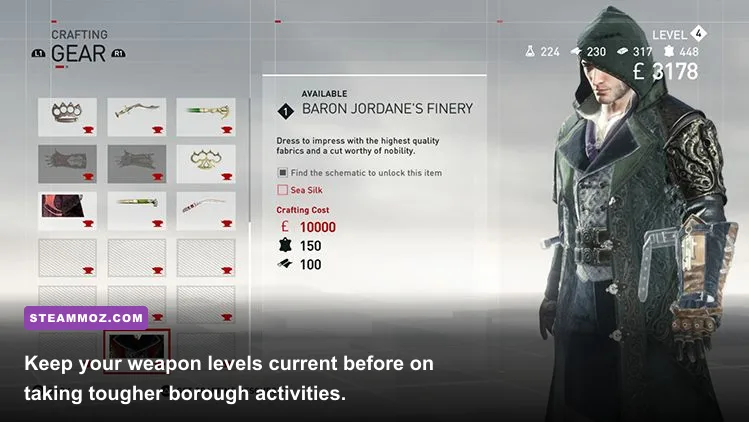
Syndicate’s gear has levels, damage values, and perks, but the numbers are only useful when they stay close to your character level. A higher-level weapon usually beats a lower-level favorite, even if the lower-level item has a tempting perk. Check your inventory before every major memory sequence and equip the strongest current weapon in each category.
For Jacob, use brass knuckles as your primary combat weapon. They stagger human enemies quickly and feel excellent against groups once your stamina skills are active. Keep a kukri equipped for targets that punish close-range brawling or missions where you need faster lethal damage. The cane sword is Evie’s natural weapon because it supports a stealth-focused style and looks less conspicuous in social spaces, but its usefulness still depends on its level and perk roll.
For firearms, a pistol with a damage or ammunition-related perk is the safest beginner choice. Firearms are loud and should not replace stealth, but they’re excellent for interrupting an enemy, shooting a hanging object, or finishing a low-health target during a getaway. Throwing knives are better for quiet isolated kills; smoke bombs are the best emergency tool.
Recommended gear priorities
- Weapon level first: Never cling to an underpowered weapon because you like its appearance. Upgrade or replace it when enemies begin absorbing several full combos.
- Health and damage perks: These are more consistently valuable than highly situational bonuses during a first run.
- Tool capacity: Additional ammunition and consumable capacity improves your ability to recover from mistakes, particularly in large enemy compounds.
- Ranged damage: Prioritize it only if you regularly use pistols or knives. Stealth players can put those resources elsewhere.
Gear crafting is worth doing when the required materials are already in your inventory, but don’t empty your treasury chasing a small numerical improvement. Syndicate’s main missions generally provide enough usable equipment to keep you competitive. Treat crafting as a way to maintain your level and activate a useful perk, not as a reason to grind every chest in Whitechapel.
| Slot | Beginner recommendation | Priority stat or perk | Why |
|---|---|---|---|
| Primary weapon | Level-appropriate brass knuckles | Damage, stun or combat utility | Best fit for Jacob’s crowd control |
| Secondary weapon | Kukri or current high-level cane sword | Damage and assassination usefulness | Provides a faster lethal option |
| Firearm | Current-level pistol | Damage or ammunition capacity | Interrupts and finishes targets |
| Outfit | Highest-level outfit with useful perk | Health, stealth, or tool capacity | Protects the build’s weak point |
| Tools | Smoke bombs and throwing knives | Capacity first | Improves both recovery and silent kills |
Rooks upgrades and the fastest useful progression
Don’t treat the Rooks menu as optional flavor. Rooks upgrades are one of the cleanest ways to make the opening hours easier, particularly because they improve the support available around London and help your gang become more useful during activities.
Begin with upgrades that improve your income and practical support rather than spending everything on novelty bonuses. Rooks Leadership is a smart early direction because it increases the strength and usefulness of your gang presence. Black Market upgrades help you acquire consumables and ammunition more comfortably. Pub Investments can improve income, giving you more freedom to purchase and craft gear without stopping to loot every crate.
Gang Strongholds are your best early source of practical experience. Capture them after scouting the area with Eagle Vision. Look for alarm bells, rooftop snipers, and heavy enemies before starting the takeover. You don’t need to clear every guard silently: eliminate the bell ringer first, then decide whether Jacob or Evie is better suited to the remaining objective.
Activities also feed your progression loop. Child Liberation missions are excellent for learning stealth routes and moving through restricted areas. Bounty Hunts teach you to read target behavior and manage escapes. Gang Wars are where Jacob’s combat build earns its keep, but they’re much easier after you’ve upgraded your health and equipped current-level weapons.
| Progression target | Recommended timing | Primary benefit | Beginner warning |
|---|---|---|---|
| Health and stamina skills | First several skill points | More forgiving combat | Don’t delay survivability for niche perks |
| Rooks Leadership | Early borough control | Stronger gang support | Requires resources, so spend deliberately |
| Pub Investments | After basic gear is stable | More money for equipment | Income upgrades pay off over time |
| Gang Strongholds | As soon as you can scout safely | Experience, money, and borough progress | Disable alarms before committing |
| Train hideout upgrades | Mid-game | Convenient planning and utility | Don’t ignore main-story unlock requirements |

| PC setting | Recommended beginner value | FPS impact | Visual note |
|---|---|---|---|
| Texture quality | High if VRAM allows | Low to medium | Preserves clothing and city detail |
| Environment quality | High | Medium | Improves London’s geometry and distance detail |
| Anti-aliasing | High, reduce if needed | Medium to high | One of the easier settings to lower |
| Shadows | High or medium | Medium | Medium usually keeps the scene attractive |
| Volumetric fog | Medium | Medium to high | Lower it first during heavy performance drops |
| Ambient occlusion | HBAO+ or medium | Medium | Adds depth beneath objects and characters |
For more PC troubleshooting ideas, Steamoz’s ELEX crash and FPS fixes offers useful general habits: update drivers, verify files, and test one graphics setting at a time rather than changing the entire profile blindly.
Your final beginner loadout checklist
By the time you’re comfortable in Whitechapel and Lambeth, your build should feel deliberately flexible rather than randomly assembled. Jacob should have Health Boost, Combat Stamina, Counter Boost, and Execution. Evie should have her early Stealth upgrades, improved Eagle Vision, and a reliable silent-kill option. Both characters should carry a current-level weapon, a pistol or throwing knife option, and smoke bombs for emergency exits.
Use Jacob when the objective allows combat or asks you to disrupt enemy control. Use Evie when the map gives you vertical routes, disguise opportunities, or a valuable target surrounded by guards. Keep checking gear after missions, spend Rooks currency on practical upgrades, and scout every stronghold before starting trouble.
This build won’t force you into one rigid playstyle, and that’s precisely why it works. You’ll learn Syndicate’s counters without fearing every brawl, experience the stealth systems without restarting every failed approach, and preserve enough money for meaningful gear upgrades. Once the fundamentals click, you can specialize freely: turn Jacob into a relentless street fighter, push Evie deeper into invisibility, or build both around the tools you use most.
For another perspective on upgrading a game’s systems without overcomplicating the early hours, see Steamoz’s Dungeons 3 beginner tips. The lesson carries over nicely: establish a dependable core first, then chase the fun specialist upgrades. In Syndicate, that core is stamina, survivability, stealth awareness, and gear that matches your level.