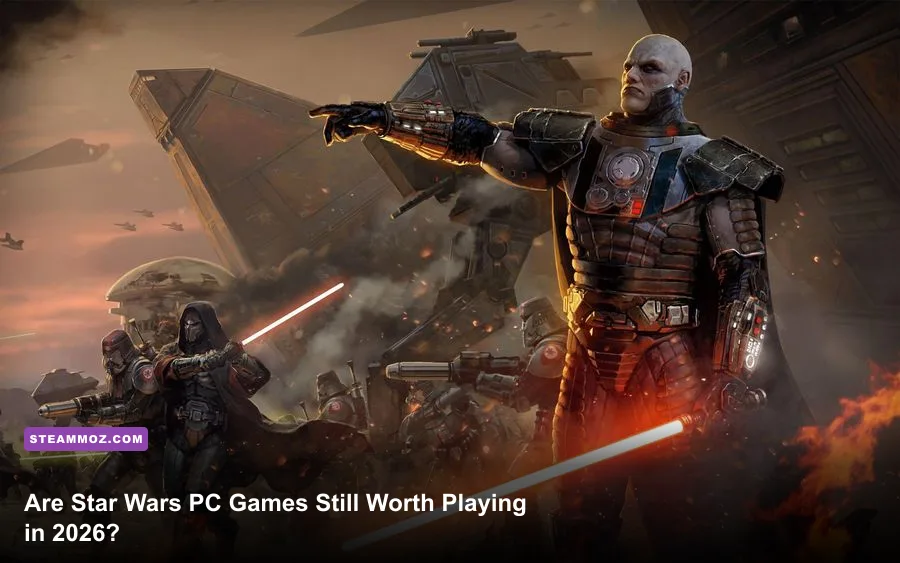
Yes, Star Wars PC games are still worth playing in 2026—but not all for the same reason. Knights of the Old Republic remains the best story-driven RPG, Jedi Academy still owns the lightsaber-combat throne, Empire at War is the strategy game with the longest tail, and Battlefront II is the most polished way to experience large-scale Star Wars battles today. The catch is that older PC ports need a little technical care, while newer multiplayer games demand realistic expectations about player populations and support.
This isn't a nostalgia pass. Several of these games have awkward interfaces, dated animation, or servers that are quieter than they were at launch. Yet the core fantasies remain unusually strong: becoming a Jedi, commanding a Star Destroyer, surviving Imperial occupation, or making a moral choice that changes an entire galaxy. In 2026, that foundation still beats many newer licensed games.
The Star Wars PC games that still deserve your time

The strongest lineup spans three eras. BioWare's Knights of the Old Republic and Obsidian's KOTOR II are RPGs first, while Raven's Jedi Outcast and Jedi Academy focus on physical lightsaber combat. Petroglyph's Empire at War treats the universe as a living military sandbox. Then there are the more modern spectacle-driven games: DICE's Battlefront II and EA Motive's Squadrons.
My ranking changes depending on what you want. KOTOR is still the safest recommendation for a single-player campaign, thanks to its clear 20-level progression cap, party system, and memorable alignment decisions. KOTOR II has more ambitious writing and influence mechanics, but its original restoration issues mean you should install the official Steam version alongside the widely used restored-content mod.
| Game | Best For | 2026 Verdict | Main Warning |
|---|---|---|---|
| Knights of the Old Republic | Story and RPG choices | S-Tier | Old interface and widescreen quirks |
| Jedi Academy | Lightsaber combat | S-Tier | Gunplay feels dated |
| Empire at War | Strategy and replayability | S-Tier | Large battles can stress the engine |
| Battlefront II | Modern multiplayer spectacle | A-Tier | Population varies by mode and region |
| Squadrons | Focused space combat | A-Tier | Low long-term live-service support |
Republic Commando also deserves a special mention. Its four-person squad has more personality than the limited command system suggests, and its short campaign avoids the bloat that hurts many modern shooters. It isn't the deepest tactical game, but the helmet-level audio, brutal Geonosis firefights, and Trandoshan encounters still feel distinctive. If you like focused campaigns, it pairs nicely with our guide to running older PC shooters smoothly.
Why KOTOR and Jedi Academy have aged differently
KOTOR has aged well because its best systems are abstract. Combat runs on a real-time-with-pause version of the d20 ruleset: attack rolls, defense, saving throws, feats, and Force powers determine the result beneath the action. You can queue a critical strike, use Stun against a low-Will enemy, then follow with Flurry or a lightsaber attack. The animations are stiff, but the decision-making still works.
Its most important build lesson is not to spread attributes evenly. A melee Jedi wants Strength or Dexterity, Constitution for survivability, and Wisdom or Charisma if Force power difficulty matters. Master Speed is particularly powerful because it adds attacks and movement utility; Force Push and Force Breach remain valuable well beyond the opening planets. You can finish the game with imperfect choices, but a focused build makes the late-game Star Forge battles much less punishing.
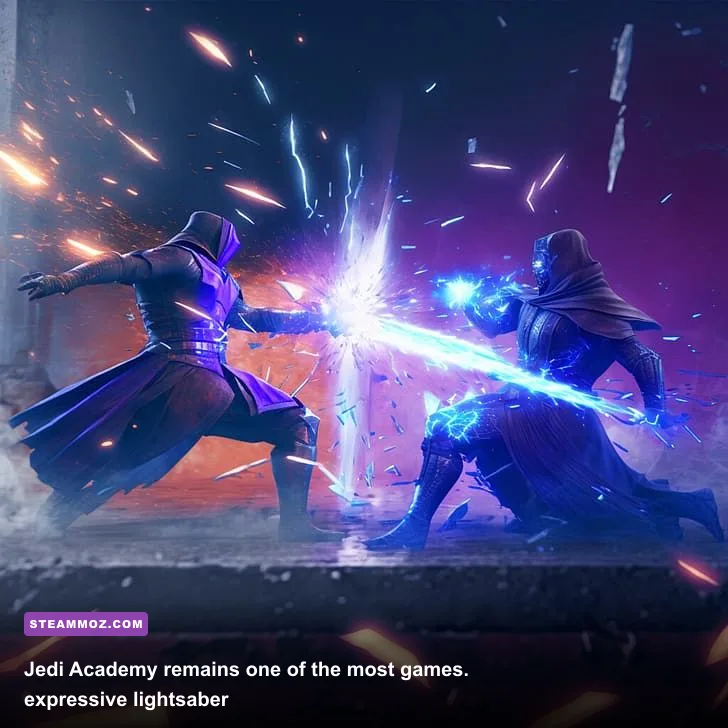
Jedi Academy aged in the opposite direction. Its story is simple, but the combat is physical, readable, and still wonderfully chaotic. You choose between single, dual, and double-bladed lightsabers, then unlock stance options that alter speed, reach, and damage. The single saber's fast stance is forgiving; the strong stance trades speed for heavier strikes; dual sabers give you pressure and defensive flexibility, while the staff excels at controlling groups.
The combat's secret is spacing. Don't mash attack into a Stormtrooper line. Circle, block blaster bolts, use Force Push to break formation, and reserve Force Pull for disarming or repositioning. Against lightsaber users, watch their shoulder and blade angle rather than their health bar. A committed red-stance swing creates a punish window, while repeated blocking drains your tactical options. The old engine doesn't explain this well, but once it clicks, few Star Wars games feel as personal.
| Game | Core Progression | Best Ability or System | How It Holds Up |
|---|---|---|---|
| KOTOR | Levels, feats, Force powers | Master Speed and party synergy | Excellent RPG depth |
| KOTOR II | Influence and prestige classes | Companion influence system | Great writing, rougher finish |
| Jedi Outcast | Force upgrades and weapon unlocks | Classic single-saber duels | Still tense and focused |
| Jedi Academy | Force powers and saber styles | Flexible saber loadouts | Best melee sandbox |
Empire at War is still the replayability champion
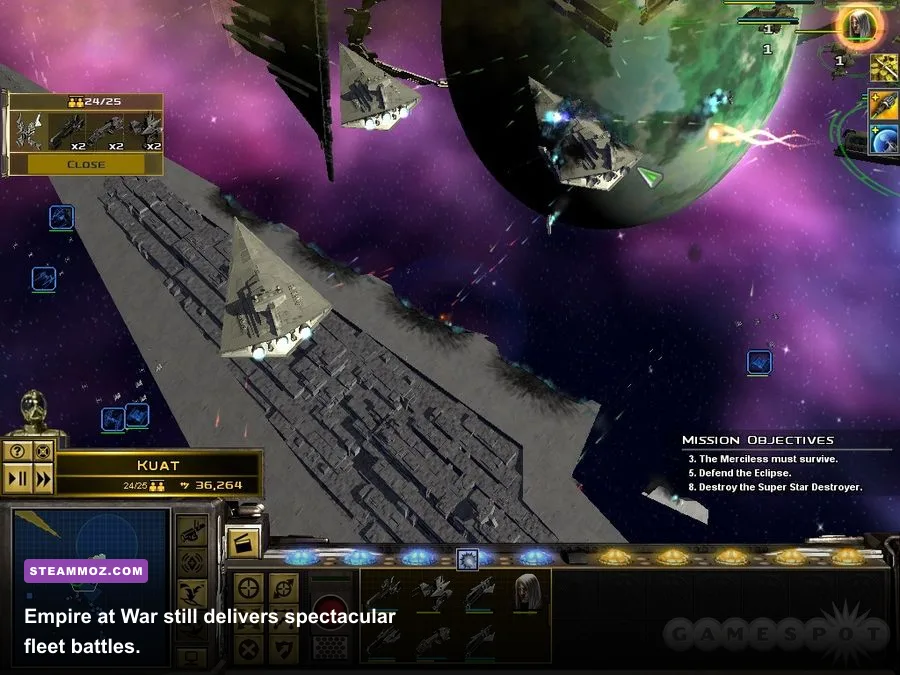
Empire at War remains the Star Wars PC game I return to most often. Its campaign layer and tactical battles connect in a way that newer strategy games frequently separate. You move fleets across a galactic map, capture planets, build space stations, and decide whether to spend credits on economy, defenses, or a dangerous offensive. Winning a battle matters because surviving units carry forward; losing a fleet can permanently change the campaign rhythm.
The original game has two main campaigns, while Forces of Corruption adds the Zann Consortium and a different economic identity. The Empire leans into heavy armor, TIE swarms, and Star Destroyers. The Rebels rely on mobility, hit-and-run attacks, and powerful late-game capital ships. The Consortium's corruption mechanics let you steal income, bribe units, and destabilize planets before committing your fleet. Those asymmetries make the factions feel designed rather than cosmetically different.
Its engine shows age during huge battles. Unit pathfinding can become messy, and the game is still fundamentally limited by older CPU behavior. Keep the battle speed at normal when several capital ships overlap, pause to issue orders, and avoid stacking every fighter squadron into one launch point. Mods are the real reason the game remains relevant. Thrawn's Revenge and Empire at War Remake add new eras, ships, and campaigns, although the largest conversions can demand more RAM and patience than the base game.
If you want a clean first session, start with the Galactic Civil War campaign on normal difficulty. Build a second space station before expanding too aggressively, protect income planets with garrisons, and research one technology branch instead of buying every available upgrade. The game rewards a stable front more than a flashy early conquest.
Battlefront II and Squadrons are better than their reputations

Battlefront II had a disastrous launch, but its final version is a very different product. The class system gives each role a clear battlefield job: Assault closes distance, Heavy anchors objectives with the Combat Shield, Officer supports allies and deploys the Sentry Turret, and Specialist controls sightlines. Heroes add spectacle, but the infantry loop is what keeps the game playable.
For a practical build, try Assault with the CR-2 at close range, Improved Thermal Detonator, and Toughen Up. Heavy works best with the DC-15LE, Explosive Sentry, and Resourceful if you're holding chokepoints. Don't charge a hero alone. Star Cards and ability cooldowns matter, but positioning matters more: use cover, attack from an angle, and let your squad create crossfire before spending reinforcement points.
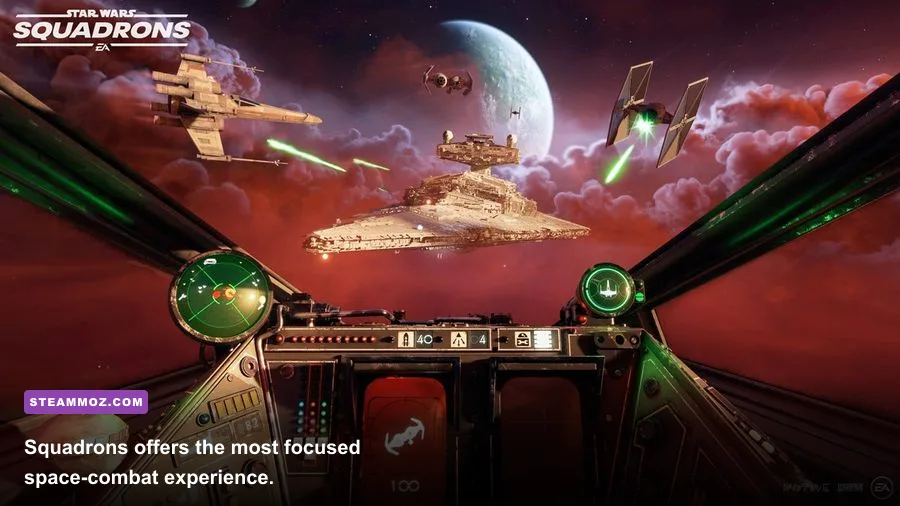
Squadrons is much narrower but more mechanically serious. X-wings and TIE fighters manage power differently, and diverting energy at the correct moment is the difference between surviving and exploding. With the X-wing, shunt power to engines to build boost, then redirect to weapons before an attack run. TIE craft lack shields, so speed, drift control, and break timing are essential. The campaign teaches the basics, but Fleet Battles is where the system earns its keep.
| Game | Recommended Mode | Strong Starting Choice | Player-Population Risk |
|---|---|---|---|
| Battlefront II | Supremacy or Co-Op | Assault with CR-2 | Low to medium, region dependent |
| Squadrons | Fleet Battles versus AI | X-wing power management | Medium to high |
| Republic Commando | Story campaign | AI squad commands | Not applicable |
Buy Battlefront II for the campaign, co-op, and large battles rather than expecting a thriving esports scene. For Squadrons, treat multiplayer as a bonus and use AI Fleet Battles if queues are slow. The Steam edition of Battlefront II is the sensible modern entry point, while Squadrons on Steam remains excellent with a controller or flight stick.
How to make these games run properly on a modern PC
Modern hardware creates a funny problem: these games are usually easy to run, but not always easy to run correctly. Old engines can dislike ultrawide resolutions, high refresh rates, overlays, or uncapped frame rates. Start with a clean baseline, disable unnecessary overlays, and add widescreen fixes only after confirming the unmodified game launches.
| Game | Minimum Practical Hardware | Recommended Setting | Common Fix |
|---|---|---|---|
| KOTOR | Any modern dual-core CPU, 4GB RAM | 1080p, 60 FPS cap | Widescreen patch and compatibility mode |
| Jedi Academy | Any integrated GPU from the last decade | 1080p or 1440p, 60-144 FPS | Community source-port fixes |
| Empire at War | Modern quad-core CPU, 8GB RAM | 1080p, moderate unit counts | Keep large battles below engine limits |
| Battlefront II | GTX 970 or equivalent, 16GB RAM | High settings, 60 FPS target | Use DirectX 11 if DX12 stutters |
| Squadrons | GTX 1070-class GPU, 16GB RAM | High settings, stable 90 FPS for VR | Reduce volumetrics and shadows first |
For Battlefront II, ray tracing is not the target; consistency is. Lower post-processing and volumetric effects before textures, because texture quality has a smaller impact on clarity than unstable frame pacing. On a 1440p system, a High preset with motion blur disabled is a strong compromise. In Squadrons, shadows and volumetric effects hit performance hardest, especially in VR. A locked 90 FPS is more valuable than a sharper cockpit.
Steam's community guides are useful, but verify every mod against the current game build. The GOG release of KOTOR can be a good alternative for compatibility, and the Mod DB archive for Empire at War remains the best place to investigate major conversions. If an older title crashes, our PC crash-fixing checklist covers the same basics: verify files, remove conflicting overlays, and test a clean configuration before blaming the game.
The honest 2026 verdict
Star Wars PC games are still worth playing because their best ideas haven't been replaced. KOTOR gives you role-playing choices with genuine dramatic weight. Jedi Academy makes every duel feel improvised rather than scripted. Empire at War turns the entire galaxy into a campaign board. Battlefront II delivers the blockbuster battlefield fantasy, and Squadrons understands that piloting a TIE fighter should feel demanding.
Start with one game that matches your mood. Choose KOTOR for a 30-to-40-hour story, Jedi Academy for immediate action, or Empire at War if you want a strategy game that can absorb an entire weekend. Buy Battlefront II for the modern presentation, but don't confuse its excellent final package with an active live-service future. These games are survivors, not relics—and in 2026, that distinction matters.