
Arcade Spirits doesn’t hide collectibles behind secret passages or a traditional map. Its secret locations are optional story destinations, side conversations, and route-specific visits that appear only when your choices build the right relationship. The most valuable rewards are extra scenes, romance endings, character achievements, and alternate finale moments. This guide lists every location worth checking, explains when each one becomes available, and shows how to replay efficiently without guessing.
Spoiler warning: the guide discusses character routes, optional scenes, and ending requirements. If you’re playing blind, bookmark this page before Chapter 4 rather than reading every route condition immediately.
Arcade Spirits on Steam is fundamentally a branching visual novel, so “secret” content works differently from secrets in an action game. There’s no button combination that opens a concealed room. Instead, the game quietly checks your personality responses, your relationship choices, and whether you spend time with specific characters when the opportunity appears.
How Arcade Spirits’ hidden content actually works
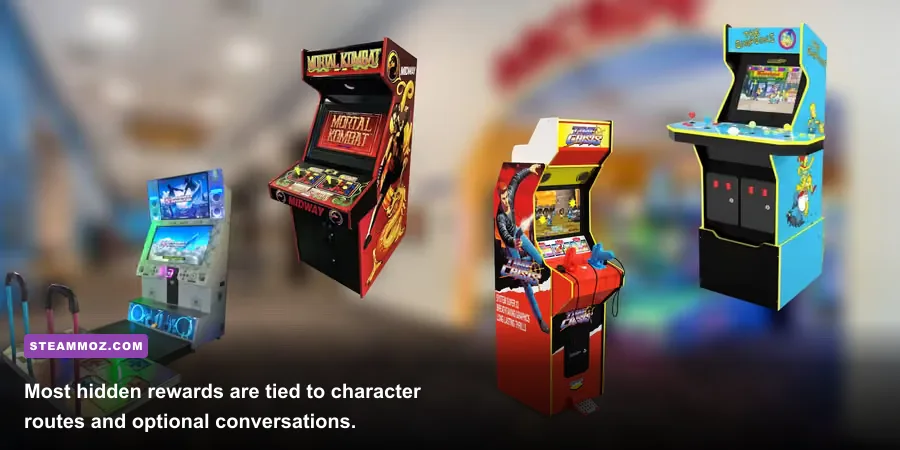
Every chapter gives you a mixture of mandatory Funplex scenes and optional choices about where to spend your time. The game tracks your responses through personality tendencies rather than a conventional combat-style stat sheet. You’ll regularly choose between sympathetic, confident, playful, analytical, or rebellious answers, and those choices influence both the tone of later conversations and which character route remains available.
The important distinction is that a single answer rarely locks you out immediately. The real danger is inconsistency. If you repeatedly show interest in one character, then abandon that character during later optional scenes, the route may soften into a friendship ending or lose its special final scene.
There are three practical rules for finding everything:
- Check every available destination before advancing the main story. If the game presents a location choice, treat it as missable until proven otherwise.
- Follow one character per save file. Trying to romance everyone in one run spreads relationship progress too thin.
- Create a manual save before major chapter decisions. Autosaves are useful, but they don’t give you the flexibility needed for efficient cleanup.
| Hidden-content type | How it appears | What it rewards | Best tracking method |
|---|---|---|---|
| Optional location scene | Destination choice between story beats | Extra dialogue and relationship progress | Visit every available location |
| Character side scene | Choosing a specific person during free time | Route flags and unique conversations | Use a character-focused save |
| Arcade milestone | Supporting the Funplex and its games | Achievements and finale variations | Keep positive arcade decisions consistent |
| Ending reward | Final chapter route resolution | Character ending and achievement | Replay from a pre-finale save |

🎮 Arcade Spirits
Looking to experience this game? Grab your digital key directly on our store for $1.99.
View on Steammoz Store →The Funplex floor is the first secret location
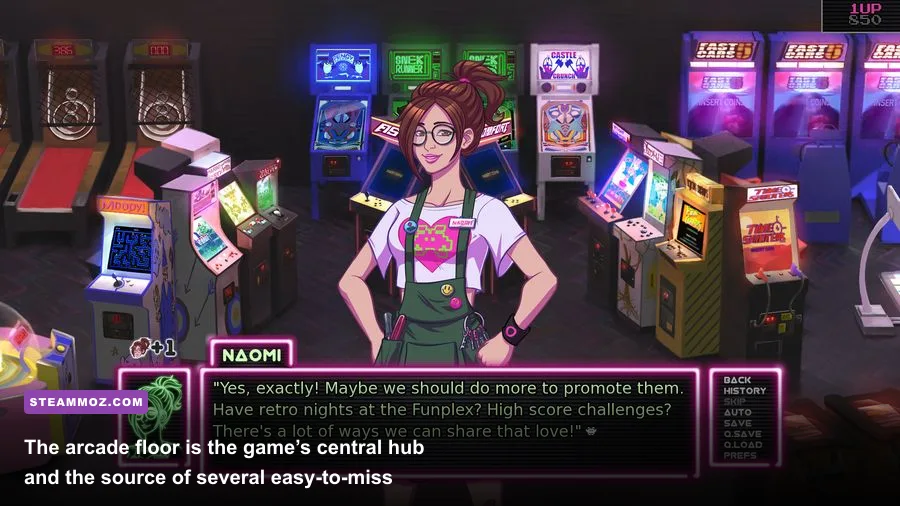
The Funplex arcade floor is the location most players rush through because it looks like the game’s default backdrop. That’s a mistake. When the story gives you time to walk around the arcade, inspect the floor before selecting the next main objective. The cabinet-filled main room is where several optional conversations trigger, especially scenes involving Naomi, Gavin, and the broader arcade team.
Look for opportunities to comment on the machines, ask about the arcade’s history, or spend time with staff members instead of immediately choosing the obvious work-related option. These interactions don’t function like inventory pickups, but they can contribute to character affinity and unlock small callbacks later in the story.
The Funplex floor also matters for the arcade-management thread. Choices that protect the arcade, encourage community events, or show respect for the regulars strengthen the “save the Funplex” arc. That arc is separate from romance progress, which means you can complete a character ending and still miss the strongest arcade-focused conclusion if your business decisions are consistently dismissive or selfish.
What to check on the arcade floor
- Talk to any character who has a new speech indicator before leaving.
- Choose dialogue that asks about a cabinet instead of skipping straight to the next objective.
- Support events and community activity when the story offers a choice between short-term convenience and long-term arcade health.
- Keep a save before major public events, since these scenes often combine arcade-progress and character-progress checks.
The game’s cabinet references are part of its charm, but they aren’t a traditional collectible set. Don’t waste time clicking every machine repeatedly. The reward comes from the conversations and decisions attached to the scene, not from inspecting one cabinet in a particular pixel.
Staff areas and the break-room conversations
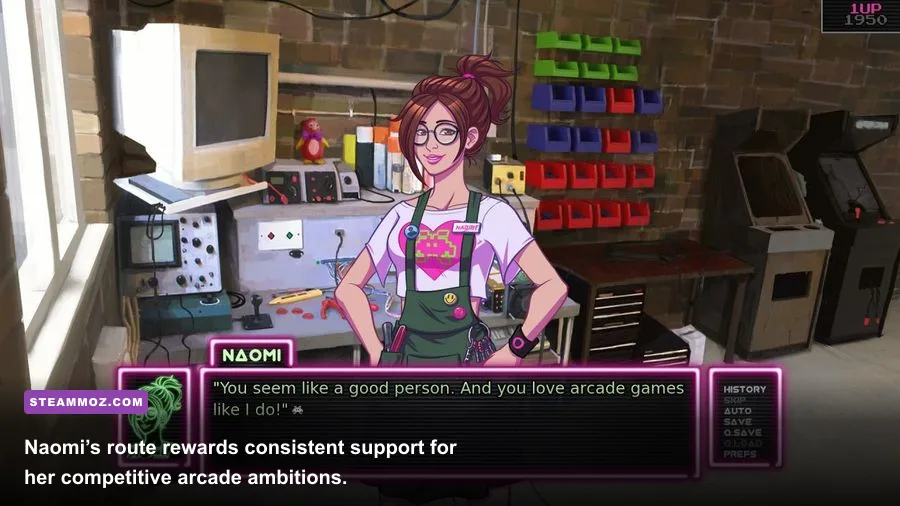
The Funplex staff area, including the break-room and work spaces, is where the game hides its most personal conversations. These scenes can look like downtime, but they’re often route checks in disguise. If a character invites you to talk, don’t treat the exchange as filler: the tone of your response can determine whether the relationship becomes romantic, platonic, or simply supportive.
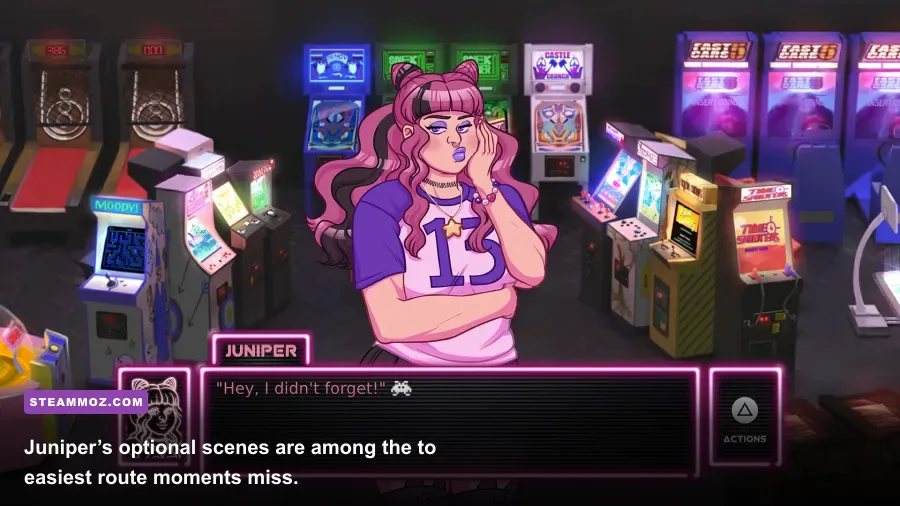
Juniper’s scenes are especially easy to overlook because her conversations frequently feel like team-building rather than direct romance setup. Choose to hear her out when she discusses the arcade’s future, creative projects, or her anxieties. A sarcastic answer may fit the protagonist’s personality, but repeatedly brushing her off can cost you later optional scenes.
Gavin’s route benefits from patience. When he is defensive or overwhelmed, the safest responses are usually the ones that acknowledge his concern before pushing for a solution. The game rewards emotional consistency more than a single “correct” line. If you want his strongest ending, avoid turning every disagreement into a challenge.
These staff-area moments also offer useful route diagnostics. If the same character keeps appearing in optional conversations and their dialogue becomes more open, you’re probably on the right track. If the game instead gives you generic group scenes, your previous free-time choices may have spread affinity across too many characters.
| Character | Best optional focus | Common route mistake | Reward for consistency |
|---|---|---|---|
| Juniper | Listen to her plans and support her creative side | Skipping personal conversations for work scenes | Additional emotional scenes and her route ending |
| Naomi | Respect her competitive goals and ask about arcade culture | Treating competition as pointless or hostile | Route scenes tied to her ambitions |
| Gavin | Use patient, reassuring responses during conflict | Turning every disagreement into a confrontation | Deeper personal scenes and ending variation |
| Queen | Engage with her confidence without mocking it | Reducing her persona to a joke | Unique route dialogue and finale payoff |
| Percy | Encourage his technical interests and curiosity | Ignoring quieter support scenes | Extra friendship or romance resolution |
| Ashley | Back her enthusiasm and social energy | Choosing only practical responses | Additional character moments and route content |
Naomi’s competitive arcade scenes
Naomi is tied most closely to the arcade’s competitive side, so her hidden content appears when you treat games and tournaments as meaningful rather than disposable distractions. When the story gives you a choice to join, watch, or discuss a competitive event, choose Naomi’s orbit if you’re pursuing her.
Her route isn’t simply a matter of selecting every enthusiastic answer. Naomi responds to genuine respect for skill and dedication. Support her goals, ask why a match matters, and avoid patronizing explanations. The game’s dialogue makes a clear distinction between cheering someone on and treating them like a novelty act.
The safest Naomi progression is to select her during free-time choices, back her during competitive discussions, and avoid contradicting her solely to create drama. You can still choose playful or teasing dialogue, but the joke should land as camaraderie rather than contempt.
Naomi’s optional scenes are also a good example of why you should keep separate saves. Her route can overlap with the arcade’s wider tournament storyline, and a late-game choice may look like a general business decision while actually reinforcing her personal arc. Save before major tournament or public-event scenes and replay the branch if the ending doesn’t appear.
Juniper’s quieter hidden scenes

Juniper’s route is the one most likely to be missed by players who focus only on overt romance cues. Her content is spread across ordinary-looking conversations about the Funplex, its identity, and the people who keep it alive. Choose Juniper during free time, but also select responses that show curiosity about her creative and emotional priorities.
Don’t assume that the flashiest answer is the best one. Juniper’s scenes often reward sincerity. If the protagonist can either make a joke or ask a thoughtful follow-up, the latter is usually safer for relationship progress. That doesn’t mean you need a relentlessly serious personality; it means you should avoid treating her concerns as an obstacle to the next plot beat.
Her optional scenes tend to build gradually, making manual tracking useful. Write down which chapter last featured Juniper and reload if she disappears from your available choices for too long. The game does not provide a visible relationship meter, so the absence of her scenes is your main warning sign.
For completionists, Juniper is a strong first route because it teaches the game’s central lesson: the hidden rewards are earned by paying attention to people, not by exploiting a secret code or finding a single concealed object.
Queen, Percy, Ashley, and the group-event branches
The remaining character routes are easier to mishandle when you assume group scenes count equally for everyone. They don’t. A group event can provide useful context, but a character-specific conversation is usually more important for route progression. If you’re targeting Queen, Percy, or Ashley, prioritize their individual invitations whenever the game offers a choice.
Queen benefits from responses that recognize the person behind the performance. Playful banter is fine, but repeatedly mocking her confidence can turn a promising route into a shallow friendship path. Choose dialogue that lets her explain herself, particularly when the conversation moves beyond her public persona.
Percy is quieter and more technical. His scenes reward genuine interest in how things work, whether the subject is arcade hardware, game design, or the practical problems facing the Funplex. Don’t skip the explanatory dialogue just because it seems less dramatic; those details are often the point of his scenes.
Ashley is more outwardly energetic, but her route still needs deliberate support. Choose her during social opportunities and respond positively to her enthusiasm. A purely pragmatic protagonist can accidentally shut down her best scenes, especially when the arcade’s financial problems make every emotional decision seem inefficient.
| Route target | Prioritize | Avoid | Recommended save point |
|---|---|---|---|
| Queen | Personal conversations and respectful banter | Mocking her identity or dismissing her act | Before her first major one-on-one invitation |
| Percy | Technical discussions and patient questions | Skipping exposition-heavy conversations | Before a hardware or project decision |
| Ashley | Social events and enthusiastic encouragement | Choosing only financially practical answers | Before a major group gathering |
| Friendship completion | Balanced, supportive choices | Overcommitting to one romance route | Before the final chapter |
Hidden rewards, achievements, and alternate endings
The game’s hidden rewards are primarily narrative. Expect route achievements, extra ending scenes, and variations in the final state of the Funplex rather than new weapons, costumes, or arcade minigames. The achievement list on the official Steam community hub is useful for confirming completion, but it won’t explain every route condition.
For the cleanest completion plan, use one first playthrough to learn the cast and protect the arcade. Then create a save at the beginning of each major chapter and focus on one character at a time. Finish that route, return to the branch save, and repeat. Because the game is dialogue-driven, this is dramatically faster than restarting from the opening every time.
There are three categories of endings worth tracking:
- Character endings: earned by consistently selecting one character during optional scenes and supporting their defining goals.
- Friendship or neutral endings: produced when you maintain strong group relationships without committing deeply to one route.
- Arcade-focused outcomes: shaped by decisions that protect the Funplex, its community, and its future rather than chasing only personal rewards.
Don’t confuse a completed romance ending with total completion. You can finish a character route while missing another character’s side achievement, a group-event scene, or the strongest arcade resolution. The game encourages multiple runs, and its short scene structure makes cleanup manageable once your saves are organized.
A reliable 100% replay plan
Start by making a manual save before the first major free-time selection. On your first run, choose the character you naturally prefer and make broadly supportive choices for the Funplex. Avoid experimenting with every romance option in the same file; that’s the fastest way to produce an ambiguous ending.
On the second run, use chapter saves to target a different character. Visit every available location, inspect the arcade floor before moving on, and select one-on-one scenes over generic group activities when both are available. If a character stops appearing, reload the most recent chapter save rather than pushing forward and hoping the route recovers.
Finally, replay the late-game decisions while protecting the arcade’s future. The best completion file is not necessarily the one with the most aggressive or profitable answer. Arcade Spirits repeatedly rewards choices that preserve the Funplex as a community space, so treat staff morale, regulars, and the arcade’s identity as real objectives.
For more choice-heavy game advice, Steamoz’s Edge of Eternity secret-locations guide uses the same save-management approach, while these Chroma Squad tips cover another game where apparently small decisions snowball into major results.
What isn’t secretly hidden in Arcade Spirits
There is no traditional secret room, secret weapon, cheat cabinet, or stat exploit that unlocks every ending. You won’t improve completion odds by clicking random background objects or replaying the same cabinet interaction. The game’s hidden design is social: location choices determine who you spend time with, dialogue tone determines how that relationship develops, and arcade-management choices determine the broader finale.
That’s why a checklist is more useful than a collectible map. Track each optional location, record which character you selected, and keep a save before major events. If you do that, every hidden reward becomes predictable without stripping away the fun of discovering the characters yourself.
For official background on the developer and the game, visit Fiction Factory Games and the Arcade Spirits Steam page. The short version is simple: explore the Funplex whenever the story lets you, follow one character with genuine consistency, and save before every major branch. That’s the key to finding all of Arcade Spirits’ secret locations and hidden rewards.