
Yes, Amnesia: A Machine for Pigs is worth playing in 2026—but only if you want a short, story-first horror experience rather than another Dark Descent clone. The Chinese Room's 2013 follow-up remains brilliantly atmospheric, thematically ambitious, and unusually good at making industrial spaces feel alive. It also removes inventory management, resource scarcity, sanity effects, and almost all player agency. That makes it less mechanically demanding than Amnesia: The Dark Descent, but it gives the narrative room to hit harder. At roughly four to five hours, its flaws are easier to tolerate, especially when the game is regularly discounted to a few dollars on Steam.
What makes A Machine for Pigs different?
A Machine for Pigs follows Oswald Mandus, a wealthy industrialist who wakes in London in 1899 after a mysterious illness. His children, Edwin and Enoch, are missing, and a voice from the machine below his estate keeps calling him downward. That setup sounds familiar, but the sequel quickly moves away from the isolated castle structure of The Dark Descent. You travel through a mansion, slaughterhouse, underground tunnels, sewers, and public streets while uncovering Mandus's connection to the horrifying Machine.
The biggest mechanical change is the removal of friction. There is no inventory screen, no tinderbox collection, no oil gauge, and no sanity meter. The lantern is effectively unlimited, so you aren't forced to choose between seeing a room and preserving fuel. Doors, valves, switches, and simple environmental interactions replace the earlier game's item puzzles. The result feels more like a guided haunted-house adventure than a survival-horror sandbox.
That design is deliberate. The game wants you focused on audio logs, environmental storytelling, and the moral consequences of Mandus's work. If you enjoyed the oppressive atmosphere of classic PC games with strong world-building, the shift may not bother you. If your favorite part of The Dark Descent was improvising with limited resources, expect a much more linear ride.
| Feature | A Machine for Pigs | The Dark Descent |
|---|---|---|
| Core structure | Linear narrative journey | Exploration with branching routes |
| Sanity system | Removed | Present and mechanically important |
| Resource management | Minimal; unlimited lantern | Oil and tinderboxes matter |
| Combat | No weapons or fighting | No weapons, but more systemic hiding |
| Typical length | 4–5 hours | 8–10 hours |

🎮 Amnesia: A Machine For Pigs
Looking to experience this game? Grab your digital key directly on our store for $3.99.
View on Steammoz Store →Is the horror still effective in 2026?
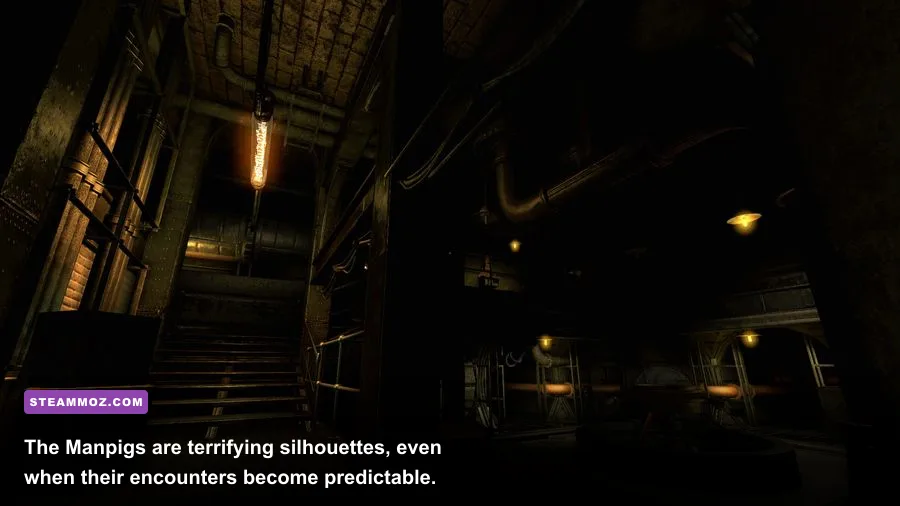
Its horror has aged better than its technology. The sound design remains exceptional: distant metal groans, wet machinery, footsteps above the ceiling, and the sudden bellow of a Manpig create a constant sense that the building is digesting you. The soundtrack knows when to stay quiet, too. Several of the best scares happen when nothing attacks and you simply hear something moving behind a wall.
The Manpigs are the game's signature enemies. They are hulking, mutilated creatures created through Mandus's experiments, and their silhouettes still look nasty in the low light. Their encounters are based on avoidance. You can't stun them, distract them with thrown objects, or fight back. Hide behind furniture, break line of sight, and keep moving when the route opens. The problem is that their artificial intelligence is less flexible than the monster behavior in The Dark Descent. Once you've seen a few encounters, you can often predict the chase trigger and the safe direction.
There are also stretches where the game appears to promise a terrifying pursuit, only to let you walk through a sequence without meaningful danger. That uneven pacing is the central weakness. The first half builds excellent dread around the mansion and factory, while later scenes sometimes feel like connective tissue between audio logs.
The story is the real monster
The narrative is where the sequel earns its reputation. Mandus's industrial empire is tied to meatpacking, automation, colonial exploitation, and the belief that human suffering can be optimized away. The Machine isn't just a creepy location; it's a physical expression of his ideology. The game asks whether progress without compassion becomes a form of slaughter.
Some players will find the conclusion too explicit, but the final act gives earlier details more weight. Notes, recordings, and visual clues point toward Mandus's guilt long before the reveal. Play with headphones if possible. The voice work and layered machinery are doing as much storytelling as the written notes.
How long is it, and does the pacing hold up?
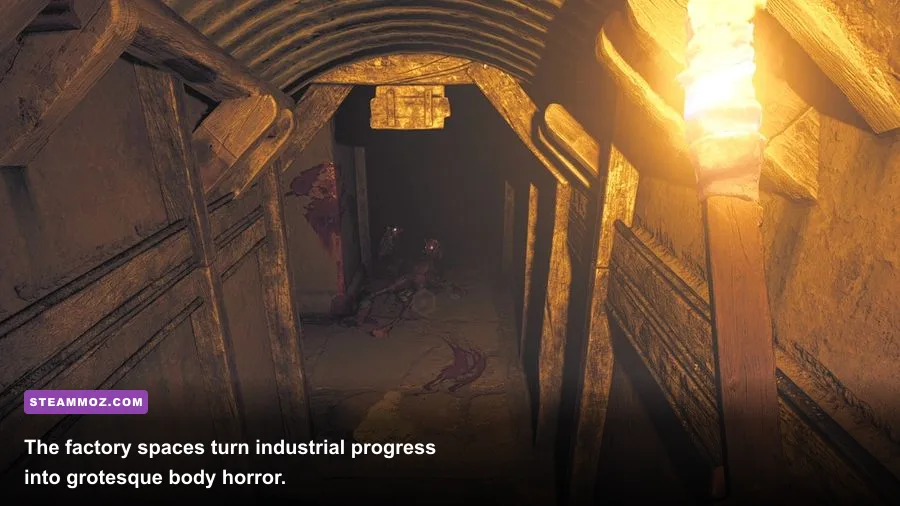
Expect around four hours on a focused first playthrough and closer to five or six if you inspect every side room and listen to every recording. There are no traditional difficulty levels, no combat build, and no collectible-heavy postgame. You can replay the campaign for atmosphere or story details, but the lack of alternate routes limits its long-term value.
The opening is the strongest section. Mandus's estate teaches the language of the game through locked doors, machinery, and distant noises without burying you in tutorials. The factory then widens the scale, showing how the Machine converts living bodies into industrial output. The middle chapter through the sewers has several memorable visuals, though it also contains the most repetitive valve-and-switch objectives.
That short length works in the game's favor. A ten-hour version would likely expose every weakness in the enemy AI and puzzle design. Instead, the campaign ends before the atmosphere completely collapses. This is a weekend horror game, not a forever game, and its price should be judged accordingly.
| Play style | Expected length | What you gain | Main drawback |
|---|---|---|---|
| Story-focused | 3.5–4.5 hours | Clean narrative momentum | Misses optional recordings |
| Explorer | 5–6 hours | More notes and environmental details | Linear objectives remain simple |
| Atmosphere replay | 2–3 hours | Strong sound and visual mood | Scares lose surprise |
What are the biggest gameplay problems?
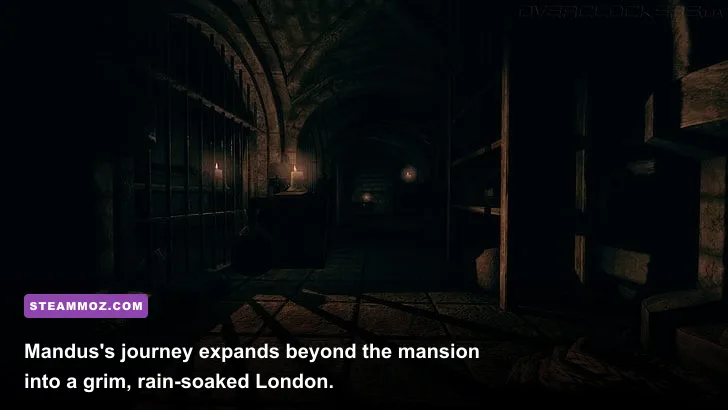
The lack of interaction is both the sequel's identity and its biggest limitation. You cannot pick up objects freely, build a route with distractions, or use the environment against enemies. Most puzzles ask you to locate a lever, restore power, rotate a valve, or follow a clear path. They aren't difficult, and the game rarely allows you to get genuinely lost for long.
That makes the experience accessible, but it also removes the improvisational tension that made Frictional's earlier work special. In The Dark Descent, a bad decision could cost oil, expose your hiding place, or leave you scrambling through an unfamiliar room. Here, failure is usually a short reload followed by another attempt at the same scripted sequence.
The checkpoint system is generally forgiving, although a few chase sections can feel awkward when the game saves just before a trigger. The absence of combat isn't a problem by itself; many excellent horror games avoid fighting. The issue is that the stealth tools are so limited that avoiding a Manpig becomes more about memorizing the intended route than reading the situation.
Still, the environmental design deserves credit. The transition from Victorian luxury to industrial nightmare is carefully staged. Pipes replace wallpaper, blood replaces water, and the Machine's deep mechanical pulse turns every location into part of the antagonist. If you prefer horror that prioritizes mood over systems, these shortcomings may barely register.
Best PC settings for playing in 2026
The original PC release is lightweight by modern standards, but compatibility matters more than raw power. The official Steam listing dates the game to the Windows XP/Vista/7 era and lists a 2 GHz processor, 2 GB of RAM, a Radeon X1000 or GeForce 6-class graphics card, and roughly 5 GB of storage. Any current gaming laptop should clear those requirements easily. The real variables are ultrawide scaling, old fullscreen behavior, controller support, and frame pacing.
Start with the native desktop resolution and test both fullscreen and borderless modes. If the image flickers, alt-tabs badly, or refuses to use the correct refresh rate, borderless mode is usually the cleaner modern workaround. An external frame limiter set to 60 fps can also smooth the experience on high-refresh displays, although the game itself is not demanding enough to require aggressive optimization.
| Setting or issue | Recommended value | Performance impact | Visual note |
|---|---|---|---|
| Resolution | Native display resolution | Low on modern GPUs | Preserves dark-detail clarity |
| Anti-aliasing | Highest stable option | Low | Reduces jagged machinery edges |
| Shadow quality | High | Low to moderate | Important for the horror mood |
| Fullscreen mode | Borderless if alt-tab issues occur | Negligible | Improves modern desktop compatibility |
| Frame cap | 60 fps | None on capable hardware | Stable pacing suits scripted chases |
Don't overbrighten the game with your monitor's HDR or gamma settings. The darkness is intentional, and lifting black levels can flatten the lighting that makes the factory work. Headphones matter more than a new graphics card. For troubleshooting older PC releases, Steamoz's guide to PC crashes and frame-rate fixes is useful general reading, though its specific fixes aren't written for this engine.
Who should play it in 2026?
Play Amnesia: A Machine for Pigs if you want a compact, atmospheric horror story with excellent sound design, grotesque industrial imagery, and a memorable central metaphor. It's especially easy to recommend to players who bounced off resource management or found the first game's sanity effects distracting. The unlimited lantern and simplified controls let you absorb the setting without worrying about a hidden meter.
Approach cautiously if you expect modern stealth systems, multiple endings, combat options, or a long campaign. Games such as Alien: Isolation and Outlast offer more elaborate pursuit behavior, while The Dark Descent remains the better choice for systemic survival horror. You may also want to read Steamoz's Don't Be Afraid 2 review if you're looking for a newer, more aggressive horror experience.
The best way to approach this sequel is as an interactive gothic novella. Follow the story, listen closely, and resist the urge to sprint through every hallway. Its scares are less about surprise than accumulation: the sound of the Machine, the implications of Mandus's work, and the awful realization of what the creatures are made from.
Final verdict: Amnesia: A Machine for Pigs is worth playing in 2026 at a low sale price, and arguably essential for fans of narrative horror. It isn't the deeper game, the scarier game, or the more replayable game in the series. But its four-hour descent into industrial guilt still has a distinct voice. The mechanics are thin; the atmosphere is not. Buy it for the haunted factory, stay for the story, and don't expect another castle survival simulator.
For more older-PC recommendations, compare it with Steamoz's Disciples: Liberation review and our look at games that still hold up years later. You can also find the developer's broader work through Frictional Games' official site and learn more about The Chinese Room via its official developer website.