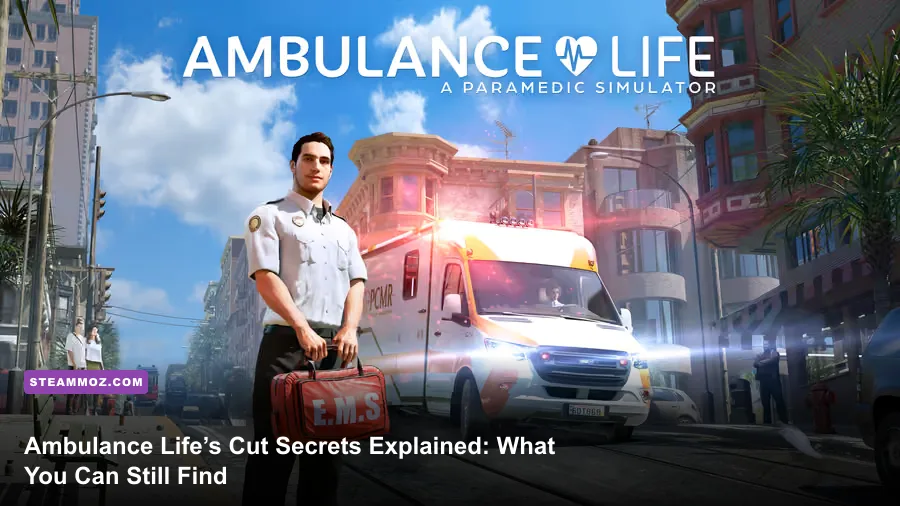
Short answer: Ambulance Life: A Paramedic Simulator does not currently have a verified set of secret locations or hidden rewards connected to the Paramedic Handbook. The “cut secrets” claim appears to come from early expectations, unused-looking map spaces, and guide videos that mistake normal scenario objectives for collectibles. You can still uncover optional calls, unusual patient outcomes, extra handbook entries, and progression rewards, but there is no confirmed treasure map, secret uniform cache, or hidden San Pelícano collectible route.
That distinction matters because Ambulance Life is structured very differently from an open-world action game. The city is there to make response driving, traffic management, call selection, and patient urgency feel stressful. It is not designed around climbing every rooftop or checking every alley for a chest. The real “secrets” are systemic: the diagnosis you only reach by asking the right questions, the secondary symptom you miss when you rush, and the reward you earn by finishing a difficult emergency without making the wrong treatment call.
This guide separates confirmed content from cut-content speculation, explains what the Paramedic Handbook actually tracks, and gives you the most reliable way to find every meaningful optional discovery still present in the released game.
What the developers actually cut
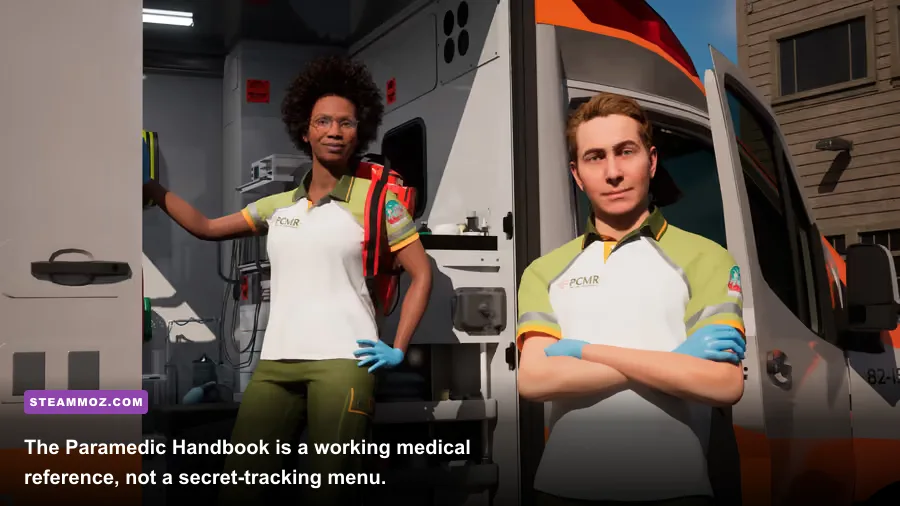
There is no official developer list titled “all cut secret locations” for Ambulance Life. The game was developed by Aesir Interactive and published by NACON, and the public-facing material focuses on emergency scenarios, progression, map exploration, and medical decision-making rather than hidden rewards. The safest reference point is the game’s official Steam page, alongside updates posted through the publisher’s official channels.
Players have reported several things that can look like removed secrets:
- Blocked roads and inaccessible buildings that appear to lead somewhere important.
- Small props, locked doors, and interior windows that suggest more detailed exploration.
- Handbook topics or scenario hints that seem to promise a larger collection system.
- Unusual call outcomes that award progression but do not appear as traditional loot.
Those observations do not prove that a secret area was cut. Simulation games often use visual barriers to control traffic routes, reduce loading demands, or keep the player inside the playable emergency-response space. A locked door in San Pelícano is usually just a locked door. Unless a patch note, developer statement, achievement description, or repeatable in-game trigger confirms otherwise, treat claims about “deleted locations” as unverified.
The same rule applies to supposed hidden rewards. There are progression unlocks tied to campaign advancement, successful calls, equipment access, and improved performance. Those are rewards, but they are not secret collectibles. The difference is useful: you should spend your time improving patient outcomes and response efficiency instead of driving in circles looking for a non-existent stash.
| Claim | What is confirmed | Best player response |
|---|---|---|
| Secret buildings contain loot | No verified collectible system or hidden loot cache has been documented | Ignore inaccessible doors unless a scenario explicitly directs you there |
| The Handbook hides a treasure list | It supports medical information and scenario decision-making | Use it to compare symptoms, not to hunt icons |
| Every unusual prop marks cut content | Many props are environmental dressing or route boundaries | Check objectives and call text before investigating |
| Perfect calls unlock secret uniforms | Successful performance supports progression, but secret cosmetic caches are unconfirmed | Prioritize diagnosis, treatment, and safe transport |
🎮 Ambulance Life - Paramedic Handbook Devs cut
Looking to experience this game? Grab your digital key directly on our store for $3.49.
View on Steammoz Store →How the Paramedic Handbook really works

The Paramedic Handbook is best understood as a reference and decision-support tool. It helps you interpret symptoms, review possible conditions, and choose a sensible next action during an emergency. It is not a traditional codex filled with hidden pages waiting behind secret doors.
When you arrive at a call, resist the urge to open the Handbook immediately and pick the first diagnosis that sounds familiar. Start with the patient interaction. Ask available questions, inspect visible symptoms, and use the examination tools the scenario provides. The information you collect narrows the likely condition. The Handbook then becomes useful for checking whether the evidence supports your diagnosis and treatment plan.
A reliable sequence looks like this:
- Secure the scene and approach the patient.
- Read the call objective instead of skipping straight to treatment.
- Ask every available question before committing to a diagnosis.
- Perform the relevant examination actions and watch for changes in patient status.
- Open the Handbook to compare symptoms with possible conditions.
- Apply only the treatment supported by your findings.
- Reassess the patient before transport and monitor the final condition.
This process reveals the game’s genuine hidden depth. Some scenarios appear simple because the first symptom points toward an obvious answer. A second question or follow-up examination can expose a complication that changes the correct treatment. If you rush, you may finish the call but receive weaker feedback, lose time, or miss the better outcome. That is the closest thing Ambulance Life has to a secret-reward loop.
| Handbook use | When to use it | What it prevents | Common mistake |
|---|---|---|---|
| Symptom comparison | After questioning and examination | Premature diagnosis | Choosing a condition from one visual symptom |
| Tool reference | When an objective names a medical action | Using the wrong equipment | Applying every available tool automatically |
| Scenario review | Before transporting a patient | Leaving an unresolved problem | Driving away as soon as the patient stands up |
| Progression check | After completing calls | Missing newly available activities | Assuming every reward is located on the city map |
The real hidden discoveries in San Pelícano
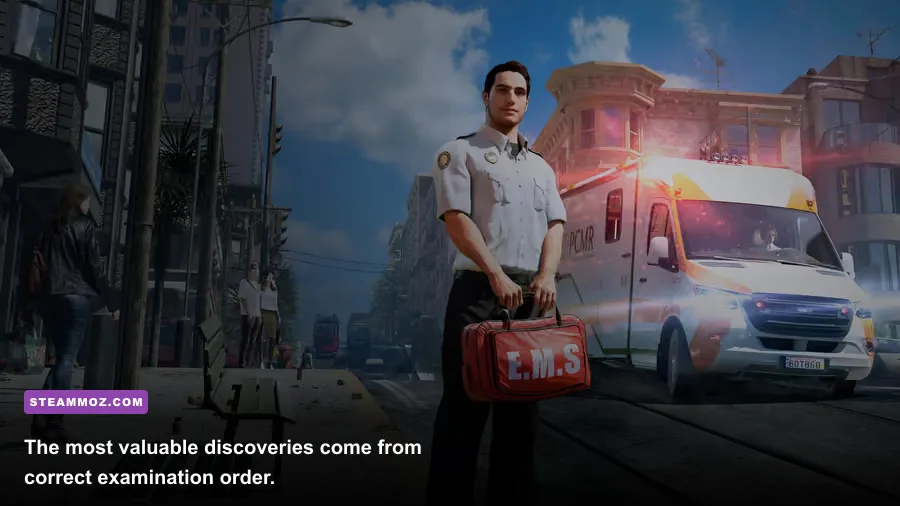
San Pelícano does contain optional moments, but they are tied to emergency work rather than free-roaming secrets. Calls can vary by patient condition, location, traffic pressure, and the choices you make on site. A scene that looks routine can become more demanding when the patient’s symptoms develop or when you fail to gather enough information before treatment.
To find these variations, replay calls with a deliberate method. On your first attempt, follow the basic objective and learn the scenario flow. On later attempts, change one decision at a time: ask a different question first, perform a more complete examination, delay transport until the patient is reassessed, or choose a safer route when the game gives you that option. This makes it possible to identify genuine outcome differences without confusing random timing with secret content.
Driving is another source of optional discovery. The quickest route is not always the safest or most reliable one. Traffic, intersections, narrow roads, and the distance between the ambulance and the patient all affect your response. A route that looks like a shortcut can create a longer delay if you get boxed in or approach the scene from the wrong side. Think like a dispatcher: choose the route that protects arrival time, not the route with the fewest map bends.
Do not expect every building entrance to function as an exploration point. The game’s map uses scenery to sell the feeling of a living city, while the playable interactions remain concentrated around emergency scenes and ambulance operations. That is why a locked shop, fenced construction site, or blocked tunnel should not automatically be added to a “cut secret locations” list.
A practical route-and-call checklist
- Read the call location and urgency before moving the ambulance.
- Use the map to identify obvious choke points and avoid unnecessary detours.
- Park close enough to reduce walking time, but don’t block your return route.
- Finish all available examination steps before declaring the call complete.
- Check the post-call result and progression screen for rewards or unlocks.
- Replay only when you have a specific alternative decision to test.
If you enjoy games where routing and response pressure matter, Steamoz’s guide to bus simulation games is a natural follow-up. Ambulance Life is more hands-on and medically focused, but both genres reward calm route planning over reckless speed.
How to unlock every legitimate progression reward
The most dependable way to uncover all available rewards is to play the campaign as a performance challenge. Don’t chase secret markers; chase complete calls. Finish objectives accurately, keep your response time under control, and avoid unnecessary treatment actions. Progression is connected to doing the job well, not to finding a hidden room behind an ordinary city prop.
There are four areas worth monitoring after each emergency:
- Call completion: Confirm that the primary objective and any secondary instruction are finished.
- Patient condition: Reassess before transport so the patient is not left with an unresolved issue.
- Response efficiency: Reduce wasted driving, excessive menu time, and repeated actions.
- New availability: Review unlocked equipment, scenarios, and handbook information before starting the next shift.
Perfect results are not always about speed. A fast arrival followed by a bad diagnosis is worse than a slightly slower response with a correct treatment plan. The game’s tension comes from balancing urgency against accuracy. That balance also explains why players sometimes believe a hidden reward has been missed: a lower-quality call can feel like the game withheld something, when the actual result is simply weaker progression feedback.
| Priority | What to do | Why it matters | What to avoid |
|---|---|---|---|
| 1. Scene information | Read the objective and inspect the patient | Prevents blind treatment | Skipping dialogue to save seconds |
| 2. Diagnosis | Combine questions, symptoms, and examination results | Improves treatment accuracy | Picking the first plausible condition |
| 3. Treatment | Use the appropriate available tool | Protects patient outcome | Using equipment just because it is equipped |
| 4. Transport | Recheck the patient and select a sensible route | Preserves the call result | Driving aggressively after a weak examination |
| 5. Review | Check results and newly unlocked content | Shows legitimate rewards | Searching the city for unconfirmed caches |
Why “all secrets were cut” is misleading
The wording sounds definitive, but there are two very different claims hiding inside it. The first is that the developers removed specific secret locations and rewards during production. The second is that the released game does not include a conventional secret-hunting system. The second statement is much easier to support. The first requires developer evidence, and that evidence has not been publicly established.
Early trailers, pre-release builds, concept material, and unused assets can create expectations that never become features. That happens constantly in game development. A placeholder building may survive in the final map, an animation may be visible only in a test scene, or an early interface concept may disappear before launch. None of those automatically represent cut content that players can recover.
Be especially wary of videos claiming exact coordinates for secret rewards. Test the claim against three standards: can the location be reached in the current retail build, does the interaction trigger without a mod or debug command, and does the game provide a repeatable reward? If the answer is no, you are looking at speculation, an old build, a bug, or edited footage.
For technical problems, don’t mistake a missing object for a streaming failure. Verify the game files through Steam, update your graphics driver, and restart the session before concluding that a location has vanished. Steamoz’s PC crash and low-FPS troubleshooting guide covers the same basic diagnostic habits, while the graphics settings guide explains why inconsistent frame pacing can make map details appear to pop in late.
A final checklist for secret hunters
Use this checklist before accepting any claim about Ambulance Life’s hidden rewards:
- Confirm the claim works in the current unmodified version.
- Check whether the supposed location is part of an active call route.
- Look for a clear interaction prompt rather than a decorative object.
- Complete the patient examination and reassessment before leaving the scene.
- Review the progression screen after every completed emergency.
- Replay scenarios with one changed decision to test alternate outcomes.
- Compare the result with official information from the Aesir Interactive website and NACON’s official site.
- Ignore coordinate guides that require debug tools, mods, or an unreleased build.
There may be future updates, balance changes, or developer clarifications, so this subject can evolve. For now, the honest Ambulance Life - Paramedic Handbook answer is straightforward: no verified secret-location network or hidden-reward stash has been cut from the retail game in a way players can document and recover. The meaningful secrets are in the calls themselves. Ask better questions, examine patiently, treat conservatively, and check every result screen. That is where San Pelícano actually hides its depth.
And if you want another game built around stressful decisions rather than map collectibles, Steamoz’s Badlands Crew survival tips are worth a look. The lesson carries over: the best rewards usually come from understanding the system, not from following a suspicious-looking alley to nowhere.