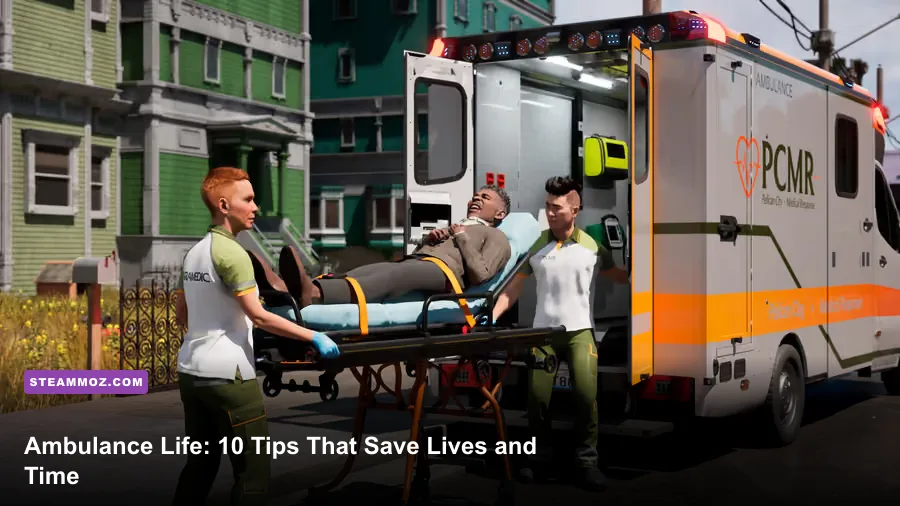
The best way to succeed in Ambulance Life: A Paramedic Simulator is to slow down at the patient, follow the examination chain, and treat only what you can justify. Drive defensively, secure dangerous scenes, triage multiple casualties before committing to one person, and learn the difference between a symptom and a diagnosis. Those habits will earn better results than simply flooring the accelerator or clicking every available treatment. These 10 tips will help new players handle calls in San Pelícano with fewer mistakes, cleaner handovers, and much less wasted time.
Ambulance Life is deliberately built around procedure. You are not playing an arcade racer with a medical skin; you are balancing travel, scene safety, patient assessment, treatment, and transport. The game also introduces new situations and equipment through career progression, so your first hours are partly about building reliable habits before the call types become more demanding. For a useful comparison with other demanding PC simulations, see our Dragonkin performance settings guide.
1. Learn the call loop before chasing speed
Every emergency follows a repeatable rhythm: receive the dispatch, reach the location, assess the environment, examine patients, apply appropriate care, and transport or complete the handover. New players often treat the travel segment as the main challenge, but the largest score losses usually happen after arrival. A rushed examination can hide a serious condition, while an unnecessary action can waste time or worsen the situation.
At the start of a call, read the dispatch details rather than instantly moving. The briefing gives you a rough idea of the incident type, not a complete diagnosis. A report mentioning a fall does not tell you whether the patient has a fracture, head trauma, shock, or several problems at once. Use that information to prepare mentally, then verify everything at the scene.
Keep this basic sequence in your head:
- Stop the ambulance safely and identify the interaction area.
- Check whether the scene is safe before focusing on a casualty.
- Observe the patient and use the available examination tools.
- Confirm the condition through the examination results.
- Apply the matching treatment, then reassess when the game allows it.
- Transport the patient when the call objective requires hospital care.
The game rewards consistency. You do not need to role-play every real-world protocol perfectly, but you do need to complete the information-gathering steps the scenario expects. Think of the call as a checklist with consequences, not a guessing game.

🎮 Ambulance Life: A Paramedic Simulator
Looking to experience this game? Grab your digital key directly on our store for $11.99.
View on Steammoz Store →2. Drive quickly, but never drive recklessly
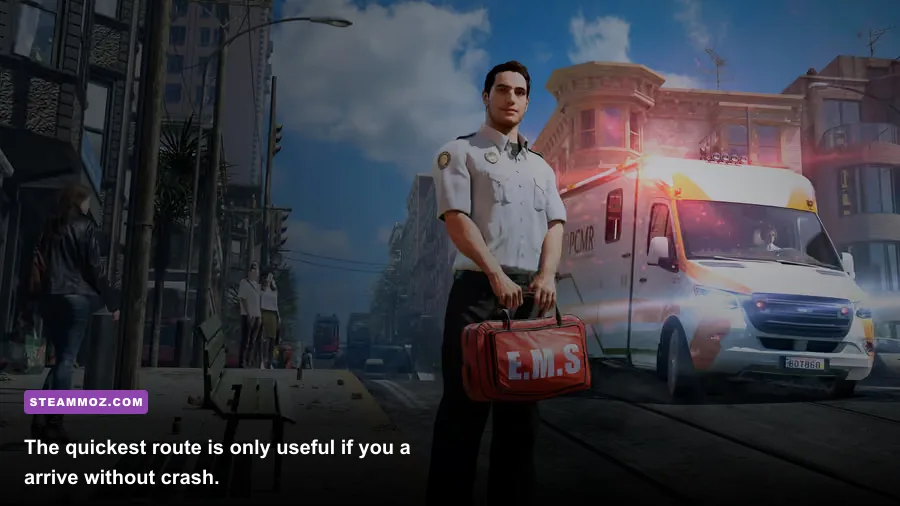
Your siren gives you priority, not invincibility. Ambulance Life’s city traffic can turn a short response into a frustrating detour when you clip a vehicle, hit roadside objects, or lose control at an intersection. The fastest reliable driver is usually the one who brakes early and keeps momentum through corners, rather than the one who holds maximum speed everywhere.
Use the route display as a planning tool. Look several seconds ahead for turns, traffic clusters, and narrow roads. Lift off the accelerator before a junction instead of braking at the last instant. On wider roads, stay predictable and avoid weaving between cars; sudden lane changes create more collisions than they prevent. If traffic blocks the obvious route, a slightly longer street can be faster than forcing a gap.
There is also a practical reason to protect the ambulance: a crash costs more than travel time. It can interrupt your route, damage your rhythm, and leave you arriving at a scene already under pressure. The small saving from driving aggressively rarely compensates for a full stop or a missed turn.
| Driving habit | Why it works | Common beginner mistake |
|---|---|---|
| Brake before intersections | Keeps the ambulance stable through turns | Braking after entering the corner |
| Plan one turn ahead | Reduces missed-route corrections | Following the GPS without looking forward |
| Use the siren as a warning | Gives traffic time to react | Assuming every vehicle will clear instantly |
| Take a clean alternate route | Avoids gridlock and collision penalties | Cutting across lanes to save seconds |
3. Make scene safety your first medical decision
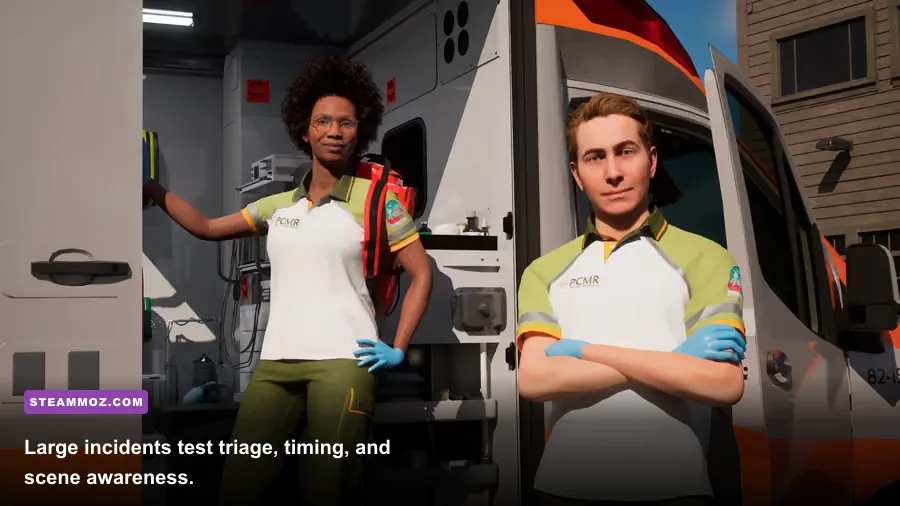
Arriving at an accident does not mean you can immediately treat the nearest person. Fire, wreckage, traffic, and unstable surroundings can make an incident unsafe. In Ambulance Life, the scene itself often tells you how the call should be approached: a road collision demands awareness of multiple casualties, while a domestic or medical call usually lets you concentrate on one patient more quickly.
Before interacting, take a short visual sweep. Look for every person in the area, not just the casualty highlighted by the objective. Check whether another patient is lying behind a vehicle or slightly away from the central incident. Missing someone creates a much bigger problem than spending a few seconds surveying the location.
For multi-patient scenes, triage comes before comfort. Find the person who appears most unstable or whose condition can deteriorate quickly, then work through the remaining patients. Do not spend your entire call completing a long examination on someone who is clearly stable while another casualty is waiting nearby. The game’s objective structure may vary, but prioritizing the most urgent patient is the safest default.
A simple triage order
- Identify patients who are unresponsive, bleeding heavily, or showing obvious distress.
- Check whether a patient can answer basic prompts or react normally.
- Handle immediate threats first, then perform deeper examinations.
- Remember which patients still need assessment before leaving the scene.
This is one of the most important Ambulance Life tips because it prevents tunnel vision. The first patient you notice is not automatically the first patient you should treat.
4. Follow the examination chain instead of guessing
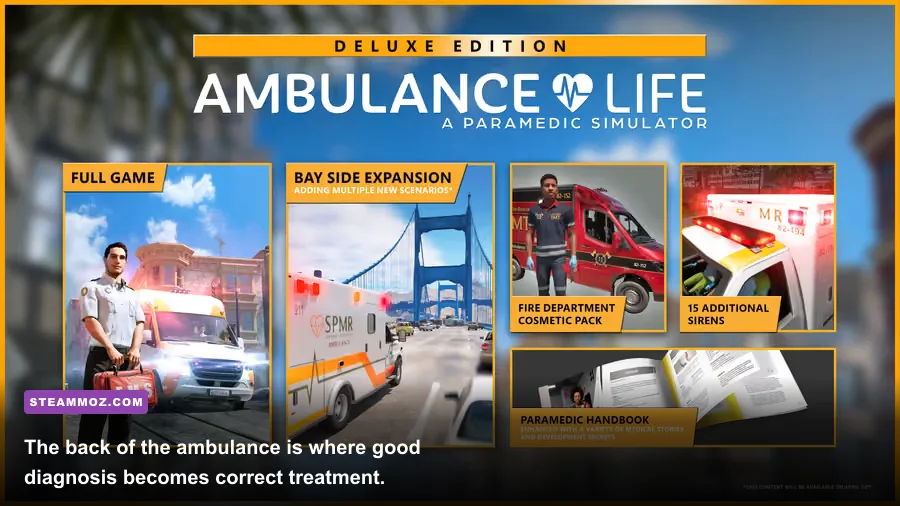
The examination tools are not decorative minigames. They are how the game turns a vague complaint into a specific treatment decision. If a patient reports pain, dizziness, breathing trouble, or an injury, begin with the basic assessment available for that situation and pay attention to the results. Jumping directly to a treatment because it sounds plausible is a reliable way to lose accuracy.
Use patient dialogue as a clue, not proof. A complaint can point toward the right branch, but the next examination step confirms whether you are dealing with trauma, a circulation problem, breathing distress, or another condition. The same visible symptom can appear in different emergencies, which is why the game expects you to investigate rather than diagnose from one line of dialogue.
Slow down during the interactive checks. Read the prompts, keep your cursor controlled, and do not click through the result screen before you understand what it is telling you. If a tool produces a result that contradicts your first assumption, trust the result. A professional response in this game comes from updating your diagnosis, not defending your initial guess.
| Situation | Best first response | What to avoid | Why |
|---|---|---|---|
| Patient reports pain after impact | Inspect the injury and complete the prompted assessment | Applying treatment immediately | Trauma symptoms can overlap |
| Breathing difficulty | Check the patient’s condition and follow the respiratory prompts | Assuming the cause from dialogue alone | Different conditions can produce similar complaints |
| Confusion or unusual behavior | Use the available checks before transport | Ignoring the patient because there is no visible wound | Serious problems are not always external |
| Several casualties | Perform a quick priority assessment on everyone | Finishing one long interaction first | The most urgent patient may be elsewhere |
For players who enjoy systems-heavy games, the mindset is similar to learning a build in an RPG: establish the correct sequence first, then optimize it. Our Dungeons 3 beginner tips cover the same kind of decision discipline in a very different genre.
5. Treat the confirmed problem, not every available symptom
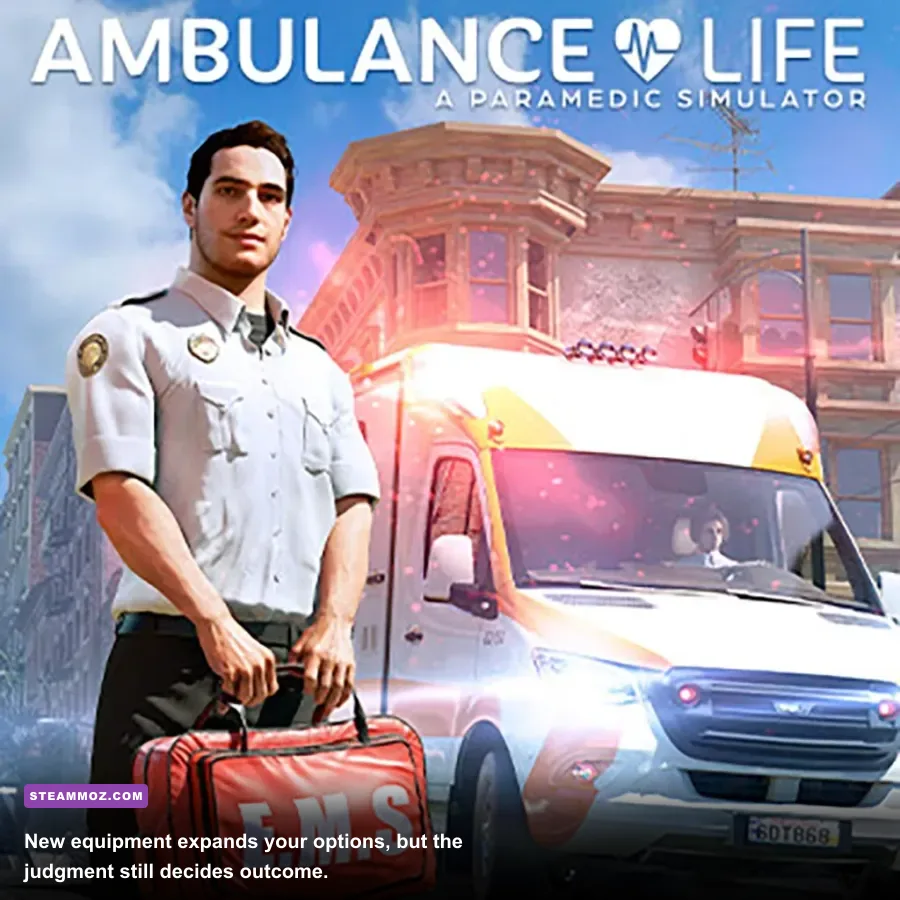
Once the examination identifies a condition, choose the treatment that directly answers it. New equipment can make the treatment menu look more powerful, but more options do not mean every patient needs every intervention. Extra actions consume time and can make a correct call feel messy.
Separate emergency stabilization from routine care. If the patient has an immediate threat, deal with that before spending time on secondary complaints. If the game presents a straightforward injury with no indication of a wider crisis, complete the relevant care and move on to reassessment or transport. The objective is not to perform the longest possible treatment sequence; it is to perform the necessary one accurately.
Watch the patient’s response after treatment. A successful action should change the situation, advance the objective, or make the next interaction available. If nothing progresses, do not blindly repeat the same action. Reopen the examination flow and look for the missing diagnosis, untreated condition, or required step.
Keep the official Steam page bookmarked for updates, since simulation games can adjust interactions and scenario behavior after launch. The exact presentation may change, but the core principle remains: diagnosis first, treatment second.
6. Use the ambulance interior as a second workspace
Transport is not merely a loading screen between the scene and the hospital. Once the patient is inside, pay attention to the available interactions and the current objective. Some calls require additional care, monitoring, or a final action before the handover is complete. Driving away immediately can leave an otherwise successful call unfinished.
Before leaving the scene, mentally confirm three things: the patient is ready to move, the necessary treatment is complete, and the destination or next objective is clear. That tiny pause prevents the classic beginner error of reaching the hospital and discovering that a required step was skipped at the roadside.
While driving with a patient onboard, keep the ride smooth. The trip is still part of the job, and reckless driving can undermine the careful work you just completed. Take corners under control, avoid unnecessary contact, and prioritize a clean arrival over a dramatic one.
7. Read objectives as hints, not a substitute for diagnosis
The call objective usually tells you what the game wants completed, but it does not always provide the entire medical answer. If the objective says to examine, stabilize, or transport someone, treat that as the next operational goal. Do not interpret it as permission to skip the patient’s examination.
Pay attention to changes in the objective text after each successful interaction. A new instruction often confirms that you used the correct branch. If the objective does not advance, stop clicking and review your previous actions. You may have selected a plausible but incorrect treatment, missed another patient, or failed to complete an examination interaction.
This habit is especially useful during early career missions, when the game is teaching mechanics in layers. Complete the call cleanly rather than trying to discover every possible interaction at once. Mastery comes from recognizing patterns across scenarios.
8. Spend progression rewards on options that widen your response
Career progression unlocks new scenarios, equipment, and responsibilities. Resist the urge to think of upgrades as a simple power curve. In a paramedic simulator, the best unlock is often the one that helps you identify more conditions or handle a broader range of calls, not the one that makes a single familiar task marginally faster.
Prioritize tools that expand diagnosis and treatment coverage. They become more valuable as missions introduce unfamiliar patient states and busier scenes. If a new unlock adds complexity, spend a few calls practicing it in lower-pressure situations. You do not want to learn a new interaction for the first time during a multi-patient emergency.
| Progression priority | Value for new players | Best time to focus on it |
|---|---|---|
| Core examination tools | High; improves diagnostic confidence | As soon as the game introduces them |
| Expanded treatment options | High; prevents narrow response habits | Before taking on harder call types |
| Advanced scenario access | Medium; increases variety and pressure | After the basic call loop feels automatic |
| Optional challenge content | Medium; useful for practice and mastery | After consistent clean handovers |
For another example of progression planning, check our fast-leveling guide for Empires of the Undergrowth. The lesson carries over: unlocks matter most when they support the way you actually play.
9. Tune performance before difficult calls
Ambulance Life combines a city environment, traffic, interiors, and busy emergency scenes. If your frame rate stutters, driving precision and small interaction prompts become harder, especially when a scene contains several objects and characters. A stable 60 frames per second is more useful here than unstable maximum settings.
Start with the game’s display resolution and frame cap, then adjust shadows, reflections, effects, and view distance if needed. Keep textures higher if your graphics memory allows it, because lowering every setting often makes the game look worse without solving the real performance bottleneck. If crowded scenes cause drops, reduce the settings that affect world complexity first.
| Setting area | Recommended starting point | Performance impact | Visual trade-off |
|---|---|---|---|
| Resolution | Native monitor resolution | Very high | Lowering it is effective but noticeably softer |
| Shadows | High, then Medium if needed | High | Reduced depth around vehicles and buildings |
| Reflections | Medium | Medium to high | Less detail on wet roads and vehicle surfaces |
| Effects | Medium or High | Medium | Lower impact effects and emergency visuals |
| Frame cap | Stable target matching your PC | Improves consistency | May limit peak frame rate |
Test settings during an active drive and a crowded incident, not just in an empty menu. Our FPS-first troubleshooting guide explains the same testing principle for another demanding PC game, while the Drawful 2 PC requirements breakdown is useful when checking whether a machine is being pushed beyond its comfort zone.
10. Review every failed call like a replay
A poor result is most useful when you identify the exact moment the call went wrong. Was the accident scene not surveyed? Did you treat before confirming the condition? Did you miss a patient, damage the ambulance, or leave without completing the required handover? Write down the first mistake rather than blaming the final score.
Use a short post-call review:
- Travel: Did you miss turns or take avoidable risks?
- Scene: Did you identify all patients and hazards?
- Assessment: Did you follow the examination chain?
- Treatment: Did every action match a confirmed problem?
- Transport: Did you complete the final objective before leaving?
That review turns repetition into actual improvement. Ambulance Life becomes much less chaotic once you stop treating each call as a unique surprise and start recognizing its structure. The game’s strongest moments come when you arrive at a complicated scene, establish priorities, work methodically, and finish with no unnecessary actions.
Build a calm, repeatable paramedic routine
These Ambulance Life: A Paramedic Simulator tips all point toward the same winning approach: controlled speed, careful triage, evidence-based treatment, and clean follow-through. Drive like the siren matters but physics still exists. Survey every scene. Use the examination tools instead of guessing. Spend progression rewards on broader capability, and tune your PC for stable performance before taking on crowded emergencies.
For official updates and platform information, follow Aesir Interactive and the official Nacon game page. Once the basic rhythm becomes automatic, harder calls stop feeling like frantic minigames and start feeling like what the simulator is aiming for: a chain of small, smart decisions under pressure.