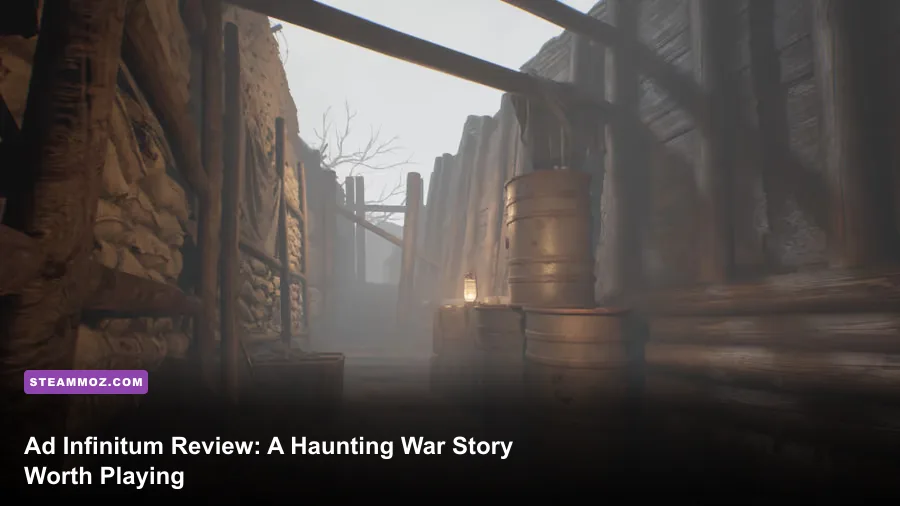
Ad Infinitum - Supporter Edition is worth playing in 2026 if you want a story-first psychological horror game, not a combat-heavy survival horror experience. Its strongest ideas are still striking: a German soldier's trauma becomes a shifting nightmare of trenches, gas, machinery, and monstrous figures, while the real-world horror of World War I bleeds into a damaged family history. The Supporter Edition is the version to buy only if you value the digital extras; the base game delivers the same campaign, puzzles, stealth, and atmosphere.
That distinction matters. Ad Infinitum is not a hidden Amnesia sequel, and it is not trying to compete with Resident Evil's weapon upgrades or Alien: Isolation's systemic AI. Developer Hekate gives you a compact, cinematic descent into memory. There are no guns to upgrade, no skill tree, no conventional inventory economy, and no repeatable endgame. What you get instead is a roughly six-to-eight-hour narrative horror game whose best moments come from connecting a family tragedy to the industrial nightmare of the Great War.
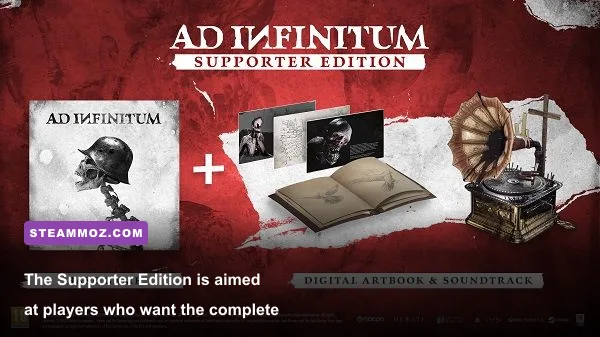
What the Supporter Edition actually offers

The Supporter Edition's value depends on your relationship with extras rather than gameplay. The campaign, locations, puzzles, enemy encounters, endings, and technical options are not fundamentally transformed into a deluxe version of the game. Before buying, check the current package listing on the official Steam page, because regional bundles and platform listings can change over time.
Historically, the edition has been positioned as a collector-friendly package built around the digital artbook and soundtrack-style extras. Those additions make sense for Ad Infinitum because the game's visual language does a lot of storytelling: rusted metal, surgical instruments, ruined interiors, military paperwork, and grotesque silhouettes are repeatedly used to connect private grief with industrialized warfare. The extras are appealing if you enjoy concept art, production notes, or keeping a horror soundtrack in your library. They are much harder to justify at a large price premium.
| Edition feature | Gameplay impact | Who should care | My verdict |
|---|---|---|---|
| Full Ad Infinitum campaign | Complete story, puzzles, stealth, and endings | Every player | Essential |
| Digital artbook | No mechanical impact | Horror and concept-art fans | Good bonus |
| Digital soundtrack or music extras | No mechanical impact | Players who enjoy atmospheric scores | Nice, not necessary |
| Supporter branding or pack extras | No change to campaign balance | Collectors and fans of Hekate | Purely optional |
My buying rule is simple: choose the Supporter Edition during a sale or when the price difference is modest. If the premium approaches the cost of another full game, buy the standard edition and spend the savings on something else. This is not a “deluxe” edition with new chapters or a separate playable scenario.

🎮 Ad Infinitum - Supporter Edition
Looking to experience this game? Grab your digital key directly on our store for $3.99.
View on Steammoz Store →A story about war, guilt, and inherited trauma
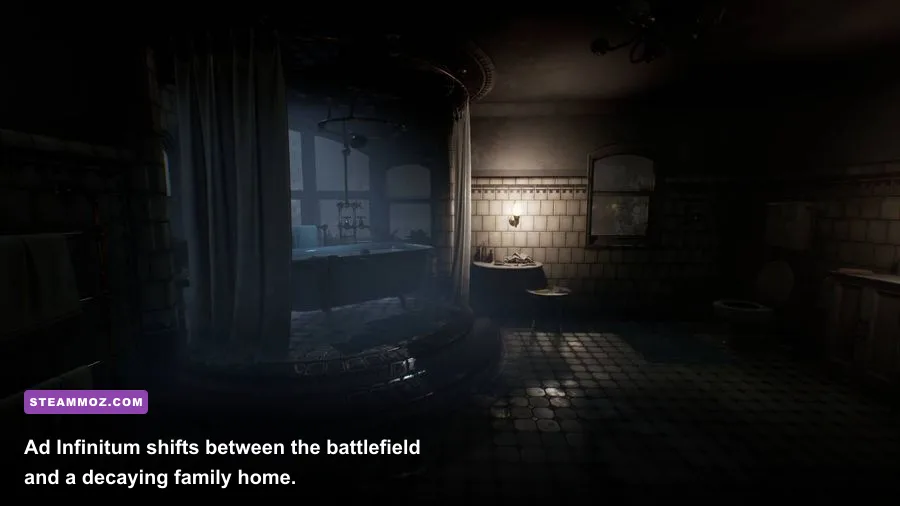
Ad Infinitum follows Paul, a German soldier whose experience of World War I is presented through a fractured psychological landscape. The game constantly destabilizes the boundary between what happened in the trenches, what happened in the family home, and what Paul can no longer process. That structure is the game's biggest narrative weapon. A corridor in a mansion can echo the geometry of a bunker; a domestic object can carry the same threat as a battlefield machine; a childlike image can turn into something genuinely vile.
The story works best when it refuses to make horror feel decorative. Barbed wire, gas masks, artillery damage, and amputated bodies are not just grim scenery. They are part of a system that treats people as materials to be consumed. The family material gives that historical horror a more intimate shape, although the writing can occasionally become blunt. Some revelations arrive with the subtlety of a hammer, and the alternating timelines can make the emotional rhythm feel uneven.
That unevenness is worth tolerating because the game understands that trauma is repetitive. You revisit ideas, rooms, and images with altered meaning. The design is less interested in surprising you with a plot twist every hour than in making familiar spaces feel contaminated. Players who prefer clear lore documents and neatly explained mythology may find the symbolism too opaque. Players who enjoy reading environmental clues and interpreting recurring imagery will have more to chew on.
It is also worth approaching the setting with some historical care. Ad Infinitum is a fictional psychological horror story set against World War I, not a substitute for a military history course. The game's emotional target is the damage caused by war rather than a detailed simulation of a particular battle. For a second opinion on a very different style of dark game storytelling, Steamoz's Dungeon Siege review is a useful contrast: Ad Infinitum is far more linear, intimate, and deliberately oppressive.
How the horror and stealth systems really work
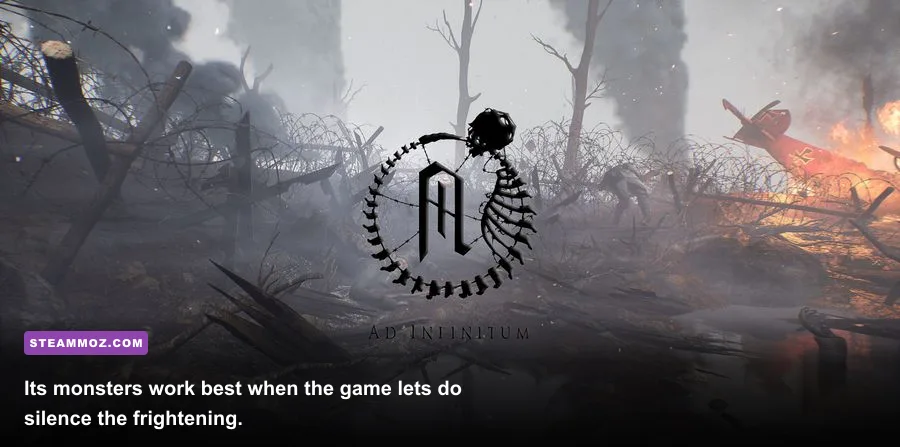
Ad Infinitum's horror loop is built around exploration, environmental puzzles, scripted chases, and stealth sequences. You are not managing ammunition or selecting a weapon loadout. The meaningful resources are attention, positioning, and nerve. That makes the game closer to a narrative stealth-horror experience than a traditional survival horror game.
Enemy encounters usually communicate danger through sound and space before they become a direct pursuit. Listen for movement, mechanical noise, breathing, and changes in the ambience. Sprinting everywhere is a mistake: it makes you less likely to notice an approaching threat and can push you into a dead end during a chase. Crouch when the game signals that concealment matters, break line of sight before hiding, and avoid assuming that the nearest locker or dark corner is automatically safe.
The game does not present a deep, universal stealth simulation. Many sequences are authored set pieces with intended routes and timing windows. That is not a flaw by itself; it gives Hekate control over pacing and visual composition. The trade-off is predictability. Once you understand a creature's patrol pattern or the location of a safe hiding space, the fear can drop sharply on a retry.
| Threat situation | What to watch for | Best response | Common mistake |
|---|---|---|---|
| Open trench or bunker corridor | Long sightlines and limited cover | Move slowly and identify exits before advancing | Sprinting into an unrecoverable dead end |
| Creature patrol | Footsteps, growls, or repeated route timing | Break line of sight, then hide only after distance is created | Entering cover while the enemy is still watching |
| Chase sequence | Doors, barriers, and narrow turns | Commit to the route and keep moving once triggered | Stopping to search for optional objects |
| Dark puzzle room | Interactive objects highlighted by context | Scan documents, mechanisms, and nearby shelves methodically | Leaving the room before checking visual clues |
There is no combat build to rescue you from a bad encounter. That limitation is central to the experience, but it will frustrate anyone expecting the empowerment curve of a modern action-horror game. Ad Infinitum's best scares happen before you know exactly what the rules are. Once the rules become familiar, the atmosphere has to carry the scene.
Puzzles, exploration, and the campaign's pacing
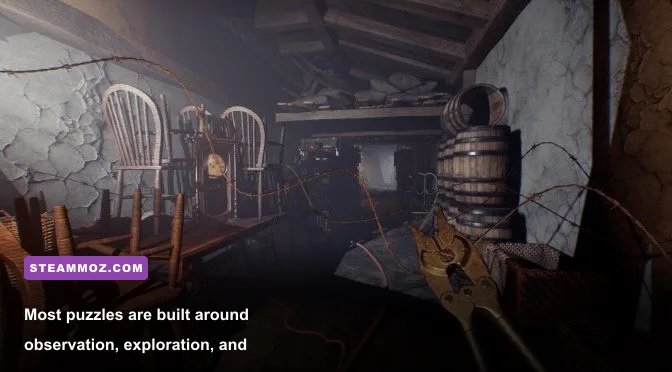
The puzzles are generally environmental rather than abstract. You search rooms, inspect documents, operate machinery, locate keys or components, and use visual relationships to determine what belongs where. The game often puts the answer close to the problem, so slow observation beats random interaction. Look at wall markings, furniture placement, written clues, and repeated symbols before wandering back through every room.
Some puzzles are satisfying because they make the setting feel coherent. A machine does not simply exist to block a door; it reinforces the game's obsession with industrial processes and human bodies. Other tasks feel like conventional adventure-game gates, particularly when the solution depends on finding one small object in a visually busy room. If you get stuck, retrace the last major story event and inspect newly accessible spaces first. Ad Infinitum typically signals progression through changed lighting, opened routes, or a fresh environmental disturbance.
Exploration rewards patience, but the campaign is not a sprawling immersive sim. There are no large optional zones packed with side quests. Collectible documents and environmental details add context, yet they rarely produce a separate mechanical reward. This is a game about controlled momentum. It wants you to absorb a room, solve its problem, experience its consequence, then move into the next nightmare.
The pacing is strongest in the opening and middle sections, where the contrast between the family mansion and the warfront keeps the imagery fresh. Later chapters can feel more linear and more dependent on chase beats. If you play in one or two sittings, that repetition is easier to accept. Spread the campaign across several weeks and the lack of a deep progression system becomes more obvious.
Graphics, audio, and PC performance in 2026
Ad Infinitum's visual identity remains effective on current PC hardware. Its environments lean on fog, darkness, volumetric lighting, texture detail, and carefully staged silhouettes rather than constant spectacle. The mansion's decayed interiors and the trenches' muddy, metallic claustrophobia are distinct enough that the transition between them carries real dramatic weight.
For 2026 players, the practical question is less whether the game looks cutting-edge and more whether your system can maintain stable frame pacing. The exact result depends on resolution, GPU drivers, upscaling options, and the specific area on screen. Start from the game's official PC requirements on the Steam listing, then tune for consistency rather than chasing maximum shadows.
| Setting | Recommended value | Performance impact | Visual trade-off |
|---|---|---|---|
| Resolution | Native monitor resolution | Very high | Best clarity; lower first if GPU-limited |
| Shadow quality | High | Medium to high | Lower settings soften bunker and corridor depth |
| Volumetric effects | Medium or High | Medium | Fog and light shafts lose richness on Low |
| Texture quality | High if VRAM allows | Low to medium | Important for walls, documents, and props |
| Motion blur | Off or Low | Negligible | Cleaner camera movement and puzzle reading |
| V-Sync or frame cap | Use a stable cap | Can improve pacing | Prefer consistency over unstable peak FPS |
Headphones matter more than another small graphics bump. The soundscape uses distant artillery, creaking structures, machinery, voices, and sudden silence to create anticipation. A cheap stereo headset with clear positional separation will usually help more than an expensive monitor upgrade. Keep subtitles on if you care about the narrative, but don't treat every line of text as an explanation; the game often communicates its most important ideas visually.
If you are troubleshooting an older PC, Steamoz's ELEX PC fixes guide offers useful general habits for crash diagnosis, while the Dragonkin settings guide covers the broader principle of prioritizing frame pacing. Those articles are not Ad Infinitum-specific fixes, so check the game's current patch notes and community reports before changing configuration files.
Who should play Ad Infinitum in 2026?
Play Ad Infinitum if you like slow-burn horror, authored stealth, symbolic storytelling, and games that use historical settings for emotional weight. It is a particularly good fit for players who enjoyed the oppressive exploration of Amnesia, the psychological ambiguity of Layers of Fear, or the quieter narrative side of SOMA. It also works for anyone curious about a World War I game that focuses on trauma rather than battlefield power fantasies.
Skip it, or wait for a deep discount, if you need combat, open-ended exploration, multiple character builds, or enemy encounters that remain unpredictable across retries. The short runtime is not automatically a weakness, but it does make the purchase price important. The Supporter Edition should be treated as a fan package, not as essential DLC.
| Player type | Fit | Why | Recommended purchase |
|---|---|---|---|
| Atmospheric horror fan | S-Tier fit | Excellent sound design, oppressive spaces, strong visual motifs | Supporter Edition on sale |
| Story-focused player | A-Tier fit | Compelling themes, though some reveals are heavy-handed | Standard or Supporter Edition |
| Action-horror fan | C-Tier fit | No weapons, upgrades, boss combat, or power curve | Try before paying a premium |
| Completionist | B-Tier fit | Documents and details encourage replay, but there is no huge endgame | Standard Edition is enough |
One useful comparison is with games built around progression and repeatable rewards. Steamoz's Everspace weapons guide is almost the opposite of Ad Infinitum's design philosophy: Everspace asks you to optimize equipment, while Ad Infinitum asks you to interpret space and survive the next authored sequence. Neither approach is better, but knowing which loop you want will prevent buyer's remorse.
Final verdict: buy the game, not the label
Ad Infinitum remains worth playing in 2026 because its central combination of World War I imagery and psychological horror still feels distinctive. It has a clear point of view, a memorable atmosphere, and enough narrative ambition to stay with you after the credits. Its limitations are equally clear: stealth is mostly scripted, puzzles can be uneven, the campaign is short, and the monsters lose some power once their patterns are understood.
Final score: 7.5/10.
The standard edition is the smarter value for most players. Choose the Supporter Edition when you want the artbook and soundtrack extras, the price gap is small, or you specifically want to support Hekate's work. Don't buy it expecting new missions, deeper mechanics, or a replay-focused deluxe campaign. Buy it for a focused, unsettling story that turns trenches and family rooms into two versions of the same nightmare.
For official background on the project, visit the Hekate Games website and the official Nacon game page. If you're comfortable with a short, linear horror game and can find the Supporter Edition at a sensible price, Ad Infinitum deserves a place on your 2026 backlog.