If you want desktop games that feel genuinely different from the usual Steam recommendations, start with Duskers, Hypnospace Outlaw, Strange Horticulture, The Case of the Golden Idol, and UnReal World. They are inexpensive, mechanically distinctive PC experiences built around deduction, atmosphere, and systems that rarely appear in mainstream releases.
None of these games is a throwaway curiosity. Duskers can make a three-word command feel more stressful than a boss fight, while The Case of the Golden Idol turns a frozen murder scene into a logic puzzle. Strange Horticulture is gentler but just as demanding, asking you to identify plants from incomplete evidence. If your library is full of blockbuster action games, these are the hidden gem desktop games that can reset your expectations.
Why these overlooked PC games are worth your time
The common thread is meaningful friction. These games do not bury their best ideas under endless quest markers or daily rewards. They give you a compact ruleset, a strange world, and enough information to make mistakes your own. That makes them especially good choices for a keyboard-and-mouse setup, where command entry, inventory sorting, maps, and notes feel deliberate rather than awkward.
They also run on modest hardware. You do not need a current graphics card to enjoy them, and most support windowed play, making them perfect for a second monitor or a short evening session. The table below shows what each game is really asking from you.
| Game | Core Challenge | Typical Session | Best For |
|---|---|---|---|
| Duskers | Commanding drones through abandoned ships | 20–45 minutes | Players who enjoy tension and resource management |
| Hypnospace Outlaw | Investigating a fictional 1999 web | 30–60 minutes | Detail hunters and internet nostalgists |
| Strange Horticulture | Identifying magical plants | 30–90 minutes | Relaxed puzzle players |
| The Case of the Golden Idol | Reconstructing murders from evidence | 20–40 minutes | Hard deduction fans |
| UnReal World | Surviving a historical wilderness | 1–3 hours | Sandbox survival veterans |
For more unusual recommendations, Steamoz's Eternal Destiny hidden rewards guide and Everspace 2 secret locations guide are good reminders that exploration still matters in PC gaming.
Duskers makes a command line feel terrifying

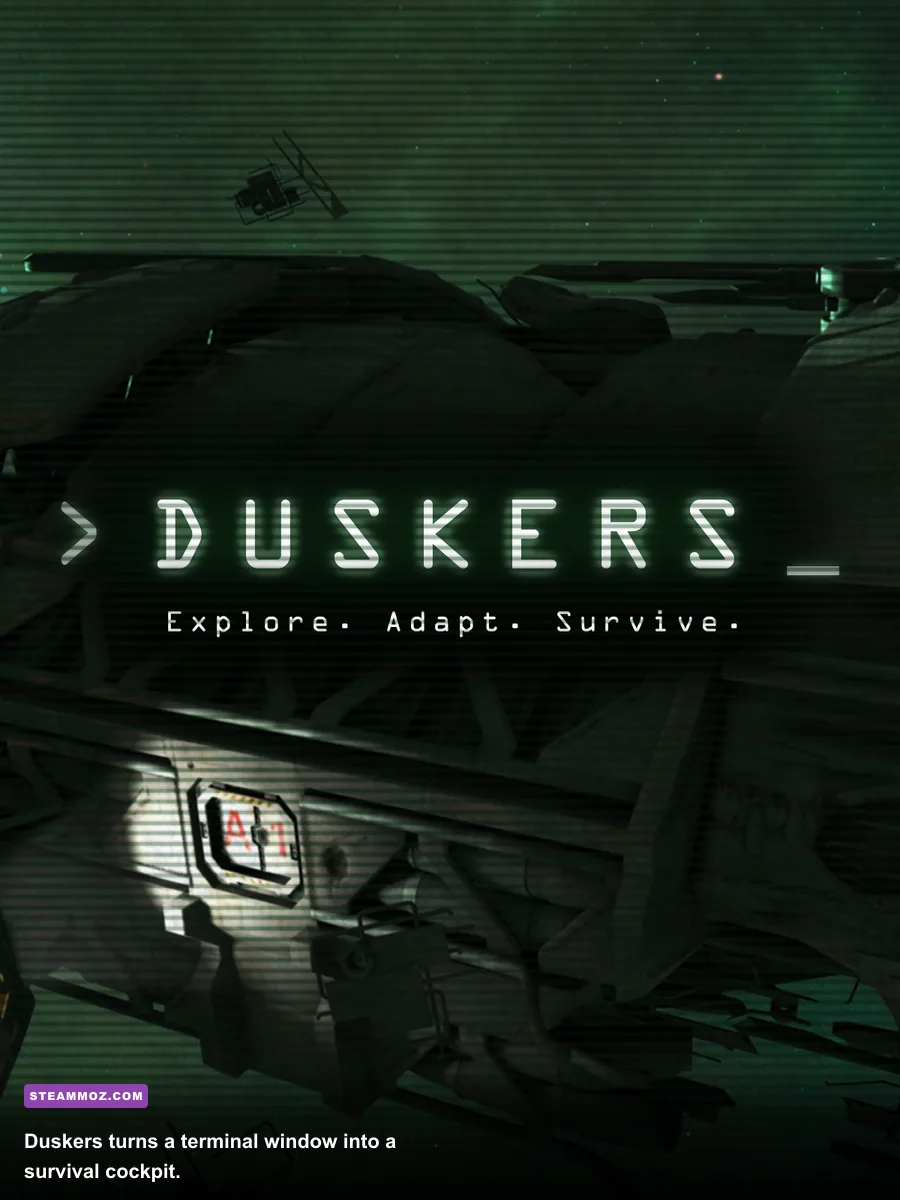
Duskers on Steam is a roguelike salvage game played through a remote terminal. Humanity has vanished, and you explore derelict ships using drones while your mothership remains safely outside. The catch is that the ship's sensors are unreliable, doors hide hostile organisms, and every drone you lose takes useful equipment with it.
The mechanics that make Duskers special
Your basic commands include navigate, open, close, and scan. The commands are simple; the consequences are not. A motion drone module can reveal movement in nearby rooms, but it does not tell you whether the contact is harmless. A generator module keeps other tools running, while remote power lets you activate machinery from a safer distance. The tow module can pull a disabled drone, turning a disastrous expedition into a salvageable one.
Always send your least valuable drone into an unknown room first. Keep one drone near the airlock, and never spend every scrap of ship fuel reaching a derelict. Infestations can spread, doors can seal, and a ship that looks empty may contain a Swarm or a deadly Guardian. Duskers' tension comes from imperfect information: the game rarely kills you because you lacked skill. It kills you because you assumed the next room was safe.
| Tool | What It Does | Best Use | Main Risk |
|---|---|---|---|
| Motion | Detects movement nearby | Checking rooms before entry | Does not identify the threat |
| Generator | Provides power to modules | Keeping a utility drone active | Uses limited drone space |
| Remote Power | Activates ship systems remotely | Opening doors without exposure | Can consume scarce resources |
| Tow | Pulls disabled drones | Recovering damaged equipment | Requires careful positioning |
The official Duskers Steam page is worth checking before buying because its command-driven interface is the whole point. If you want a game that makes typing open door3 feel like pulling a pin, this is the standout pick.
Hypnospace Outlaw turns browsing into detective work

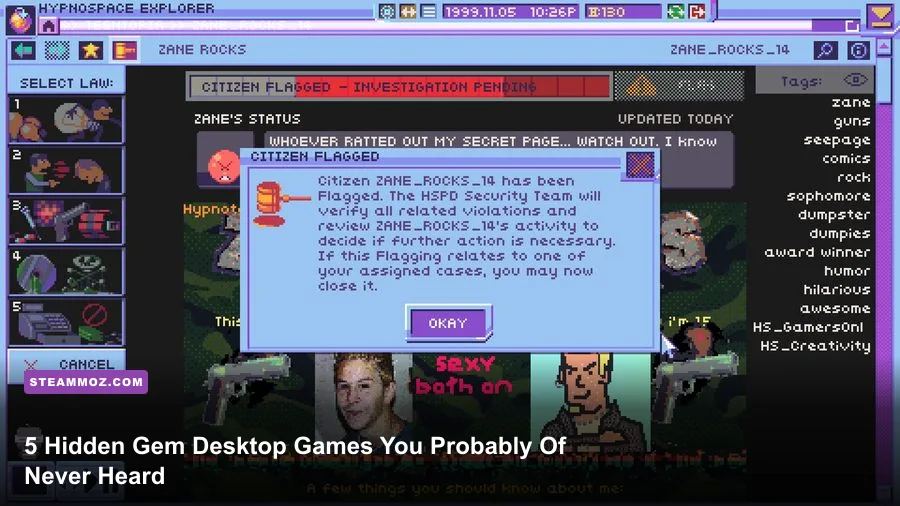
Hypnospace Outlaw simulates an alternate internet from 1999, complete with animated backgrounds, awful music, personal homepages, fan communities, and aggressively strange memes. You play an Enforcer whose job is to investigate reports and remove illegal or harmful content. In practice, that means browsing dozens of pages and noticing details other games would treat as decoration.
The main campaign rewards cross-referencing. A user's page may contain a username, a broken link, or a suspicious download that points toward another part of Hypnospace. Installable programs add functionality to your desktop, including tools that help reveal hidden information. Some cases are straightforward policy violations; others become miniature stories about obsession, harassment, and online identity.
How to investigate without missing clues
Save suspicious pages, read guestbooks, and revisit sites after receiving new evidence. Do not rush to close a report just because the first page looks obvious. The game often hides the useful clue in a banner, a music player, or a deliberately ugly piece of fan art. Keep notes on usernames and recurring symbols. Hypnospace is at its best when you stop treating it like a linear adventure and start treating it like an actual archive.
The presentation is deliberately noisy, so lower the music volume slightly if overlapping loops become tiring. The payoff is one of the most convincing fictional online cultures in an indie game. For another PC title where technical details matter, Steamoz's Filament settings guide covers a very different but equally focused desktop experience.
Strange Horticulture hides a mystery inside every plant
In Strange Horticulture, you run a plant shop in the town of Undermere. Customers bring ailments, occult problems, and incomplete descriptions. You identify plants using a botanical guide, then choose whether to sell, recommend, or withhold them. The store's desk is your safe space, but the map outside gradually opens a darker mystery involving local groups and supernatural forces.
Specific specimens matter. Witherwort is tied to decay, Witch Phyge has distinctive hooked leaves, and St John's Poppy is one of several plants whose properties become important when customer requests get more dangerous. You should compare leaf shape, flower color, stem structure, and habitat rather than relying on a single visual trait. The book's text is intentionally incomplete, so identifying a plant is a process of elimination.
Do not burn through every new plant immediately. Keep unfamiliar specimens labeled and use the map's clues before selecting a destination. Some choices affect the ending, and certain customer interactions can remove opportunities later. Strange Horticulture is less about reflexes than confidence: once you recognize a plant, the correct decision feels satisfying because you earned it through observation.
The Golden Idol rewards evidence over guesswork
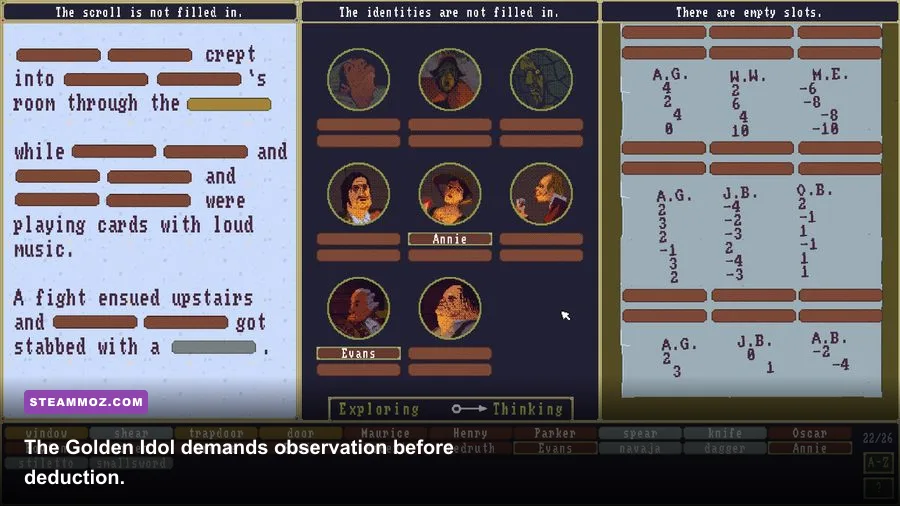
The Case of the Golden Idol gives you twelve interconnected murder scenes rendered in chunky pixel art. Each scene freezes the moment after something terrible happened. You can inspect bodies, weapons, rooms, letters, and witnesses, then fill in a deduction panel with names, motives, actions, and methods.
The key is separating observation from interpretation. First, click everything. Record exact wording, especially unusual nouns and titles. Then identify what physically happened: who was holding the gun, which body suffered the wound, and which object moved. Only after that should you infer motive. The game accepts a completed deduction when the major facts line up, but it will not rescue you from a plausible theory built on one wrong assumption.
A reliable three-pass solving method
On pass one, collect every highlighted word and inspect every corpse. On pass two, map relationships between characters and compare clothing, insignia, and locations. On pass three, enter the deduction panel and test the least certain fields first. If a scene refuses to resolve, revisit the evidence instead of brute-forcing names. Later cases depend on details learned earlier, making the full twelve-scenario campaign feel like one elaborate conspiracy rather than a stack of disconnected puzzles.
UnReal World is survival without the usual power fantasy
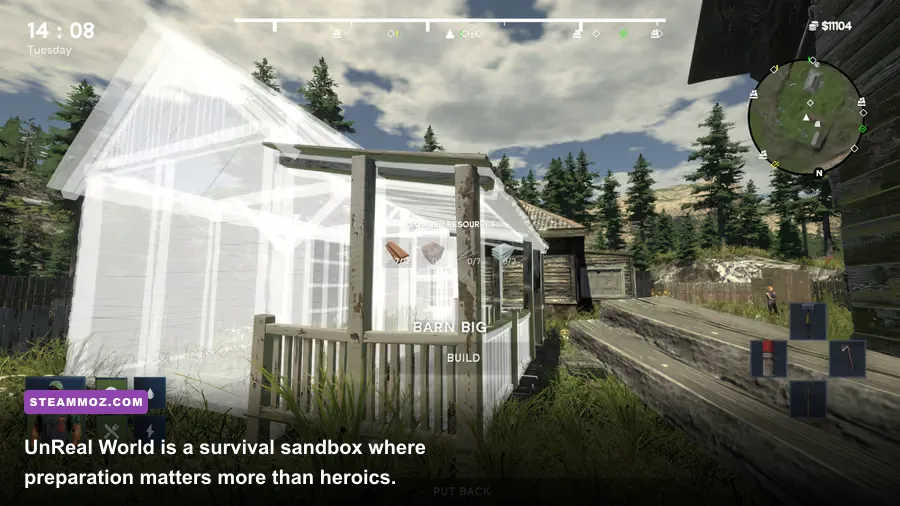
UnReal World has been in development for decades and remains one of the most detailed survival sandboxes on PC. Set in Iron Age Finland, it asks you to hunt, fish, build shelters, dry food, travel across frozen terrain, and survive injuries that do not conveniently disappear after a nap.
Character creation is unusually important. A strong hunter with poor climbing ability plays differently from a nimble woodsman with weak endurance. Your first goal should be a reliable food loop: find a safe shelter, gather firewood, make basic tools, and learn the local terrain before chasing ambitious prey. Spears and bows are useful, but hunting large animals can leave you injured or overloaded. Small game, fishing, and preserved food are safer foundations.
Weather and fatigue are as dangerous as enemies. Wet clothing can become a serious problem in cold conditions, while long travel without rest damages your ability to fight and work. Carrying too much slows you down, and a slow retreat is often worse than avoiding the fight entirely. The game has no traditional victory screen, which is precisely why every successful winter feels like an achievement.
| Game | Learning Curve | Failure Cost | Recommended First Goal |
|---|---|---|---|
| Duskers | High | Lost drones and resources | Recover one valuable module safely |
| Hypnospace Outlaw | Moderate | Missed evidence or case outcomes | Archive suspicious pages before reporting |
| Strange Horticulture | Moderate | Missed story branches | Build a dependable plant identification habit |
| Golden Idol | High | Time spent on a false theory | Separate visible facts from assumptions |
| UnReal World | Very High | Permanent survival setbacks | Secure shelter, food, and fire before exploring |
These five hidden gem desktop games are worth playing because they trust you to pay attention. Duskers weaponizes uncertainty, Hypnospace Outlaw understands online culture, Strange Horticulture makes botany dramatic, Golden Idol delivers pure deduction, and UnReal World turns preparation into its own adventure. They are not the loudest games in your Steam library, but they are exactly the kind you keep thinking about after you close the desktop.