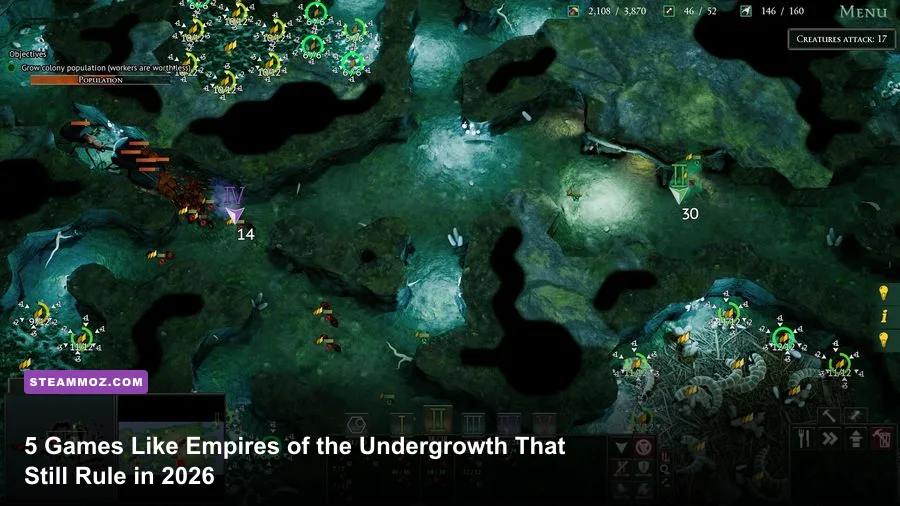
If Empires of the Undergrowth’s worker queues, pheromone trails, hungry predators, and sudden nest collapses have you hooked, start with They Are Billions, RimWorld, and Dungeons 3. They aren’t carbon copies, but each nails a different part of the formula: relentless colony defense, obsessive simulation depth, or underground base construction. Evil Genius 2 is the best choice for players who love turning a hidden lair into a living machine, while SimAnt is the essential historical pick for anyone who wants to see where the ant-colony idea began.
This is the shortlist of the best games like Empires of the Undergrowth you need to play in 2026, ranked by how well they reproduce the original’s most important pleasures. I’m judging them on colony control, resource pressure, creature behavior, tactical decision-making, replayability, and how quickly a clever plan can turn into an entertaining disaster.
The games that come closest to the Undergrowth formula

Empires of the Undergrowth is unusually specific. You are not just building a base or selecting an army; you’re running an insect society where food, brood chambers, worker jobs, territory, and pheromone-driven movement all collide. That makes direct replacements rare. Most alternatives borrow one or two ingredients rather than the whole recipe.
| Game | Closest Match | Best Feature | Main Difference |
|---|---|---|---|
| They Are Billions | S-Tier | Colony defense and escalating threats | Human settlements and firearms replace insect armies |
| RimWorld | S-Tier | Emergent colony simulation | Pause-and-plan management is slower and less RTS-focused |
| Dungeons 3 | A-Tier | Underground construction and minion control | Mission-based fantasy combat is more linear |
| Evil Genius 2 | A-Tier | Specialized rooms, workers, and base flow | Spies and objectives matter more than battlefield tactics |
| SimAnt | B-Tier | Pure ant behavior and colony identity | Old interface and limited modern quality-of-life features |
One important warning: none of these games has the exact combination of Empires of the Undergrowth’s real-time nest skirmishes and campaign storytelling. If you want help mastering the original before moving on, Steamoz’s fast leveling and gold farming guide is still a useful companion. The recommendations below are about finding a new obsession, not pretending every colony sim plays identically.

🎮 Empires of the Undergrowth
Looking to experience this game? Grab your digital key directly on our store for $8.99.
View on Steammoz Store →They Are Billions is the best survival-strategy substitute
They Are Billions is the strongest recommendation for players who love the panic of an ant nest being discovered. Its infected are effectively an ever-growing predator ecosystem. A single runner reaching your wall can infect nearby workers, those workers can infect soldiers, and a contained breach can become a dead save within seconds.
The campaign’s core loop is built around expansion and risk. You start with a Command Center, a small group of Rangers and Soldiers, limited Workers, and a map packed with infected villages. Food comes from Hunter’s Cottages, fishing, farms, and later advanced agriculture. Wood supports early housing and defenses; stone unlocks stronger structures; iron and oil power the late-game military economy. Every resource has a job, so greedily claiming a second food region can leave you unable to repair the first defensive line.
Its best tactical lesson is information discipline. Rangers are quieter and cheaper, making them excellent for clearing isolated infected, while Soldiers deal more damage but generate noise that attracts larger groups. Put Rangers on patrol near the perimeter, use Soldiers for controlled pushes, and never let your scouting force drift beyond retreat distance. The final wave arrives on a fixed day in campaign and survival modes, so the correct question is not simply “How fast can I expand?” but “Can this expansion be defended when the horde arrives?”
Compared with Empires of the Undergrowth, the unit control is less organic. You don’t paint pheromone routes or assign workers to brood chambers. In return, walls, gates, towers, ballistae, executors, shocking towers, and layered choke points create a superb defensive puzzle. The game also runs well on modest hardware, though huge late-game hordes can punish CPU performance. Lowering shadows and effects helps, but simulation speed—not just visual quality—is the real concern.
Why it ranks first
- Best overlap: expanding a vulnerable colony while hostile creatures constantly test the perimeter.
- Best skill transfer: scouting, choke-point planning, worker efficiency, and emergency response.
- Biggest drawback: losing one infected civilian can trigger a chain reaction that feels harsher than most ant missions.
If you want more PC strategy recommendations with a technical angle, compare that experience with Steamoz’s Dungeons 2 weapon tier list and its fastest leveling and gold route.
RimWorld is the deepest colony sim here
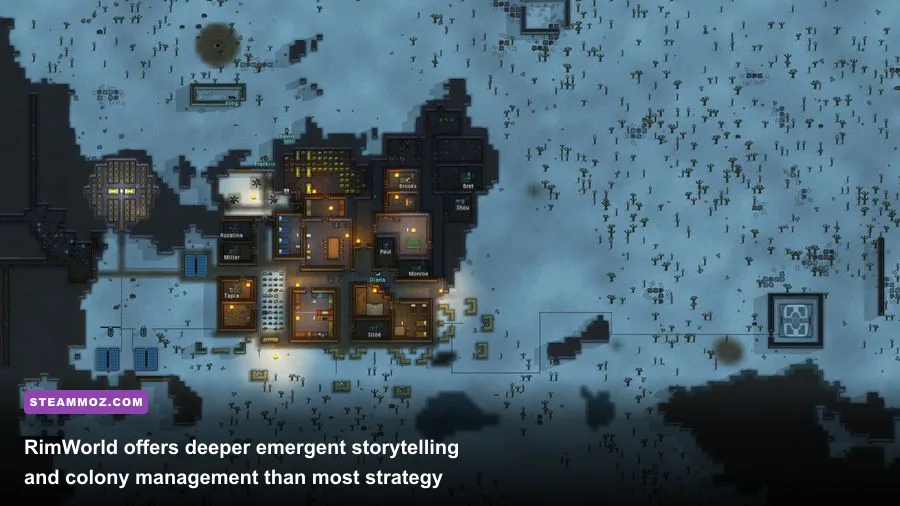
RimWorld is the pick for players who care less about controlling a perfectly synchronized army and more about watching a colony develop a personality. Its storyteller system, needs model, injuries, relationships, and mood breaks produce the kind of stories that strategy games usually script badly. Your colony may survive a raid only to lose its best doctor to food poisoning, a social fight, or a poorly timed psychic drone.
The mechanical foundation is wonderfully granular. Colonists have skills from 0 to 20, passions that accelerate learning, and work priorities from 1 to 4. A colonist with Plants 8 and a burning passion can transform a food-starved settlement, while a talented shooter with terrible mood management may still flee during the next raid. The work tab is your equivalent of an ant colony’s labor system: set construction, growing, cooking, hauling, and research priorities correctly, and the base flows. Set them badly, and your colonists will clean a room while corpses rot outside.
Choose Crashlanded for the classic three-colonist start, Strive to Survive for a firm but readable challenge, and Cassandra Classic if you want escalating pressure rather than a purely random mood swing. The first research targets should reflect your map. Batteries and solar panels are vital on difficult electricity maps, while Complex Clothing and Devilstrand matter more when temperature and armor become the main threats. Don’t rush fabrication if your colony still has no stable food surplus or hospital.
RimWorld’s combat is pause-and-plan rather than continuous RTS. Draft colonists, use cover, split firing lanes, and reserve your best melee fighter for enemies who breach the line. A simple three-layer defense—outer barricades, a fallback position, and a protected hospital—will save more lives than an expensive early weapon. Mods and expansions can push it far beyond the scope of Empires of the Undergrowth, but the unmodded base game already offers hundreds of hours of emergent problems.
| RimWorld Priority | Early Target | Why It Matters | Undergrowth Equivalent |
|---|---|---|---|
| Food | Rice and a freezer | Prevents starvation spirals | Secure food tiles and workers |
| Defense | Cover and a fallback line | Reduces injuries during raids | Guard chokepoints and nest entrances |
| Labor | Work priorities 1–4 | Keeps critical jobs staffed | Manage worker and brood roles |
| Research | Electricity or Complex Clothing | Unlocks survival infrastructure | Invest in nest upgrades and species tech |
RimWorld is slower, messier, and more personal than Empires of the Undergrowth. That’s exactly why it belongs on this list. For another old-school PC strategy comparison, Steamoz’s Dungeon Siege review is worth a detour.
Dungeons 3 turns nest-building into dungeon engineering
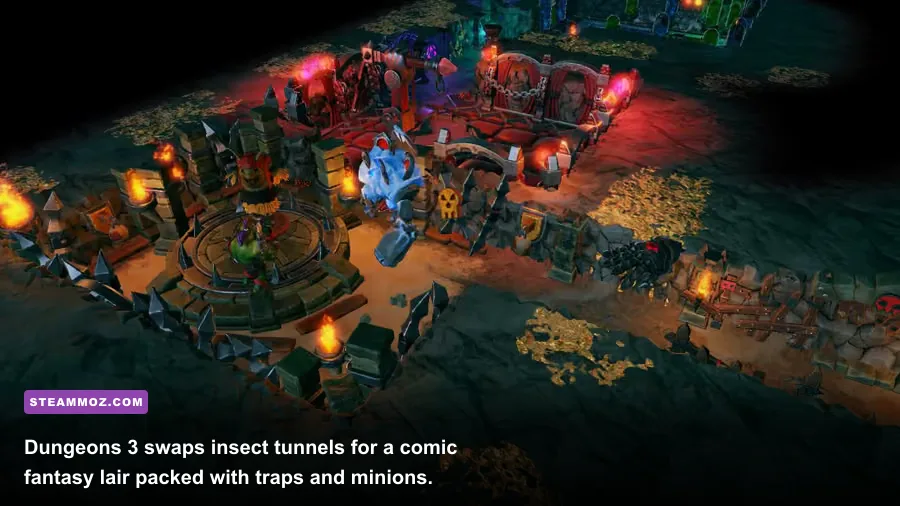
Dungeons 3 is the most immediately comfortable recommendation if your favorite part of Empires of the Undergrowth is digging out a base, placing specialized rooms, and keeping a workforce productive while enemies prepare an assault. Its Dungeon Lord, creatures, traps, and rooms replace ants and larvae, but the underlying satisfaction is familiar: carve a useful layout, build an economy, and make intruders regret entering.
The dungeon economy revolves around Gold and Mana. Treasury rooms let you store more gold, while a fully functioning dungeon needs lairs, hatcheries, training spaces, and workshop infrastructure. The game’s creatures are not interchangeable. Orcs are reliable frontline bruisers, nagas provide ranged pressure, bile demons punish groups, and skeletons offer expendable bodies. Your composition should match the map rather than simply filling every available slot.
Traps work best as part of a kill zone, not as isolated decorations. Slow effects buy your ranged creatures time to fire, fear and confusion disrupt enemy formations, and damage traps become far more valuable when enemies are forced through a narrow corridor. Leave enough room to repair and reinforce the route. A dungeon that looks clever but has no fallback path can collapse when the campaign introduces stronger heroes or a new attack angle.
The campaign is more guided than the skirmish missions in Empires of the Undergrowth, and the humor can be loud, but the construction rhythm is excellent. You’re constantly deciding whether to spend gold on another creature, a room upgrade, or a trap network. The game also offers a clearer learning curve than many dungeon-management titles, making it a good bridge for new players who want strategy without RimWorld’s huge simulation burden.
For the best opening, expand the dungeon in compact blocks rather than digging every visible tile. Keep the Dungeon Heart protected behind two routes, position the training room close to the spawn area, and avoid overbuilding rooms before your gold income can support them. The strongest early layout is functional, not pretty: short travel distances, a controlled entrance, and enough open space to reposition minions during an invasion.
Evil Genius 2 is the best lair-management alternative
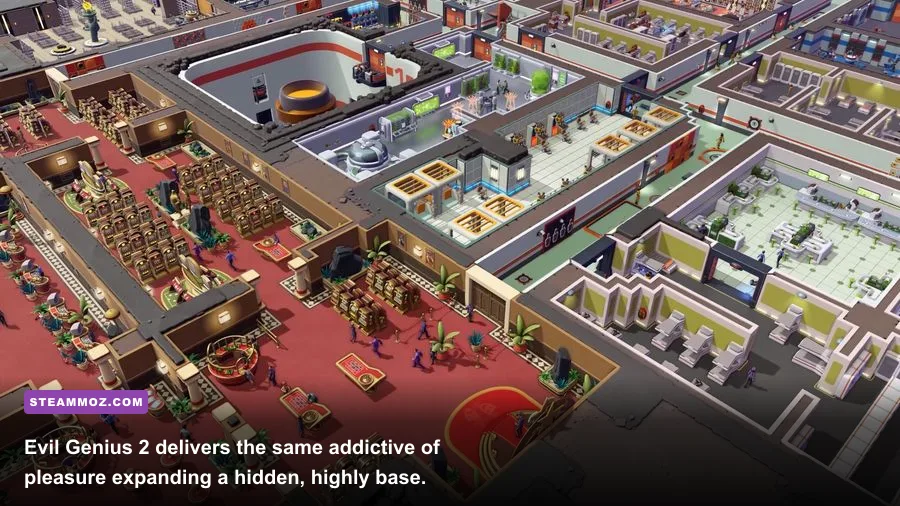
Evil Genius 2: World Domination swaps insect instincts for supervillain logistics, but it understands the joy of watching a specialized base come alive. You choose one of four geniuses—Maximilian, Red Ivan, Zalika, or Emma—and build an island lair around that character’s strengths. Every room exists to solve a problem: training minions, generating research, laundering money, handling heat, or distracting investigators.
The closest parallel to an ant colony is the minion pipeline. Workers construct rooms and perform routine tasks, while specialized minions handle science, military operations, deception, and social control. If you train too many advanced minions without improving food, beds, or morale infrastructure, your base becomes a traffic jam. If you focus only on workers, investigators eventually expose the lack of security. The game rewards the same kind of role balance that makes ant economies work.
Room placement matters more than newcomers expect. A Control Room generates intel and expands your world map, but it also benefits from proximity to corridors and security. Training rooms should sit near barracks and mess facilities, while casino distractions belong along likely investigator routes. Tagging suspicious agents and assigning guards is safer than allowing every minion to attack immediately; combat creates bodies, heat, and attention.
Maximilian is the most forgiving first campaign because his income and worker-focused abilities support expansion. Red Ivan is more aggressive, Zalika leans into science, and Emma emphasizes deception and control. Choose based on the kind of base you want to run rather than chasing a supposedly perfect tier list. The campaign’s biggest weakness is repetition: world-stage operations and investigation events can feel familiar after the novelty wears off. Still, the base itself remains a satisfying machine to tune.
This is not a tactical battlefield game, so don’t expect the precise swarm movement of Empires of the Undergrowth. It’s better at the quiet work behind the action: room adjacency, worker traffic, training throughput, and hiding the consequences of your empire from increasingly capable spies.
SimAnt is the purest ant-colony ancestor
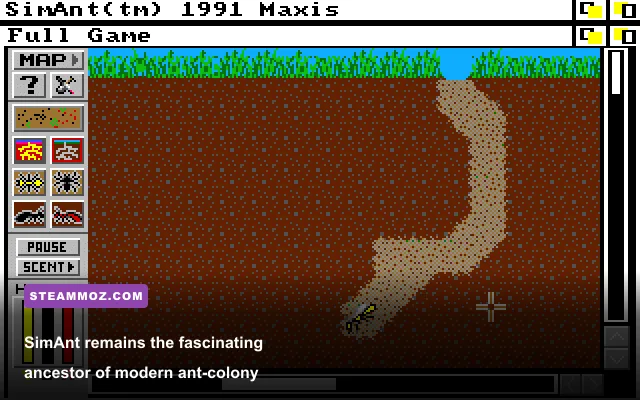
SimAnt is old, strange, and still uniquely focused. Released by Maxis in 1991, it lets you control a black ant colony across underground chambers, garden terrain, and hostile encounters with red ants, spiders, and human interference. Its graphics and interface are obviously dated, but the fantasy is remarkably close to what modern ant-game fans want: food trails, larvae, queen protection, tunnel expansion, and an ecosystem that doesn’t care about your plans.
The most important difference is scale. You often guide the colony indirectly rather than micro-managing a full tactical army. Workers gather food and care for brood, soldiers defend the nest, and the queen is the strategic center of the entire operation. If she dies, the colony’s future ends. That creates a different kind of tension from Empires of the Undergrowth, where species upgrades and combat formations offer more direct control.
SimAnt’s garden map is especially memorable because the threats are environmental as much as military. Spiders can pick off isolated ants, rival colonies contest food, and human activity can destroy territory that took time to secure. The game’s appeal is observational: you build a network, watch traffic develop, and intervene when the colony starts losing momentum.
Modern players should approach it as a historical simulation rather than a polished replacement. The controls can feel clumsy, the visuals are low-resolution, and there is no modern tutorial flow. Emulation or a legitimate re-release is the practical route, and you should save often. But if you’re curious about the design DNA behind today’s ant colony games, SimAnt is impossible to ignore. It explains why the fantasy still works decades later.
Which game should you play first in 2026?
The right choice depends on the specific part of Empires of the Undergrowth you want to preserve. Choose They Are Billions if you live for last stands and defensive walls. Pick RimWorld if worker management, unpredictable stories, and long-term colony survival matter most. Go with Dungeons 3 for the closest underground construction rhythm, or Evil Genius 2 for a more relaxed but richly themed lair simulator. Play SimAnt when the ants themselves—not modern convenience—are the point.
| If You Love This in Empires | Play This First | Recommended Approach | Difficulty Feel |
|---|---|---|---|
| Defending against overwhelming waves | They Are Billions | Scout early, build layered walls, protect the economy | Harsh and unforgiving |
| Managing workers and unpredictable crises | RimWorld | Set work priorities, stabilize food, build fallback defenses | Emergent and variable |
| Digging and fortifying an underground base | Dungeons 3 | Keep rooms compact and build a trap kill zone | Accessible with spikes |
| Optimizing a specialized hidden headquarters | Evil Genius 2 | Control minion traffic and manage investigator heat | Relaxed to moderate |
| Watching a true ant society develop | SimAnt | Protect the queen and expand food networks carefully | Old-school and opaque |
There’s also no reason to stop at one. A strong 2026 rotation would be They Are Billions for short, high-pressure sessions, RimWorld for a long colony campaign, and Dungeons 3 when you want a more structured evening. Check the official Empires of the Undergrowth Steam page for its current updates, and browse the They Are Billions Steam listing, RimWorld’s official Steam page, and the Dungeons 3 Steam page before buying. Prices, bundles, supported platforms, and update status can change.
My personal order is simple: They Are Billions first for the tactical pressure, RimWorld second for the simulation depth, and Dungeons 3 third for the most immediately familiar base-building loop. None replaces the personality of an ant colony, but together they cover nearly every reason Empires of the Undergrowth is so difficult to put down.