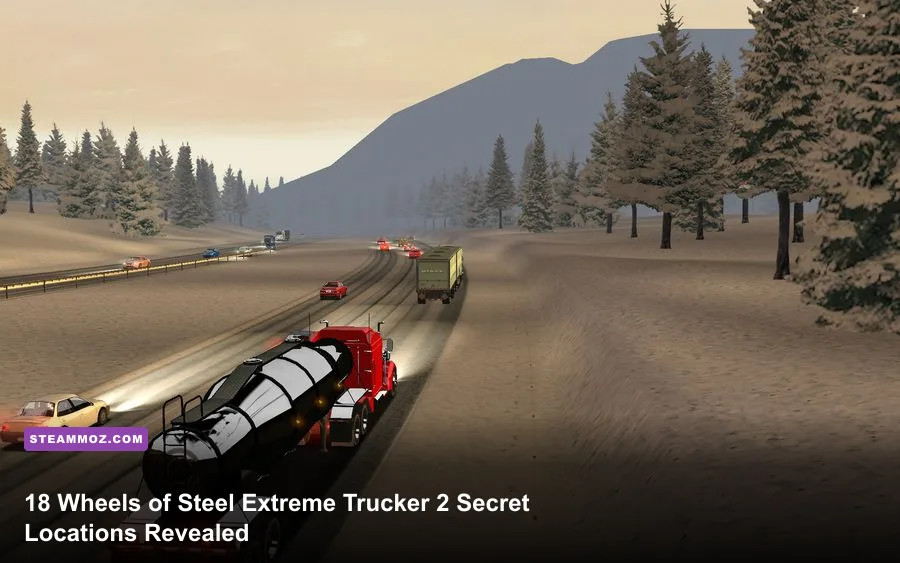
The short version: 18 Wheels of Steel: Extreme Trucker 2 does not contain a conventional collectible hunt with numbered secret tokens or hidden chests. Its “secret locations” are unadvertised road branches, remote loading areas, alternate delivery approaches, and map landmarks that can trigger extra jobs or reveal more profitable cargo opportunities. The reliable way to find them is to scout every junction in Australia, Bolivia, Canada, and Montana, accept the newly exposed contracts, and finish deliveries without damaging the cargo.
That distinction matters because many old guides call every unexplored branch a secret location, then promise a reward that the game never actually awards. Extreme Trucker 2’s hidden rewards are practical rather than flashy: additional freight listings, better-paying jobs, access to more difficult cargo categories, and progress toward regional completion. There is no secret truck waiting behind a gate, no cheat-code garage, and no universal achievement counter for visiting every dirt road.
How the game hides its rewards
Extreme Trucker 2 uses a job-and-route structure instead of the discovery systems found in newer truck simulators. You choose a region, select an available contract, and drive the assigned cargo to its destination. The map does not always advertise every usable road at first glance, while some loading and unloading points sit beyond the most obvious approach. A road that appears to be scenery can therefore become relevant once a contract sends you toward it.
The first important rule is simple: the reward is usually unlocked by completing the job, not merely by touching the location. Driving down a side road and turning around may reveal the terrain, but it does not necessarily add anything to your career. If a branch leads to a depot, mine, farm, construction site, or remote industrial yard, look for the contract that uses it and complete that contract cleanly.
Before hunting, create a manual save at the region-selection screen. The game is old, and route markers can be awkward when the camera is zoomed out. A save lets you test an unfamiliar turn without losing a high-value load. Also disable unnecessary speed if you are scouting: the fastest route is not always the route that exposes the destination trigger.
| Discovery type | What you actually receive | How to trigger it | Common mistake |
|---|---|---|---|
| Remote depot | New destination or freight listing | Reach the yard and complete its contract | Assuming the road is decorative |
| Alternate junction | Shorter or safer delivery approach | Explore before accepting a time-sensitive job | Following GPS blindly |
| Regional landmark | Usually no direct reward; confirms map coverage | Drive close enough for the route to register | Expecting cash or a hidden vehicle |
| Difficult cargo route | Access to tougher, higher-value contracts | Finish earlier jobs with low damage | Wrecking the load to save minutes |
For context, the game’s official listing and original documentation are more useful than fan-made “100 percent secret” videos that mix Extreme Trucker 2 with other 18 Wheels of Steel releases. Check the official Steam page for the supported release, and compare it with SCS Software’s game page before applying old fixes or save files.

🎮 18 Wheels of Steel: Extreme Trucker 2
Looking to experience this game? Grab your digital key directly on our store for $3.99.
View on Steammoz Store →Australia’s hidden outback branches
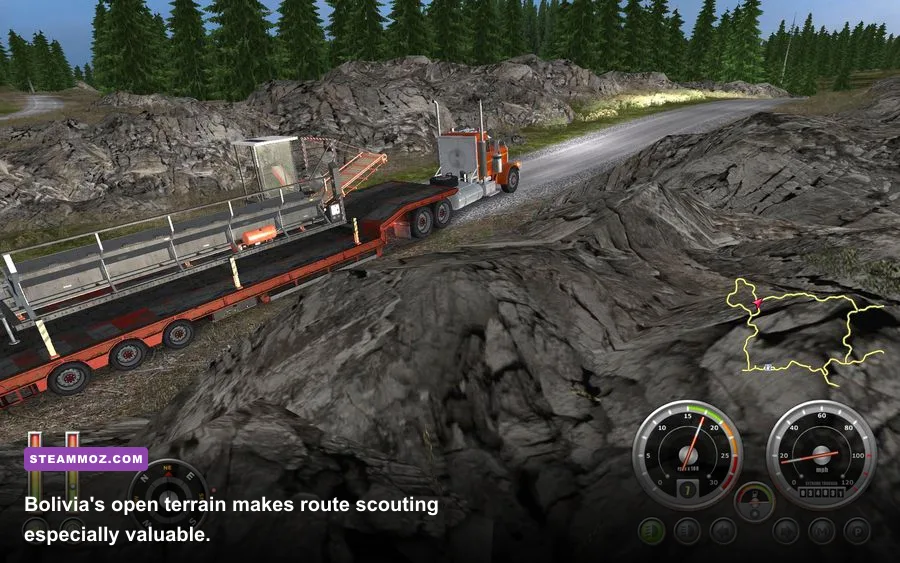
Australia is the easiest region in which to miss a useful location. Its wide dirt roads make every turn look interchangeable, and the horizon gives you very little visual help. The hidden content is concentrated around remote outback depots and the rough approaches used by oversized or fragile cargo. Don’t treat the first paved road as the only legitimate route.
1. Scout the long dirt-road split
When a main route divides into a maintained road and a narrower dirt branch, take the dirt branch during a low-pressure contract. These branches commonly lead toward isolated loading zones rather than a separate “secret area.” You are looking for a yard entrance, fuel point, or delivery marker that does not sit directly on the route line.
Use the external camera before committing. In the default chase view, a branch can disappear behind scrub or a low ridge. Slow to roughly walking pace at blind corners, because the game’s collision model is unforgiving around fences and parked equipment. If you find a depot, return to the job board after completing the current delivery; newly available work may not appear while you are still hauling.
2. Search around mine and quarry approaches
Australia’s heavier contracts tend to point toward industrial spaces. The visible road often ends at one gate while the actual loading trigger sits farther inside the yard. Follow the broadest tire-worn path, not the prettiest road. If the trailer refuses to connect at the first marker, straighten the truck, pull forward a few meters, and try again rather than abandoning the contract.
The hidden reward here is progression. Finishing these awkward jobs with minimal damage helps expose more demanding contracts. The game does not hand you a trophy, but the career board becomes noticeably richer after you prove you can handle rough access roads. This is also where a cautious driver earns more than an aggressive one: a damaged heavy load can erase the financial advantage of a higher-paying contract.
3. Don’t confuse scenery with a secret
Remote buildings, bridges, and long fenced compounds are visual landmarks, not guaranteed unlock points. If there is no usable entrance, loading marker, or contract destination, you cannot force a reward by circling the structure. Mark it mentally as a navigation reference and move on. The practical test is whether the location connects to a drivable road and whether the job board eventually names it as a destination.
Bolivia’s salt-flat detours and remote yards
Bolivia is less about hidden buildings and more about route interpretation. The open landscape makes the official line look optional, especially around salt-flat stretches and unpaved approaches. That freedom is useful, but it can also send a trailer across soft ground where turning becomes difficult. Explore Bolivia with an empty truck or a low-risk delivery first.
1. Check both sides of every broad junction
At a wide split, the GPS may favor the direct road while the other branch bends toward a remote worksite. Follow the unused branch until it either reconnects or reaches a clearly modeled yard. If it ends at a dead visual landmark, record it as scenery. If it contains a gate, loading pad, or signposted entrance, return after the next contract refresh.
Bolivia’s hidden routes are especially valuable for learning the game’s trailer behavior. A road can look flat while the wheels sit at different heights, causing the trailer to swing when you correct the steering. Keep your speed low, avoid sharp throttle inputs, and begin wide turns earlier than you would on asphalt. The reward is not just finding a new contract; it is reaching the destination with the cargo intact.
2. Use the destination marker as a search radius
If a marker seems to stop short of a building, don’t assume the contract is broken. The trigger may be around the rear of the facility or at a side entrance. Pull past the first marker, inspect the yard with the external camera, then reverse in a straight line. Jackknifing repeatedly is the fastest way to turn an exploration run into a repair bill.
Players who enjoy route optimization should compare this method with the broader progression advice in Steamoz’s progression guide for Deponia; the systems are obviously different, but the same principle applies: test what the game actually rewards instead of trusting an assumed unlock list.
Canada’s ice roads and concealed approaches
Canada’s hidden locations are the most dangerous to scout because the road itself is an obstacle. Ice-road sections punish abrupt steering, and a shortcut that saves distance can cost the entire contract if the trailer slides wide. The safest approach is to search during a job with generous time, then repeat the route once you understand the surface.
1. Follow maintenance tracks, not open snow
Look for parallel tracks beside the principal ice road. Some are genuine access routes; others are merely visual traces. A real route normally maintains a consistent width, connects to a bridge or work compound, and supports the truck without immediately sinking or sliding away. If the surface drops you into an unrecoverable angle, reload rather than trying to brute-force the rig back onto the road.
2. Approach remote camps from the wide side
Work camps and industrial destinations often have one approach that is much easier for a long trailer. The GPS may point you toward the closest entrance, but that is not always the best entrance. Continue around the perimeter if the road allows it, then line up with the broadest turning area. This is a hidden tactical reward: you spend less time correcting the trailer and take less damage.
Keep steering inputs smooth. On ice, a correction made too late produces a larger correction in the opposite direction, which becomes a pendulum effect through the trailer. Feather the throttle, leave extra stopping distance, and avoid using the shoulder as a passing lane. The game’s traffic is limited, but the physics still punish impatience.
| Region | Best place to scout | Main hazard | Reward pattern |
|---|---|---|---|
| Australia | Dirt-road splits and mine approaches | Fences, dust, awkward yard entrances | Remote contracts and progression |
| Bolivia | Wide salt-flat junctions and isolated worksites | Soft ground and trailer swing | Alternate destinations and higher-risk jobs |
| Canada | Parallel ice tracks and camp perimeters | Sliding and poor stopping distance | Safer delivery approaches and difficult cargo access |
| Montana | Logging roads and mountain turnoffs | Hairpins, grades, tight clearances | Specialized freight opportunities |
Montana’s mountain roads and real hidden rewards
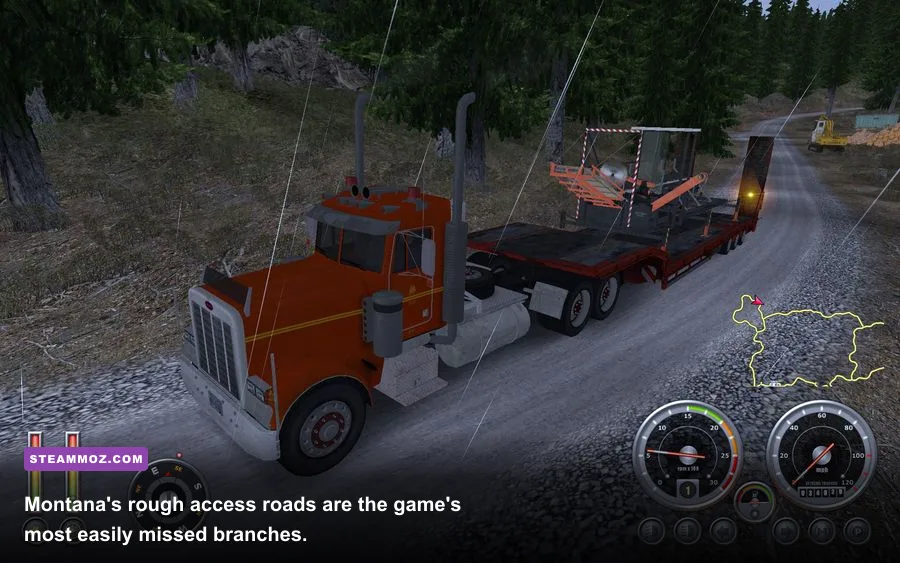
Montana has the most convincing “secret” roads in Extreme Trucker 2. Logging tracks, industrial spurs, and mountain turnoffs can look like ordinary scenery until a contract sends you toward them. The terrain also makes them memorable: steep grades expose weak braking habits, while hairpins punish drivers who enter too quickly.
1. Inspect every logging-road turnoff
Whenever a forest road branches away from the main highway, drive it far enough to identify its purpose. A usable logging route usually has a broad entrance, tire marks, and enough room for a heavy vehicle to turn. If it leads to a loading pad, you have found a meaningful branch. Return to the job board after delivery and look for timber, machinery, or oversized freight tied to that area.
2. Treat downhill sections as the actual challenge
The discovery is only half the job. On a mountain delivery, brake before the hairpin rather than halfway through it. Enter wide, keep the trailer inside the road edge, and accelerate only after the cab is pointed toward the exit. If the truck begins to push straight ahead, steering harder will not solve the problem; reduce speed and let the tires regain control.
Montana’s better rewards are tied to reliability. There is no universal secret-cash bonus for touching a mountain spur, but repeated clean completions improve your access to the game’s more demanding jobs. That is why a route that appears inefficient can be worth learning. You are building a dependable delivery loop, not collecting a hidden object.
Unlock checklist and the fastest completion route
Use this checklist if you want to uncover every meaningful hidden branch without wasting hours on dead scenery.
- Start with a low-risk contract. Use it to learn the region’s junctions before taking fragile or oversized cargo.
- Save before scouting. Old physics and awkward collision points make experimentation unnecessarily expensive.
- Drive every plausible branch once. Continue until the road reconnects, reaches a yard, or clearly becomes non-drivable scenery.
- Record destinations, not landmarks. A building matters only if it has a usable entrance or appears in the contract flow.
- Return to the job board. New work is the real sign that your exploration mattered.
- Complete the route cleanly. Avoid damage, missed checkpoints, and reckless shortcuts; hidden progression follows successful deliveries.
- Repeat with specialized cargo. Some remote branches only become relevant when the contract requires a trailer capable of reaching them.
For a practical completion order, begin in Australia, where the roads are broadest and scouting is least punishing. Move to Bolivia once you understand trailer swing, then Canada after you are comfortable with low-grip surfaces. Leave Montana for last because its narrow grades combine nearly every mistake the game can punish. This order also gives you a natural difficulty curve instead of throwing a fragile load onto an unexplored ice road.
One final warning: do not download a save file advertised as “all secret locations unlocked” unless you know exactly which release it belongs to. Save formats can differ between retail, Steam, and compatibility installs, and a damaged profile can remove more progress than any hidden route is worth. If you want more old-school PC troubleshooting, Steamoz’s PC fixes guide and performance-focused specs guide offer useful general advice.
Extreme Trucker 2’s best secret is that it rewards truckers who read the road instead of the arrow. Australia hides worksite branches, Bolivia conceals useful routes in open terrain, Canada buries access roads beside the ice, and Montana tucks contracts behind mountain turnoffs. Visit the branches, refresh the job board, and finish the resulting deliveries without destroying the cargo. That is the complete hidden-reward loop—and it is far more reliable than hunting for a collectible that the game never included.
If you enjoy games where careful planning matters more than raw speed, Steamoz’s Dins’s Curse survival tips and Desperados III analysis are worth a look after you finish mapping every back road in Extreme Trucker 2.