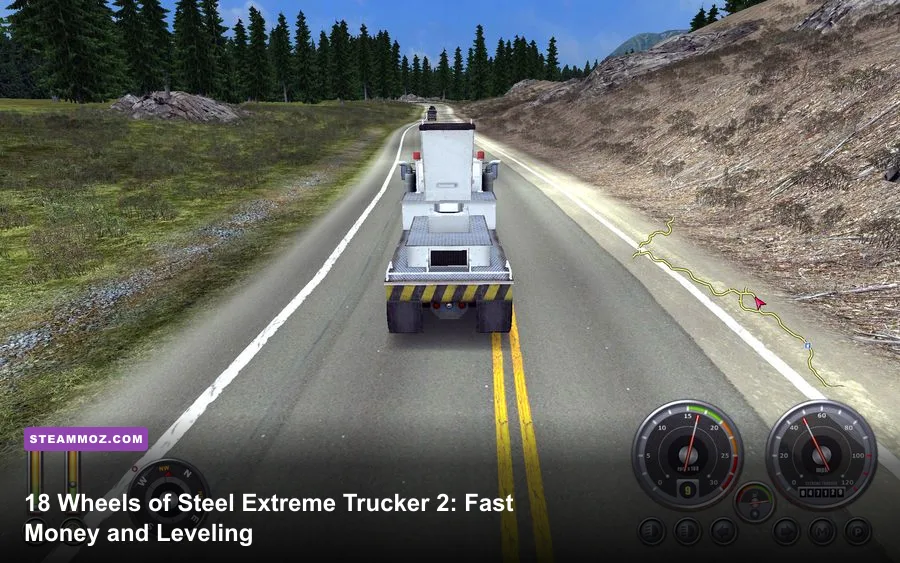
The fastest way to make money and advance in 18 Wheels of Steel: Extreme Trucker 2 is to chain short, low-risk deliveries in Montana, avoid damage and late penalties, then move into Bangladesh and Bolivia only after your truck and cash reserve can absorb mistakes. There is no modern RPG-style character level tree to grind here. Progression is driven by completed jobs, available routes, vehicle access and your balance, so the real leveling strategy is improving profit per minute rather than hunting an imaginary XP exploit.
That distinction matters. A huge contract looks exciting on the job board, but a long haul with a tight deadline, fragile cargo and difficult terrain can earn less per minute than two clean regional deliveries. Extreme Trucker 2 rewards consistency. Finish intact, arrive on time, keep fuel and repair costs under control, and your career accelerates naturally.
This guide focuses on legitimate fast leveling and gold farming: route selection, cargo risk, regional progression, driving technique, truck spending and the settings that make the old game easier to read. If you enjoy demanding classic simulations, Steamoz's Dungeon Siege retrospective has a similar appreciation for older PC design that expects players to learn systems instead of waiting for tutorials.
How progression really works
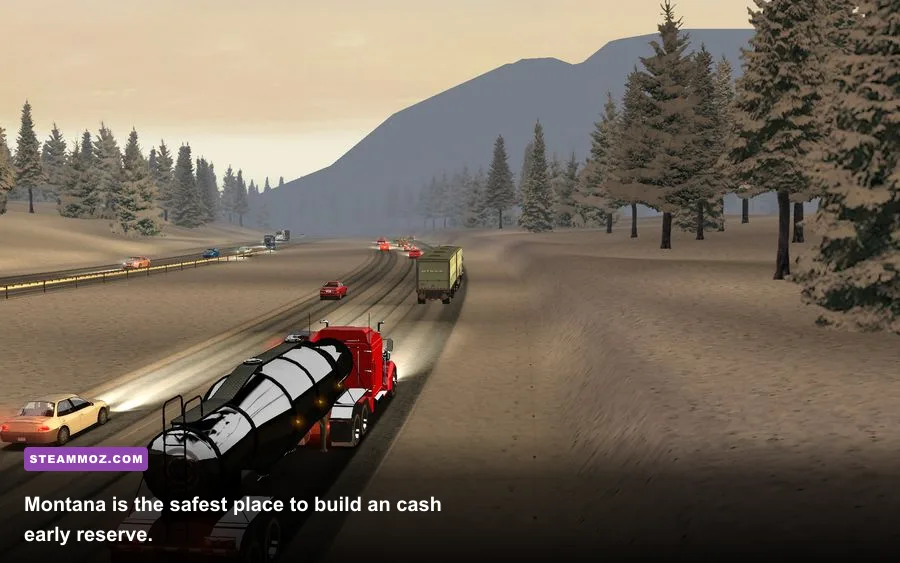
Extreme Trucker 2 does not present progression like a contemporary live-service game. You are not stacking character levels, assigning skill points or unlocking a combat build. Your career grows through the jobs you accept and the parts of the map you can successfully operate. The practical progression loop is simple: accept a contract, deliver the cargo, collect the payout, repair or refuel when necessary, and reinvest enough money to attempt better work.
That makes three numbers more important than any supposed leveling trick:
- Net payout: the contract reward after repairs, fuel and penalties.
- Completion time: how quickly you can repeat a profitable route without reckless driving.
- Failure exposure: the chance that damage, a missed deadline or a damaged load wipes out the advantage of a larger reward.
Use the job board as a filter, not a shopping list. A good early contract has a manageable distance, forgiving delivery timing and cargo that does not punish ordinary braking. A bad contract combines heavy weight, narrow mountain roads, heavy traffic and a deadline that forces speeding. The reward may be higher, but one collision can erase several successful runs.
| Progression target | What to prioritize | Why it works | Common mistake |
|---|---|---|---|
| Starting cash | Short Montana jobs | Low exposure and quick repeats | Taking the largest visible payout |
| Early expansion | Clean medium-distance contracts | Builds a repair and fuel reserve | Spending every dollar immediately |
| Advanced career | Bangladesh and Bolivia high-value work | Higher reward density | Ignoring terrain and traffic risk |
| Late-game farming | Routes you can complete without damage | Reliable net income per minute | Rerolling endlessly for a theoretical perfect job |

🎮 18 Wheels of Steel: Extreme Trucker 2
Looking to experience this game? Grab your digital key directly on our store for $3.99.
View on Steammoz Store →Montana is the best early gold farm
Start in Montana whenever the game gives you a choice. Its roads are generally easier to read than the congested Bangladesh routes, and the terrain is less punishing than Bolivia's mountain work. That makes Montana ideal for learning the game's turning radius, braking behavior and delivery timing while building a cash cushion.
For your first several jobs, favor cargo with a normal trailer profile and a generous delivery window. The goal is not to prove that you can thread a heavy rig through a dangerous shortcut. The goal is to complete a loop with minimal downtime. Check the route before accepting: if the destination requires a long backtrack, a difficult reverse or a mountain section that consistently causes damage, skip it even when the advertised reward is attractive.
A strong early routine looks like this:
- Open the available contracts and compare reward, distance and deadline instead of selecting the first job.
- Choose a route that keeps most of the drive on familiar, wide roads.
- Drive below the limit on blind bends and enter every town already prepared to brake.
- Deliver cleanly, then immediately compare the next contract before spending your earnings.
- Repeat until you have enough money for repairs, fuel and at least one failed experiment.
Do not turn the opening hours into a repair simulator. If a job repeatedly leaves you with a damaged trailer, it is not a farm route. A slightly smaller payout with zero repair cost is usually superior. Think in terms of net cash per completed minute, not the number printed on the contract.
The reset test
After three or four Montana deliveries, compare your results. If a route takes ten minutes and pays 4,000 but routinely costs 800 in damage and fuel, its effective return is 3,200. A safer eight-minute route paying 3,400 may be better because it gives you more completed contracts per hour and keeps the truck available. The exact figures vary with the contract and difficulty, but the calculation never changes.
When to move into Bangladesh and Bolivia
Bangladesh and Bolivia should be treated as profit tiers, not automatic upgrades. Bangladesh can produce excellent money, but dense traffic, narrow roads and unpredictable interactions make careless farming expensive. Bolivia is more open in places, yet mountain gradients, sharp bends and exposed roads amplify every bad decision. Move regions when you can afford a bad run without being forced back into desperate low-paying work.
A useful reserve is enough money to cover several repairs and a full restart of your current route plan. Do not empty the account on a truck purchase or upgrade immediately before entering a difficult region. Cash is performance here: it lets you abandon a bad contract, repair before the next delivery and test a new route without career panic.
| Region | Best use | Main danger | Farming approach |
|---|---|---|---|
| Montana | Early leveling and route practice | Long detours and complacent speeding | Chain short, clean deliveries |
| Bangladesh | Mid-career cash bursts | Traffic, tight spaces and sudden braking | Choose forgiving cargo and leave time |
| Bolivia | Advanced high-value hauling | Grades, bends and difficult recovery | Use conservative speeds and study the route |
In Bangladesh, treat traffic as a schedule problem. Leaving a little earlier is more valuable than trying to make up time at every junction. Keep extra room behind slower vehicles, because a chain reaction near a town can damage both truck and cargo. In Bolivia, momentum management is everything. Build speed before a climb when the road is clear, but never enter a bend fast enough that braking becomes your only option.
The best high-level farm is the hardest route you can complete repeatedly without damage. If Bolivia pays more but you crash once every three deliveries, return to a safer Bangladesh or Montana loop. Farming should be boring in the best possible way.
Truck spending that protects your profit
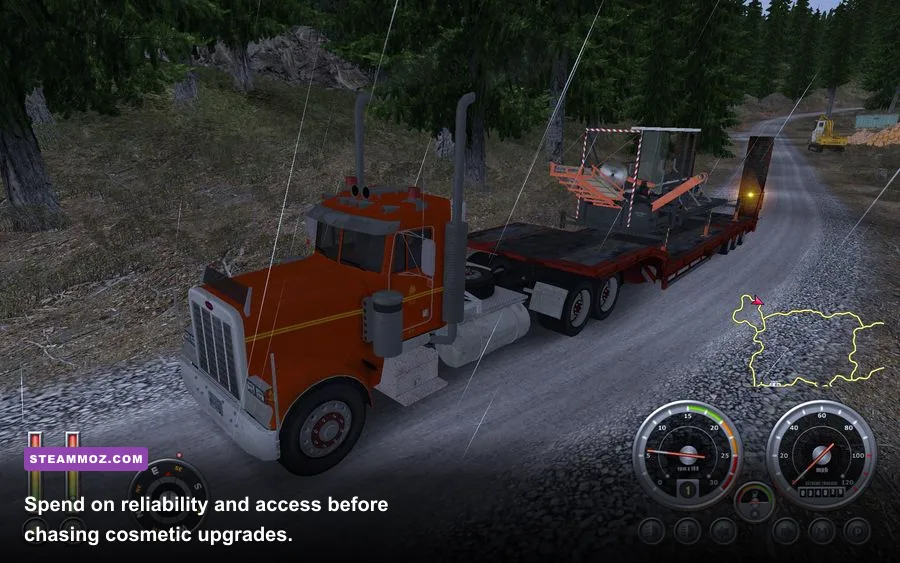
Money disappears fastest when players upgrade for excitement rather than efficiency. In a game this old, the exact available vehicle choices can depend on edition, profile and career state, so judge each purchase by what it changes on the road. A more powerful truck is useful when heavy cargo or gradients repeatedly slow you down; it is not automatically profitable if the job board still offers easy work.
Use this spending order:
- Repairs first: a damaged truck is a direct threat to the next contract.
- Fuel reserve second: never accept a long job with barely enough money to refill.
- Access and capability third: buy the vehicle or improvement that opens better-paying work.
- Comfort and cosmetics last: they do not improve net payout unless they change your driving efficiency.
| Purchase decision | Profit value | Buy when | Skip when |
|---|---|---|---|
| Repair | Very high | Before every serious contract | Never skip a major repair to fund cosmetics |
| Fuel | High | Before a remote or long delivery | When the next job is a short local run |
| More capable truck | High if route-limited | Heavy cargo or grades are costing time | You are still crashing on ordinary roads |
| Cosmetic upgrade | Low | After establishing a reserve | During early progression |
Power also has a hidden opportunity cost: it can encourage higher entry speeds. The faster truck does not fix late braking, poor lane position or reckless overtakes. Practice with the vehicle you already control before interpreting a purchase as a leveling solution.
Driving technique that turns clean runs into fast leveling
The fastest drivers in Extreme Trucker 2 are not constantly at maximum speed. They maintain momentum where the road is safe and spend less time stopped, damaged or recovering from a mistake. Brake before the corner, not halfway through it. Enter towns with your foot ready to slow down. On mountain roads, use a steady pace rather than alternating between full throttle and emergency braking.
Keep the trailer's swing in mind when turning. A tractor can clear an obstacle while the trailer clips it, especially at tight yards and urban corners. Take wider approaches, finish the turn before accelerating and avoid cutting across the opposing lane unless the road is completely clear. Reversing is slower than setting up the turn correctly, and every recovery wastes the time that makes a supposedly lucrative contract worthwhile.
Camera choice is personal, but consistency matters more than preference. Use the view that lets you judge trailer clearance and upcoming bends without constantly switching perspective. If the road feels unreadable, lower visual clutter and stabilize the frame rate. Classic truck games often feel worse when modern systems run them inconsistently, even if the frame counter looks high.
For more PC optimization context, compare Steamoz's ELEX crash and FPS fixes and its guide to running older PC games smoothly. They cover a different pair of games, but the core lesson applies: stable input and predictable performance beat flashy settings.
A practical route rhythm
Read the first section of road before accelerating hard. Settle into cruise speed on open highway, lift early for junctions, and leave enough margin that a slower vehicle does not force a panic maneuver. At delivery yards, slow down before the entrance rather than trying to make up seconds inside the lot. The clock rewards completed deliveries, not dramatic arrivals.
Settings and habits for reliable farming
Extreme Trucker 2 is lightweight by modern standards, so maximum graphics settings are rarely the real issue. Visibility and stable input are. Use a resolution your monitor displays cleanly, disable distracting effects if they make road edges harder to read, and cap or synchronize the frame rate if the game produces uneven motion. Test changes one at a time, because old engines can react unpredictably to compatibility modes and forced driver features.
| Setting or habit | Recommended approach | Performance impact | Gameplay benefit |
|---|---|---|---|
| Resolution | Native display resolution if stable | Moderate | Sharper signs and road edges |
| Anti-aliasing | Use the lowest clean option | Low to moderate | Less shimmer without excess overhead |
| Shadows and effects | Reduce first if motion feels uneven | Moderate | Clearer image during traffic scenes |
| Frame pacing | Use a stable cap or sync option | Usually low | More predictable steering and braking |
| Save discipline | Save before risky contracts where supported | None | Protects a profitable career streak |
Before changing files or installing community fixes, check the official Steam listing and the SCS Software website for the correct game version. Compatibility advice for another 18 Wheels of Steel release may not apply cleanly to Extreme Trucker 2. Keep backups of save files before experimenting.
The fastest repeatable money route
Here is the complete strategy in one loop. Begin in Montana and select the shortest clean contract with a respectable reward. Complete it without damage, refuel only when the next route demands it, and compare the next three available jobs. Repeat until your balance can cover multiple repairs. Move to Bangladesh for higher-value contracts, but reject jobs that combine tight traffic with an aggressive deadline. Once you can finish those runs consistently, test Bolivia's heavier mountain work.
Track three outcomes after every delivery: payout, expenses and minutes spent. If a job feels exciting but underperforms on that sheet, stop farming it. The winner is the route with the best stable average across five runs, not the single biggest jackpot. That method also reveals your personal weak point: if damage is the problem, slow down; if fuel is the problem, shorten your loops; if time is the problem, improve route familiarity before buying power.
For comparison, Steamoz's fast leveling and gold route guide and Empires of the Undergrowth farming guide use the same broad principle: repeat the content you can clear efficiently, then reinvest when the upgrade changes your income curve. In Extreme Trucker 2, that means clean deliveries, controlled risk and enough cash to keep moving.
The short version: farm Montana early, measure net cash per minute, save a repair reserve, enter Bangladesh cautiously, treat Bolivia as advanced work, and spend on capability rather than cosmetics. There is no magic leveling exploit. The closest thing to one is a route you can drive perfectly five times in a row.