
If Diluvian Winds hooked you with its flooded lighthouse, vulnerable animal communities, and calm-but-demanding resource loops, start with Against the Storm, The Wandering Village, and Timberborn. They capture the same satisfying rhythm of gathering, sheltering survivors, and solving environmental disasters, while Banished, Frostpunk, and Spiritfarer offer sharper or more emotional variations for 2026.
Diluvian Winds is unusually good at making a small settlement feel personal. You aren't painting a giant empire across a map; you're keeping a handful of people alive inside a lighthouse while storms, rising water, limited space, and shifting needs constantly squeeze your plans. That makes the best alternatives less about grand strategy and more about compact communities, readable systems, and consequences that arrive quickly.
Best Diluvian Winds alternatives ranked

The games below aren't interchangeable clones. Each one matches a different part of Diluvian Winds' appeal: weather pressure, cozy presentation, survival logistics, or the emotional weight of protecting a fragile group. My top recommendation for most players is Against the Storm, but The Wandering Village is the closest tonal match.
| Game | Best match for Diluvian Winds | Difficulty | Why play it in 2026 |
|---|---|---|---|
| Against the Storm | Short settlements and escalating weather | High | Exceptional replayability and deep production chains |
| The Wandering Village | Protecting a vulnerable moving community | Medium | Distinctive Onbu ecosystem and toxic-world survival |
| Timberborn | Water management and settlement engineering | Medium | Excellent districts, dams, and vertical construction |
| Banished | Small-town survival and careful stockpiling | High | Still one of the cleanest survival-city foundations |
| Frostpunk | Disaster pressure and hard social choices | Very high | Powerful scenarios with meaningful moral trade-offs |
| Spiritfarer | Cozy characters and bittersweet farewells | Low | The strongest narrative companion to Diluvian Winds |
My quick recommendation
Choose Against the Storm if you want systems that constantly push back. Choose The Wandering Village if your favorite part of Diluvian Winds is caring for a living community. Pick Timberborn if the flood itself made you want to design better water infrastructure. For a gentler, story-led experience, Spiritfarer is the obvious detour.

🎮 Diluvian Winds
Looking to experience this game? Grab your digital key directly on our store for $5.39.
View on Steammoz Store →Against the Storm is the strongest strategy upgrade
Against the Storm takes the settlement scale of Diluvian Winds and turns every expedition into a pressure cooker. You build a town for the Queen, survive hostile weather in the Blightstorm, and eventually abandon the settlement to start again elsewhere. That reset sounds harsh, but it is the game's secret weapon: a failed town teaches you something without deleting your entire campaign.
The core loop is built around Resolve, Hostility, and Queen's Impatience. Resolve is not a decorative happiness bar. If a species' Resolve drops below its breaking point, villagers leave; if you can push it high enough, they generate reputation. Reputation fills the victory bar, while Queen's Impatience steadily reduces the time available to finish. Hostility rises from population, years, and nearby dangerous events, so uncontrolled expansion can actively make a town worse.
Species also change how you plan. Beavers prefer comfort and luxury goods, Lizards respond better to jerky and warm service buildings, Humans value housing and biscuits, Harpies are fragile but excellent in production chains, and Foxes thrive around water and specialized infrastructure. The best early move is rarely to build everything. Establish a crude shelter, secure fuel for the Hearth, then target one Resolve-producing chain your current species can actually support.
Against the Storm is much less cozy than Diluvian Winds, but its production chains are more legible and its replay value is dramatically higher. The official Steam page is worth checking if you want to see how frequently the game has evolved through updates. Players who enjoy deliberate progression should also read Steamoz's Dins Curse town-saving tips for another take on survival-town decision making.
The Wandering Village nails the cozy disaster fantasy

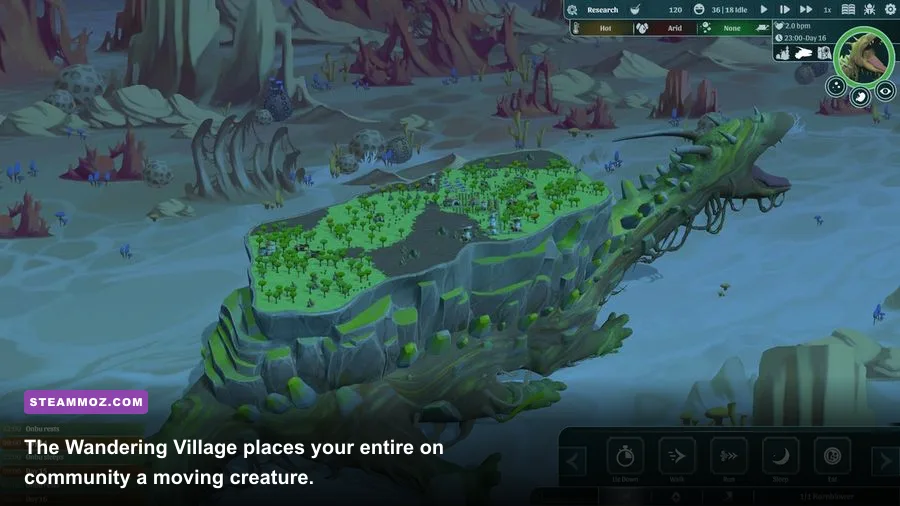
The Wandering Village is the closest recommendation if what you love about Diluvian Winds is the sight of a small group trying to stay kind in an unsafe world. Your settlement grows on the back of Onbu, a gigantic creature crossing a poisonous landscape. You manage villagers, farms, housing, research, and Onbu's health while deciding whether your traveling home should enter a toxic biome or take the safer, slower route.
Onbu is both transport and dependent. You must feed it through an Onbu Feeding Centre, earn its trust, and eventually issue commands such as resting or changing direction. Ignore its hunger or repeatedly harvest from its body and trust falls. At low trust, Onbu may refuse your instructions, which can send the settlement directly toward a toxic cloud or dangerous weather system. That relationship gives every logistical choice a surprisingly personal edge.
The village's major challenge is balancing normal food with Onbu food. Farms need fertile plots and clean water, while scavenging and research unlock stronger ways to survive poison. My reliable opening is to secure a Woodworker, build basic housing, establish a Compost Heap, and avoid overbuilding decorative structures until food production is stable. Researching too quickly can be a trap: each new system adds labor demands, and a settlement with ten impressive buildings but no spare workers collapses fast.
The game's Steam listing for The Wandering Village shows the premise, but the real appeal is the pace. It gives you time to read the situation, then punishes neglect rather than demanding frantic clicks. That makes it a superb follow-up for players who find Frostpunk too bleak but Diluvian Winds slightly too small in scope.
| Game | Main pressure | First priority | Common beginner mistake |
|---|---|---|---|
| Against the Storm | Hostility and Resolve | Fuel, shelter, and one reputation route | Expanding before the Hearth is secure |
| The Wandering Village | Poison, food, and Onbu trust | Stable food plus Onbu feeding | Researching systems without spare workers |
| Timberborn | Drought cycles and water flow | Reservoirs and controlled irrigation | Building farms before measuring water capacity |
| Banished | Winter shortages | Firewood, houses, and food stockpiles | Growing population faster than production |
Timberborn turns water into a building puzzle
Timberborn is the pick for players who want Diluvian Winds' flood theme with far more engineering. Its beaver colonies live through repeating wet and dry seasons, and water is not just a resource: it is terrain, irrigation, power, transport, and a weapon against drought. A dam in the wrong place can flood your district; a reservoir that's too shallow can leave farms dead before the next wet season arrives.
The two major factions play differently. Folktails lean toward natural food, wind power, and flexible farming, while Iron Teeth favor industrial infrastructure, engines, and a more aggressive approach to production. Both need a reliable water network, but the exact priority changes. Early on, build a simple dam and a water pump, then use levees to keep fertile ground wet. Don't place every farm at the lowest point just because it looks convenient; drought management depends on controlled channels and storage depth.
Timberborn's district system is the major learning curve. A district can only function if workers can reach jobs, haulers can move goods, and housing remains connected to the active settlement. Later, you can use District Gates and separate production zones, but splitting too early creates isolated colonies that lack builders and food. The game's official Timberborn Steam page is a good starting point for its current faction and update structure.
Compared with Diluvian Winds, Timberborn is less about individual survivor stories and more about solving a physical system. The payoff is enormous when a canal you designed several seasons earlier keeps an entire district alive.
Banished and Frostpunk are the hard-mode choices

Banished is the purist's option. There are no dramatic character arcs and no forgiving tutorial layer. You assign citizens to roles such as Gatherer, Forester, Hunter, Fisherman, Blacksmith, and Teacher, then watch the supply chain. Food must cover winter, firewood must cover homes, tools must keep labor productive, and housing must expand without creating a population boom you can't feed.
The cleanest Banished opening is deliberately boring: build a few houses, a Gatherer's Hut, a Forester Lodge, a Stock Pile, and a Woodcutter. Keep enough adults available for builders and laborers. A school improves future workers but costs a citizen immediately, so placing it too soon can damage the first winter. Banished is excellent if Diluvian Winds' limited-space decisions are your favorite part, but its interface and mod ecosystem feel much older than the other recommendations.
Frostpunk is what happens when the weather becomes the villain and the settlement becomes a moral argument. Your generator has multiple heat levels and range settings, while coal consumption rises sharply when you heat more buildings. The Book of Laws lets you solve immediate crises with choices such as Emergency Shift, Extended Shift, Child Labour, or radical purpose and order policies.
Track Hope and Discontent as carefully as coal. A city can have enough food and still lose because people believe you have failed them. Steam Hubs, medical posts, and resource depots need to be placed around heat zones rather than scattered for visual balance. If you like brutally clear consequences, our Dragonkin performance settings guide is another useful read before tackling demanding survival systems.
Spiritfarer is the emotional alternative

Spiritfarer shares Diluvian Winds' strongest hidden quality: the settlement feels meaningful because the people inside it matter. You play Stella, ferrying spirits toward the Everdoor while expanding and managing a boat. Each passenger has a personal questline, a unique building, favorite foods, dislikes, and a final farewell. The result is not a survival simulation, but it scratches the same itch of building a safe temporary home for vulnerable characters.
Gwen's Lodge, Atul's Workshop, Alice's Cottage, and the other spirit buildings are not interchangeable upgrades. They unlock quest steps, minigames, recipes, and emotional context. Cooking favorite meals improves relationships, while collecting materials through fishing, mining, gardening, and platforming keeps the boat moving forward. The game is gentler than Diluvian Winds and has no true failure state, but that softness is exactly why it works as a companion game.
Try Spiritfarer if you care more about companionship than optimization. Try Banished if you want every stockpile to matter. Try Frostpunk if you want your weather systems to bite. For the best overall match in 2026, though, Against the Storm remains the winner: its short settlement runs, layered production chains, and escalating storms turn the same small-community fantasy into a far deeper strategy game.
Before starting, decide which part of Diluvian Winds you actually want more of. The Spiritfarer Farewell Edition is ideal for story-first players, while Against the Storm is the long-term choice for builders who want endless strategic problems. If you prefer games with stronger character progression, Steamoz's Dungeon Siege retrospective offers a very different but worthwhile survival-adjacent detour, and the Desperados III review is a reminder that compact, carefully designed scenarios can still beat bloated open worlds.