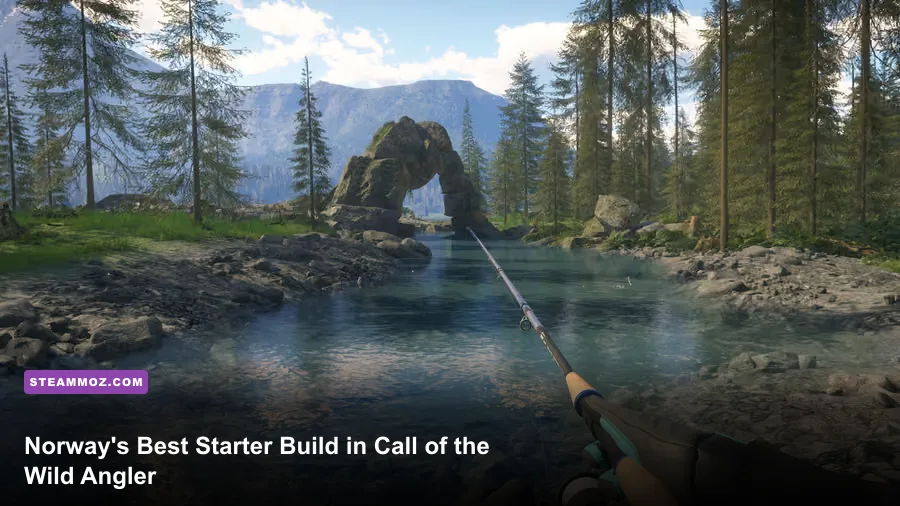
The best beginner build for Call of the Wild: The Angler’s Norway Reserve is a medium spinning setup with the default balanced rod, a matching medium reel, 8–10 lb monofilament line, and a small spinner or spoon. Start with brown trout and Arctic char in streams, switch to a medium spoon for pike and zander, and only chase Atlantic salmon after upgrading your line and reel. This setup is forgiving, cheap to maintain, and versatile enough to cover nearly every early Norway objective without filling your tackle box with specialist gear.
Norway punishes the classic beginner mistake: building for the biggest fish immediately. Heavy tackle makes small trout feel lifeless, while an ultralight outfit leaves you vulnerable when a pike takes the lure and sprints toward structure. The smart route is a middle-weight build, deliberate lure progression, and skill points spent on control rather than flashy long-distance casting.
The Norway Starter Build That Actually Works

Your opening loadout should be built around one idea: keep the rod, reel, and line in the same practical weight class. The game’s tackle system rewards balanced equipment. A rod with a sensible lure range gives you useful casting control, the reel provides enough drag and retrieval speed for repeated fights, and the line prevents an avoidable break when a larger fish changes direction.
Use the starting spinning rod and pair it with the starting spinning reel until the shop offers a clear upgrade in line capacity, drag, or retrieval speed. Don’t replace equipment simply because a new item has a higher headline rating. For Norway, a modest improvement to line strength is usually more valuable than a small casting-distance increase.
| Build Slot | Beginner Recommendation | Why It Works in Norway | Upgrade Trigger |
|---|---|---|---|
| Rod | Balanced medium spinning rod | Handles trout lures while retaining enough power for pike | Replace when a rod offers a clearly higher lure range or strength |
| Reel | Matching medium spinning reel | Reliable retrieve and enough drag control for river fish | Upgrade when salmon repeatedly empty the spool |
| Line | 8–10 lb monofilament | Forgiving during sudden runs and easy for new players to manage | Move toward 12–15 lb for regular pike and salmon attempts |
| Primary Lure | Small spinner | Simple retrieve, visible flash, and strong trout coverage | Keep it permanently; add a spoon rather than abandoning it |
| Secondary Lure | Medium spoon | Reaches deeper water and presents a larger target to pike | Use heavier options only after the reel and line improve |
Mono is the right first line even if another line type appears more attractive on paper. Its stretch softens rushed hooksets and protects you when a fish turns near the bank. That matters because Norway’s shorelines are cluttered with rocks, reeds, and steep drop-offs. The best beginner build isn’t the one with the highest theoretical power; it’s the one that forgives a late reaction.
Carry at least three lure sizes: a small spinner for brown trout and Arctic char, a medium spoon for pike and zander, and a heavier option reserved for deeper water or salmon. The exact colour matters less than depth, speed, and whether the lure matches the fish’s strike zone. If you’re still learning the map, start with silver or natural metallic finishes because they remain readable in clear Scandinavian water.
🎮 Call of the Wild: The Angler - Norway Reserve
Looking to experience this game? Grab your digital key directly on our store for $3.99.
View on Steammoz Store →What to Fish First and What to Ignore
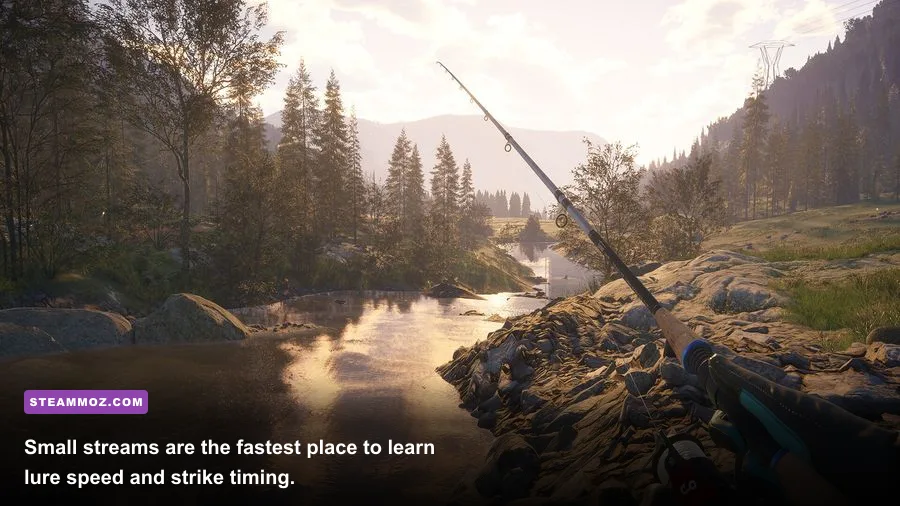
Norway’s species are not equally useful during the opening hours. Brown trout and Arctic char should be your first targets because they teach the core loop without demanding perfect tackle. They often respond to a controlled retrieve near current seams, shallow shelves, and the edges of deeper pools. You’ll also earn experience quickly by landing several smaller fish instead of spending ten minutes wrestling one oversized target.
Use a small spinner with a steady retrieve, then vary the pace in short bursts. A reliable pattern is two seconds of normal retrieval followed by a brief slowdown. The pause gives the lure time to drop and often creates the visual change that triggers a following trout. If the fish follows but refuses to strike, don’t immediately swap locations. Change speed first, then alter your casting angle so the lure crosses the current instead of moving straight with it.
Northern pike should be your second milestone. They are excellent for testing whether your line, drag, and stamina management are working together. Move to the medium spoon and fish the margins of weed beds, reed lines, and darker water beside shallow flats. Pike frequently punish a fast, panicked retrieve. Let the spoon fall briefly, retrieve it smoothly, and avoid lifting the rod aggressively when the fish is still far away.
| Target | Starting Lure | Where to Look | Beginner Fight Plan |
|---|---|---|---|
| Brown Trout | Small spinner | Current seams, stream pools, shallow shelves | Steady retrieve with short pauses; keep pressure moderate |
| Arctic Char | Small spinner or light spoon | Cold clear water and deeper stream edges | Slow the lure and allow a controlled drop |
| Northern Pike | Medium spoon | Reeds, weeds, drop-offs, lake margins | Maintain side pressure and avoid a frantic rod lift |
| Zander | Medium spoon | Deep edges and dimmer water | Count the lure down before a slow retrieve |
| Atlantic Salmon | Heavier spoon after upgrade | Strong river runs and deeper channels | Keep the fish away from rocks; let the drag work |
Zander are worth pursuing once you understand depth. They are a poor first target because random surface casting rarely puts your lure in front of them. Cast beyond the drop-off, let the lure sink, and begin the retrieve only after it reaches the level where fish are holding. Norway’s water clarity makes this especially important: the lure can look perfect and still be several metres above the strike zone.
Leave Atlantic salmon alone until you have a stronger line and a reel with dependable drag. Salmon are the first fish in this reserve that can expose a poorly balanced build. They make long runs, change direction sharply, and turn a fight near structure into a line-breaking disaster. Catching one early is possible, but it’s inefficient. Build confidence and cash on trout and pike first.
Skill Points and Upgrade Order for Beginners

Spend early progression points on skills that improve consistency: casting control, lure handling, line management, and fish-fighting stability. The names and availability of individual skills can vary with updates and progression, so read each tooltip rather than blindly copying a fixed order. Prioritise any skill that improves lure presentation or reduces mistakes during a fight. A small mechanical advantage used on every cast beats a niche bonus that only matters for one species.
Your first spending plan should follow this order. First, improve the part of the skill tree that makes casting and retrieval easier. Second, invest in fish control or line durability. Third, take a bonus that improves rewards, experience, or tackle efficiency. Only then should you chase specialist bonuses for a particular lure family or species.
| Priority | Skill Type | Reason | When to Take It |
|---|---|---|---|
| S-Tier | Casting and lure-control skills | Improves every cast and makes depth changes easier to learn | First available points |
| S-Tier | Fight stability, drag, or line-management bonuses | Prevents avoidable breaks against pike and salmon | Immediately after basic casting help |
| A-Tier | Experience or reward bonuses | Speeds the next reel and line upgrades | Once your core handling feels reliable |
| A-Tier | Species or lure-specific bonuses | Strong when farming one target, weaker while exploring | After choosing a main fishing route |
| B-Tier | Pure distance or niche convenience bonuses | Extra range cannot fix the wrong depth or poor positioning | Late game or for a specialised loadout |
Don’t interpret “cast farther” as “catch more fish.” Norway’s best early spots are often close to shore. A short cast that lands beside a current seam is better than a maximum cast that sends your lure beyond the productive water. Use skill points to make accurate casts repeatable, then develop distance naturally as you learn the reserve.
For progression, replace the line before the rod unless the rod is obviously underpowered for your lure. The line is your direct safety margin. Next, improve the reel’s drag and capacity. Upgrade the rod last, choosing a model whose lure range covers both your small spinner and medium spoon. This keeps one outfit useful while you save for a dedicated heavy setup.
How to Fight Norway’s Bigger Fish Without Snapping Line
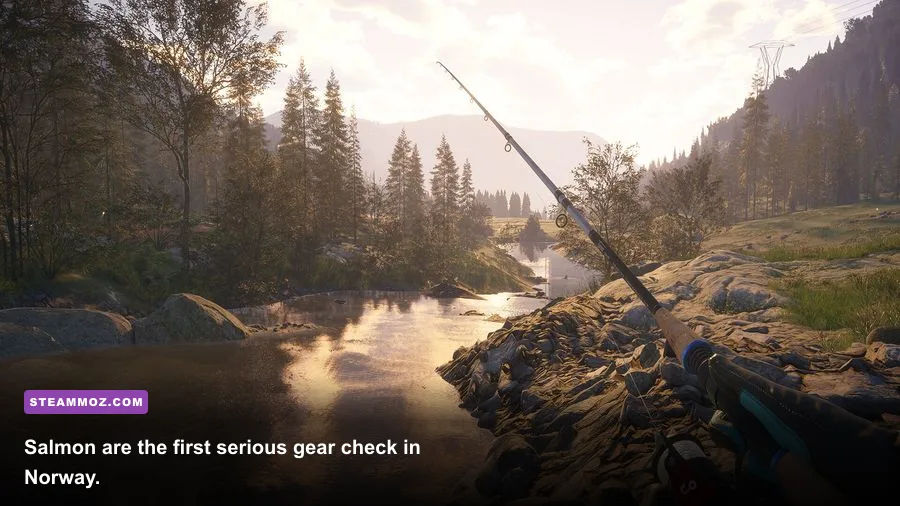
The fight begins before the hookset. Keep the rod angle controlled, maintain tension, and watch the fish’s direction rather than staring only at the tension indicator. When a fish runs away, lower your aggression and let the reel absorb the movement. When it turns toward you, retrieve quickly enough to prevent slack. Slack is the real beginner killer: it gives the fish room to shake free and makes the next direction change harder to read.
Against pike, use side pressure. Aim the rod away from nearby reeds or rocks and guide the fish into open water. Don’t hold maximum pressure continuously; steady pressure is safer than frantic corrections. If the fish changes direction, follow the movement with the rod while keeping the line tight. Near the bank, reduce pressure and let the fish tire rather than forcing an immediate landing.
Salmon require patience. Their long runs can make a modest fish look enormous on the tension meter. Keep the drag working, avoid repeated hard lifts, and use the open side of the river as your fighting lane. If the fish heads toward a rock, the correct response is controlled lateral pressure, not simply increasing force. Move your position when possible. In Norway, footwork is part of the build.
| Fight Moment | Main Danger | Correct Response | Bad Habit to Avoid |
|---|---|---|---|
| Initial strike | Overreacting and tearing the hook free | Set tension smoothly and begin controlled retrieval | Instantly holding maximum rod pressure |
| Fish runs away | Line overload or empty spool | Reduce pressure, monitor capacity, let drag work | Trying to stop the run immediately |
| Fish turns toward you | Slack line | Retrieve faster while keeping the rod loaded | Waiting for the fish to slow down |
| Fish reaches structure | Rock or vegetation cutting the line | Apply side pressure and reposition on shore | Pulling straight upward |
| Landing range | Last-second surge | Ease pressure and secure the fish only when stable | Forcing the final metres |
Take screenshots of the tension and line-capacity indicators if you’re still learning them. The interface communicates more than the fish animation does. A fish that appears calm can still be loading the line, while a dramatic splash doesn’t always mean an immediate emergency. Learn to separate visual noise from actual danger.
Norway Settings, Routes, and Money-Saving Habits
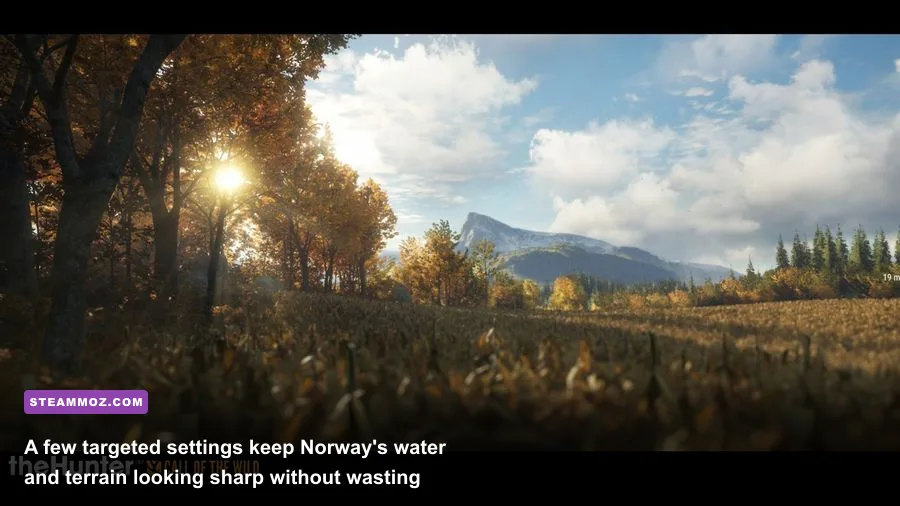
Norway’s scenery is demanding, especially around water reflections, foliage, volumetric effects, and long fjord views. If performance dips while you’re tracking a fish, the problem isn’t cosmetic anymore: inconsistent frame pacing makes lure movement and tension changes harder to read. Use the in-game benchmark or a repeatable overlook before changing settings, and prioritise a stable frame rate over maximum reflections.
| Setting | Recommended Starting Value | FPS Impact | Visual Trade-Off |
|---|---|---|---|
| Resolution | Native monitor resolution | High if reduced | Keep native unless you need a major performance recovery |
| Upscaling | Quality mode | Medium benefit | Usually preserves water detail better than Performance mode |
| Shadows | Medium | Medium to high | Good savings with limited impact on fishing readability |
| Foliage | Medium | Medium | Reduces distant vegetation density around banks |
| Reflections | Medium | High | Water can lose some shimmer, but gameplay remains clear |
| Motion Blur | Off | Minimal | Sharper lure, fish, and shoreline movement |
For money, avoid buying every lure colour and every rod class. Keep the small spinner, add one medium spoon, and improve the outfit’s weakest component. Sell or ignore redundant tackle until you know whether you prefer trout streams, pike lakes, or salmon rivers. A compact box also makes it easier to change setups quickly when a mission changes species.
Use Norway’s missions as a route planner rather than rushing across the map. Complete nearby objectives while fishing the same water type, and take advantage of fast travel only after you have exhausted the productive shoreline. Exploration rewards are useful, but a beginner with a balanced build gains more from ten clean trout fights than from repeatedly driving to a distant icon with no lure plan.
Before heading out, check the game’s official Steam page for current updates and reserve information. The official Call of the Wild: The Angler site is also worth checking when equipment names or balance details change. For PC troubleshooting, Steamoz’s guide to max-FPS settings offers useful general habits, while its crash and performance fixes cover the same driver and frame-pacing checks that help here.
The short version is simple: use a medium spinning outfit, fish small spinners for trout and char, bring a medium spoon for pike and zander, and upgrade line and reel before chasing salmon. Spend skills on control and reliability, not vanity distance. Once that setup feels routine, Norway stops being a gear check and becomes what it should be—a brilliant fishing playground where smart positioning beats expensive tackle.