
Fly Corp becomes much easier once you stop treating every unlocked city as an invitation to build a route. The winning approach is to create a compact, profitable network first, connect passengers through deliberate hubs, and spend research points on the bottleneck that is actually slowing you down. These 10 Fly Corp tips will help new players survive the opening, avoid airport overload, expand across borders safely, and turn a fragile airline into a reliable global system.
1. Pick a forgiving starting country
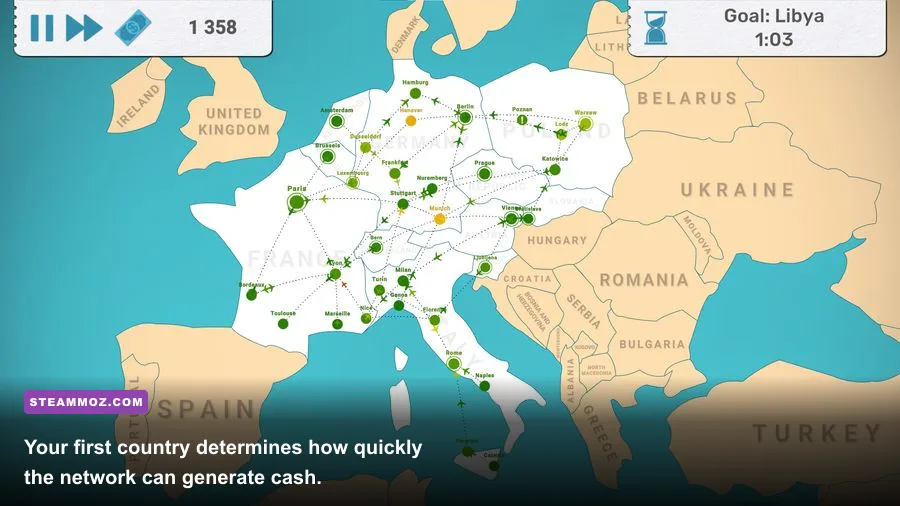
Your first decision has more impact than it looks. A country with several nearby cities gives you short routes, frequent passenger demand, and enough room to learn the interface before long-haul costs begin eating your budget. Europe is generally friendlier than a huge, sparsely populated country because cities are close together and international connections become useful quickly. Russia, Canada, and Australia can work, but their distances punish sloppy route planning from the opening minutes.
Begin with the capital or the largest available city, then connect only two or three nearby destinations. Watch the passenger counters before adding another line. If your starting airport is already filling quickly, upgrading capacity is usually smarter than opening a fourth route. The game rewards movement, not map coverage: an airport that handles a steady flow of passengers is more valuable than an impressive-looking web of empty connections.
Keep the initial network cheap. Short flights cost less to establish and let you learn how demand behaves. Your first objective is not to unlock half a continent; it is to build a cash cushion large enough to survive an unexpected airport unlock or a sudden demand spike.
| Starting Situation | Best Opening | Main Risk |
|---|---|---|
| Dense region with nearby cities | Capital hub plus two short routes | Adding too many destinations too quickly |
| Large country with distant cities | Regional mini-hub near the capital | Long routes draining early cash |
| Small country with few cities | Connect outward after stabilizing locally | Depending on one airport for all demand |

🎮 Fly Corp
Looking to experience this game? Grab your digital key directly on our store for $10.49.
View on Steammoz Store →2. Build a hub-and-spoke network
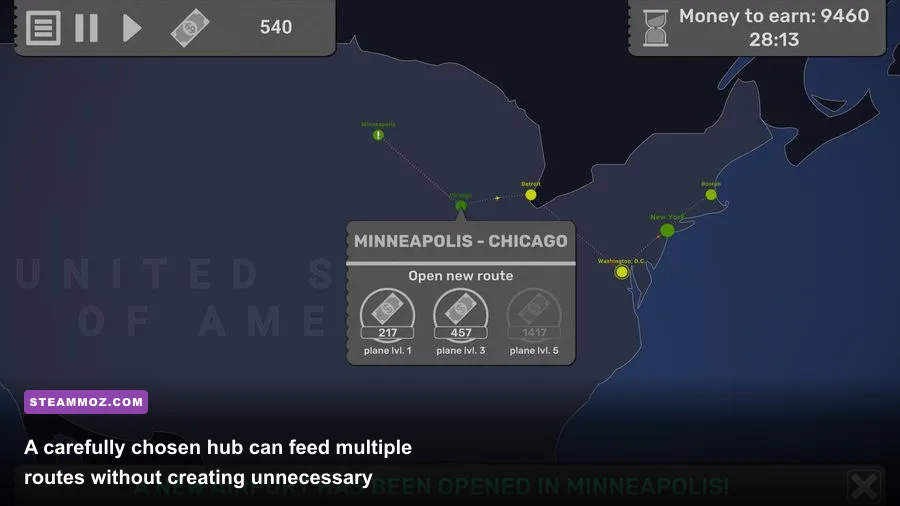
Fly Corp's most important strategic idea is the hub-and-spoke network. A hub is an airport where several routes meet; the spokes are the direct connections branching from it. This structure gives passengers more possible destinations without requiring a direct route between every pair of cities. If City A, City B, and City C all connect to one central airport, passengers can often transfer through that airport instead of demanding three separate routes.
Don't turn every airport into a hub. A hub needs enough passenger volume to justify the extra connections and enough capacity to absorb transfers. One overloaded central airport can ruin an otherwise profitable network because delays and queues spread along every route touching it. Start with one primary hub and, once the region grows, add a secondary hub rather than forcing every new destination through the original.
Place hubs where geography and demand agree. A central location with several nearby cities is usually better than the largest city on the map if that largest city sits at the edge of your network. For cross-border expansion, connect the new region to the closest established hub first. That creates a controlled entry point and makes it easier to see whether the new territory deserves its own local hub.
There is also a practical interface benefit. A structured network is easier to diagnose. When passengers pile up, you can inspect the hub, identify the overloaded spoke, and upgrade one piece. A tangled direct-route network gives you no obvious place to start.
3. Watch passenger queues before your wallet
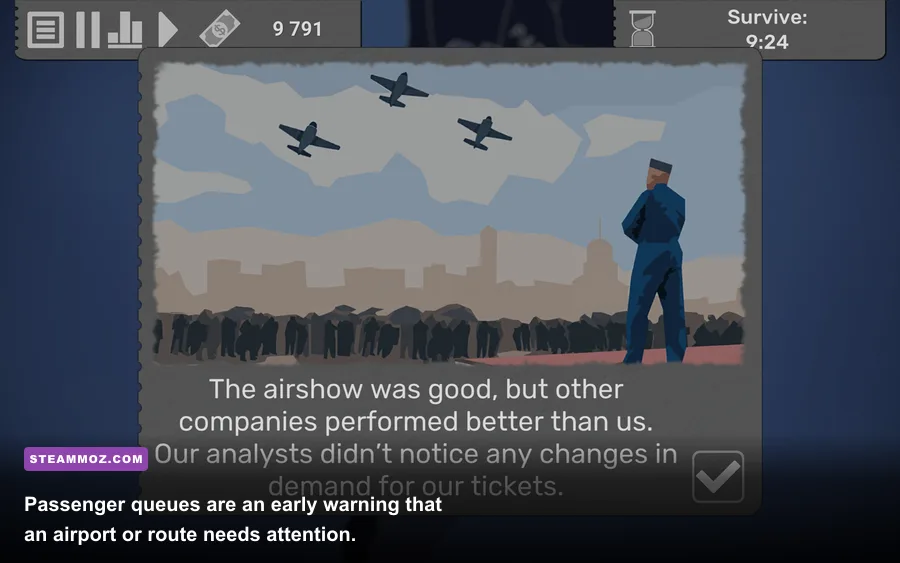
Money is the scoreboard, but passenger queues are the warning system. A route can look profitable while quietly creating a backlog at one end. Open the airport and route information regularly, especially after unlocking a new city or connecting a new country. Rising queues mean demand is outpacing the route's available service, and the problem tends to compound as more passengers use the same connection.
When a queue grows, check the entire chain rather than buying capacity blindly. A passenger may be waiting because the first flight is full, because a transfer hub is saturated, or because the destination route has too little service. Upgrading the wrong airport fixes the symptom for a few seconds and wastes cash. Trace the passenger's path and find the narrowest link.
Use a simple priority order. First, improve a route that is consistently full and feeding a profitable destination. Second, increase capacity at a hub that is backing up several routes. Third, add a parallel connection when one route has become strategically essential. The third option costs more, but redundancy protects the network when a single connection becomes overloaded.
| Warning Sign | Likely Cause | Best Response | Avoid |
|---|---|---|---|
| Queue at one destination | Route capacity is too low | Upgrade or duplicate that route | Opening an unrelated city |
| Several queues at one hub | Hub capacity bottleneck | Upgrade the hub first | Adding more spokes immediately |
| Queues across a region | Weak aircraft or insufficient network capacity | Research the relevant upgrade | Expanding globally |
| Passengers vanish from a route | Demand shifted or connection is inefficient | Recheck route profitability | Assuming every route stays useful |
4. Spend research points on bottlenecks
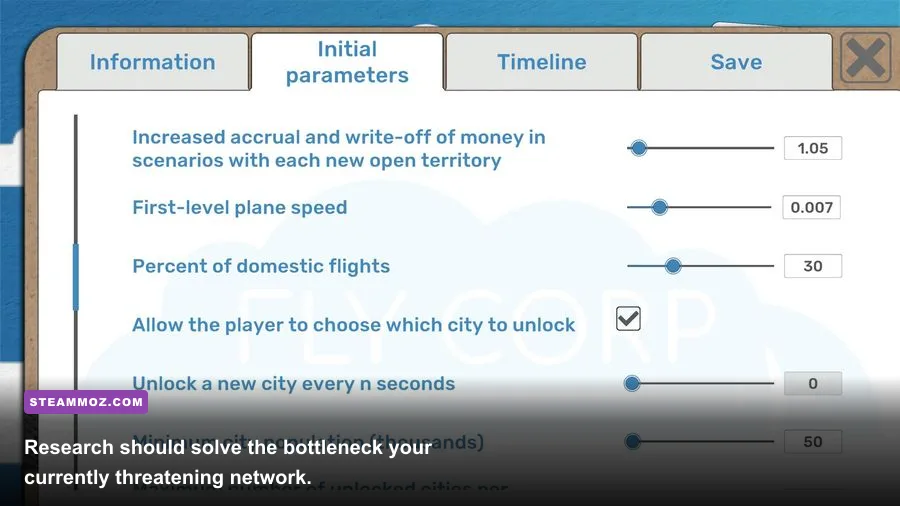
Research is where many new players lose momentum. The tempting choice is to buy the most exciting upgrade as soon as it appears, but Fly Corp rewards targeted spending. Look at the problem your network is experiencing, then choose the upgrade that directly addresses it. If short routes are packed, capacity or airport improvements matter more than a long-range option you cannot yet use efficiently.
Aircraft upgrades are strongest when your existing routes are already busy. Faster or more capable aircraft can increase the useful output of the network, but they do not magically create demand. Unlocking range too early often encourages expensive routes between distant cities before your economy can support them. Range becomes valuable when your regional network is stable and a major geographic gap is the next meaningful expansion.
Airport capacity upgrades are often deceptively powerful. A single improved hub can stabilize several routes at once, while a flashy new destination may produce little income and add another maintenance problem. Passenger-related research is most useful when your map has enough connected cities to generate transfers; before that point, it can be weaker than simply improving the infrastructure you already own.
Think in three research phases. Early research should make the opening network reliable. Mid-game research should increase throughput and open controlled international expansion. Late-game research should remove the largest remaining bottleneck, whether that is route distance, airport congestion, or aircraft performance. If you want broader PC strategy advice about making every frame count in a management game, Steamoz's Bionic Dues settings guide has a similarly practical mindset.
| Network Problem | Research Priority | Why It Helps |
|---|---|---|
| Busy short-haul routes | Capacity or aircraft throughput | Moves more passengers through proven demand |
| Overloaded central airport | Airport capacity | Protects multiple connected routes at once |
| Stable region, distant target | Range | Enables profitable long-distance expansion |
| Long routes taking too long | Aircraft speed | Improves service efficiency on established lines |
5. Expand in controlled geographic steps
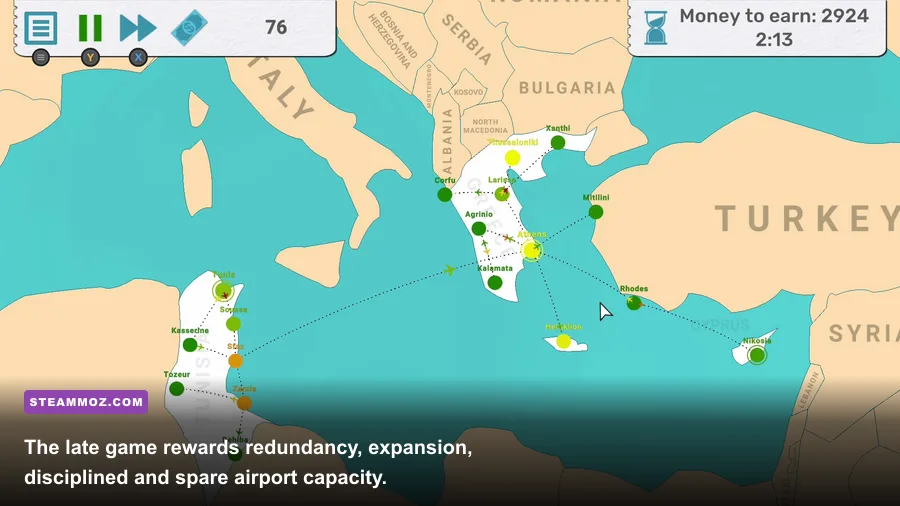
Expansion should look boring on purpose. Connect a neighboring country or a nearby cluster of cities, stabilize it, and only then move farther away. Every new territory adds routes, airports, passenger flows, and potential bottlenecks. If you jump from a compact European network to distant continents because the option is available, your cash can disappear before those routes start paying back their cost.
Use your existing hubs as anchors. The first international route should usually connect your strongest hub to a city that opens several useful onward connections. That city becomes a bridge rather than an isolated destination. Avoid routes that end in a geographic dead end unless the city has enough demand to justify a dedicated connection.
Pause before major expansion. Fly Corp lets you think through route placement without letting the simulation punish indecision. While paused, inspect the target region, compare distances, identify its likely hub, and reserve enough money for at least one capacity fix. Expansion money that leaves no emergency fund is not expansion money; it is a delayed game over.
The same discipline applies to unlocked countries. You don't need to claim everything immediately. A newly available country is an opportunity, not a mandatory purchase. If your current network has queues, unstable hubs, or no spare cash, fix those first. A smaller airline with healthy passenger flow will outperform a sprawling airline held together by panic upgrades.
6. Treat route length as an economic decision
Long routes are not automatically better routes. They can connect valuable regions, but they also consume more time and usually require stronger aircraft or better research. Before launching one, ask what it contributes to the network. Does it unlock a new hub? Does it connect two dense passenger pools? Does it remove a serious transfer detour? If the answer is no, the route may be expensive scenery.
Short routes are excellent for the opening because they produce fast feedback. You can see whether demand is real, whether an airport can handle the traffic, and whether the line is worth upgrading. Medium routes become the backbone of a mature regional network. Long-haul routes should be added when they solve a strategic problem, not simply because the map looks empty.
Don't confuse distance with profitability. A short connection between two active hubs can generate more useful traffic than a spectacular line between distant cities. Passenger transfers are especially valuable: one well-placed connection can feed several destinations and make the entire network more productive.
7. Keep an emergency cash reserve
New players tend to spend every available coin the moment it arrives. That feels efficient until the game unlocks a location that must be connected or an existing hub reaches its limit. Keep a reserve large enough to upgrade a critical airport, repair a failing route, or establish one emergency connection. The exact amount changes with the scale of your network, but the principle never does: liquidity is part of your infrastructure.
Separate routine spending from expansion spending. Routine spending keeps current routes healthy; expansion spending creates future income. If your expansion budget is also your emergency budget, every mistake forces you to wait while passengers pile up. A stable reserve also lets you pause and make a measured decision instead of accepting the first affordable route.
Review expenses after each major purchase. If income slows, don't immediately assume the whole airline is failing. Look for one underused long route, an isolated destination, or a hub upgrade that hasn't produced enough traffic. Fly Corp is a game of compounding small efficiencies, so removing one bad expense can be more valuable than opening another marginal route.
8. Use secondary hubs before the first one breaks
A secondary hub is a pressure valve, not a luxury. Once your first hub handles traffic from several countries, watch for routes that spend most of their time feeding the same airport. Build a second hub in a dense nearby region and redirect new connections through it. This shortens some passenger journeys and gives the network another place to absorb demand.
Don't split traffic randomly. The primary hub should keep the routes that are already profitable and heavily used. The secondary hub should serve a clear territory: a new continent, a dense neighboring group, or a set of destinations that would otherwise create a long detour. A hub with no defined role adds complexity without solving congestion.
Redundancy matters too. When a region has two sensible paths to the rest of the network, one overloaded airport won't freeze the entire airline. This is the same kind of risk management that makes convoy games more forgiving; Steamoz's Badlands Crew convoy tips is a useful comparison for players who enjoy planning around failure instead of reacting to it.
9. Learn the map in Campaign before going all-in
Campaign mode is the best classroom because it forces you to deal with staged progression and changing network demands. Use it to learn how route costs, airport limits, research unlocks, and passenger transfers interact. Free Play is more relaxed, but the freedom can hide mistakes: you may build a huge network without understanding which parts are actually carrying the economy.
Challenge scenarios are useful once you understand the basics because they expose specific weaknesses. If a scenario punishes slow expansion, practice building a compact hub quickly. If it pressures airport capacity, focus on queue management rather than collecting destinations. Treat each scenario as a lesson in one system, not as a reason to copy a single opening forever.
Save before major milestones if your platform and mode support it. A save gives you a safe point before unlocking a new region, purchasing a major upgrade, or adding a long-haul route. Experimentation is valuable, but you don't need to sacrifice an hour of healthy network growth to discover that a distant connection was premature.
For the current feature set, mode details, and updates, check the official Fly Corp Steam page and the KishMish Games developer page. Community discussion can also reveal how updates affect balance, but always verify advice against the version you're playing.
10. Use a repeatable pause-and-check routine
The strongest Fly Corp players aren't clicking faster; they're checking the right information at the right time. Pause before every major route, airport, or research purchase and run the same short checklist. Is the destination close enough to serve efficiently? Does the route connect useful passenger flows? Will the airport have capacity? After the purchase, where is the new bottleneck likely to appear?
- Check demand: confirm passengers are actually waiting for the connection rather than assuming an empty map means opportunity.
- Check geography: prefer routes that strengthen a region or connect hubs instead of isolated one-off lines.
- Check capacity: inspect both endpoints and every major transfer airport on the likely passenger path.
- Check research: spend points on the constraint visible right now, not a hypothetical late-game problem.
- Check cash: leave enough money for one emergency upgrade or route after the purchase.
- Check again: unpause briefly, watch the queues, and verify that the new route is improving flow.
That routine turns the game from a frantic map-clicking exercise into a readable management puzzle. If the interface slows down on a large network, reduce unnecessary visual effects and make sure your system is stable; Steamoz's City of Gangsters performance fixes offers useful general advice for troubleshooting simulation-heavy PC games.
How to turn these tips into a winning opening
For a reliable first run, choose a dense starting area, connect the capital to two nearby cities, and wait until those routes show consistent traffic. Upgrade the busiest airport before adding more spokes. Save research for the weakness you can see, then expand into the nearest useful country or regional cluster. Keep a reserve, pause before large purchases, and add a secondary hub when the first one begins carrying too much of the map.
The key lesson is simple: Fly Corp is not asking you to own the most routes. It's asking you to move passengers efficiently. Short routes teach you the economy, hubs multiply connections, upgrades remove bottlenecks, and controlled expansion protects your cash. Follow those principles and the world map stops looking like a wall of disconnected cities. It starts looking like a network you can actually control.