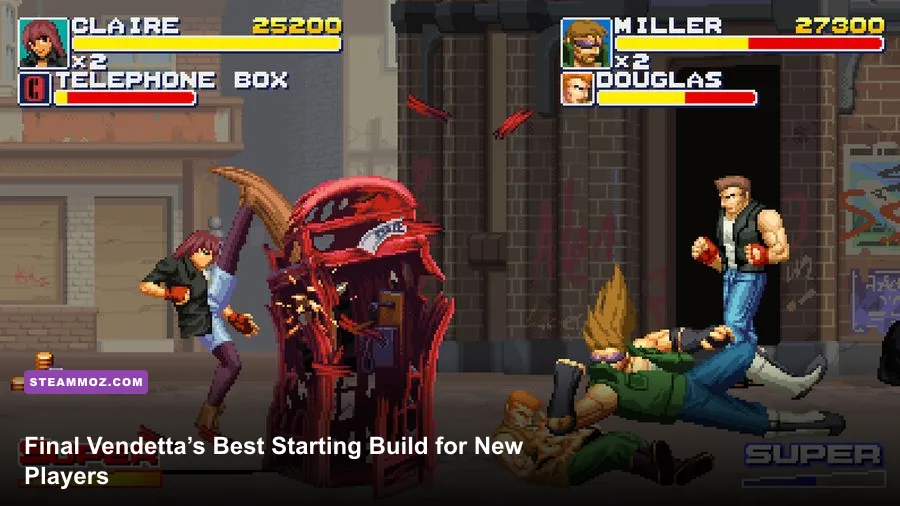
The best beginner setup in Final Vendetta is Claire on Easy or Normal, with a defensive, spacing-first playstyle built around jump-ins, throws, weapon control, and conserving your special meter for crowded screens. The game doesn't have a traditional skill tree, equipment screen, or stat allocation system, so your real build is a character choice plus a repeatable combat routine. Start with Claire, learn her safe rhythm, and only move to Duke or Miller after you can clear early stages without burning every life.
That distinction matters. Final Vendetta looks like a classic arcade brawler, but it punishes button mashing much harder than a casual Streets of Rage-style run might suggest. Enemies surround you quickly, some attacks cannot be interrupted safely, and bosses are designed to punish players who keep attacking after a combo has ended. This guide turns the game's limited character selection into a practical starting build, complete with move priorities, stage habits, weapon rules, and a boss-ready progression plan.
Choose Claire for the safest first clear
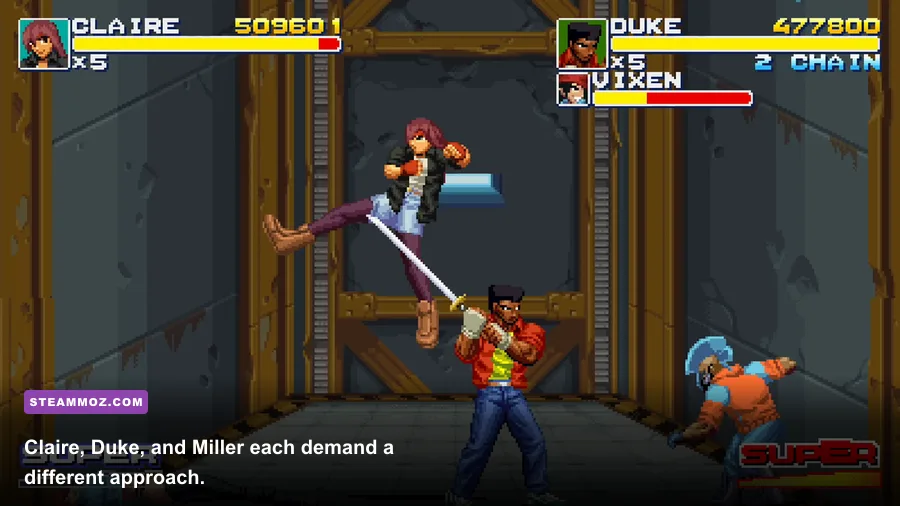
Claire is the strongest first pick because she gives beginners the most forgiving balance of reach, mobility, and damage. Duke hits harder but feels less nimble, while Miller's speed can tempt new players into attacking too aggressively. Claire lets you learn the fundamentals without forcing you into either extreme.
There are no permanent stats to raise in Final Vendetta. You cannot invest points into health, power, or speed, and there is no gear system that secretly changes damage values. Character selection is the build decision. Claire's advantage is practical: she can approach with a jump attack, convert into a short ground string, then disengage before the next enemy reaches her.
| Character | Beginner rating | Strength | Weakness |
|---|---|---|---|
| Claire | S-Tier starter | Balanced movement, reliable pressure, forgiving neutral game | Needs disciplined spacing to maximize damage |
| Duke | A-Tier | Higher-impact attacks and strong crowd control | Slower recovery makes missed swings dangerous |
| Miller | B-Tier starter | Fast movement and aggressive combo potential | Lower margin for error when surrounded |
Pick Claire for your first serious run, not because the other two are bad, but because she teaches transferable habits. Once you understand when to stop a combo, how to turn around quickly, and how to isolate one target, Duke becomes a satisfying power option. Miller is better saved for a second character run when you already understand enemy spacing.

🎮 Final Vendetta
Looking to experience this game? Grab your digital key directly on our store for $6.24.
View on Steammoz Store →Your beginner build and combat priorities
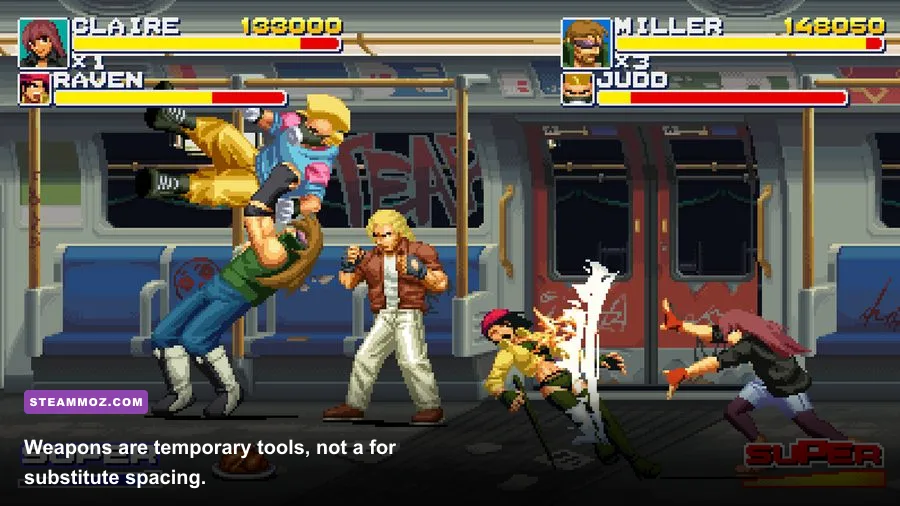
Think of the Claire build as a five-part loadout: safe approach, short combo, throw, crowd-control special, and emergency movement. The exact button layout varies by platform, but the logic stays the same. You want actions that finish quickly and leave you ready to block, jump, or turn around.
1. Use jump attacks to start, not to autopilot
A jump-in is useful when an enemy is isolated or committed to a long animation. It is a poor answer when three enemies are already standing underneath you. Land beside the group rather than in the middle, then immediately face the nearest threat. Final Vendetta's biggest beginner trap is winning the opening exchange and then losing track of the enemy entering from behind.
2. Keep ground strings short
Claire's basic attack string is most valuable as a confirm, not a habit. Tap out a compact sequence, watch whether the target is staggered, and stop before the recovery animation becomes predictable. If another enemy is close, use the final hit only when it creates space. A full-looking combo is worthless if it leaves you stationary while a second attacker winds up.
3. Throw whenever the crowd gives you room
Throws are one of the safest ways to control a packed screen. Grab the closest ordinary enemy, send them away from the group, and use the knockdown to reposition. Don't throw toward the edge of the screen unless you know the landing area is clear; corner pressure can trap you beside the recovering target and its friends.
4. Save special attacks for geometry, not pride
Your special attack is an escape valve. It is most valuable when two or more enemies are inside striking distance, when a fast attacker has slipped behind you, or when a boss has cornered you. Spending it to finish one already-stunned enemy feels good, but it leaves you exposed during the next wave. Treat the meter as insurance and build it back through normal combat.
| Build element | Priority | How to use it | Common mistake |
|---|---|---|---|
| Claire | Required | Use her balanced movement to isolate targets | Trying to out-damage Duke instead of playing safely |
| Jump attack | High | Approach isolated enemies and punish recovery | Landing in the center of a crowd |
| Short ground string | High | Confirm hits, then disengage or throw | Repeating the full string automatically |
| Throw | High | Send a target away and reset screen position | Throwing into another active enemy |
| Special | Very high | Escape clustered pressure or secure a boss punish | Using it for routine damage |
Weapons, pickups, and the damage trap

Weapons such as the baseball bat, knife, and pipe can swing a screen in your favor, but they are temporary pickups rather than permanent build pieces. The best weapon is the one that solves the immediate problem: a bat is excellent for buying space through a line of enemies, while a knife can create fast damage before you need to move again. Never stand still trying to extract every possible hit from a pickup.
Weapon range changes how you should position Claire. With a bat or pipe, keep enemies at the end of the swing and avoid walking forward after each hit. With a knife, step in only far enough to connect, then retreat before a second enemy reaches you. If the weapon drops or disappears, return to Claire's normal rhythm immediately instead of chasing it into a corner.
Environmental objects are just as important. Barrels, crates, and other breakable items can produce weapons or useful openings, but smashing everything immediately can also pull your attention away from incoming enemies. Clear the nearest threat first, then break objects when the screen is stable. This is an arcade game, not a scavenger hunt.
Stage-by-stage progression for your first run

Final Vendetta's campaign moves through distinct urban environments, including streets, a subway section, and nightclub-style interiors. Each stage tests the same fundamentals in a different visual wrapper: controlling the horizontal lane, reacting to enemies entering from off-screen, and recognizing when the game wants you to stop advancing.
Opening streets
Use the first stage to practice turning around. Walk forward only after the last enemy has finished recovering, and keep Claire near the center of the available space. If a foe jumps or rushes from the edge, stop attacking and face them. Your goal is not speed; it is finishing the stage with your special meter available.
Subway encounters
The subway's tighter spaces make crowd control more valuable than raw damage. Do not pin yourself against scenery. Lure one enemy toward the open side, throw them away from the group, and use the resulting gap to reset. Weapons are especially useful here because they reduce the number of simultaneous threats before the screen becomes congested.
Nightclub and late-stage rooms
Later arenas are designed to punish tunnel vision. Enemies can attack while your attention is locked on a tougher target, so prioritize the fastest mover rather than the enemy with the most health. If the game introduces a new enemy type, spend the first exchange watching its telegraph. Learning whether it rushes, jumps, or pauses before attacking is worth more than landing one extra combo.
| Situation | Immediate danger | Counter | Best resource |
|---|---|---|---|
| One enemy at mid-range | Whiffed approach | Walk in, short string, then reposition | Basic attacks |
| Two enemies on one side | Overlapping hitboxes | Throw one away and move through the gap | Throw |
| Enemies on both sides | Blindside attack | Turn immediately and use a special if trapped | Special meter |
| Weapon pickup nearby | Standing still to collect hits | Grab it, strike once or twice, then relocate | Bat, knife, or pipe |
| New enemy type | Unknown telegraph | Block, observe, and punish recovery | Patience |
Boss preparation and punish windows
Bosses in Final Vendetta are less about memorizing a long combo and more about refusing unsafe damage trades. Before every boss door, finish the previous encounter with your special available if possible. Enter with a weapon only when it is already in your path; don't risk health walking through a dangerous screen to retrieve one.
Most boss attacks have a readable setup: a step forward, a brief pause, a jump arc, or a clear change in stance. Block or move during that signal, then attack during recovery. The safest punish is usually a short string followed by movement. If the boss is near a wall, avoid extending the combo unless you have confirmed the boss cannot retaliate immediately.
When a boss summons support or fills the arena with distractions, kill the fastest interruption threat first. A weaker enemy that can stagger Claire is more dangerous than a slow, high-health target. Use a special to clear breathing room, not necessarily to touch the boss. Surviving the next ten seconds is often the real damage increase.
Difficulty, co-op, and the fastest way to improve
Start on Easy if you are unfamiliar with arcade beat-'em-ups, then move to Normal once you can consistently preserve lives through the opening stages. Easy is not wasted practice: it gives you room to identify attack tells and learn stage pacing. Harder modes magnify every greedy decision, so jumping there immediately can teach panic rather than precision.
Co-op changes the build. Two players can cover opposite sides, but splitting too far apart makes enemies harder to control and can leave one player surrounded. Stay close enough to answer a blindside attack, alternate who starts pressure, and avoid throwing enemies into your partner's active combo. The strongest co-op team is not two damage dealers; it is two players who share screen control.
For a useful practice routine, replay the first stage three times. On run one, focus only on turning and avoiding blindside hits. On run two, restrict yourself to short strings and throws. On run three, save your special until a genuine crowd emergency. This drills the exact habits that carry into the subway, nightclub, and boss encounters.
Final Vendetta beginner build summary
Claire is the clear recommendation for a first campaign: approach with measured jump attacks, confirm with compact ground strings, throw enemies away from the group, and reserve special attacks for moments when the screen collapses around you. Weapons should create space, not lure you into standing still. The game offers no stats or skill tree to optimize, so smart positioning is your real progression system.
Once that rhythm feels natural, try Duke for heavier pressure or Miller for a faster, riskier run. For official platform details and updates, check the Final Vendetta Steam page, the Bitmap Bureau website, and the publisher's Numskull Games site. If you enjoy learning systems through repetition, Steamoz's Dungeons 2 beginner build guide and Din's Curse survival tips are good follow-ups. Final Vendetta is at its best when every hit has a purpose—and Claire gives you the cleanest route to discovering that.