
EVERSPACE Encounters gets much easier once you stop treating every sector like a shooting gallery. The winning formula is simple: spend credits on permanent pilot upgrades, protect your energy economy, loot selectively, and use devices to control encounters before your weapons overheat. These 10 tips cover the mistakes that wipe out new pilots, plus the specific weapons, devices, sectors, and upgrade choices that make the Encounters expansion far less punishing.
Encounters builds on the original roguelike structure: every run sends you through randomized sectors, death sends you back to the hangar, and permanent progression keeps improving your next attempt. The expansion adds new story content, locations, enemies, equipment, and the Colonial Scout ship. That extra variety is excellent, but it also creates more ways to waste resources. If you're just getting started, bookmark the official Steam page and keep these rules in mind.
1. Build your first run around survival
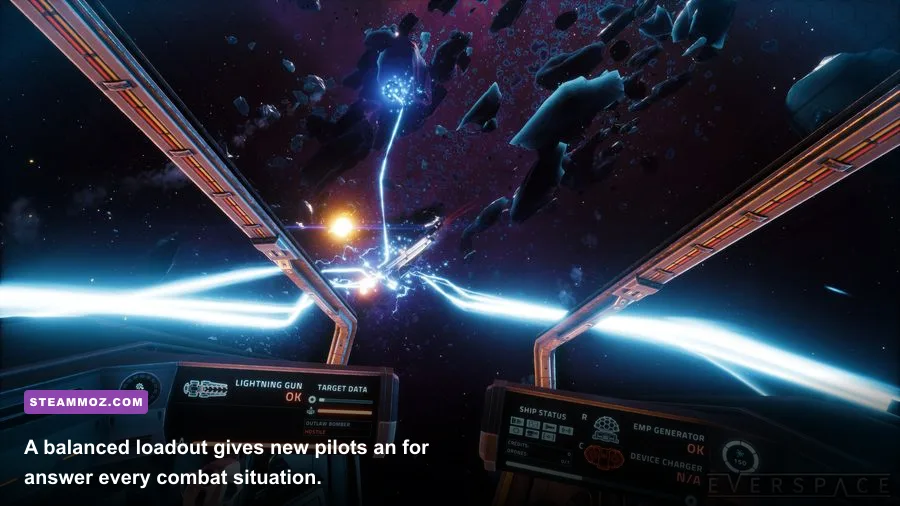
Your first objective isn't reaching the final sector. It's learning how the game pays you for risk. A short run that earns enough credits for permanent upgrades is more valuable than a doomed expedition carrying a full cargo hold.
Tip 1: Buy pilot upgrades before chasing perfect gear
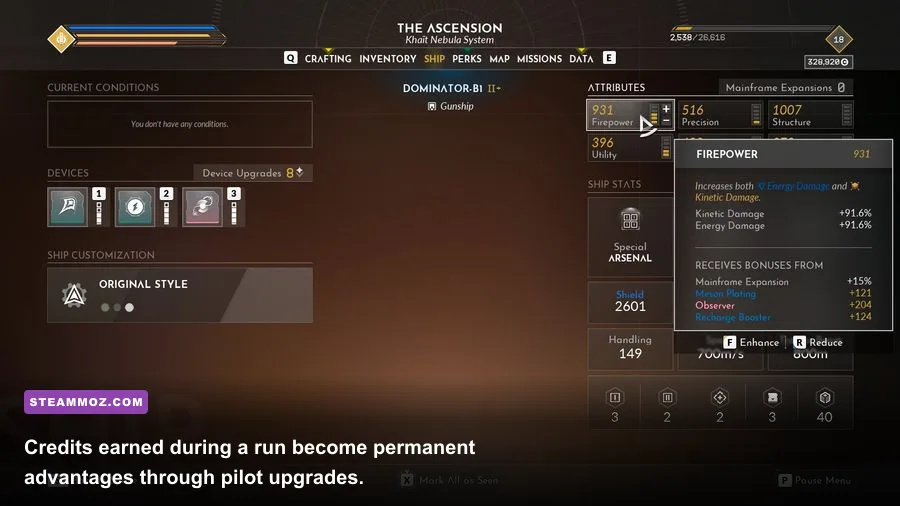
Credits spent in the hangar persist after death, while most equipment found inside a run does not. Prioritize the pilot skill categories that improve the entire account: Energy, Shield, Armor, Handling, Weapons, and Devices. Energy upgrades are especially valuable early because nearly every weapon and active device competes for the same energy economy.
Don't dump everything into one flashy weapon upgrade. A little more energy capacity, stronger shields, and better device efficiency help across every ship. If you regularly die while escaping a fight, invest in Shield or Handling. If you survive encounters but can't finish them before your energy runs dry, improve Energy and Weapons instead.
Tip 2: Learn what each ship is asking you to do
The Colonial Scout rewards reconnaissance and precision. Its smaller profile and agility make it a safer learning platform than a slow, weapon-heavy ship, but it won't forgive sloppy exposure. The Gunship can mount more firepower and absorb punishment, yet its sluggish turning makes missile timing and positioning much more important. The Interceptor is built around speed and aggressive engagements, while the Sentinel leans into shields and device utility.
| Ship style | Best beginner strength | Main weakness | Good first habit |
|---|---|---|---|
| Colonial Scout | Agility and reconnaissance | Limited room for mistakes | Attack from behind and disengage early |
| Sentinel | Shield-focused safety | Lower burst potential | Fight inside shield range, then recharge |
| Interceptor | Speed and offensive pressure | Fragile hull | Never stop moving during a dogfight |
| Gunship | Heavy weapons and durability | Slow turning | Use cover before committing to a target |
For a useful comparison, our starting-build guide for DeltaZeal covers a similar principle: choose a setup that reinforces your first reliable habit instead of trying to master everything at once.
🎮 EVERSPACE - Encounters
Looking to experience this game? Grab your digital key directly on our store for $1.99.
View on Steammoz Store →2. Treat energy as your real ammunition
EVERSPACE's most common beginner mistake is firing continuously because the weapon reticle is red and an enemy is nearby. Weapons, shields, boosters, and devices all create an energy-management puzzle. When your energy generator can't keep up, your ship becomes a target even if your hull is untouched.
Tip 3: Pair weapons with different energy demands
The Gatling Gun is excellent for sustained pressure against exposed hulls, but it burns through energy and can overheat during long bursts. The Pulse Laser is easier to control and remains dependable against ordinary fighters. The Plasma Gun hits harder but is less forgiving when you miss. A Rail Gun rewards careful aim at long range, especially against shield generators and larger targets.
A practical early setup is a reliable primary weapon such as the Pulse Laser or Gatling Gun, plus a higher-impact option such as the Plasma Gun or Rail Gun. Fire the primary while tracking a target, then swap to the heavy weapon during a clean opening. Don't hold every trigger at once; alternate weapons so one can recover while the other works.
Tip 4: Match damage to the target's defenses
Read the target's shield and hull states instead of assuming raw damage solves everything. Shielded enemies are easier to pressure with weapons that can maintain accurate fire, while hull damage becomes much more important after the blue shield bar collapses. Missiles are excellent for finishing a damaged target, but they're wasteful against a fast fighter with active countermeasures.
The Flak Cannon is a strong answer to clusters of smaller ships because its spread forgives imperfect aim. The Beam Laser can maintain pressure while you maneuver, but it demands a stable energy supply. The Shock Rifle is useful when you can create distance and line up a deliberate shot. Test each weapon at a trading outpost; rarity alone doesn't make a weapon suitable for your ship.
Tip 5: Carry one escape device
Every loadout should have a way to reset a bad fight. The Teleporter can break distance instantly, while the Missile Defense System is priceless when several hostile ships launch ordnance together. A Decoy buys time against lock-ons, and the EMP Generator can interrupt or disable nearby threats long enough to turn away.
| Situation | Recommended tool | Why it works | Common mistake |
|---|---|---|---|
| Missile swarm | Decoy or Missile Defense System | Breaks tracking or destroys incoming ordnance | Waiting until impact is unavoidable |
| Overwhelmed by fighters | EMP Generator | Creates a short control window | Using it after shields are already gone |
| Need to disengage | Teleporter | Instantly changes range and angle | Teleporting without checking the destination |
| Long attrition fight | Shield Booster | Restores survivability between attack passes | Activating it while still taking concentrated fire |
3. Win fights before they become dogfights

EVERSPACE rewards the pilot who chooses the first engagement. Cruise through a sector with your sensors active, identify patrols, and decide whether the reward justifies the ammunition and energy cost. You don't have to destroy every ship on the map.
Tip 6: Scan before you commit
Use sensors to identify enemies, containers, wreckage, and points of interest before boosting into the middle of a group. The first target should usually be the ship that can change the fight: missile carriers, drone controllers, shield-support units, or fast attackers that stay on your rear.
Approach from cover whenever possible. Asteroids and wreckage break lines of fire and give you a place to recharge shields. Start with a short burst, retreat behind cover, then re-enter from a new angle. This hit-and-fade rhythm is much safer than spinning in open space while several enemies attack from different directions.
Tip 7: Use the Cruise Disruptor deliberately
The Cruise Disruptor is not just a way to stop fleeing enemies. It can force a target out of cruise mode and create a controlled opening, but using it carelessly can also announce your position to nearby hostiles. Pick a target, check your surroundings, and fire only when you have enough space to finish the interruption.
Against larger ships, don't sit directly behind the engine and hope damage numbers solve the problem. Strafe across the target's flank, keep your reticle on vulnerable components, and break away before turrets settle on your position. The safest kill is usually a sequence of short attack passes, not one heroic full-boost charge.
Tip 8: Save missiles for high-value problems
Missiles are limited resources, and their best use is removing a dangerous target quickly. Save them for elite enemies, turrets, heavily damaged capital ships, or a fighter that is about to finish your hull. Against ordinary scouts, your primary weapon is usually more efficient.
Before launching, check whether the target has countermeasures or whether another enemy can destroy the missile. A missed missile is more than lost damage: it can leave you without the emergency burst needed during the next encounter.
4. Loot, explore, and prepare for Encounters sectors
Encounters adds more reasons to leave the obvious route, including story encounters, unusual locations, and the Okkar Homeworld content. Exploration can produce excellent gear, but every detour increases exposure to ambushes and drains consumables. The answer isn't avoiding side content; it's entering it with a plan.
Tip 9: Keep cargo space flexible
Don't fill every cargo slot with low-value commodities during the first few sectors. Equipment, fuel, nanobots, missiles, and crafting materials can be more important than a modest trade payout. Sell common loot at a station when the hold starts blocking better drops, but keep rare weapons and devices until you've compared their bonuses.
Fuel is particularly important because a run can end prematurely if you can't reach the next jump. Buy fuel when the price is reasonable, and avoid spending your last credits on a weapon upgrade when the next sector route is uncertain. The resource-management lessons in our Death Howl farming guide apply here too: consistent gains beat one greedy haul.
Tip 10: Approach Ancient Ruins and Okkar territory slowly
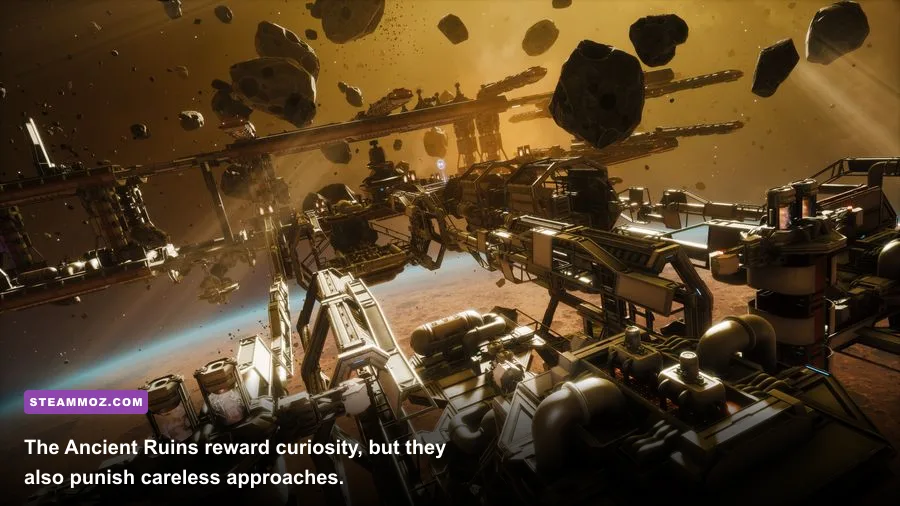
The Ancient Ruins are an invitation to investigate, not a signal to boost straight through. Check for hostile spawns, use the structure as cover, and search the area only after nearby attackers are under control. If an encounter offers a choice between a guaranteed safe reward and a high-risk bonus, take the safe reward while you're still learning the expansion's event patterns.
The Okkar Homeworld is where under-upgraded ships get exposed. Arrive with at least one escape device, spare missiles, repair resources, and a weapon combination that can handle both shields and hull. If your ship is already damaged, turn back before entering the sector. Encounters rewards confidence, but it doesn't reward stubbornness.
| Run stage | Priority purchase | Equipment goal | Risk to avoid |
|---|---|---|---|
| Opening sectors | Energy and shield upgrades | Reliable primary weapon and escape device | Spending all credits on rare loot |
| Mid-run | Devices and weapon efficiency | Shield and hull damage coverage | Entering optional fights while damaged |
| Late sectors | Survivability and handling | Missile defense, repairs, and reserve fuel | Exploring with an empty cargo or energy reserve |
| Okkar Homeworld | Whatever fixes your weakest defense | Balanced weapons plus a panic button | Fighting every patrol in open space |
For more game-specific reading, the official ROCKFISH Games page provides the expansion's broader context, while the official Steam community hub is useful for checking current player discoveries and unusual encounter behavior.
5. Turn failed runs into permanent progress
Death is part of EVERSPACE's progression loop, but a failed run shouldn't feel empty. Review why the run ended. Were you killed while chasing a container? Did you enter a new sector without fuel? Did a missile warning go unanswered because your device was on cooldown? That answer tells you which pilot upgrade will produce the biggest improvement.
Upgrade for the mistake you actually made
If you died with energy available but couldn't turn quickly enough, Handling is more useful than another damage point. If you consistently lose your hull after shields collapse, Armor and repair-related improvements deserve attention. If you run out of energy during every boss-scale encounter, increase Energy or change the weapon pairing before buying more raw firepower.
Graphics settings matter less than combat readability, but stable performance still helps. On older PCs, lower volumetric effects and shadows first, then keep resolution and texture quality as high as your memory allows. A consistent frame rate makes missile warnings, weapon timing, and fast turns easier to read than a pretty but unstable profile. For broader PC optimization ideas, see our Dragonkin performance settings guide.
Finally, don't confuse caution with passivity. The best EVERSPACE pilots are aggressive at the exact moment an enemy is vulnerable, then disappear before the counterattack. Scan, isolate, burst, disengage, repair, and repeat. Once those ten habits become automatic, the Encounters expansion stops feeling like a wall of random danger and starts feeling like what it really is: a sharp space-combat roguelike where smart preparation beats lucky loot.