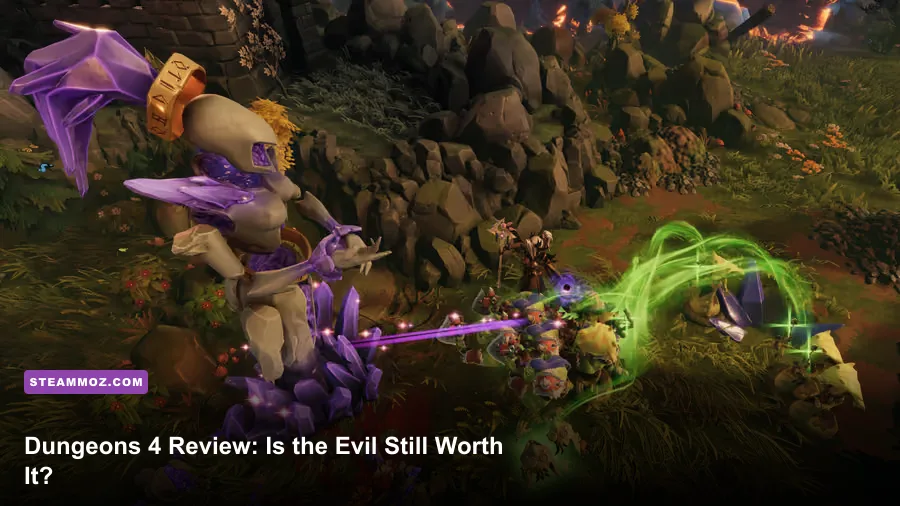
Dungeons 4 is worth playing in 2026 if you enjoy relaxed dungeon management, goofy villainy, and RTS skirmishes—but it isn’t the genre revolution its campaign occasionally promises. Realmforge Studios has made a bigger, cleaner sequel with a generous 20-mission campaign, more room to build and a stronger surface war layer. The catch is that the AI, mission pacing and repetitive resource loops still keep it just short of essential. At a discount, or through a subscription, this is a very easy recommendation for strategy fans who want Dungeon Keeper-style mischief without the pressure of a hardcore competitive RTS.
The basic fantasy remains wonderfully intact. You carve out an underground lair, place rooms, train creatures, trap intruders and send the forces of evil above ground to smash the benevolent kingdom. Thalya, the Dungeon Lord’s ferociously sarcastic champion, ties the story together with a campaign that constantly pokes fun at heroic fantasy conventions. It’s broad comedy rather than subtle writing, but the tone suits the game’s toy-box approach.
What Dungeons 4 Gets Right

Dungeons 4 understands that a good evil lair should feel busy. Your creatures don’t simply wait in a military queue; they sleep, eat, train, manufacture goods and react to threats. The dungeon’s economy is built around a readable chain of rooms and resources. Treasury space stores gold, the Hatchery keeps creatures fed, the Training Room improves your fighting force, and the Workshop supports traps and other dungeon infrastructure. You can see the machine working, which is half the pleasure.
The sequel also improves the scale. Digging is more generous than in the older games, and larger maps give you room to build themed wings instead of squeezing every room into a cramped rectangle. That matters because dungeon layout is not cosmetic. A central Treasury may be efficient early on, but it becomes an obvious target once heroes begin tunneling toward your Dungeon Heart. Separating vulnerable production rooms from your main entrance gives defenders more time to respond.
Combat is deliberately accessible. You directly control Thalya or another selected force, issue movement orders and use abilities while your creatures handle much of the brawling. The result feels closer to a casual RTS than a pure dungeon simulator. Your best decisions usually happen before the fight: choose a sensible army composition, build a safe route and avoid sending expensive units into an unexplored objective without support.
| System | What It Does | Why It Matters |
|---|---|---|
| Dungeon Heart | Core base and defeat condition | Protect it with distance, doors, traps and defenders |
| Treasury | Stores gold collected by creatures | More capacity prevents wasted income during expansion |
| Hatchery | Produces food for your creatures | Feeds the army and keeps the dungeon functioning |
| Training Room | Improves creature readiness and progression | Important before pushing into tougher surface zones |
| Workshop | Supports traps and dungeon tools | Turns corridors into defensive advantages |
If you’ve played Dungeons 3’s campaign, the learning curve feels familiar. New players get enough breathing room to experiment, while returning Overlords will understand the rhythm almost immediately.

🎮 Dungeons 4
Looking to experience this game? Grab your digital key directly on our store for $27.49.
View on Steammoz Store →The Campaign Is Fun, But It Repeats Itself

The campaign is the game’s strongest value proposition. Its 20 missions introduce rooms, enemies and objectives gradually, then remix them through escort jobs, territory grabs, destruction tasks and defensive scenarios. Thalya’s narration keeps the transition between missions lively, and the story knows not to take its own fantasy melodrama seriously.
However, the campaign’s structure becomes predictable after the first several hours. Most missions still ask you to establish an economy, clear nearby threats, expand into new territory and eventually attack a heroic settlement. The maps change, but the cadence rarely does. The best missions create friction between dungeon defense and surface aggression; weaker ones feel like a checklist interrupted by enemy raids.
That repetition is less damaging than it sounds because Dungeons 4 is a comfort strategy game. It’s satisfying to pause, redesign a corridor, upgrade your army and watch a plan slowly become self-sustaining. Players expecting the systemic chaos of Dwarf Fortress or the brutal tactical consequences of XCOM may find it too forgiving. Players wanting a funny, low-stress campaign can settle into it quickly.
The sandbox and skirmish options help after the story campaign, especially if you enjoy optimizing room layouts or experimenting with different evil factions. Still, the long-term loop isn’t as endlessly compelling as the best management games. Once you’ve mastered food, gold and defensive chokepoints, many missions stop surprising you.
Dungeon Building and Surface Combat Compared
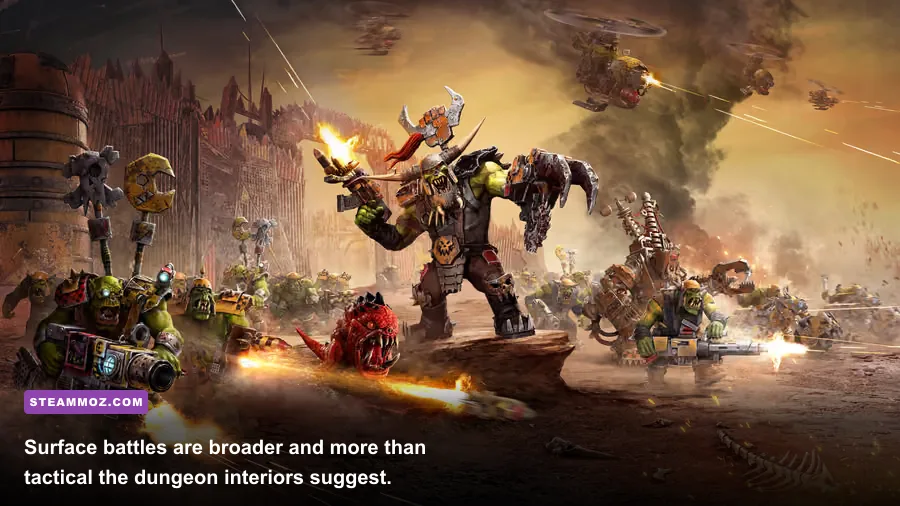
Dungeons 4 is split between two identities, and they don’t always fit perfectly. Underground, you’re a manager. Above ground, you’re an RTS commander. The dungeon side is more distinctive: digging, room placement and creature behavior create the game’s personality. The surface layer is useful and sometimes exciting, but it often feels like a support system for the dungeon rather than an equal partner.
The key tactical mistake is treating the overworld as a simple march toward the next objective. Surface missions reward scouting. Neutral enemies, resource nodes and enemy defenses can punish a force that moves in a straight line. Let Thalya’s group clear a safe route, then bring the slower support units behind it. Pulling wounded creatures away from a fight is often smarter than replacing them, especially when the mission has limited access to food or recruitment.
Your army should also match the job. Orc-heavy groups are comfortable in direct engagements, while ranged or magical support becomes increasingly important against clustered defenders and tougher heroic units. Undead and demon options give you more flexibility as the campaign unlocks them, but no composition excuses poor positioning. A large blob of units can win early fights; later missions demand focus fire, retreat timing and ability management.
| Approach | Strength | Weakness | Best Use |
|---|---|---|---|
| Orc-heavy army | Durable frontline pressure | Can struggle against concentrated ranged damage | Breaking camps and holding chokepoints |
| Mixed army | Reliable frontline and support balance | More demanding food and training economy | Most campaign objectives |
| Fast assault force | Excellent for exposed objectives | Vulnerable if surrounded or overextended | Resource grabs and timed attacks |
| Defensive dungeon plan | Strong against raids and invasions | Slow to complete aggressive objectives | Survival and holdout missions |
This two-layer design is why the game feels broader than Dungeons 3, but also less focused. If you want a pure dungeon sim, surface combat can feel like busywork. If you want a full RTS, the army control is not granular enough to compete with dedicated classics like Age of Empires.
How to Build a Dungeon That Doesn’t Collapse
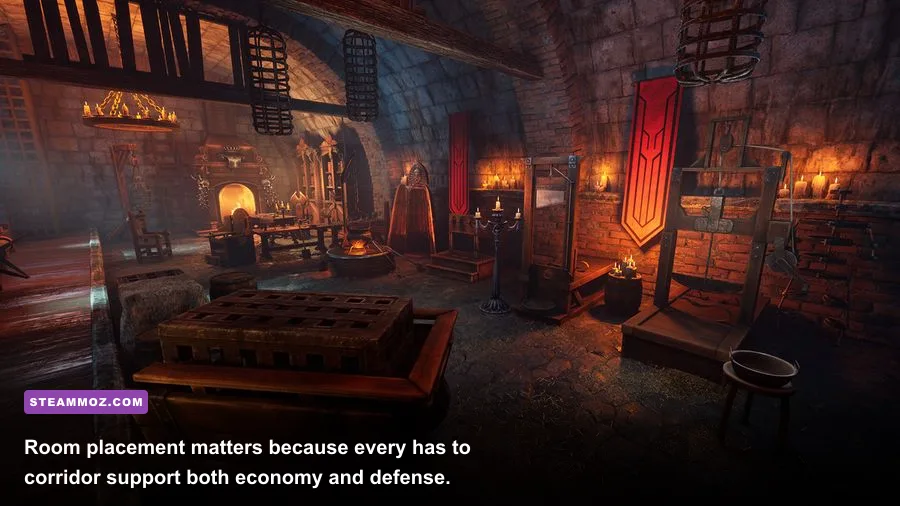
Early-game efficiency is less about cramming rooms together and more about protecting the route between them. Start with a compact core: Dungeon Heart, Treasury, Hatchery and Training Room. Leave expansion space around the core instead of immediately filling every mined tile. You’ll need room for defensive corridors and additional production once the map starts sending stronger heroes your way.
Put your Workshop and trap infrastructure near likely invasion routes, but don’t make a single corridor your only answer. A trap can buy time; it won’t replace defenders. Guard Rooms work best where they overlap with traps and where creatures can reach the fight quickly. If an enemy spends half the battle walking through empty tunnels, your layout is wasting its biggest advantage: time.
Resource bottlenecks are the silent killer. Gold capacity that’s too small makes workers stop collecting. Too little food creates a painful gap between expanding your army and sustaining it. Before launching a major surface attack, check your storage, creature health and recruitment pipeline. The game rarely demands perfect optimization, but it does punish attacking at the exact moment your economy is already strained.
| Phase | Priority Rooms | Defensive Goal | Common Mistake |
|---|---|---|---|
| Opening | Treasury, Hatchery, Training Room | Keep the core compact | Overbuilding empty corridors |
| Expansion | Workshop, extra storage, Guard Rooms | Create layered routes | Leaving production rooms exposed |
| Midgame | Upgraded economy and creature support | Force heroes through defended lanes | Sending every unit to the surface |
| Endgame | Redundant defenses and reserve forces | Protect the Dungeon Heart during attacks | Ignoring raids while chasing objectives |
The design philosophy overlaps with the lessons in our Dins’s Curse survival tips: build for the crisis you haven’t seen yet. In Dungeons 4, that means keeping a reserve army and a fallback corridor rather than spending every resource on the next offensive upgrade.
Performance, Controls, and PC Requirements

Dungeons 4 is not a technical showcase, but large bases and crowded battles can expose performance dips. The biggest cost usually comes from view distance, shadows, effects and the number of active units rather than the simple act of digging. On a mid-range gaming PC, 1080p High is a sensible starting point; lowering shadows and effects is more useful than dropping texture quality immediately.
The official Steam page lists 8 GB of RAM and a GTX 960-class graphics card in the minimum specification, while the recommended tier moves to 16 GB of RAM and a GTX 1070-class GPU. Those targets are dated by 2026 standards, but the recommended memory figure still makes sense for huge maps and background applications. An SSD also helps with loading and reduces the friction of restarting missions.
| Setting | Recommended Value | FPS Impact | Visual Trade-Off |
|---|---|---|---|
| Resolution | Native 1080p or 1440p | High | Lower resolution is the fastest broad performance gain |
| Shadows | Medium | Medium to high | Less depth in tunnels, especially during large fights |
| Effects | Medium or High | Medium | Lower settings reduce spell and combat spectacle |
| Textures | High with 6-8 GB VRAM | Low to medium | Keep high unless VRAM limits cause stutter |
| View distance | High, reduce for crowded maps | Medium | Far terrain and units lose detail |
Mouse and keyboard controls are the clear choice for serious dungeon planning, although the interface is approachable and controller support makes couch play viable. The camera can become busy when underground and surface objectives compete for attention, so pause frequently. This isn’t a reaction-speed game; pausing to inspect unit health and queued tasks is part of playing well.
Is Dungeons 4 Worth Playing in 2026?
Yes, with a specific expectation: buy it for the campaign and satisfying dungeon tinkering, not for deep competitive strategy. Dungeons 4 is polished enough to stand on its own, and you don’t need to play the earlier games to understand Thalya’s story. The campaign delivers a comfortable 20-mission journey, the building tools are flexible, and the humor gives every successful trap or creature stampede a little personality.
Its weak points are familiar. Surface combat lacks the precision of a dedicated RTS. Enemy behavior can feel predictable. The mission formula repeats, and the resource economy rarely becomes genuinely difficult once your dungeon is stable. None of those flaws destroy the experience, but they stop Dungeons 4 from becoming a must-play strategy classic.
That makes the purchase decision straightforward. Grab it on PC if you like management games, accessible real-time strategy or the Dungeon Keeper lineage. Wait for a sale if you’re mainly interested in difficult optimization or highly competitive combat. If you want another perspective on the series, our Dungeons 2 weapon tier list and Dungeon Siege retrospective show how differently classic PC fantasy games handle progression and combat.
For a broader look at the studio and publisher, check Realmforge Studios and Kalypso Media. Dungeons 4 doesn’t reinvent evil, but it knows exactly why the fantasy remains fun: dig a tunnel, build a nasty surprise, train a ridiculous army and watch the heroes regret knocking on your door.