
Dragonkin: Blood Scales Edition is worth playing in 2026 if you want a co-op-friendly action RPG with a distinctive build system, but it isn't a flawless Diablo replacement. Eko Software's dragon-scorched dungeon crawler has satisfying combat, a surprisingly flexible Heroic Codex, four very different heroes, and enough procedural loot runs to justify a serious weekend investment. The catch is that its endgame repetition, uneven enemy variety, and occasional rough edges are impossible to ignore. The Blood Scales Edition improves the package with its bonus content, but it doesn't magically fix the game's grind.
That makes this a recommendation with conditions. If you enjoy experimenting with skill connections, chasing better affixes, and playing through increasingly dangerous expeditions with friends, Dragonkin has real bite. If you need perfectly tuned seasonal progression, an enormous bestiary, or the endless polish of Diablo IV and Path of Exile, wait for a discount or a substantial content update. After revisiting it in 2026, I found a game that is more interesting than its first impression suggests, even if it still feels one major expansion short of greatness.
What Blood Scales Edition Actually Adds
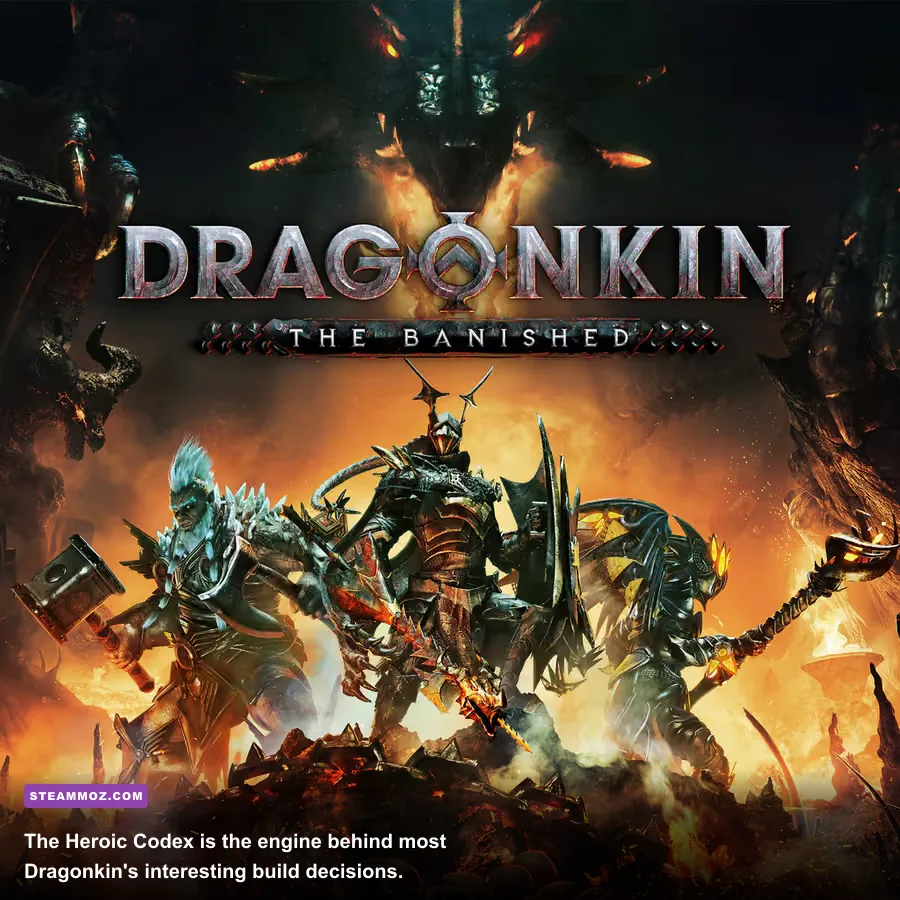
Dragonkin: The Banished is built around a simple premise: dragons have poisoned the world, and four heroes are fighting through the aftermath. The playable roster consists of the Barbarian, Oracle, Knight, and Witch. They are not just cosmetic variations. The Barbarian leans into close-range impact and rage-fueled aggression, the Knight specializes in defensive control and reliable frontline damage, the Oracle uses spiritual and elemental abilities, while the Witch turns curses, summons, and area denial into a weapon.
The story is delivered through a campaign of procedurally generated missions, conversations in the central settlement, and expeditions into regions shaped by dragon influence. It is not trying to be a cinematic, character-heavy RPG. The writing mainly exists to give your next hunt a reason, introduce new systems, and frame the conflict between humanity and the dragons. That works best when you treat the narrative as seasoning for the loot loop rather than the main course.
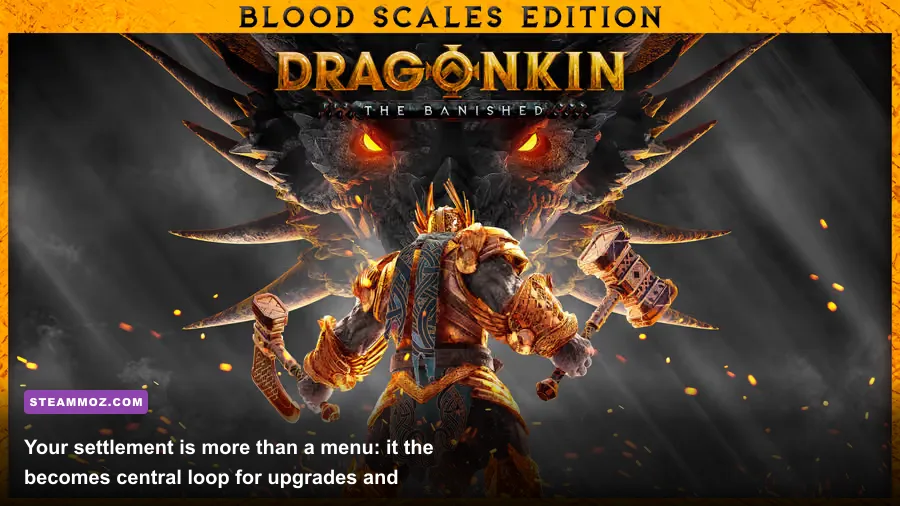
The Blood Scales Edition is the premium version of the game. Its value depends on the exact store bundle and the content attached to your platform, so check the current official Steam listing before buying. The important point is that the edition is primarily a package upgrade: it gives committed players additional Blood Scales-themed content and the base game, but it does not create a separate campaign or a new hero class.
That distinction matters in 2026. Buy it for the complete cosmetic and bonus-content package if the price difference is modest. Don't buy it expecting an entirely different endgame. The core experience remains the same: clear a map, complete objectives, collect equipment, return to town, improve a build, and push into tougher versions of the same broad activity.
| Edition or Purchase Choice | Best For | What You Get | My Verdict |
|---|---|---|---|
| Base game | Players testing the combat loop | Full core campaign, four heroes, procedural expeditions | Best entry point on sale |
| Blood Scales Edition | Fans already committed to the grind | Base game plus Blood Scales bonus content listed by the platform | Worth it when the premium is small |
| Wait for a sale | Solo players unsure about repetition | Same systems at a lower risk | Smartest choice for cautious buyers |
Before jumping in, it is worth reading the developer's official Eko Software site and the current patch notes linked from the Steam page. Dragonkin is the kind of live project where balance, class tuning, and technical behavior can shift between builds. A review from launch does not always describe the version you will install today.
🎮 Dragonkin - Blood Scales Edition
Looking to experience this game? Grab your digital key directly on our store for $27.99.
View on Steammoz Store →Combat Is Better Than the First Hour Suggests
Dragonkin's combat is deliberately readable rather than hyperactive. You have a basic attack pattern, active abilities, movement tools, defensive options, and a resource economy that encourages using skills instead of repeatedly tapping the same attack. Enemies telegraph heavy swings, ground effects, charges, and projectile bursts clearly enough that deaths usually feel like positioning mistakes rather than invisible dice rolls.
The first hour can undersell the system because early abilities are narrow and your equipment has few meaningful modifiers. Give the game time to open the skill grid and add support nodes. A Barbarian who simply stacks direct damage is functional, but a Barbarian combining a wide cleave with bleed application and a short-range mobility skill feels far more deliberate. The Witch has the opposite rhythm: she wants enemies grouped inside curses or elemental zones, then uses summons and detonations to punish anything that survives.
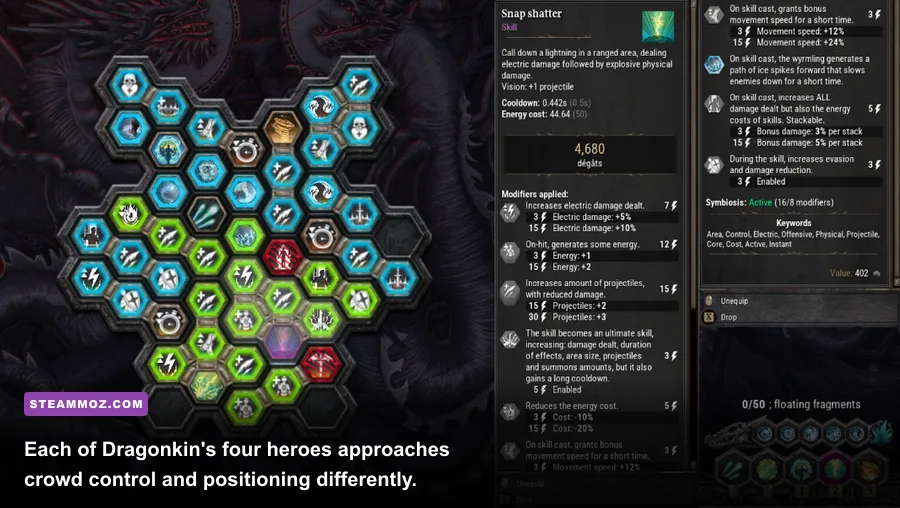
The Heroic Codex is the game's defining idea. Rather than picking abilities from a completely isolated skill tree, you connect nodes in a grid-like system. The path you take influences which skills become available, how much investment they require, and which bonuses can sit beside them. This creates a useful tension: do you travel toward a powerful active skill, or spend those connections on efficient damage, cooldown, critical chance, or survivability nodes?
That system also stops the four heroes from feeling like disposable skins. Your Knight can be built as a durable control character or pushed toward aggressive melee damage. The Oracle can focus on elemental pressure, support effects, or repeated ability casting. The best setups are not necessarily the ones with the largest tooltip number. A build that lowers cooldowns and keeps enemies staggered can outperform a theoretically stronger glass cannon once expedition modifiers become severe.
Build priorities that work early
Don't chase perfect equipment during the campaign. Replace gear often, prioritize a weapon with a meaningful damage jump, and favor defensive stats whenever your character starts dying before abilities come off cooldown. Damage-over-time builds need time to pay off, so they feel weaker against small packs and stronger against elites. Burst builds clear trash quickly but can stall against bosses if every major ability is on cooldown.
| Hero | Strong Early Direction | Important Synergy | Weakness to Watch |
|---|---|---|---|
| Barbarian | Close-range cleave and stagger | Area damage plus mobility and rage generation | Overcommitting into elite attack zones |
| Knight | Guard, control, and dependable melee | Damage reduction with taunts or crowd control | Slow clear speed when built too defensively |
| Oracle | Elemental damage and cooldown cycling | Area effects layered over debuffs | Fragility when enemies reach melee range |
| Witch | Curses, summons, and zone control | Debuff duration with repeated area damage | Set-up time against fast or scattered enemies |
The combat becomes considerably more enjoyable in co-op. One player can pin a dangerous pack while another establishes an elemental kill zone, and the game gives crowd control a practical purpose instead of reducing every encounter to raw damage. Still, co-op also makes visual clutter worse. Agree on who is handling elite targets, especially when multiple ground effects overlap, or you will spend more time reviving each other than reading telegraphs.
If you are coming from other character-action or RPG systems, the lesson is familiar: don't confuse a bigger number with a better build. Our Street Fighter 6 starting build guide covers a different genre, but the same principle applies here: choose a plan, understand its win condition, and stop scattering upgrades across incompatible ideas.
Progression, Loot, and the Endgame Grind
The campaign progression has a pleasing cadence. New regions introduce tougher enemy combinations, equipment gradually gains more useful affixes, and your settlement unlocks services that make future expeditions more efficient. The early game is about learning a hero. The middle game is about making a coherent build. The endgame asks whether that build can survive modifiers designed to expose its weaknesses.
Loot is plentiful, but not every drop deserves inspection. The useful question is whether an item improves the entire loop. A weapon with slightly lower listed damage may still be better if it boosts your primary skill, increases resource generation, or adds a chance to apply the status effect your build depends on. Defensive bonuses are equally important because a dead character contributes zero damage and loses expedition momentum.
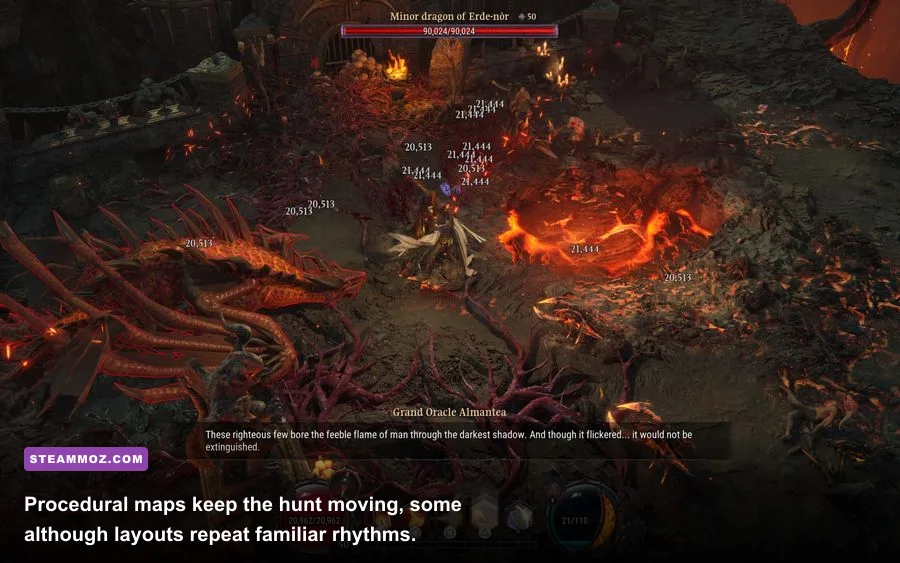
The procedural structure is a mixed blessing. Randomized objectives and layouts stop every run from being identical, and the possibility of a better item gives ordinary encounters purpose. At the same time, the game reuses visual themes and enemy behaviors more than a long-term loot game ideally should. After several hours, you begin recognizing the cadence: clear a broad room, follow a branching route, fight an elite cluster, complete the objective, then push toward the final reward.
Bosses are at their best when they force you to change position rather than simply inflate their health bar. Watch for arena attacks, delayed ground hazards, and summoned adds that pull attention away from the main target. Save your movement skill for a confirmed danger pattern instead of spending it to shave a second off travel time. That small habit makes a surprising difference in higher difficulties.
The endgame is enjoyable if you treat it as a build-testing laboratory. It is less convincing if you expect an infinite-service game with constant novelty. There are meaningful reasons to refine a character, but the reward structure can become repetitive once you have solved your preferred route through the Heroic Codex. This is where Blood Scales Edition's extra content helps presentation and collection value more than it transforms longevity.
How long does Dragonkin last?
Your first campaign run should provide a solid introduction to the four heroes and core systems, while a single character can absorb much more time if you enjoy tuning gear. The real variable is whether you like repeating expeditions. A completionist working through multiple classes will find plenty to do; a player who wants one tightly authored adventure may feel the seams much sooner.
That structure makes Dragonkin a good companion to other games rather than an all-consuming replacement. If you enjoy optimizing resource loops, our Satisfactory gold-farming guide is obviously aimed at a different kind of grind, but it captures the same appeal: efficiency becomes its own reward once the basic challenge is understood.
PC Performance and the Settings Worth Changing
Dragonkin is not an especially demanding PC game by modern standards, but crowded combat can be more expensive than a quiet town hub. Particle effects, elemental hazards, shadows, and multiple enemy attacks arriving at once are the main trouble spots. A locked 60 frames per second is more valuable here than a prettier screenshot because dodging delayed area attacks depends on consistent visual timing.
The published Steam requirements list a Windows 10 64-bit system, an Intel Core i5-8400 or AMD Ryzen 5 2600, 8GB of RAM, and a GeForce GTX 1060 or Radeon RX 580 as the minimum class of hardware. The recommended tier moves to an Intel Core i7-9700 or Ryzen 7 3700X, 16GB of RAM, and a GeForce RTX 2070 or Radeon RX 5700 XT. Treat those as a starting point, not a promise of maximum settings at a fixed frame rate.
| Setting | Recommended Value | Performance Impact | Visual Trade-Off |
|---|---|---|---|
| Resolution | Native resolution | High if reduced | Keep native when possible for sharper telegraphs |
| Shadow quality | Medium | Medium to high | Small loss in scene depth, large gain in busy fights |
| Effects or particles | Medium on mid-range GPUs | High during elemental encounters | Less spectacle, clearer and steadier combat |
| Ambient occlusion | Medium or Off | Low to medium | Flatter contact shadows when disabled |
| Texture quality | High with 6GB-plus VRAM | Low unless VRAM is limited | Keep high for equipment and environment detail |
| Motion blur | Off | Negligible | Cleaner movement and easier hazard reading |
| V-Sync or frame cap | Cap at stable refresh target | Can reduce spikes | Better consistency than chasing unstable highs |
My pro-tuned profile is simple: leave textures high, cut shadows and particles to medium, disable motion blur, and cap the frame rate at the highest number your system can hold through a four-player fight. If the game feels smooth in town but stutters in expeditions, don't immediately lower resolution. Start with effects, shadows, and any volumetric option. Those settings usually attack the real bottleneck while preserving the clarity of the world.
On a handheld PC, 30 frames per second is playable for slower Knight builds, but 40 or 45 feels much better for Barbarian and Oracle movement. Lowering effects is especially useful on a Steam Deck-style device because overlapping spell effects can obscure enemy warnings and produce inconsistent frame pacing. For more general PC tuning ideas, our Zenless Zone Zero performance settings guide explains the same practical rule: target consistency first, then add visual quality back one setting at a time.
What Holds Dragonkin Back in 2026?
Dragonkin's biggest problem is not a single broken system. It is the friction created by several merely adequate systems sitting beside a genuinely clever one. The Heroic Codex invites experimentation, but the mission structure does not always provide enough enemy variety to make every experiment feel necessary. The town offers useful progression, but returning to it can feel like housekeeping between similar runs. The loot chase works, but item comparison becomes noisy once your inventory fills quickly.
Enemy readability is generally strong, yet some encounters become messy when ranged attacks, ground hazards, summons, and elite modifiers overlap. The issue is less about difficulty than information. A build with limited mobility can be punished by a hazard hidden under a larger visual effect, particularly in co-op. Learning to pause your aggression and reposition is essential, but better contrast and cleaner effect layering would make that lesson feel fairer.
The narrative also leaves value on the table. The dragon threat is a strong premise, and the frozen landscapes have enough personality to support a memorable journey, but the campaign often rushes past character moments. The four heroes are mechanically distinct, though they do not receive the same emotional depth you would expect from a story-first RPG. If you want lore, atmosphere, and character drama above all else, this is not the loot game to choose.
Even so, these flaws are manageable because the moment-to-moment action remains responsive. You can feel when a build clicks. A well-connected Codex route changes your rhythm, a new weapon changes your priorities, and a co-op partner can turn a dangerous room into a controlled demolition. That tactile payoff is why Dragonkin survives its repetitive stretches.
Is Dragonkin: Blood Scales Edition Worth Playing?
Yes, with a sale-friendly recommendation. Dragonkin: Blood Scales Edition is worth playing in 2026 for action-RPG fans who value flexible builds, readable real-time combat, and cooperative expeditions. The four heroes feel different enough to support multiple playthroughs, the Heroic Codex gives progression more personality than a basic linear skill tree, and the loot loop is satisfying once you stop judging every item by its headline damage number.
It is not the right purchase for everyone. Skip it if you want a massive, constantly evolving endgame, a dense story campaign, or the enormous enemy and item ecosystem of the genre's biggest names. Solo players should be comfortable with repetition, and perfectionists may find the interface and loot evaluation less elegant than they would like. The Blood Scales Edition is best viewed as the version for players who already know they want to spend time with the game, not as a cure for those reservations.
| Player Type | Recommendation | Why |
|---|---|---|
| Co-op loot-game fan | Buy | Distinct heroes and complementary crowd-control roles shine with friends |
| Build-crafting enthusiast | Buy on sale or Blood Scales Edition | The Heroic Codex offers meaningful routes and experimentation |
| Story-focused RPG player | Wait | The narrative supports the missions but rarely leads them |
| Diablo IV or Path of Exile veteran | Try before committing | Combat is approachable, but the endgame is smaller and more repetitive |
| Handheld PC owner | Buy with tuned settings | Playable performance is achievable, though effects need trimming |
Start with the hero whose combat rhythm matches your patience. Pick Barbarian if you want immediate physical impact, Knight if you prefer controlled defense, Oracle if you enjoy cycling elemental abilities, and Witch if setting up curses and summons sounds more satisfying than charging into every pack. Follow one coherent Codex route, keep a movement option equipped, and don't let a flashy damage roll convince you to abandon the defenses keeping your expedition alive.
For wider context, the Steam news hub is the safest place to check current updates, hotfixes, and edition details before purchasing. Dragonkin is still easier to recommend when its support and balance work are active, so confirm the state of the latest build rather than relying on an old launch-era score.
Final score: 7.5/10. Dragonkin: Blood Scales Edition is a likable, mechanically inventive dungeon crawler with enough personality to earn your time. It stumbles when its procedural foundation starts showing through, but the Heroic Codex, strong class identities, and satisfying co-op combat give it a reason to exist beyond imitation. In 2026, it is not essential—but it is absolutely worth playing if you want a focused ARPG that rewards clever builds more than endless menu management.