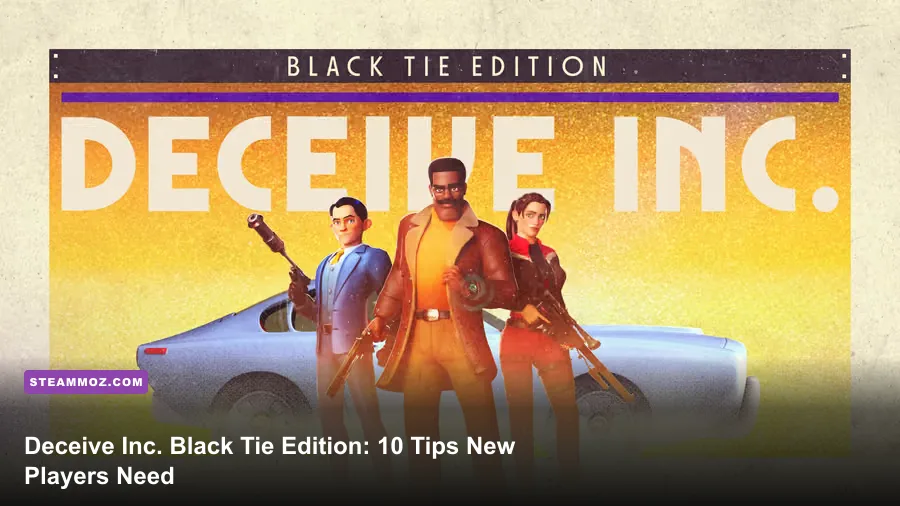
Deceive Inc. is won by players who treat stealth, information, and timing as seriously as gunplay. For your first matches, learn one agent, stay disguised until you have a reason to reveal yourself, hack Intel terminals before chasing the vault, and leave early when the package becomes too hot. The Black Tie Edition adds premium flair, but it doesn't make your agent stronger; your real advantage comes from reading NPC behavior, managing cover, and choosing fights that move the mission forward.
This is not a conventional battle royale where the loudest rifle wins. Deceive Inc. is a social-stealth extraction game built around infiltrating a guarded facility, collecting Intel, opening the Vault, stealing the package, and reaching an extraction point while rival agents hunt you. That loop creates a brutal learning curve: you can dominate a firefight and still lose because you entered the wrong room, broke cover in public, or extracted through the obvious exit.
Before jumping in, check the official Steam page for current patch notes and platform details. Balance changes can alter agent damage, cooldowns, and map layouts, so treat the advice below as durable fundamentals rather than a frozen tier list.
1. Master cover identities before firing a shot
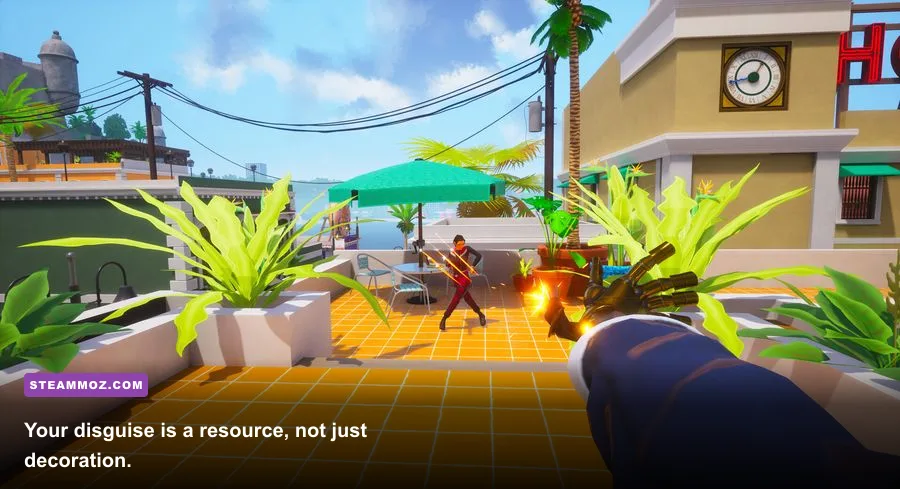
Your cover identity is your first health bar. Every map is filled with NPCs belonging to different roles, and walking through a restricted area while matching the correct disguise lets you pass security without immediately attracting attention. Entering a guard-only room as a technician is suspicious even if nobody shoots you; the alert builds, doors may lock, and nearby players receive valuable information.
Use the disguise wheel deliberately. If you need to enter a security zone, find an NPC with the correct role first, then adopt that cover before crossing the threshold. Watch how civilians move and pause. Real NPCs follow predictable routes, while a disguised player may sprint, stop at strange angles, or stare directly at a terminal. You don't need to role-play perfectly, but avoid frantic movement in crowded spaces.
Scanning can identify nearby agents, objects, and useful points of interest. Don't hold it constantly: scanning slows your awareness of threats and can become a habit that gets you caught in an exposed doorway. Pulse it when entering a room, after hearing a suspicious sound, and before committing to a terminal.
When your cover starts flashing suspicion indicators, leave the area instead of waiting for a full reveal. Duck behind cover, change into a better identity, or use a gadget to break line of sight. The worst beginner mistake is treating a compromised disguise as permission to sprint through the entire facility.
| Situation | Best response | Why it works |
|---|---|---|
| Entering a restricted wing | Match the local NPC role first | Reduces suspicion and avoids unnecessary combat |
| Cover indicator starts rising | Break line of sight and rotate | Prevents a public reveal that broadcasts your position |
| NPC route looks unusual | Pause and scan the room | Players often imitate NPCs imperfectly |
| Identity is fully compromised | Change disguise or relocate | Staying nearby gives rivals an easy target |
🎮 Deceive Inc. Black Tie Edition
Looking to experience this game? Grab your digital key directly on our store for $2.99.
View on Steammoz Store →2. Learn the Intel-to-Vault route on every map
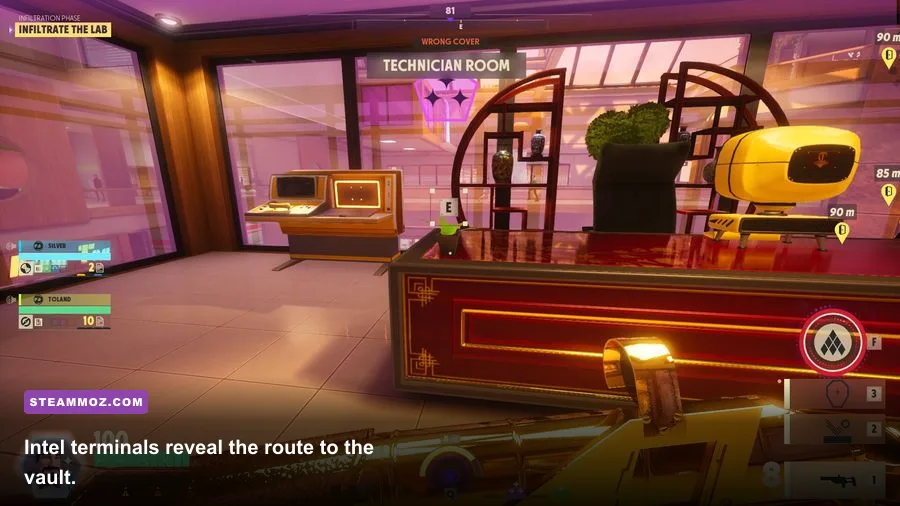
The mission route is more important than any single gunfight. You usually need to hack Intel terminals before the Vault can be opened, and each completed hack reveals progress toward the objective. On maps such as Diamond Spire, Fragrant Villa, and Hard Sell, the key terminals can sit in different wings from match to match. Learn the building's logic instead of memorizing one route.
At the beginning, move toward a low-risk terminal rather than racing straight to the center. Early Intel gives you information and lets you establish a safe rotation before the lobby becomes noisy. Listen for audio cues, watch the facility's security pattern, and note which doors connect objective rooms. A terminal beside a public corridor is often less safe than one in a restricted side room, even if both are equally close to the Vault.
Hacking creates commitment. You are vulnerable while interacting, so clear entrances before starting and keep an escape route in mind. If another player begins hacking nearby, don't automatically interrupt them. Sometimes the best play is to observe, let them reveal their position, and attack only when they leave with low resources.
Intel also helps you predict the endgame. Once the Vault is active, players converge quickly. Rotate early, position near a secondary entrance, and let impatient rivals fight over the first approach. The player who arrives second with full health and cooldowns often has the advantage over the player who touched the Vault first.
| Phase | Priority | Beginner mistake | Better habit |
|---|---|---|---|
| Opening | Find safe Intel and establish a disguise | Running directly into the central room | Use an outer route and scan each doorway |
| Mid-match | Track hacked terminals and rival noise | Hacking without checking exits | Clear one entrance and pre-plan a retreat |
| Vault active | Hold an angle or rotate to a flank | Starting a fair fight in the open | Attack weakened rivals after they commit |
| Package secured | Break contact and extract | Chasing eliminations across the map | Choose the safest exit, not the closest one |
For a useful mindset comparison, our Everspace 2 secrets guide also rewards route planning over impulsive looting. Deceive Inc. simply adds armed spies and disguises to the equation.
3. Pick one agent and understand the job they perform
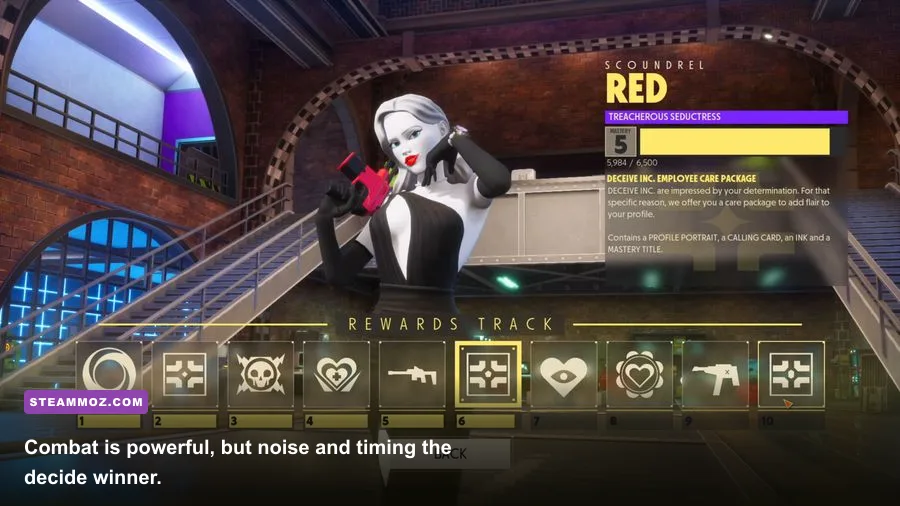
Don't rotate through the entire roster every match. Play at least five games with one agent so you learn their weapon rhythm, ability cooldowns, movement, and ideal engagement distance. Ace is a comfortable starting point because his revolver rewards accurate shots without forcing you into a narrow gimmick. Chavez is a strong choice if you want an assault rifle and a more direct combat plan. Hans teaches close-range discipline with his shotgun, while Squire demands patience and clean sightlines with his sniper rifle.
Cavalière, Luna, Red, Yu-Mi, and Juke all change how you approach the facility. Some agents excel at information, some at disruption, and others at creating a sudden escape window. Don't judge an agent only by elimination potential. A gadget that blocks a doorway, reveals a pursuer, or buys three seconds at extraction can be worth more than a damage tool.
Start every match with a simple ability plan. Use your mobility or defensive tool to escape a bad engagement, not to enter one blindly. Save information abilities for objective transitions, when knowing whether the next room is occupied matters most. Offensive cooldowns are strongest after a rival has spent their escape tool; opening with every ability can leave you helpless during the counterattack.
| Agent | Beginner-friendly strength | Risk to manage | Best learning goal |
|---|---|---|---|
| Ace | Accurate revolver and flexible dueling | Missed shots are heavily punished | Land deliberate headshots and reset fights |
| Chavez | Reliable assault-rifle pressure | Noise attracts third parties | Control bursts and disengage early |
| Hans | Devastating close-range shotgun damage | Weak when forced into long lanes | Use corners, doors, and ambush timing |
| Squire | Strong long-range pick potential | Missed shots expose your position | Relocate after firing |
| Luna | Information-focused playmaking | Less forgiving in straight duels | Win fights before they begin through intel |
Agent mastery also means knowing when not to fight. A weapon's effective range matters, but so does the room. Hans can own a tight stairwell; Squire wants a long sightline; Ace can adapt if he has cover. Choose the battlefield before you choose the target.
4. Treat combat as an ambush, not a duel
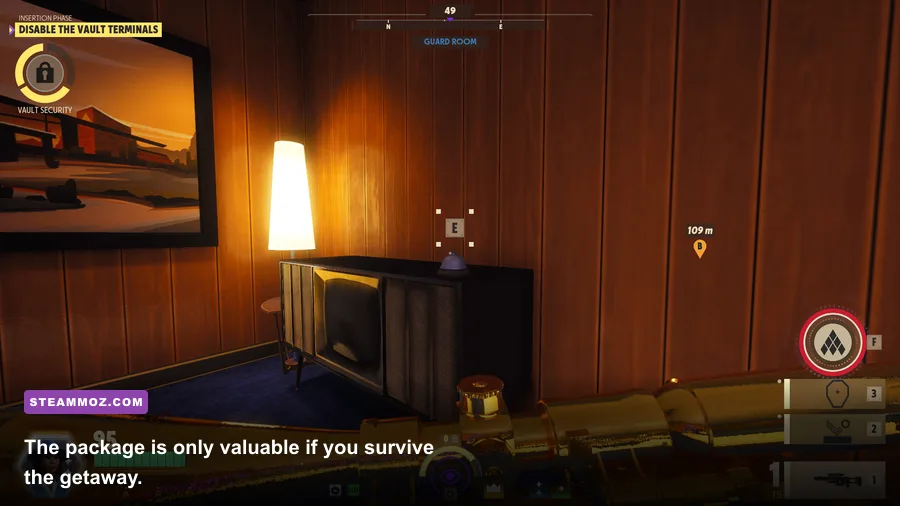
Deceive Inc. rewards the first clean burst. If you challenge an opponent in a flat corridor at full health, you're volunteering for a coin flip. Instead, attack from cover, open while they are interacting with a terminal, and force them to turn before they know your identity. The ideal fight is short enough that neither a third agent nor the facility's security can join.
Headshots matter, but accuracy isn't the only skill. Pre-aim at chest or head height, use corners to expose as little of your body as possible, and stop firing when the enemy breaks line of sight. Chasing a damaged agent around two rooms creates more danger than the original engagement. They may be baiting you toward a teammate, a turret, or a security zone.
Sound is information. Gunfire, gadget activation, doors, and footsteps tell rivals where the action is happening. After an elimination, don't instantly loot or celebrate. Reload, scan, check for a second agent, and decide whether the defeated player was bait. If the fight happened near the Vault, assume somebody heard it and is already rotating toward you.
Use the environment. Doors create shotgun traps, staircases deny clean pushes, and vertical routes let you break pursuit. Gadgets such as the Holo-Mimic, Tripwire, Goo Pod, or Bounce Pad are strongest when they support a known plan. A Holo-Mimic placed randomly is a visual joke; one positioned beside a real NPC route can make a pursuer hesitate long enough for you to vanish.
For PC players, stable frame pacing is more valuable than decorative detail in close fights. If performance is inconsistent, consult our frame-focused settings guide for the same general rule: reduce expensive effects first, keep target visibility clear, and prioritize consistent input response.
5. Make extraction your win condition
Stealing the package changes the match completely. Before touching it, identify at least one extraction route and preferably a backup. The nearest exit is often the most predictable, and predictable routes are where rivals wait. If you have low health, no escape cooldown, or a compromised identity, delaying the Vault can be smarter than grabbing it immediately.
Once you carry the package, your priorities are simple: break line of sight, avoid unnecessary fights, and keep moving toward a defensible extraction. Don't run in a straight line through the main hall. Change floors, use side rooms, and cross through areas where your disguise can be refreshed. If an opponent starts chasing, turn only when you have cover and a reason to fight.
Extraction is a timing puzzle. Arriving early can expose you to every rival still alive; arriving too late can leave you trapped by the final countdown. Watch the lobby state and listen for combat. If two players are fighting near the objective, rotate to a different exit rather than joining the pileup. Your goal is not to prove you are the best shooter. Your goal is to leave with the package.
That same discipline applies to contracts and progression. Unlocking agent levels, weapon mastery, and new gadgets becomes much faster when you survive deep into matches. A failed extraction teaches less than a successful escape with imperfect loot, because survival lets you understand the full objective cycle.
6. Use these five habits to survive your first ten matches
The first ten games should be treated as controlled experiments. Don't obsess over winning every lobby. Give each match a measurable objective: stay disguised for five minutes, complete one Intel hack, win one ambush, or extract after carrying the package. This turns a confusing loss into useful practice.
Habit one: scan before interacting
Terminals, doors, and loot create tunnel vision. Scan the room first, check the nearest entrance, and begin the interaction only when you know where you will move next.
Habit two: reload behind cover
Reloading in an open hallway is an invitation. Duck behind a doorframe or solid object, then resume your route. This matters especially for Ace and Squire, whose missed shots and reload windows can swing a duel.
Habit three: remember suspicious players
If an NPC pauses unnaturally, mirrors your route, or reaches a terminal too quickly, treat them as a possible agent. You don't need to shoot immediately. Keep distance, change direction, and watch whether they continue behaving like a real employee.
Habit four: rotate after loud actions
Every firefight creates a temporary danger zone. After shooting, hacking, or triggering a gadget, move to a new angle. Rivals often arrive after the first player has already spent health and cooldowns.
Habit five: review why you were revealed
Ask one question after every death: was I exposed by movement, sound, a bad disguise, a greedy chase, or poor positioning? Fixing one repeatable error is more valuable than copying a flashy agent montage.
If you enjoy studying systems-heavy games, Steamoz's Dungeons 3 beginner tips and ELEX performance fixes offer useful examples of the same approach: learn the rules, identify the failure point, then build a repeatable routine.
7. Tune your settings for visibility and reaction time
Fancy presentation is part of Deceive Inc.'s charm, but competitive stealth depends on seeing movement and reading silhouettes. Start with native resolution, a stable frame rate, and enough brightness to distinguish dark interiors. If your GPU struggles, lower shadows and post-processing before reducing resolution. A blurry image makes NPC recognition and long-range target identification harder.
| Setting | Recommended value | Performance impact | Visual reason |
|---|---|---|---|
| Resolution | Native monitor resolution | High GPU cost | Preserves character and disguise detail |
| Shadows | Medium | Medium to high | Keeps interiors readable without excessive cost |
| Effects | Medium | Medium | Reduces distracting combat clutter |
| Post-processing | Low or medium | Medium | Improves clarity during fast turns |
| Motion blur | Off | Minimal | Makes tracking and scanning cleaner |
| Field of view | Moderate, then adjust | Small CPU/GPU cost | Balances peripheral awareness and target size |
Don't chase a number you can't hold. A locked 60 frames per second is preferable to a wildly fluctuating 100 FPS if the instability affects aiming and movement. Players with high-refresh monitors should target a frame rate their system sustains during firefights, not just in an empty corridor. The PC performance guide on Steamoz explains the broader principle: test demanding scenes, not menu screens.
8. Stop donating information to rival agents
Every mistake in Deceive Inc. has an information cost. Shooting a civilian creates noise. Using an obvious door tells rivals which route you took. Breaking disguise in a public lobby announces that an agent is nearby. Even if you survive, you've narrowed the search for everyone else.
Use doors and corners to control what opponents can learn. Close doors behind you when retreating, but leave them open when you want to sell a false route. If you hear footsteps approaching, stop moving for a moment and let the opponent reveal whether they are an NPC or a player. Information denial is especially powerful around extraction, where a few seconds of uncertainty can separate a clean escape from a lost package.
Squads should communicate with purpose. Call out map wing, disguise type, health status, and direction rather than vague warnings like “someone's here.” A useful call sounds like “damaged agent, lower east corridor, moving toward Vault,” not “enemy nearby.” If you play solo, create the same mental callout for yourself before changing floors.
9. Build an escape kit before taking the Vault
A beginner inventory often contains offensive tools because they feel immediately useful. That's backwards. Before the Vault, reserve at least one mobility, defensive, or information option for extraction. Your strongest damage gadget should not be your only answer to a blocked doorway.
Think in pairs. A Holo-Mimic can create hesitation, while a mobility option converts that hesitation into distance. A Tripwire can protect a retreat, while a firearm handles the player who ignores it. A Goo Pod can slow a push, but it works best when you already know which exit you want to reach. Gadgets are not buttons to press whenever they become available; they're pieces of a route.
Health and ammunition are also mission resources. Don't spend every round clearing security guards if you can walk around them in a correct disguise. Don't heal after every scratch if the animation would expose you. Reach the Vault with enough resources to survive one ambush, then leave immediately after securing the package unless the extraction path is genuinely unsafe.
10. Know when to disengage and when to reset
The strongest new-player upgrade is learning that retreat isn't failure. If an agent has superior cover, your disguise is broken, and your cooldowns are empty, disengage. Run through a doorway, change floors, and force them to spend time searching. A rival who follows too aggressively may lose the objective window or expose themselves to another player.
Reset after every major event. Following a fight, reassess health, ammunition, cover, disguise, cooldowns, and objective state. If three of those are bad, rotate away. If you have full health, a fresh identity, and a clean flank, pressure the next room. This quick checklist prevents emotional re-engagement, the classic mistake where a player returns to finish a target and dies to the target's teammate.
The Black Tie Edition doesn't remove this learning curve, and that's exactly why it remains satisfying. The cosmetics can make your spy look the part, but successful matches come from quiet movement, patient Intel work, controlled gunfights, and smart extractions. Learn Diamond Spire's lanes, practice with Ace or Chavez, use your disguise until it stops helping, and make the package your priority. Once those habits click, Deceive Inc. stops feeling random and starts feeling like a spy thriller you are actively directing.
For current agent changes and community discussion, follow the official Deceive Inc. website, read updates from Steam announcements, and check the official Discord community. Patch notes matter here: a small cooldown or weapon adjustment can change which fights are worth taking, but these ten fundamentals will keep working regardless of the current meta.