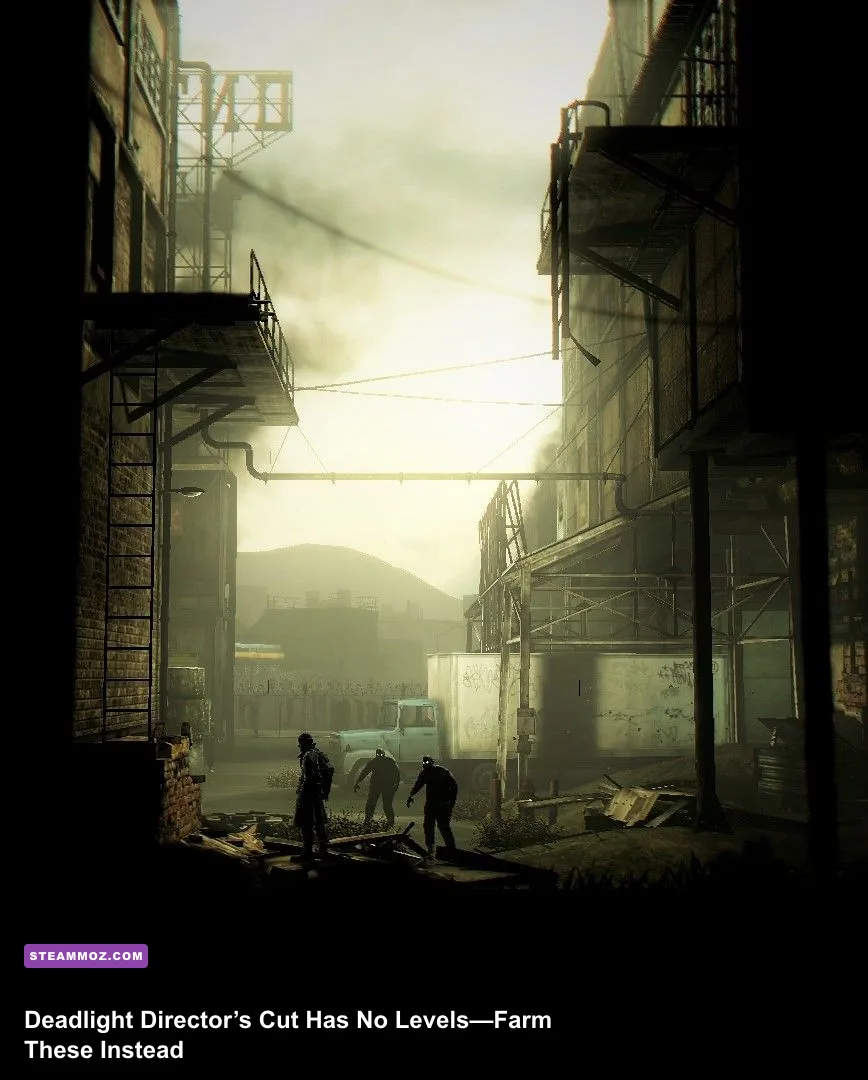
Deadlight: Director’s Cut has no character levels, XP bar, gold currency, shops, or repeatable gold farm. The fastest way to “level up” is to learn the campaign route, collect hidden items, conserve stamina, and replay chapters for cleaner completion. If you’re chasing an RPG-style grind, stop looking for a nonexistent vendor or exploit; Deadlight is a fixed-length cinematic platformer built around execution.
That distinction matters because plenty of search results describe Deadlight as if Randall Wayne can be upgraded through experience points. He can’t. Randall’s abilities are unlocked by the story, his weapons are acquired at specific moments, and the game never turns kills into currency. You don’t become stronger by farming Shadows. You become more consistent by understanding when to fight, when to run, and when to use the environment.
This guide breaks down the closest equivalents to fast leveling and gold farming in Deadlight: Director’s Cut: campaign progression, collectible routing, Survival Arena practice, weapon conservation, achievement cleanup, and Nightmare preparation. For the official PC release details, check the Deadlight: Director’s Cut Steam page before buying or reinstalling.
There Is No XP or Gold System
Deadlight is a side-scrolling survival game starring Randall Wayne, a former park ranger moving through Seattle in 1986 after a zombie outbreak. The game uses a linear chapter structure rather than an RPG progression model. You move through story scenes, platforming challenges, combat encounters, and optional secrets. Completing an encounter awards progress through the level itself—not experience, coins, or permanent stat points.
The enemies called Shadows are obstacles, not farming targets. Most fights are deliberately designed to be solved once and then left behind. Killing every enemy is often the slower and riskier option because the axe has limited stamina costs, firearms have limited ammunition, and some Shadows are positioned to pressure you into moving. A player who tries to grind kills can actually make a run worse by entering the next checkpoint exhausted or empty-handed.
The same goes for the game’s weapons. Randall’s fire axe is used for close-range attacks and environmental interaction, while firearms provide emergency control during encounters that cannot be safely handled at melee range. Their availability is tied to the campaign. There is no weapon shop, no rarity system, no damage upgrade tree, and no gold price attached to ammunition.
| RPG Feature You May Expect | Deadlight Equivalent | What Actually Improves | Best Approach |
|---|---|---|---|
| Character levels | Story checkpoints and chapter completion | Route knowledge and execution | Replay difficult sections without rushing |
| Gold currency | No currency system | Resource efficiency | Skip unnecessary fights and preserve ammunition |
| Weapon upgrades | Story-provided axe and firearms | Timing and positioning | Use the correct tool for each encounter |
| XP farming | Survival Arena practice and replaying chapters | Reaction speed and consistency | Repeat short problem sections |
| Loot progression | Secrets, collectibles, and achievements | Completion percentage | Search alternate routes after finishing the story |
That may sound less exciting than a gold route, but it makes Deadlight’s design much cleaner. Every improvement is player-facing. You’re not waiting for a number to rise; you’re learning why a jump failed, why a Shadow reached you, or why a supposedly safe combat animation left Randall vulnerable.
🎮 Deadlight: Director's Cut
Looking to experience this game? Grab your digital key directly on our store for $1.79.
View on Steammoz Store →The Fastest Campaign Progression Route

If your goal is to finish quickly, treat Deadlight like a time-trial platformer rather than a zombie brawler. The campaign rewards forward momentum. Run past enemies whenever the level geometry allows it, and only commit to combat when a Shadow blocks the route or threatens a required interaction.
1. Learn Randall’s movement before chasing speed
Randall’s movement has a deliberate rhythm. Jumps, ledge grabs, rolls, axe swings, and firearm actions are readable, but they are not instant. A common mistake is holding forward through every animation and assuming the game will correct the landing. It won’t. Release movement briefly before a precise jump, then reapply it once Randall has committed to the arc.
Use the first run to identify where the game expects a sprint, where it expects a crouch, and where a ledge can be grabbed. On later runs, the time saved comes from removing hesitation—not from taking reckless shortcuts. If a section costs more than one life when rushed, it isn’t a shortcut yet.
2. Fight only when the level demands it
The fire axe is powerful enough to dispatch isolated Shadows, but every swing consumes stamina and places Randall in a fixed animation. Against one enemy on flat ground, a controlled strike is usually safer than panic movement. Against multiple enemies, combat becomes a positioning puzzle. Look for doors, ladders, drop-offs, and narrow corridors that let the environment do the work.
Never start a fight simply because an enemy is visible. Ask whether the Shadow is actually blocking the exit. Many encounters are staged as pressure rather than mandatory combat. Running past an enemy preserves both time and resources, and the next checkpoint often makes the decision permanent for that section.
3. Use checkpoints as practice markers
Deadlight’s checkpoint structure is ideal for targeted improvement. When a jump or combat sequence repeatedly fails, restart and focus on that one sequence instead of replaying the entire campaign mentally. The objective is to create a reliable input pattern: approach, pause, jump, grab, climb, and move.
For fast completion, divide the campaign into three categories: safe movement, mandatory combat, and dangerous transitions. Safe movement should become automatic. Mandatory combat should use the least costly solution. Dangerous transitions—especially jumps made while enemies are nearby—deserve the most rehearsal because a small timing mistake can turn a clean run into a death loop.
4. Don’t confuse completion with collection
Trying to collect every hidden item during a first speed-focused run is inefficient. Deadlight’s secret areas are often placed away from the obvious route, and searching them while under pressure can create unnecessary deaths. Finish the story first, then replay chapters with a collectible checklist. This two-pass method is faster than mixing route learning, combat mastery, and exploration from the start.
Players who enjoy other compact action games may also like Steamoz’s list of games like F.E.A.R. 2, but Deadlight’s pacing is much more about movement discipline than shooting volume.
| Run Type | Primary Goal | What to Ignore | Expected Benefit |
|---|---|---|---|
| First campaign run | Learn routes and story progression | Optional secrets and risky fights | Reliable chapter knowledge |
| Speed-focused replay | Maintain forward momentum | Nonessential enemies | Lower completion time |
| Collectible replay | Search alternate paths | Fast pacing | Higher completion percentage |
| Nightmare preparation | Remove repeated mistakes | Unplanned experimentation | Fewer deaths under pressure |
How to Farm the Things Deadlight Actually Tracks
There’s no gold to farm, but there are meaningful completion targets. Deadlight: Director’s Cut includes optional secrets and collectible objectives that give exploration a purpose. These are not power upgrades, so don’t expect a hidden badge to increase axe damage or expand Randall’s health. Their value is completion, achievement progress, and the satisfaction of finding the route the level designer concealed.
Collectibles are route practice, not loot
Search above, below, and behind the main path. Deadlight frequently uses vertical layering: a route may continue to the right while a ladder, ledge, or breakable-looking side path leads to an optional room. The best collectible runs happen after you know the main route, because you can recognize when the level is asking you to stop advancing and inspect the surrounding geometry.
Keep a simple chapter-by-chapter checklist. Record the last confirmed collectible rather than relying on memory, and replay only the relevant section when something is missing. A blind full-game sweep wastes time, especially when a secret is tucked behind a timing challenge that is easy to overlook during a story run.
Use achievements as a completion roadmap
Achievements provide a more useful “leveling” framework than any imagined gold mechanic. Story achievements mark campaign progress, while exploration and challenge achievements encourage different play styles. Some reward discovering hidden content; others push you toward cleaner movement or specific survival decisions.
Don’t chase an achievement in the middle of a first playthrough if it compromises your resources. Write down the relevant chapter, finish the campaign, and return with the route already memorized. The game’s short chapter structure makes cleanup manageable, and repeated exposure turns awkward sequences into muscle memory.
Survival Arena is your repeatable grind mode
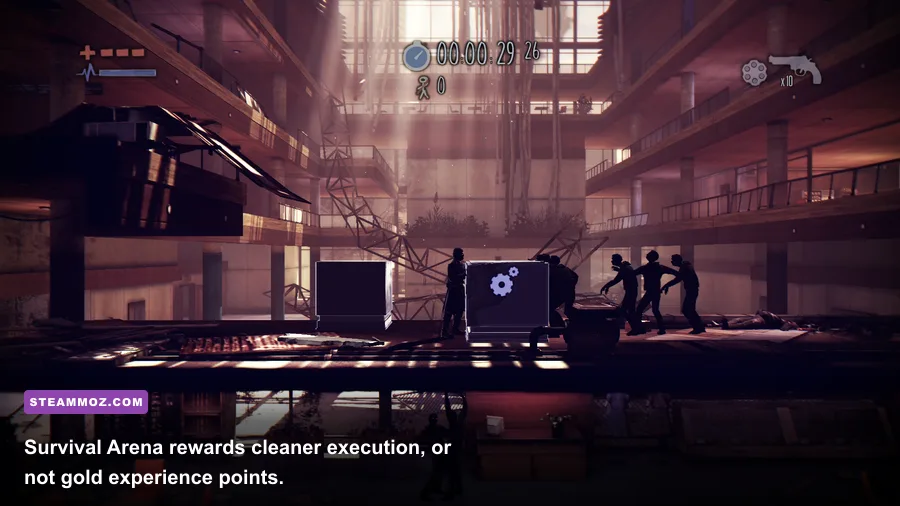
Survival Arena is the closest thing Deadlight has to an endlessly repeatable activity. It is not a currency farm, and it does not feed experience back into the campaign. Its value is mechanical practice. You learn enemy spacing, axe timing, escape routes, and how quickly stamina disappears when you swing without a plan.
Use Survival Arena to train one skill at a time. On early attempts, focus on staying alive and identifying attack patterns. Next, reduce unnecessary swings. Finally, work on movement efficiency: create distance, use the arena layout, and avoid cornering Randall. High scores come from surviving with control, not from attacking every Shadow the moment it enters the screen.
The official Tequila Works website provides background on the studio behind Deadlight, while the Deep Silver game page covers the Director’s Cut release. Those are safer references than unofficial pages that incorrectly list RPG currencies or leveling systems.
Weapons, Stamina, and Resource Management
Because Deadlight has no character stats, resource management is the real build system. Your “build” is the way you allocate stamina, ammunition, and attention across an encounter. The strongest approach is conservative: use the axe for isolated targets, firearms for situations where distance or crowd pressure makes melee dangerous, and the environment whenever it provides a safer solution.
Fire axe fundamentals
The axe is not a button you can mash through every problem. Its recovery animation matters, especially when two Shadows are close enough to attack from different timing windows. Strike when an enemy is committed, then reposition. If you keep swinging while moving backward, you’ll often discover that Randall cannot escape the next lunge.
Stamina is the hidden limiter. A player with full health can still lose an encounter by spending the stamina bar on unnecessary attacks and then needing a sprint or evasive action. Before swinging, check the exit route. If there is nowhere to retreat, reposition first. The best axe hit is the one that leaves you with enough energy to reach safety.
Firearms are emergency tools
Firearms should not be treated like a standard shooter’s primary weapon. Ammunition is limited by the campaign’s scripted supply, so shooting every visible enemy can leave you exposed during a later mandatory sequence. Save bullets for enemies that cannot be safely bypassed, crowded transitions, and moments where a shot creates the opening needed to escape.
Line up shots before committing. Panic firing while Randall is moving tends to waste ammunition and can fail to solve the actual problem, which is usually spacing. If a gunshot only staggers an enemy but leaves another one inside melee range, you haven’t bought safety—you’ve bought a brief animation.
Choose combat based on the room
Flat ground favors controlled axe timing. Narrow passages favor fast decisions and environmental movement. Vertical rooms favor patience because a missed grab can be more dangerous than the enemy below. If the game gives you a ladder, ledge, or door, assume it may be part of the intended answer. Deadlight’s best encounters are rarely asking for raw damage output.
| Tool or Action | Best Use | Main Risk | Efficiency Rule |
|---|---|---|---|
| Fire axe | Isolated Shadow on stable ground | Stamina drain and recovery animation | Strike once, reposition, then reassess |
| Firearm | Mandatory threat at unsafe distance | Limited ammunition | Save shots for crowded or unavoidable encounters |
| Sprint | Escaping pressure and crossing hazards | Arriving exhausted | Start only when the route is clear |
| Environmental route | Ladders, ledges, doors, and drops | Timing mistakes | Inspect geometry before engaging |
| Checkpoint restart | Practicing a failed sequence | Repeating the same mistake | Change one input or timing variable each attempt |
For a broader look at compact games where route knowledge beats loot grinding, Steamoz’s games like 10 Second Ninja X list is a useful detour. Deadlight is slower, but the same “learn the obstacle, then execute” mindset applies.
Nightmare Mode and the Best Replay Plan
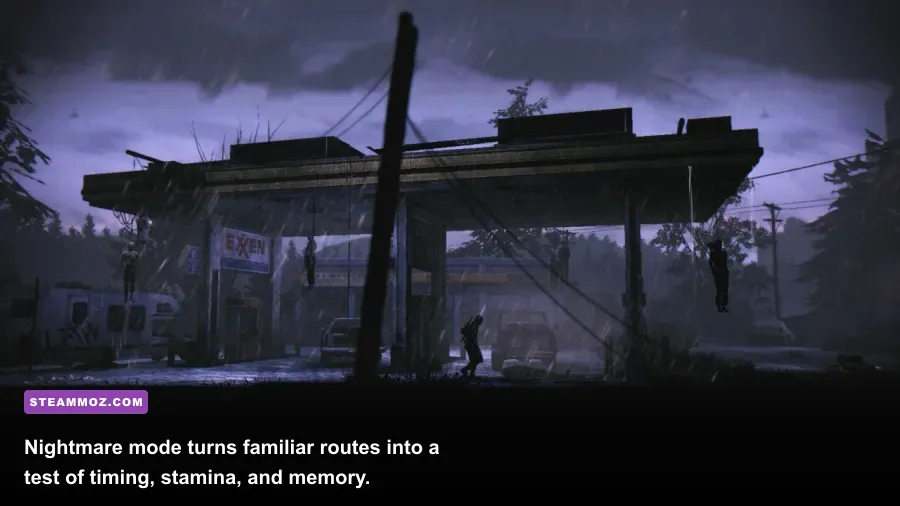
Nightmare difficulty is where the absence of leveling becomes most obvious. You cannot compensate for a weak route with extra health, stronger equipment, or a larger damage number. Nightmare asks whether you can perform the same movement and combat solutions with less room for error.
Build a two-pass Nightmare routine
Start by replaying the campaign on the standard difficulty until you know the mandatory encounters and checkpoint locations. Then enter Nightmare with a route plan, not a collection of guesses. Your first Nightmare run should prioritize survival and information. Note which sections kill you, whether the problem is stamina, enemy spacing, or a jump, and restart with one correction at a time.
After that, make a clean run focused on consistency. Avoid improvising in rooms you already understand. If a safe route takes three seconds longer but succeeds every time, it is better than a risky shortcut that causes repeated deaths. Deadlight’s short length makes disciplined repetition more valuable than theoretical optimization.
Performance settings can protect your timing
The Director’s Cut is a relatively lightweight game by modern PC standards, but stable frame pacing still matters in a precision platformer. Use a locked frame rate that your system can hold consistently rather than chasing a peak number that fluctuates during effects-heavy scenes. Disable unnecessary background overlays, and test controller input before beginning a serious replay.
On PC, start with 1080p if your display and hardware can sustain it, then prioritize stable presentation over extra resolution. If you notice inconsistent input or stutter, lower post-processing or resolution before blaming your timing. A failed jump caused by uneven frame delivery feels exactly like a failed jump caused by bad execution, which makes troubleshooting needlessly frustrating.
| Replay Profile | Resolution Target | Frame-Pacing Priority | Best For |
|---|---|---|---|
| Low-end stability | 720p or native low resolution | Locked, consistent output | Older laptops and integrated graphics |
| Balanced PC | 1080p | Stable refresh-matched cap | Most standard Steam systems |
| High-end display | 1080p or above if available | Consistency over maximum refresh | Clean screenshot and replay sessions |
| Nightmare practice | Use the clearest comfortable image | Input consistency above visual extras | Precision movement and repeated attempts |
If you’re coming to Deadlight after a modern survival game, reset your expectations. There is no base building, no crafting economy, and no endless endgame loop. Steamoz’s guide to Badlands Crew survival tips covers a much more resource-driven structure; Deadlight is tighter, more authored, and far less interested in letting you overprepare.
The Most Efficient “Gold Farm” Doesn’t Exist
So, what should you do if a quest, video, or search result tells you to farm gold in Deadlight: Director’s Cut? Treat it as a mix-up with another game. There is no gold counter to increase, no merchant inventory to unlock, and no enemy drop table worth optimizing. You can safely ignore any guide promising a coin route, XP exploit, stat-reset trick, or weapon-upgrade vendor.
The efficient replacement is simple: complete the story once, replay chapters for missed secrets, use Survival Arena to sharpen combat, and reserve Nightmare for when the standard routes feel automatic. That plan covers every meaningful form of progression the Director’s Cut actually offers.
For a first playthrough, prioritize forward movement and checkpoints. For a completion run, prioritize collectibles and hidden rooms. For a mastery run, prioritize zero-panic combat, controlled stamina use, and repeatable jumps. Each goal needs a different route, and trying to combine all three is the fastest way to make a short game feel exhausting.
Deadlight’s charm is that it never lets a spreadsheet solve the danger for you. Randall Wayne doesn’t become overpowered because you farmed a hallway for twenty minutes. You become better because you recognized the telegraph, waited for the opening, saved the bullet, and took the ledge on the first attempt. That’s the real leveling system—and it’s far more satisfying than gold.
If you want more tightly focused gaming guides, Steamoz also covers PC settings that fix low FPS and games like Dead Rising 4. Just remember the key Deadlight rule: there’s nothing to farm except cleaner runs.