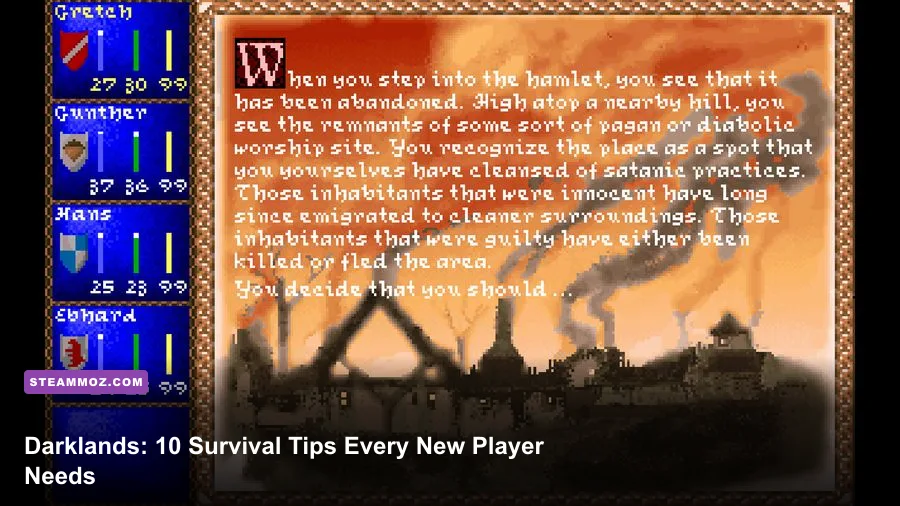
Darklands becomes far less brutal when you treat it as a preparation game rather than a power fantasy. Start with a six-person party, cover combat and utility skills, save before every journey, travel with food and money, and use alchemy, saints, and terrain to solve problems before swords come out. These 10 Darklands tips will help you survive the first week, avoid disastrous travel decisions, and build a party that can actually handle the Holy Roman Empire.
1. Build a party with jobs, not six identical fighters
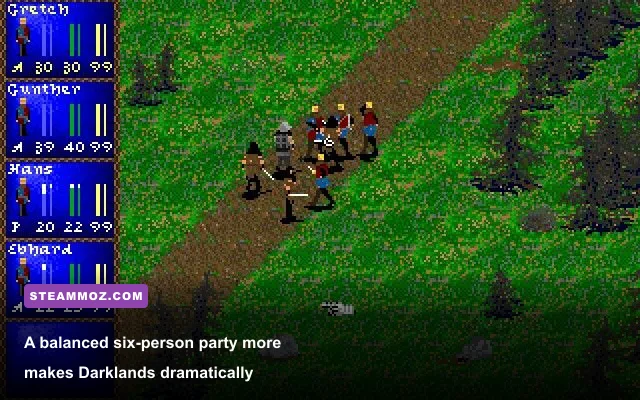
Darklands lets you create a party of up to six characters, but stacking six sword specialists is a fast route to a slow, expensive death. Every character should have a clear battlefield role and at least one useful non-combat skill. Your party needs front-line pressure, missile damage, medical support, and the practical skills that keep travel and town problems from spiraling.
A strong beginner setup uses two heavily armored melee characters, one polearm user, one missile specialist, one character focused on Alchemy, and one flexible scout with Streetwise, Stealth, or Theology. Put your best Leadership character near the front of the formation; morale failures become much more dangerous when nobody can stabilize the group.
| Role | Recommended Skill Focus | Useful Equipment | Why It Matters |
|---|---|---|---|
| Front-line fighter | Sword or Axe, Armor | Shield, helmet, heavy armor | Absorbs pressure and protects weaker characters |
| Reach fighter | Polearm, Strength | Spear or polearm | Attacks around allies and controls approaches |
| Missile specialist | Missile Weapons, Dexterity | Bow or crossbow, ammunition | Softens enemies before melee contact |
| Alchemist | Alchemy, Intelligence | Alchemy supplies and spare encumbrance | Creates healing and combat-enhancing potions |
| Scout and negotiator | Stealth, Streetwise, Charisma | Light armor and spare money | Reduces travel risk and opens safer solutions |
Don't chase perfect starting rolls. A character with a slightly lower combat score but excellent Alchemy or Theology can contribute more over a full campaign than another mediocre swordsman. The same party-building logic applies to other unforgiving RPGs; Steamoz's Din's Curse survival tips are a useful comparison.

🎮 DARK
Looking to experience this game? Grab your digital key directly on our store for $2.99.
View on Steammoz Store →2. Protect your money before you chase better gear
Gold disappears quickly in Darklands. Food, weapons, armor repairs, lodging, travel, and failed town activities all compete for the same purse. New players often spend everything on armor, then discover they cannot afford the food needed to reach the next settlement. Keep a cash reserve before every expedition instead of treating every coin as an invitation to shop.
Buy the equipment that changes survival odds first: helmets, shields, reliable armor, and ammunition. A minor weapon upgrade is rarely worth abandoning your travel budget. Heavy armor also affects movement and stamina, so don't automatically outfit every character with the most expensive protection available. Your rear-line alchemist and archer usually benefit more from mobility than from maximum armor rating.
Use towns as supply checkpoints. Nuremberg, Mainz, Augsburg, and other major settlements are safer places to reorganize than remote wilderness routes. Save before entering a town, inspect prices, and reload only if a catastrophic event or failed negotiation leaves your campaign economically crippled. Darklands is old-school enough that this isn't an exploit; it's the game acknowledging that a bad roll can erase hours of planning.
3. Learn the travel loop before exploring the map
Travel is one of Darklands' main systems, not a loading screen between fights. Your route, food supply, party condition, weather, and terrain all affect what happens on the road. Long journeys create more opportunities for ambushes, illness, and exhaustion, so plot routes between nearby towns instead of crossing half of Germany in one reckless push.
Check supplies before leaving. Food is not optional, and running short far from a settlement creates a chain reaction: hunger weakens the party, weakened characters perform worse, and poor performance makes the next encounter more expensive. Carry extra food, but don't overload everyone with unnecessary equipment. Encumbrance makes a bad journey worse.
Save at the town gate and again after reaching your destination. If a road event leaves a character badly injured or strips valuable equipment, you want a clean decision point. Also watch the calendar. Seasonal conditions and religious events can affect travel and access to services, so a route that looks efficient on the map may be a terrible idea in practice.
When the game gives you an option to avoid trouble through Stealth, Streetwise, Leadership, or another skill, consider the long-term cost. A successful bypass is usually better than winning a fight that consumes ammunition, healing, and armor durability. That risk-management mindset is also useful in Children of Silentown, where survival depends more on choosing the right solution than chasing raw power.
4. Use combat formations and pause constantly
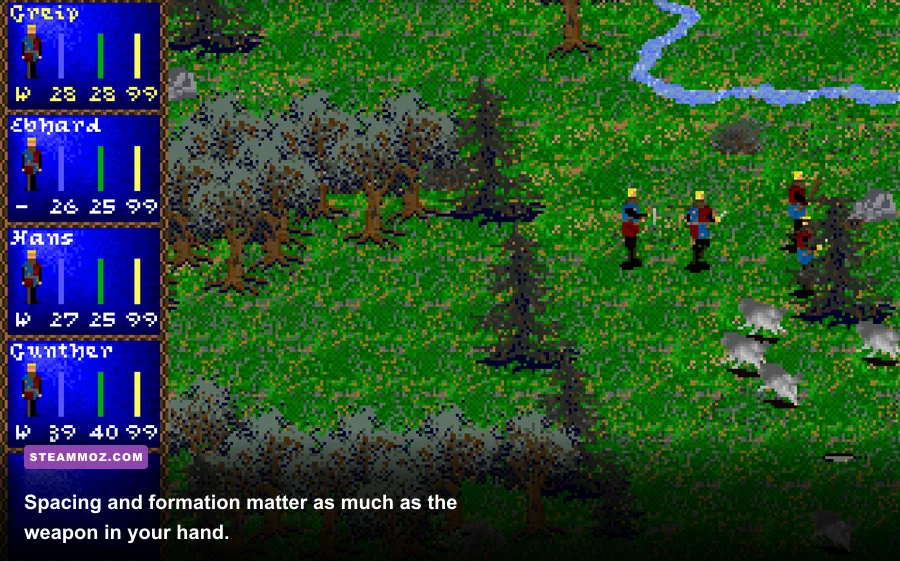
Darklands combat feels chaotic until you remember that positioning is your strongest defensive stat. Pause frequently, especially when an encounter begins, and assign targets before everyone rushes forward. Put shielded fighters between enemies and your missile users. Keep the alchemist out of the first collision. Let the polearm character attack from behind or beside the front line instead of standing alone in open ground.
Missile weapons are most valuable before the melee collapses into a scrum. Focus fire on one dangerous target rather than spreading damage across the entire enemy group. A wounded enemy still swings at full effectiveness, while a defeated one contributes nothing. Once lines meet, pull your archers back rather than leaving them trapped behind friendly bodies.
| Combat Problem | Best Response | Common Mistake | Priority |
|---|---|---|---|
| Enemies rush the back line | Pause, turn the front line, retreat archers | Letting every character chase a different target | Immediate |
| One armored enemy dominates | Focus missile fire and surround with melee | Splitting attacks across weak targets | High |
| Party is exhausted | Shorten the engagement and use consumables | Saving every potion for a boss that may never come | High |
| Formation collapses | Pause and rebuild a front line | Issuing movement commands continuously | Medium |
| Character is isolated | Move allies toward them before attacking | Charging deeper into the enemy group | Immediate |
Don't judge a weapon only by its damage. Reach, attack timing, ammunition, and the character's relevant skill determine whether it performs well. A properly positioned spear user can protect an archer more effectively than a second expensive sword fighter.
5. Treat Alchemy as a core combat system
Alchemy is not a novelty skill you level after mastering combat. It is one of Darklands' best tools for smoothing out the game's harsh progression. Give one character a serious Alchemy investment and keep ingredients whenever your travel budget allows. Healing and enhancement potions can turn an otherwise unwinnable encounter into a manageable one.
Use consumables proactively. If a front-line fighter is already close to collapse, waiting for a perfect moment often means the character never gets to drink anything. Likewise, an enhancement potion used before the first exchange can save more health than one used after the party is already surrounded. Keep the alchemist protected and avoid putting all ingredients in the inventory of a character likely to be knocked unconscious.
Alchemy also changes how you evaluate loot. A cheap ingredient may be more valuable than a mediocre weapon because it converts into multiple solutions. Check what you can craft whenever you return to town, then use spare storage for ingredients rather than hauling every low-value piece of armor back to a merchant.
6. Train skills deliberately instead of spreading points everywhere
Darklands rewards specialists. Combat skills such as Sword, Axe, Mace, Polearm, and Missile Weapons improve when used, while skills like Astrology, Theology, Streetwise, Trading, Finance, and Alchemy solve different problems outside battle. A character with five half-developed skills is usually less useful than one with two dependable specialties.
Choose a training plan before the party leaves its first town. Put weapon practice on the characters who will actually use those weapons. Don't give a bow to the character you've designed as a heavy mace fighter just because the bow has a higher listed value. Your goal is a reliable action every turn, not a character sheet full of respectable but unfocused numbers.
Leadership deserves special attention because it supports the whole party rather than one damage dealer. Charisma-linked skills can also prevent fights or improve interactions, but they won't replace a real front line. Balance social utility against the simple fact that wilderness combat remains unavoidable.
If you enjoy games where progression comes from using a system intelligently rather than following a quest marker, compare this approach with Steamoz's Death Howl leveling guide. Darklands is less transparent, but the same principle applies: specialize early, then broaden once the core loop is stable.
7. Use Theology, Astrology, and saints for more than flavor
Darklands' religious and occult systems are unusually practical. Theology and Astrology can unlock information, improve decisions, and give the party options that brute force cannot. Saints are especially important because invoking the right saint can provide a powerful answer to a specific situation, from protection to recovery and other forms of assistance.
Don't burn every religious resource the moment you receive it. Carry a small reserve for dangerous travel and major fights, but use it when the situation genuinely demands help. The correct saint or ritual can be more valuable than another item bought from a merchant, particularly when your party is too injured to risk a conventional battle.
Astrology is similarly easy to ignore because it doesn't look like a damage skill. That is a trap. Information and timing reduce risk before combat starts. Give these systems to dedicated characters rather than asking your fighters to cover them at low proficiency.
8. Save before every irreversible decision
Save often, but save intelligently. Create a town save, a pre-travel save, and a pre-combat save. Keep them separate instead of overwriting one file. Darklands can punish a decision several minutes after you make it, and a single failed event may leave you with injuries, lost supplies, or a permanently worse position.
Use separate saves before recruiting, buying expensive equipment, accepting risky work, entering ruins, and attempting unfamiliar town activities. This doesn't remove the game's uncertainty; it lets you learn its systems without losing an entire campaign to one opaque result. Classic RPGs often require this kind of discipline, much like the crash-and-performance troubleshooting in Steamoz's City of Gangsters PC guide.
9. Don't underestimate town services and rumors
Towns are where your campaign becomes sustainable. Heal damaged characters, repair equipment, restock food, check rumors, and investigate opportunities before setting out again. Rushing from one battle to another keeps the party in a permanently weakened state and makes every random encounter feel unfair.
Rumors and local information can point toward work, danger, or useful destinations. Listen before traveling blindly. A town's services also reflect your party composition: a group with strong Trading or Finance can stretch its budget, while Streetwise and Charisma can create alternatives to violence. These benefits compound over time, so utility characters become more valuable as the campaign grows.
10. Install the game carefully and embrace its old-school rules
The current Darklands Steam release is an old DOS RPG, so expect a presentation that feels rough by modern standards. Read the included documentation before starting, and keep the display settings comfortable rather than forcing a stretched image that makes text hard to read. The game's menus contain vital information, and missing a line of text can be more damaging than losing a frame.
For background on the original design, the official MicroProse Darklands page is worth bookmarking. The Steam community hub can also help with compatibility discoveries and player-made documentation. Just remember that modern convenience should support the rules, not replace learning them.
Darklands is at its best when you stop expecting a guided adventure and start thinking like a medieval expedition leader. Build specialists, preserve cash, travel in short legs, pause through every fight, and keep a recovery plan for the inevitable bad roll. Once those habits click, the game's strange systems stop feeling hostile. They become the reason this 1992 RPG still feels unlike almost anything else on PC.