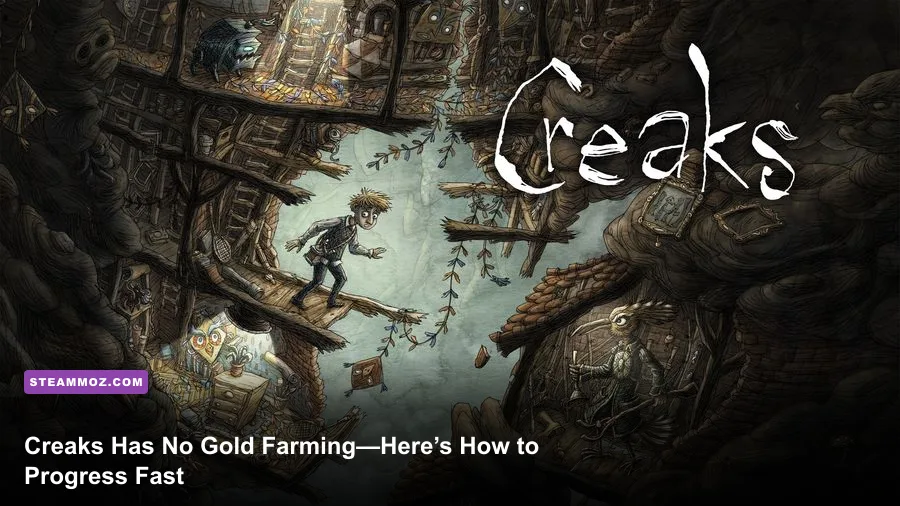
Creaks has no character levels, gold, shops, weapons, or repeatable farming route. The fastest way to progress is to solve each room efficiently, search for its hidden collectible before leaving, and use the light-and-shadow rules to control Dogs, Birds, and other hazards. If you were expecting an RPG-style Creaks fast leveling and gold farming guide, the important correction is that Amanita Design built a handcrafted puzzle adventure where progress is measured in solved screens, unlocked doors, secret paintings, and story scenes—not currency or experience points.
That distinction changes the entire strategy. Grinding enemies does nothing because enemies aren't defeated for rewards. Revisiting an area doesn't generate gold because Creaks has no currency system. There isn't an XP bar to optimize, and there are no random drops, stat upgrades, or gear tiers hiding behind difficult encounters. Your real advantage is knowledge: learning what each enemy does under light, recognizing reset states, and refusing to move on until you've checked the room's optional exits.
This guide explains the progression system Creaks actually uses, how to finish rooms with fewer failed attempts, and how to collect the game's optional rewards without turning the experience into a slow backtracking marathon.
Forget Gold Farming and Track the Right Progress
Creaks is a linear, room-by-room adventure from Amanita Design on Steam. You guide the protagonist through an underground world after strange creatures begin appearing in his home. The game gradually introduces rules, combines them, and then tests whether you've understood the environment. Nothing is procedurally generated, so the optimal route is about solving the intended puzzle cleanly rather than repeating a profitable activity.
There are four useful progress targets:
- Main-room completion: solve the mechanism blocking the next door, lift, bridge, or passage.
- Story progression: reach new underground areas and trigger the next narrative sequence.
- Optional paintings: locate concealed rooms and interact with their collectible artwork.
- Observation-game progress: find the hidden arcade-style minigames and other optional discoveries.
These targets don't have an economic value, but they do have different costs. A main route usually demands a solution. A painting often demands noticing a break in the scenery, a climbable ledge, or a side passage that isn't required for the door ahead. The sensible approach is to solve the required route first in your head, then inspect the room for optional access while the layout is still fresh.
| Activity | Reward | Can It Be Farmed? | Best Strategy |
|---|---|---|---|
| Solving a main puzzle room | New route and story progress | No | Study the whole room before touching switches |
| Defeating or avoiding enemies | Safe passage only | No | Use light, timing, and reset points |
| Finding a hidden painting | Optional collectible | No | Check side passages and suspicious architecture |
| Discovering a minigame | Optional bonus content | No | Explore areas beyond the obvious objective |
| Returning to a completed room | No repeat reward | No | Backtrack only to finish missed collectibles |
The closest thing to a perfect run is a low-restart completion that collects every optional discovery on the first visit. That saves time, but it doesn't unlock stronger abilities. Creaks deliberately keeps your movement and interaction toolkit simple so the challenge remains about spatial reasoning.

🎮 Crea
Looking to experience this game? Grab your digital key directly on our store for $14.99.
View on Steammoz Store →How Creaks’ Light System Replaces Combat Stats
The central rule behind fast progression is that light changes the behavior of the underground creatures. Your lantern is not a weapon, and the game isn't asking you to reduce enemy health. Instead, illumination alters which spaces are safe and which paths are blocked. A room that looks impossible in darkness can become straightforward once you identify the correct lamp, switch, or movable light source.
Before moving, map three things: the enemy's patrol or trigger zone, the nearest safe platform, and the device that changes the room's lighting. Treat every lamp as part of the puzzle's geometry. Turning one on may make a creature harmless, but it can also remove the cover you needed to pass another obstacle. That's why rushing toward the first visible switch often creates a dead end.
A reliable sequence looks like this:
- Stand still and watch. Let enemies complete at least one movement cycle. Their timing is usually more predictable than it first appears.
- Identify the safe state. Determine whether the creature becomes passive, retreats, or changes position when exposed to light.
- Find the reset. Look for a lever, pressure plate, door, or platform that restores the room after a mistake.
- Plan the return trip. Many solutions work in one direction but fail when you need to cross the same space again.
- Commit only after the route is clear. A successful switch activation is worthless if it leaves you trapped on the wrong side.
The game also teaches its rules gradually. Early rooms isolate one interaction, while later rooms combine multiple threats and require you to remember what happened several screens earlier. If a room feels unfair, assume you've missed a relationship between two objects. Creaks rarely asks for twitch reactions; it asks you to understand why the room changes after an action.
This is where the supposed gold-farming mindset becomes actively harmful. Repetition doesn't improve your character. Repetition improves your read of the puzzle. Restarting after a failed attempt is useful only if you can name the mistake: wrong timing, missed light source, incorrect enemy state, or an unplanned return route.
The Fastest Room-Clearing Method
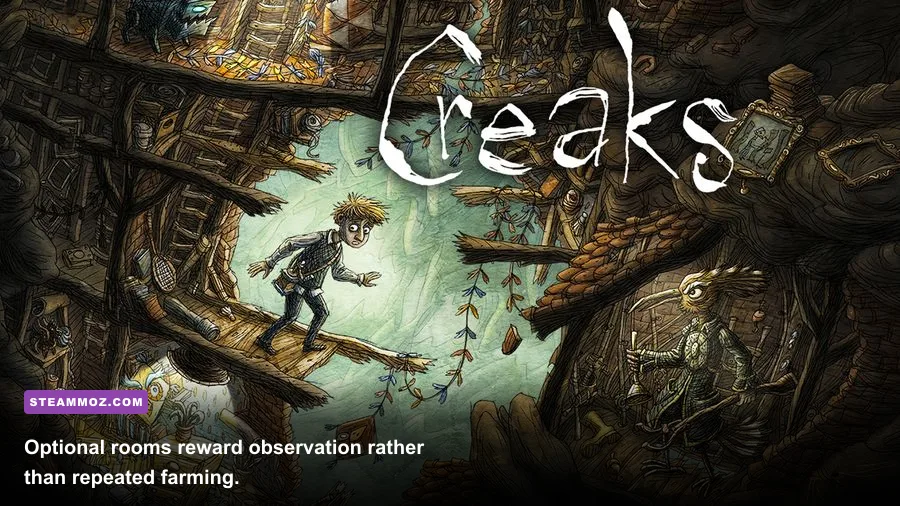
For efficient progression, use a two-pass method rather than wandering randomly. On the first pass, inspect the entire visible room without activating anything. Note ladders, doors, switches, platforms, floor panels, hanging objects, and anything that looks visually different from the surrounding wall. Amanita Design uses environmental contrast to hint at interaction points, and many solutions become obvious once you stop staring only at the locked exit.
Pass one: solve the room on paper
You don't literally need paper, but you should mentally simulate the sequence. Ask what each switch changes, whether a door stays open, and where you will stand after the animation ends. If there are two light sources, test the consequences of each one before committing to a traversal route. The best solution is usually the one that preserves access to the largest part of the room.
Pass two: collect before leaving
Once the main door is open, don't immediately exit. Scan the edges of the screen, revisit platforms that were previously blocked, and inspect paths that became accessible after the lighting changed. Optional rooms are often designed as small detours from the main solution. They reward players who remember the room's earlier state and recognize that a previously dangerous corridor is now safe.
| Room Situation | Common Mistake | Efficient Correction | Restart Value |
|---|---|---|---|
| Two switches affect one lamp | Activating them in visible order | Trace the route each lighting state creates | High if you reset immediately |
| Enemy blocks a narrow corridor | Trying to sprint through its trigger zone | Change its state before entering the corridor | Medium |
| Door opens behind the protagonist | Leaving without checking the side route | Search newly safe platforms first | Low if the room is still accessible |
| Moving platform crosses hazards | Riding before observing its full cycle | Watch the complete loop and board on the return | High when a fall resets the sequence |
| Hidden room suspected | Assuming every wall is decorative | Check dead ends, ledges, and unusual gaps | Low; return later if needed |
Keep an eye on the protagonist's position after an interaction. Creaks often places you on a platform or floor section that looks safe but limits your next move. The puzzle isn't finished when the mechanism activates. It is finished when you can reach the exit without undoing the state you just created.
If you're coming from a combat-heavy dungeon crawler, Steamoz's Dungeon Siege review covers the opposite progression philosophy: that game rewards build growth and loot, while Creaks rewards careful interpretation. Don't bring the wrong expectations into its rooms.
Hidden Paintings and Optional Rewards Without Backtracking
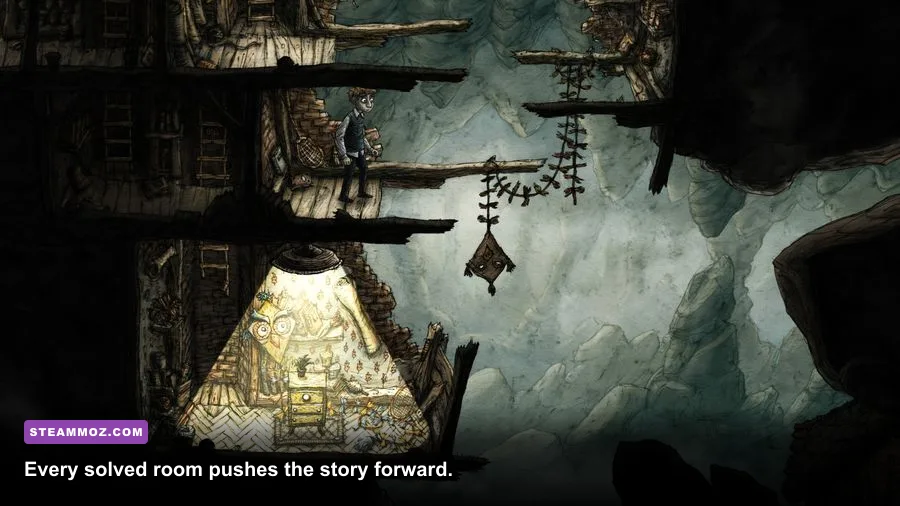
There is no gold to collect, but the hidden paintings are the closest equivalent to treasure. They expand the world and reward curiosity, yet they rarely sit directly on the critical path. The key is to search at the right moment. Explore too early and you may waste time trying to reach a route that only becomes available after a lighting change. Explore too late and you may forget which objects moved.
Use this checklist whenever you enter a new section:
- Check every visible branch before crossing the obvious central route.
- Look above and below the protagonist, especially around ladders and platforms.
- Reinspect areas after switching a lamp or opening a barrier.
- Test suspicious dead ends instead of assuming they are purely decorative.
- Before leaving, walk back through the room's safest route and compare it with the first layout.
Don't confuse a blocked side route with a missed collectible. Some optional areas are deliberately gated by the main puzzle, so a sealed passage can be a clue to return after changing the room. Conversely, if you have opened the exit and the room still contains an unexplained platform, that is a strong signal to search before progressing.
There is no penalty for completing the story first and cleaning up later, but first-visit collection is more efficient because the visual logic is still in your head. If you do backtrack, follow the main route in reverse and focus only on rooms where you remember an inaccessible ledge or unexplored branch. Randomly wandering through the underground world is the slowest possible version of Creaks.
The same principle applies to the optional minigames. They aren't a source of money or experience, and they don't turn the protagonist into a stronger character. Treat them as discoveries that complete your understanding of the setting, not as content that must be repeated for a better payout.
Difficulty, Restarts, and a Practical Completion Route
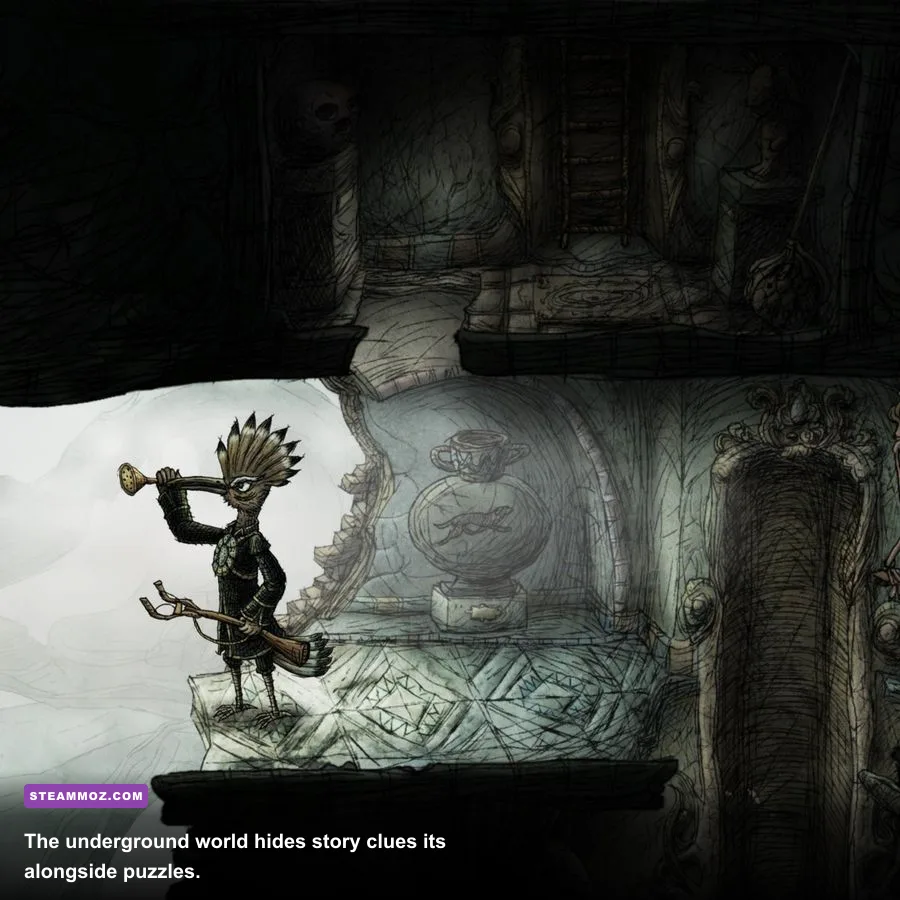
Creaks doesn't offer a conventional leveling curve, so your progression curve is cognitive. The first hours teach individual rules; the middle game combines them; the later rooms test whether you can track several changing states at once. That structure makes patience more valuable than speed. A restart after ten seconds of observation is often faster than improvising through a room and losing two minutes to a chain of bad decisions.
| Progress Stage | Primary Skill | What to Prioritize | Fast-Progress Rule |
|---|---|---|---|
| Early underground rooms | Reading light reactions | Learn each creature's safe state | Don't move until the first cycle is clear |
| Multi-switch rooms | State management | Predict how one action affects the next | Plan the exit before activating the final switch |
| Optional-area hunting | Environmental observation | Search changed routes and dead ends | Collect after solving the main logic |
| Late-game combinations | Route memory | Track timing across several hazards | Break the solution into safe checkpoints |
| Cleanup playthrough | Efficient navigation | Return only to remembered omissions | Use a written room checklist |
When stuck, don't hammer every switch. Reset the room mentally and ask which object has not yet influenced anything. Creaks puzzles usually have a central relationship: a light changes an enemy, the enemy controls access to a platform, and that platform reaches the mechanism that changes the light again. Find the missing link and the room often collapses into a manageable sequence.
For players who want a genuinely grind-focused experience instead, Steamoz's Empires of the Undergrowth farming guide is a much better fit. Its resource loop is real. Creaks is intentionally the opposite: every important solution is handcrafted and every successful step comes from understanding the room.
What to Expect From Creaks’ Ending and Replay Value
Once the main route is complete, replay value comes from missed paintings, optional minigames, and revisiting the game's visual storytelling—not from building a more powerful character. There are no new weapons to unlock, no endgame gold sink, and no difficulty treadmill designed to keep you farming after the credits.
That makes a completion checklist more useful than a build guide. Mark each major area, note whether you found its optional side room, and record any puzzle that contained a suspicious unreachable platform. On a cleanup run, move directly between those locations instead of replaying every room in order.
You can also compare Creaks with the more traditional dungeon-management systems in Steamoz's Dungeons 3 tips and Dungeons 4 hidden-reward guide. Those games turn progression into an economy of units, rooms, and upgrades. Creaks strips all of that away to make a tighter point: the player gets better, not the character.
So the honest answer to the Creaks fast leveling and gold farming question is simple: there is nothing to level and nothing to farm. The fastest route is to observe each room, manipulate light before moving through danger, solve the required mechanism, search the newly opened paths, and leave only when the optional routes are accounted for. Follow that rhythm and Creaks stays brisk, satisfying, and free of the pointless grinding its premise never included.
For more background, visit the official Creaks page from Amanita Design and the developer's official game catalogue. They make the game's design philosophy clear: Creaks is a compact, atmospheric puzzle adventure, not an RPG wearing a creepy costume.