
Yes, Cosmic Express is still worth playing in 2026—especially if you want a compact puzzle game that rewards planning instead of reflexes. Its train-track rules are simple, but the campaign keeps remixing them into clever little logic traps. The caveat is equally clear: this is a focused 2D puzzler, not a huge sandbox or a constantly updated game. If you need endless content, deep customization, or narrative momentum, its roughly 70-plus handcrafted stages can feel finite. For thoughtful players, though, Cosmic Express remains one of Steam’s neatest bite-sized puzzle games.
Developed by Draknek & Friends, Cosmic Express launched on PC in 2017 and has aged unusually well. The premise is charmingly direct: lay a route through an alien world, pick up passengers, and deliver them to the correct station without creating an impossible journey. You control the track layout before sending the train moving. Once it starts, the route has to work. There’s no combat, no inventory, and no reaction-time test to hide behind.
That simplicity is the hook. A stage may look like a small grid with a few colored aliens, but every tile represents a commitment. A track that collects one passenger can easily strand another. A shortcut can make the train arrive at a destination before it has picked up everyone required. Cosmic Express turns spatial planning into a series of small, satisfying “wait, I see it now” moments.
How Cosmic Express actually plays
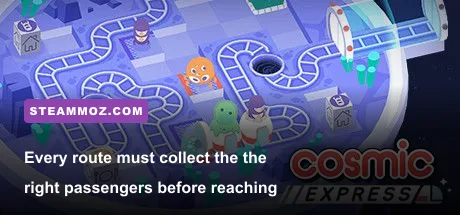
Each puzzle begins with a train, one or more passenger groups, and stations scattered across a compact map. Your job is to connect the route so the train visits the necessary locations in a valid order. Passengers board when the train reaches them, then leave when it reaches their matching destination. The important detail is that the train follows the track continuously; it doesn’t pause while you improvise.
Track placement is deliberately tactile. You draw connected pieces across the available terrain, then start the train and watch the route resolve. If the train misses a passenger, loops forever, arrives at the wrong station, or runs into a layout that cannot satisfy the level’s requirements, the attempt fails. Restarting is nearly instant, which keeps experimentation from becoming a chore.
The game’s best design decision is separating construction from execution. You can think slowly while building, but you still get a miniature simulation when you press go. That divide makes every successful run feel earned: the train is only doing what you told it to do, including the bad ideas.
| Core Element | What It Demands | Why It Matters |
|---|---|---|
| Track layout | Connect the required spaces without breaking the route | Controls the entire order of the solution |
| Passengers | Collect the correct groups before finishing | Prevents easy point-to-point shortcuts |
| Stations | Reach the matching destination at the right time | Turns route order into a logic problem |
| Train movement | Follow the completed track automatically | Exposes mistakes immediately and fairly |
| Restarts | Reset a failed attempt in seconds | Encourages testing instead of cautious overthinking |

🎮 Cosmic Express
Looking to experience this game? Grab your digital key directly on our store for $4.49.
View on Steammoz Store →Why the puzzle design still holds up

Cosmic Express teaches its rules through level design rather than long explanations. Early boards let you understand the basic loop: connect the train to a passenger, then connect that passenger to a destination. Soon, the game introduces crowded layouts and conflicting routes where the obvious line is deliberately wrong.
The difficulty curve is mostly excellent. Early stages are short enough to solve in a minute or two, while later puzzles can demand several restarts and a full mental map of the route. Crucially, difficulty comes from combinations, not from arbitrary restrictions. You aren’t asked to perform a precision input or beat a timer; you’re asked to recognize that collecting the blue group first may block access to the red station later.
The strongest levels use passenger order as a hidden spine. You might initially build toward the closest station, only to discover that the train needs to pass another group first. In other puzzles, the solution requires a loop that looks wasteful until you realize it lets the train approach a station from the necessary direction. That kind of spatial misdirection is where Cosmic Express does its best work.
There’s also a useful rhythm to the campaign. A demanding puzzle is often followed by a cleaner one that lets you apply the newly learned idea without overwhelming you. The game rarely feels like it’s padding its runtime with giant empty boards. Even when a solution is obvious in hindsight, the route usually has a small twist that makes the discovery worthwhile.
What the game does not offer
This isn’t a factory builder, a train simulator, or a procedurally generated puzzle platform. You won’t be upgrading locomotives, managing fuel, unlocking train stats, or decorating a railway network. The “progression” is knowledge: you become better at reading the board, identifying bottlenecks, and predicting the train’s full journey before pressing start.
That makes it a good companion to other short, system-driven games. If you enjoy games where the rules matter more than spectacle, our coverage of Children of Silentown’s non-combat progression explores a similarly focused design philosophy, while Construction Simulator 2015’s hidden hunt shows a very different kind of problem-solving.
Difficulty, replay value, and the biggest warning
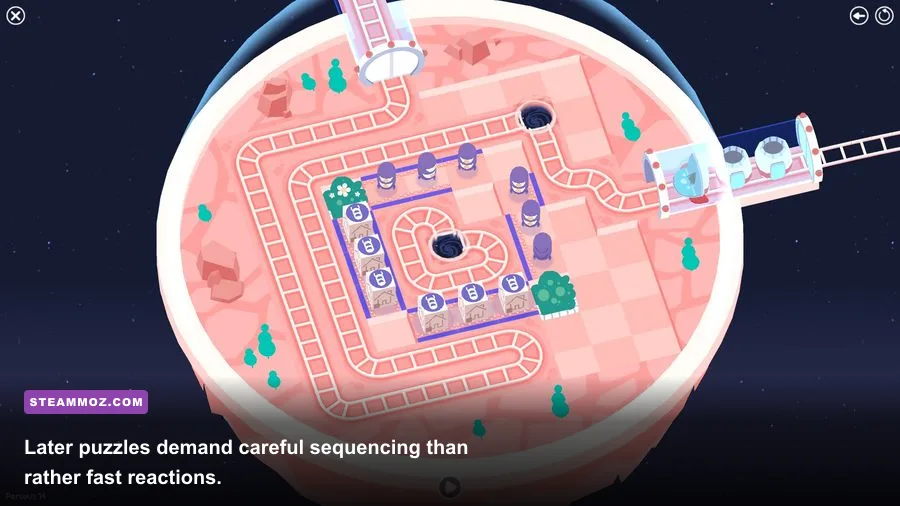
Cosmic Express is challenging without being punishing. Failure costs only the time spent watching the wrong route unfold, and the restart flow is fast enough that you can try a new idea immediately. There are no lives, resource penalties, or permanently missable decisions. That matters because the correct solution often appears only after you see exactly where your first route fails.
The main weakness is replay value. Once you solve a stage, there usually isn’t a deep second layer of mastery comparable to score-chasing in a time-attack game. You can revisit puzzles, but the satisfaction comes primarily from the first breakthrough. The campaign is substantial for its price and genre, yet it won’t occupy you for hundreds of hours.
| Player Type | Fit | Reason |
|---|---|---|
| Logic-puzzle fan | S-Tier match | Clear rules, strong deductions, quick restarts |
| Casual short-session player | A-Tier match | Stages are compact and progress is easy to resume |
| Train-management enthusiast | B-Tier match | There is track routing, but no simulation or customization |
| Completionist seeking endless content | C-Tier match | Handcrafted campaign eventually reaches its endpoint |
| Action-focused player | C-Tier match | No combat, reflex challenges, or character progression |
That finite structure is worth considering before you buy. Cosmic Express is closer to a beautifully edited puzzle book than a live-service platform. If that sounds appealing, it’s a strength. If you expect regular updates or a large post-game system, it’s the clearest reason to hesitate.
Visuals, controls, and PC performance in 2026
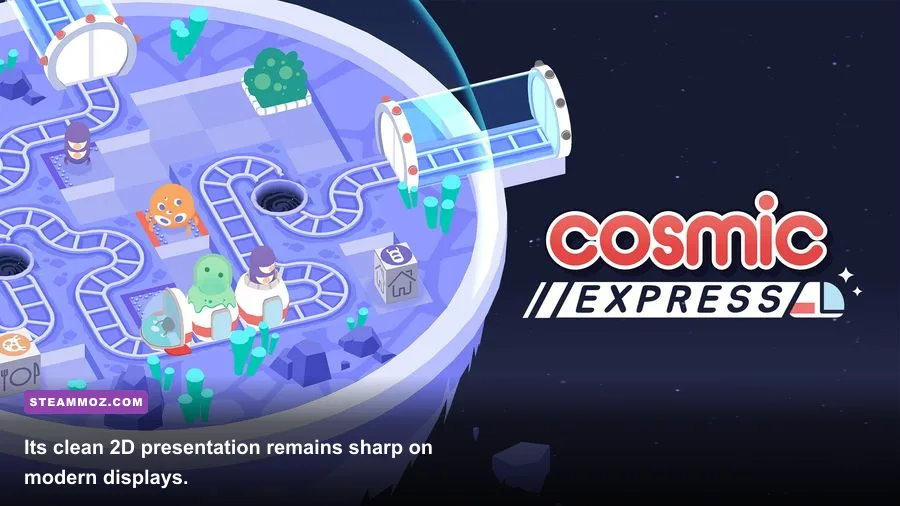
The presentation remains one of Cosmic Express’s quiet advantages. Its colorful alien worlds, rounded character designs, and clean board layouts are readable at a glance. The visual style is playful without obscuring the important information: passengers, stations, track connections, and blocked spaces are easy to distinguish.
Because it’s a lightweight 2D game, modern PCs should have no trouble running it. The meaningful performance question isn’t whether a current gaming PC can hit a target frame rate; it’s whether the game’s window, scaling, and input behavior suit your setup. On a high-resolution monitor, integer-like scaling or a smaller window can make the board feel more comfortable than stretching a simple image across a huge display.
| Setup Area | Recommended Choice | Practical Result |
|---|---|---|
| Display mode | Fullscreen or borderless window | Fast transitions between puzzle and desktop |
| Resolution | Native display resolution, adjusted for readability | Sharper board edges and cleaner text |
| Frame rate | 60 FPS or the display’s standard refresh | Responsive cursor and smooth train movement |
| Input | Mouse first; controller if preferred | Track placement stays precise and immediate |
| Session length | One to five stages at a time | Matches the game’s compact puzzle structure |
There’s no reason to chase ultra settings or expensive hardware here. This is the opposite of a demanding PC release, unlike the optimization concerns covered in our City of Gangsters performance guide or the hardware-focused look at Deadfall Adventures PC requirements. Cosmic Express is built to disappear into the background technically so the puzzle can stay front and center.
Is Cosmic Express worth playing in 2026?
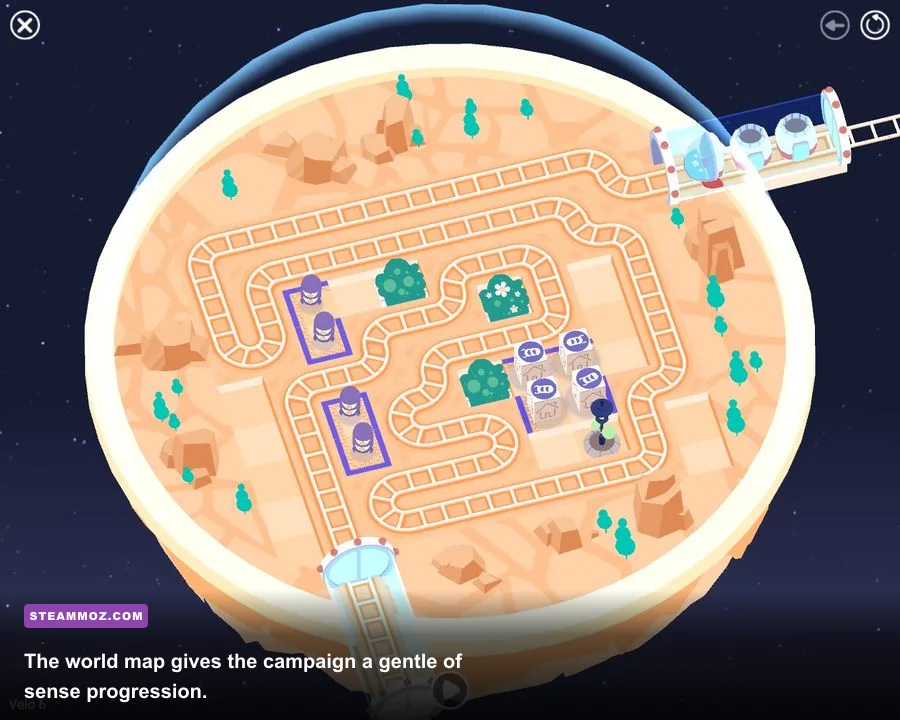
For most puzzle fans, yes. Cosmic Express has the rare quality of being instantly understandable but difficult to exhaust mentally. Its rules can be explained in a sentence, yet the interaction between passenger order, station placement, and route shape creates hundreds of ways to make a mistake. That’s excellent puzzle design.
It’s also unusually friendly to modern gaming habits. You can finish a stage in a few minutes, stop after a frustrating attempt, and return later without forgetting a complicated build or story thread. The instant restarts make experimentation painless, while the bright art and calm presentation keep failure from feeling hostile.
Buy it if you want a polished single-player puzzle campaign, enjoy visualizing routes, or need a low-pressure game between larger releases. Be cautious if you’re searching for endless procedural content, train customization, or a plot-heavy experience. Cosmic Express won’t reinvent itself after the credits, but it doesn’t need to. Its compact ruleset is strong enough to carry the entire journey.
Steamoz verdict: 8/10. Cosmic Express is a clever, welcoming, and still sharply designed puzzle game. In 2026, its age shows mostly in the lack of modern extras, not in the quality of its puzzles. Check the official Steam page for the current price, visit the official Cosmic Express website for more about the game, and consider it an easy recommendation when you want a smart game that respects your time.